Working with ROR
as a Crossref member:
What you need to know
September 29, 2021
Good to know
● You’re muted but please introduce yourself in the chat
– Where are you from? Your organization and where you are in the
world
– Why were you interested in today’s webinar?
● Ask questions in the Q&A box (not chat) so we can keep track
● The session will be recorded and slides will be shared too
● If you need an attendance certificate, please fill out this form and one
will be emailed to you: https://forms.gle/mm8UMPawuXBUZbnT9
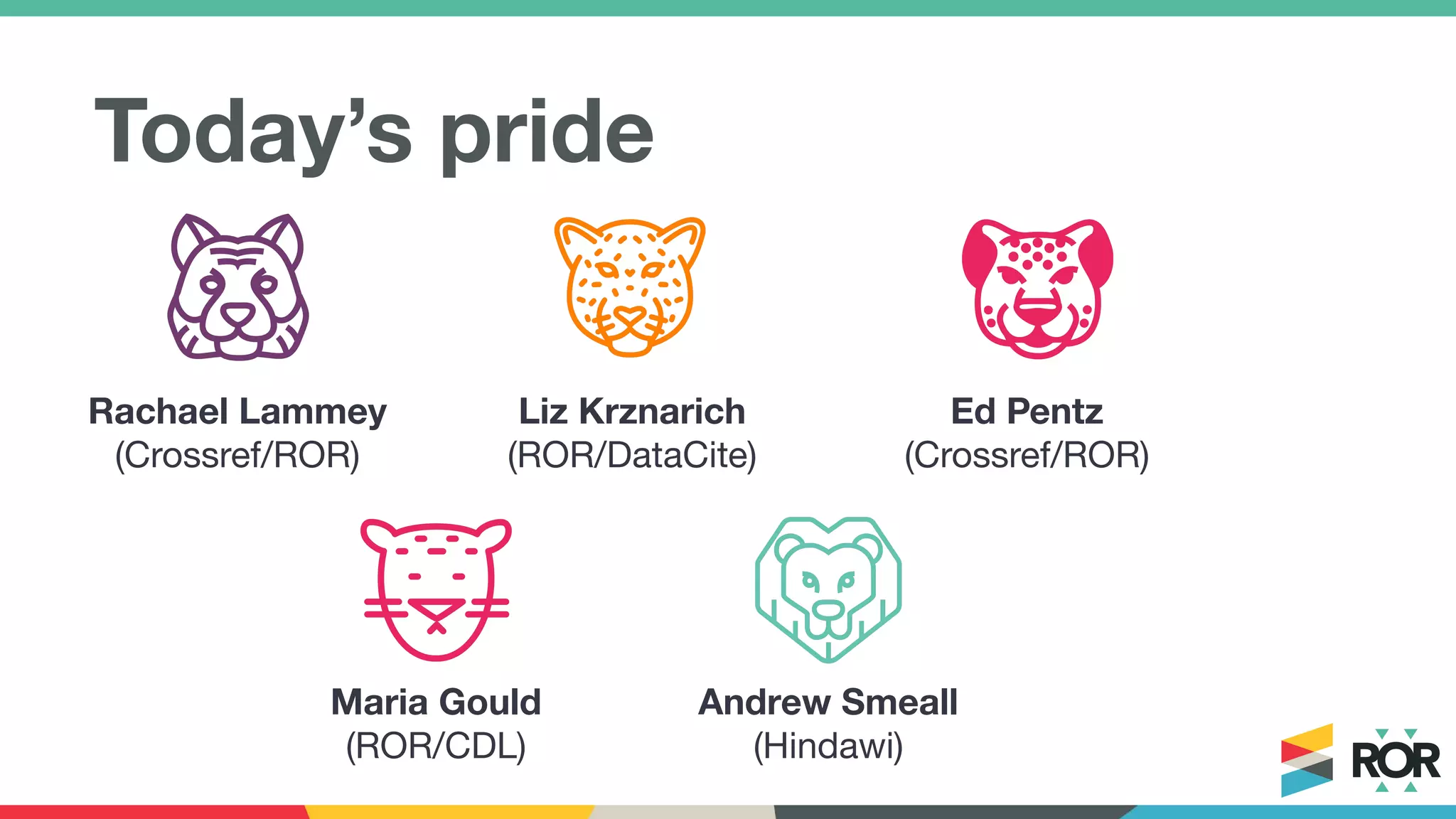
Today’s pride
Rachael Lammey
(Crossref/ROR)
Liz Krznarich
(ROR/DataCite)
Ed Pentz
(Crossref/ROR)
Maria Gould
(ROR/CDL)
Andrew Smeall
(Hindawi)
Today’s agenda
1. What is ROR?
2. Why is Crossref supporting ROR?
3. Publisher use cases for ROR
4. How to become a ROR adopter
5. Discussion/Q&A
What is ROR?
The Research Organization
Registry (ROR) is an open,
community-led registry of research
organization identifiers and
associated metadata.
ROR is a collaboration between
California Digital Library, Crossref,
and DataCite.
Why ROR?
@ResearchOrgs
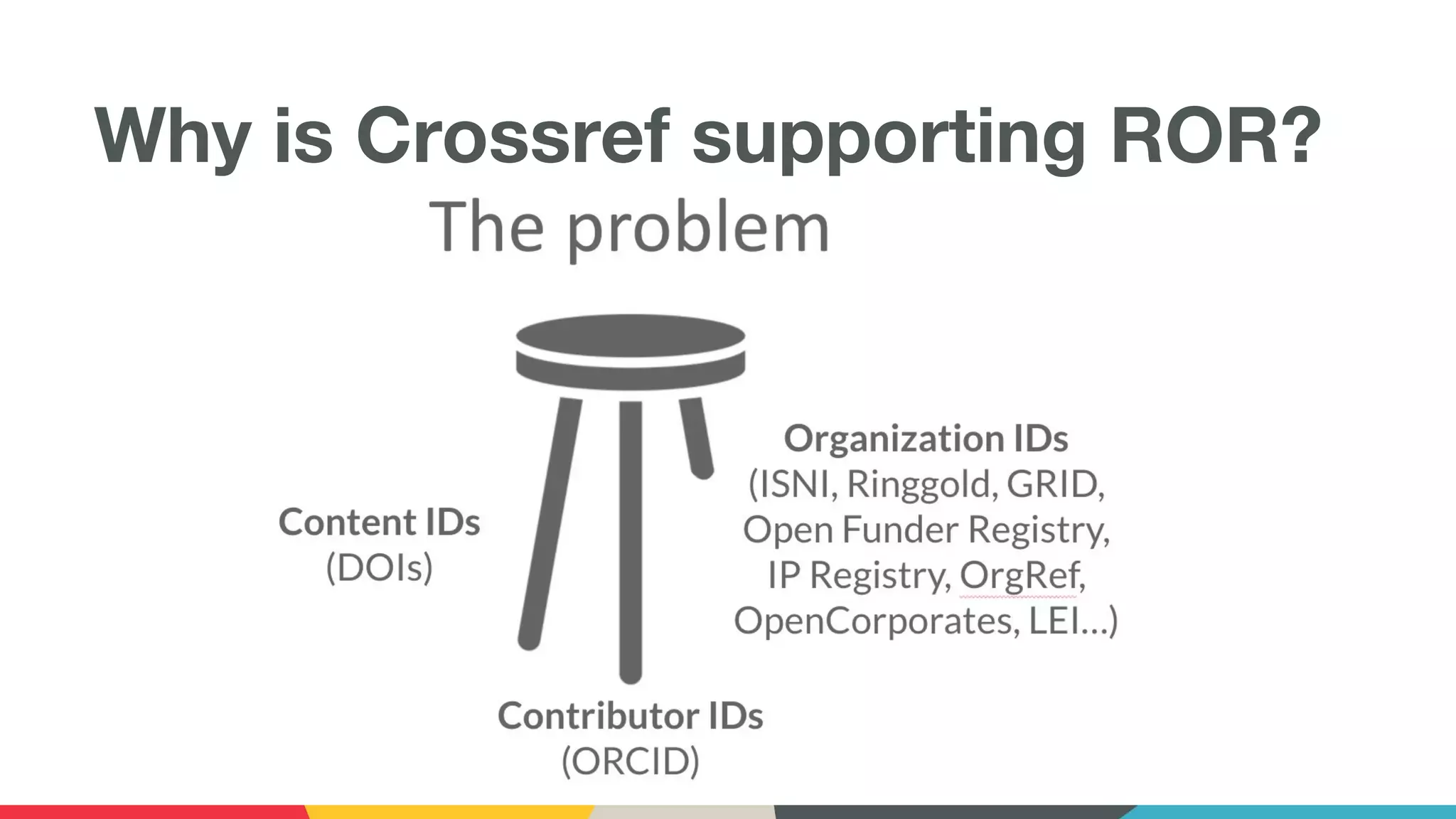
Several ID types for research organizations already
existed before ROR’s launch:
Why another organization ID?!
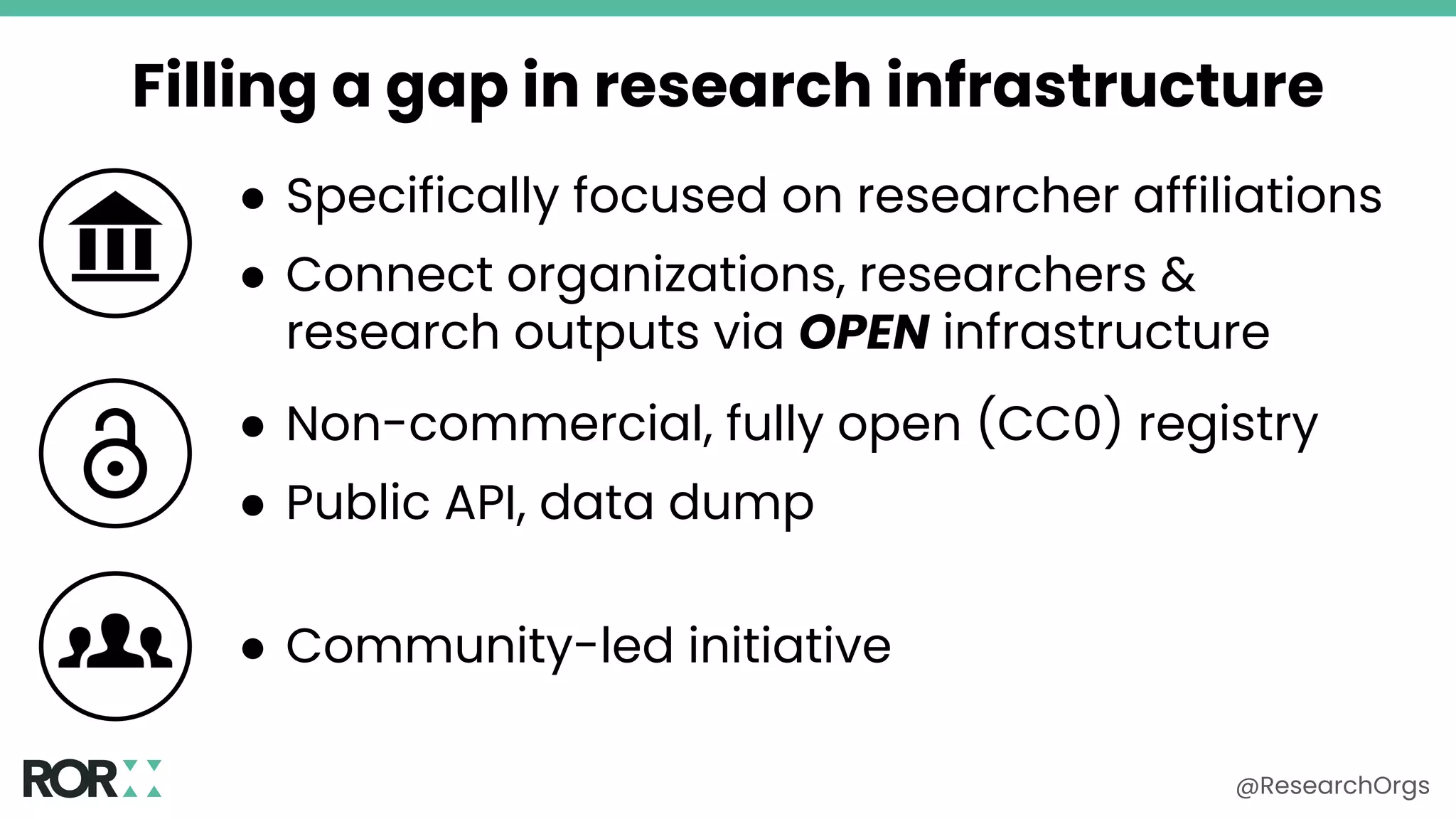
Filling a gap in research infrastructure
@ResearchOrgs
● Non-commercial, fully open (CC0) registry
● Public API, data dump
● Specifically focused on researcher affiliations
● Connect organizations, researchers &
research outputs via OPEN infrastructure
● Community-led initiative
How does ROR work?
Why is Crossref supporting ROR?
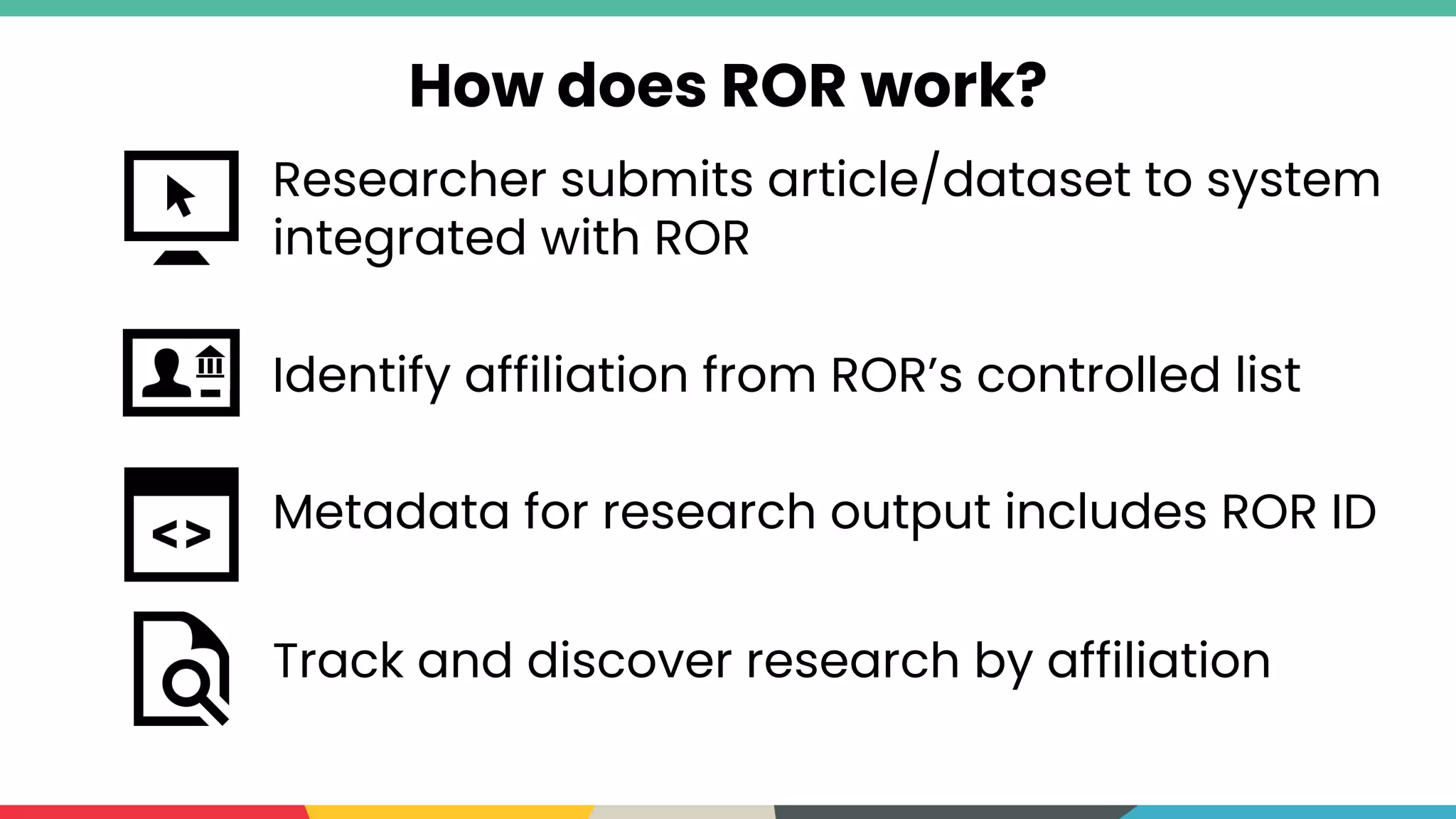
How does ROR work?
Researcher submits article/dataset to system
integrated with ROR
Identify affiliation from ROR’s controlled list
Metadata for research output includes ROR ID
Track and discover research by affiliation
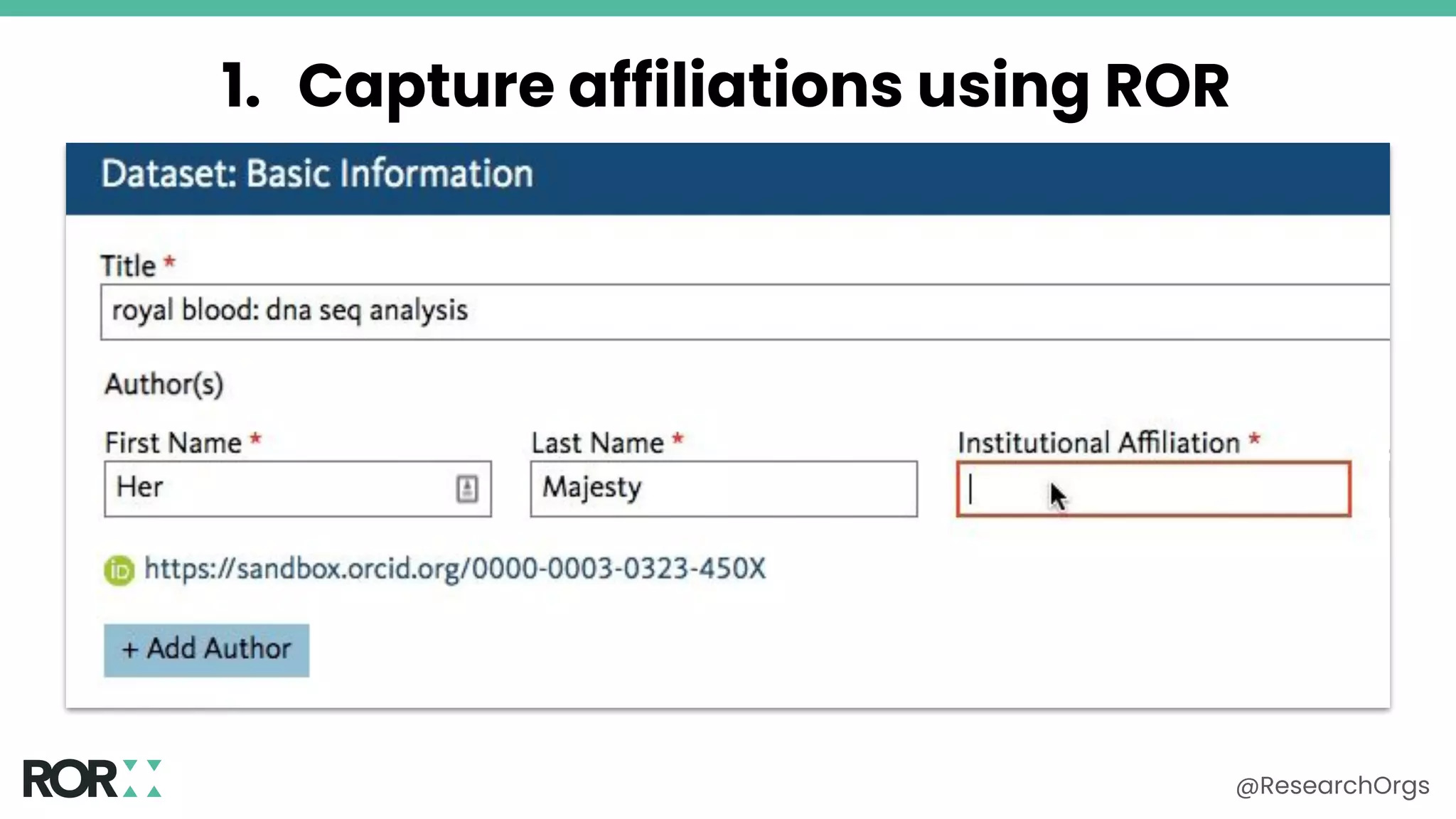
1. Capture affiliations using ROR
@ResearchOrgs
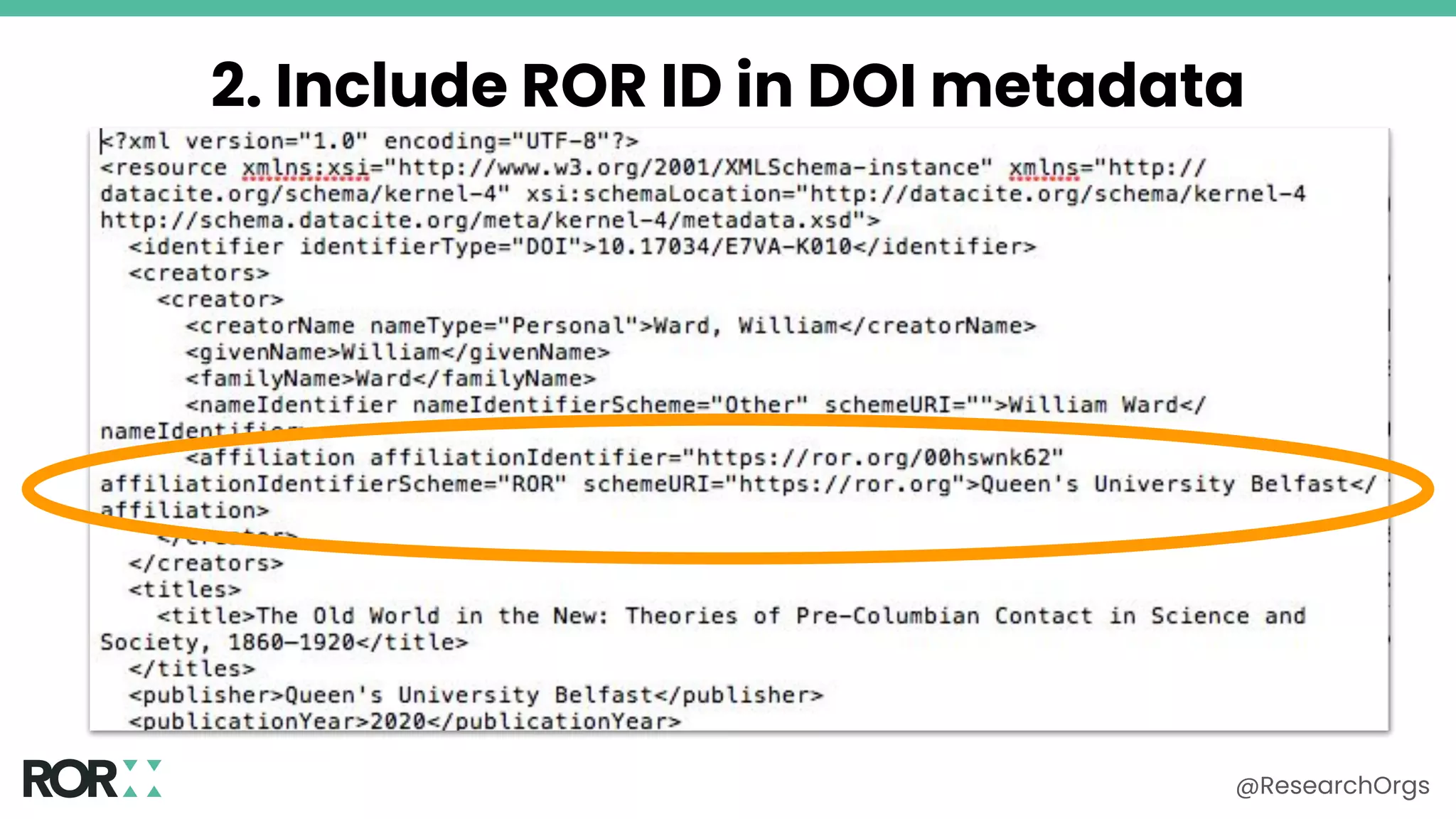
2. Include ROR ID in DOI metadata
@ResearchOrgs
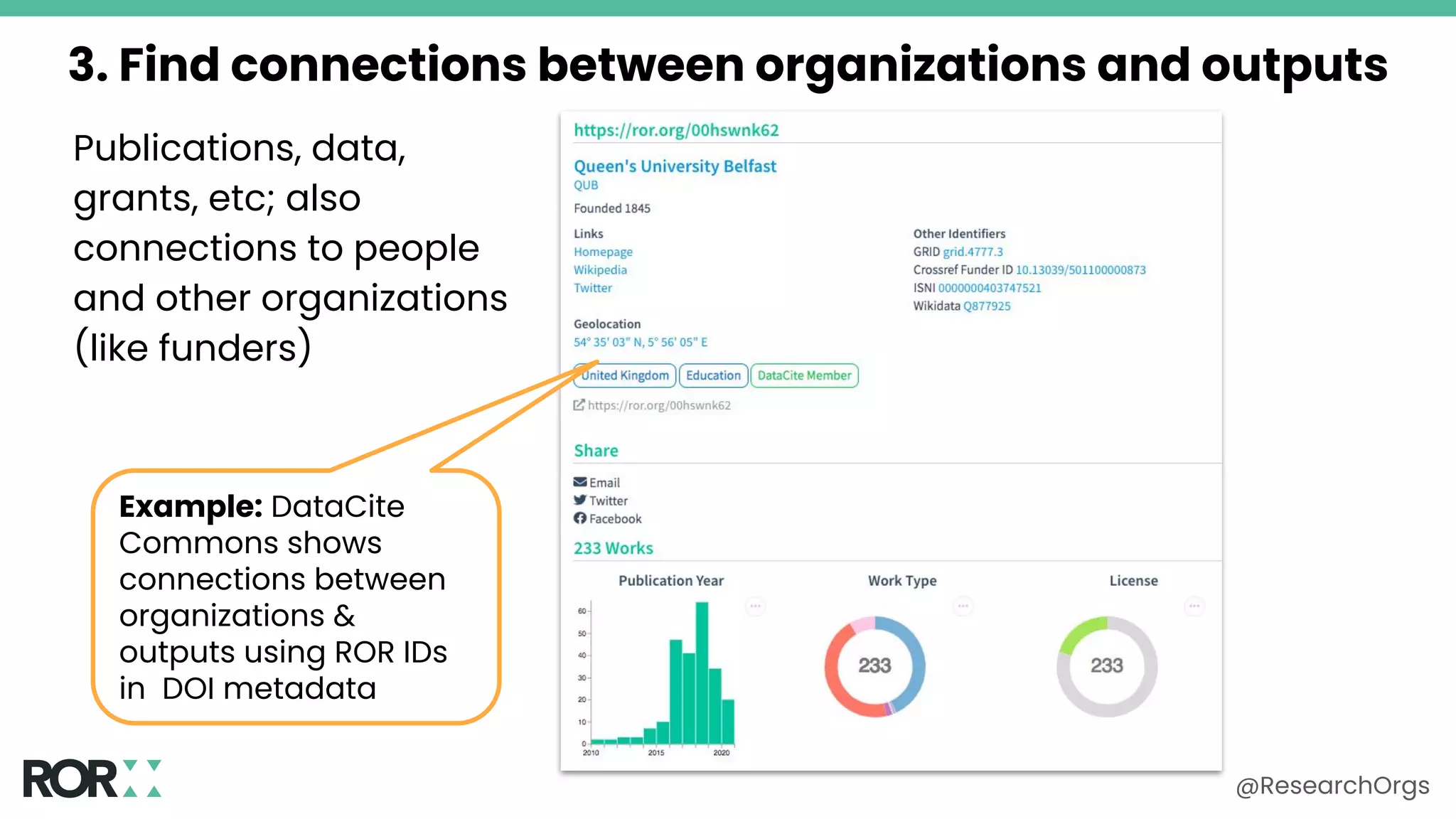
3. Find connections between organizations and outputs
@ResearchOrgs
Example: DataCite
Commons shows
connections between
organizations &
outputs using ROR IDs
in DOI metadata
Publications, data,
grants, etc; also
connections to people
and other organizations
(like funders)
Why is Crossref supporting ROR?
● Affiliations identified w/ a unique, open, sustainable
persistent identifier will:
– Add value to open scholarly infrastructure and research ecosystem
– Add value to the Crossref metadata by filling out the scholarly
record and the research nexus - connecting publications, citations,
funders, grants, authors, and affiliations
● Crossref metadata users want it - abstracts first, affiliations
second
● Members want it - Crossref LIVE19 - ROR clear top priority
Publisher use cases for ROR
● Add value by reliably connecting submissions with
institutions
– Compliance with funder and institution mandates/requirements
– Streamline OA workflows - repository deposit, payments
– Better reporting
● Enhance discoverability by including in Crossref metadata
● Improve the scholarly research ecosystem
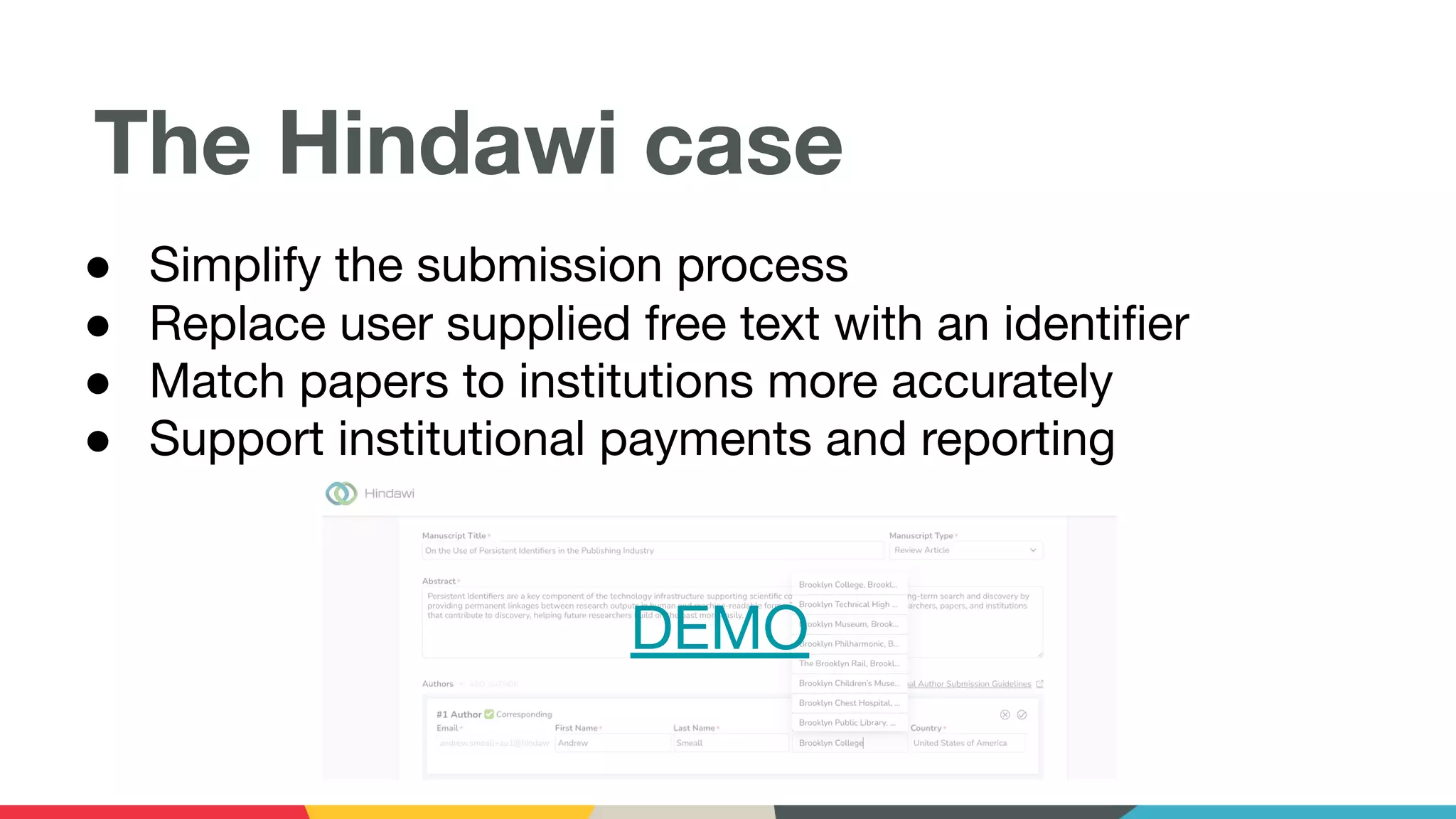
The Hindawi case
● Simplify the submission process
● Replace user supplied free text with an identifier
● Match papers to institutions more accurately
● Support institutional payments and reporting
DEMO
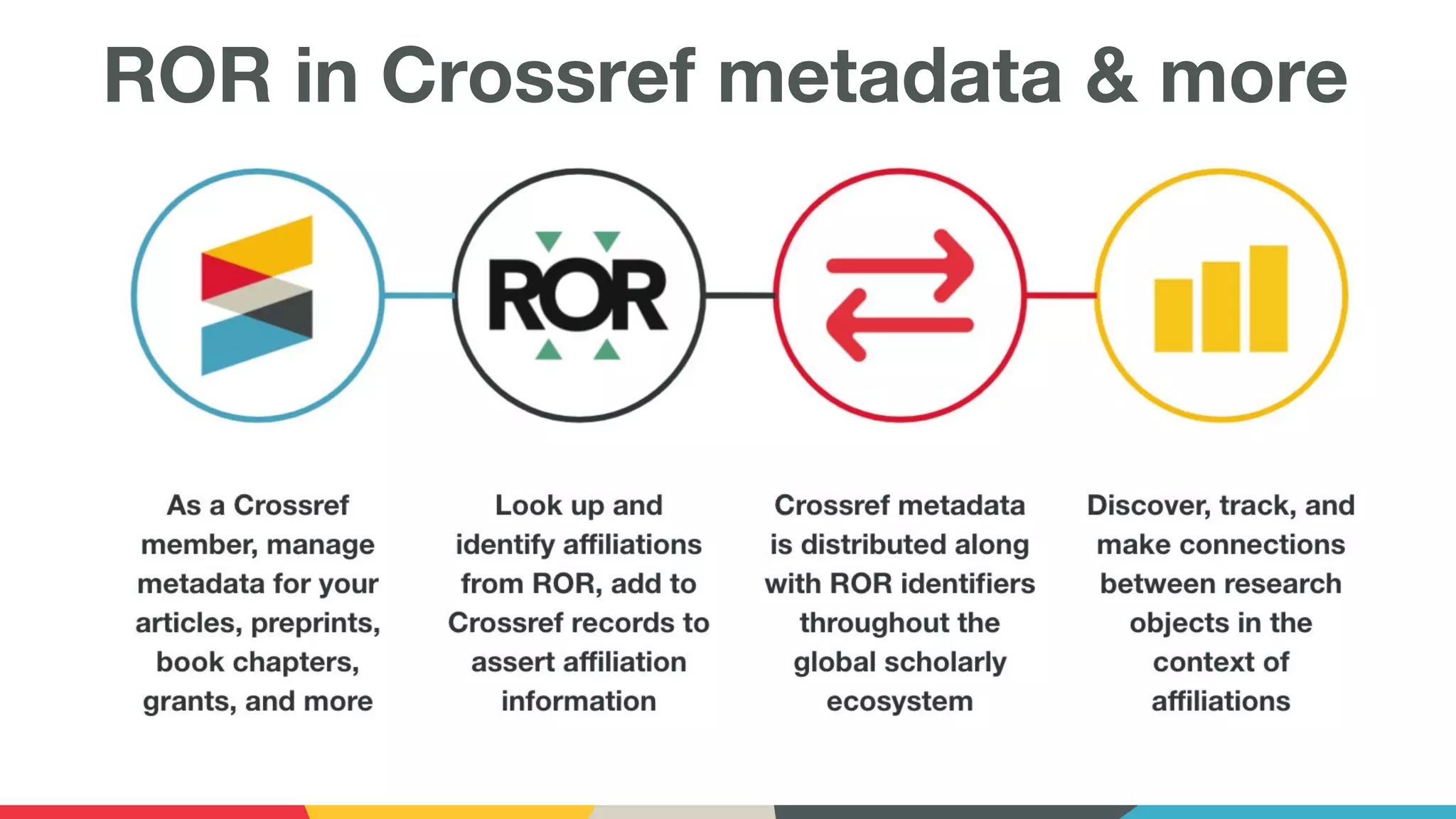
ROR in Crossref metadata & more
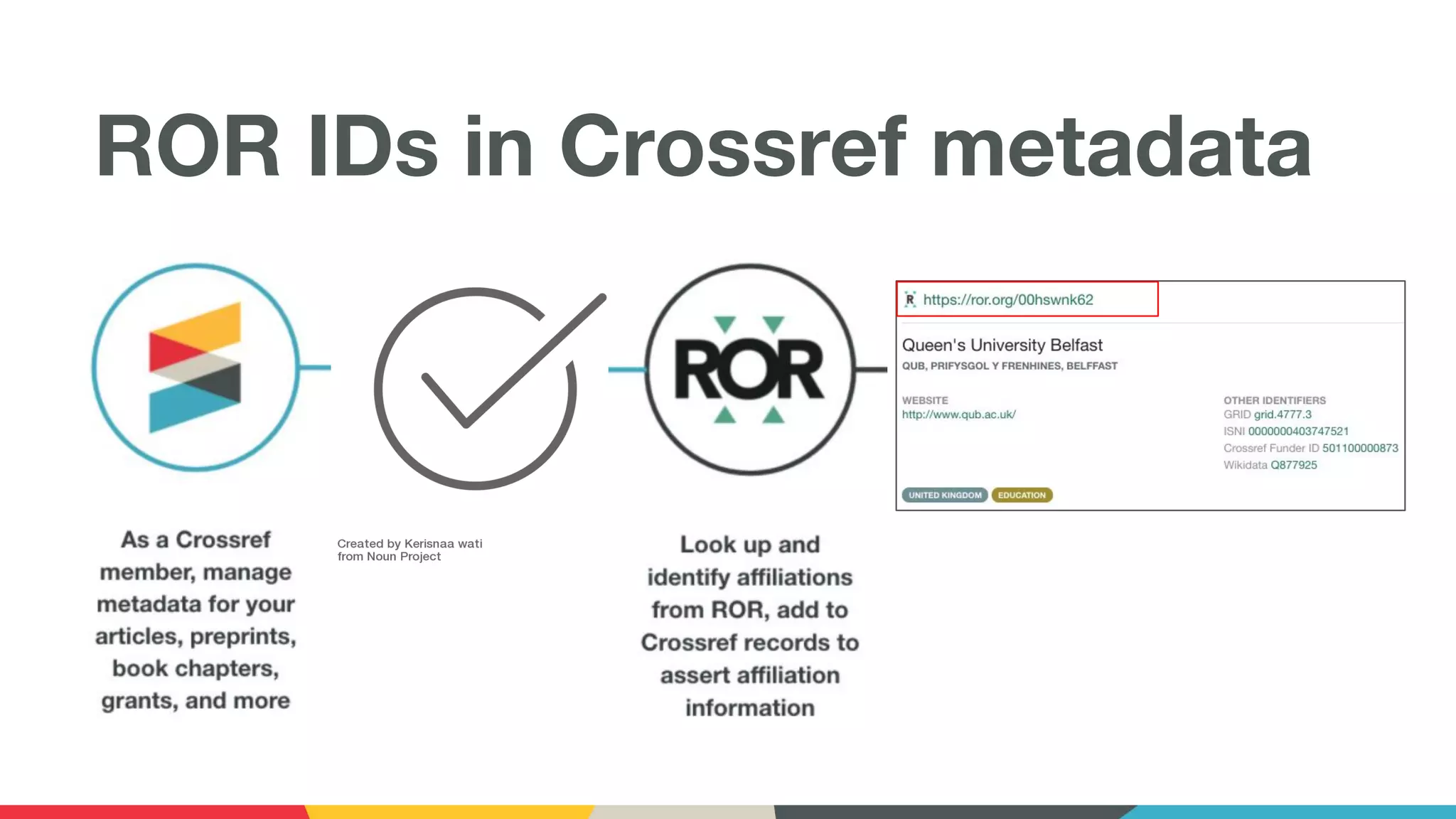
ROR IDs in Crossref metadata
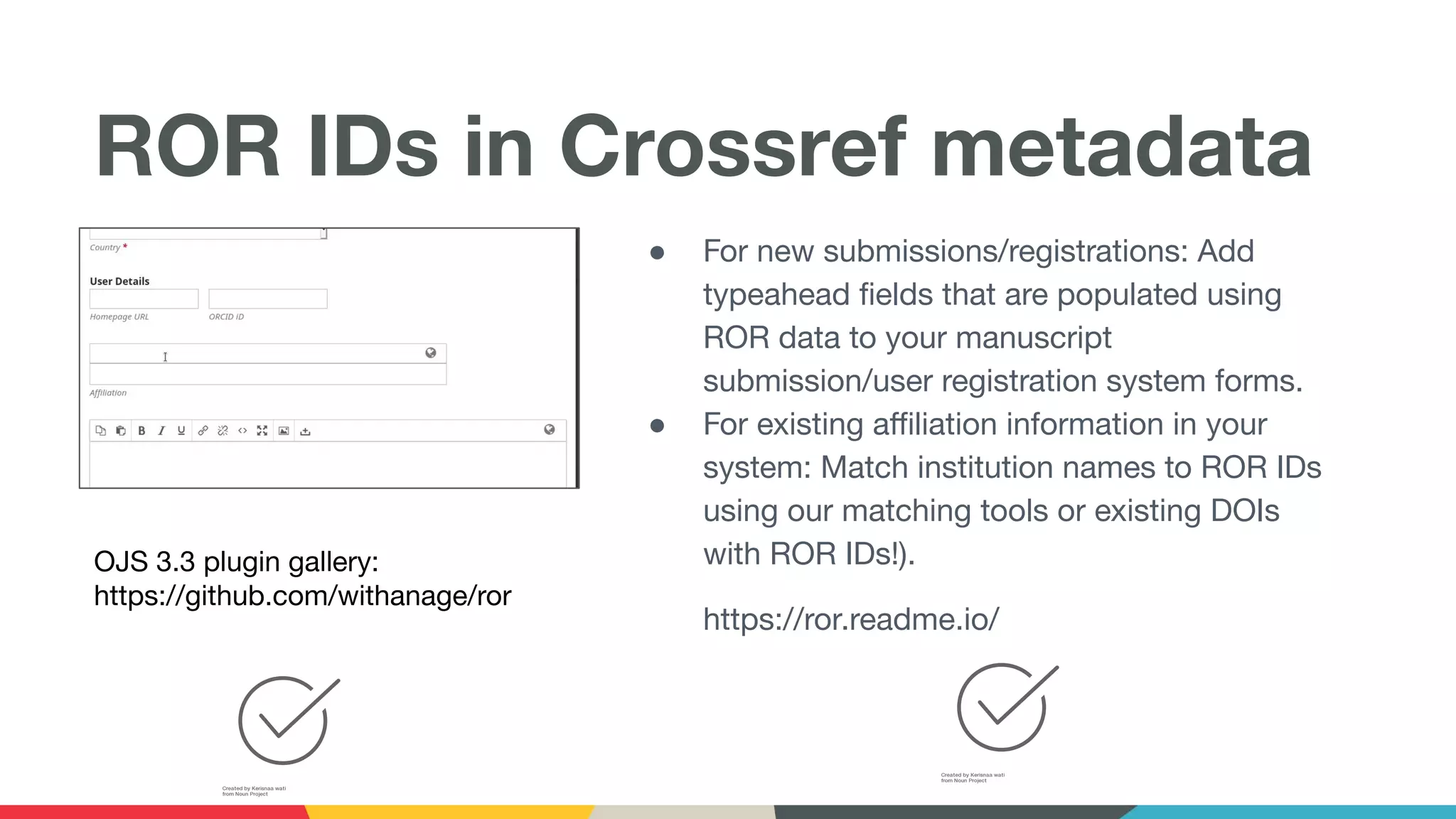
OJS 3.3 plugin gallery:
https://github.com/withanage/ror
● For new submissions/registrations: Add
typeahead fields that are populated using
ROR data to your manuscript
submission/user registration system forms.
● For existing affiliation information in your
system: Match institution names to ROR IDs
using our matching tools or existing DOIs
with ROR IDs!).
https://ror.readme.io/
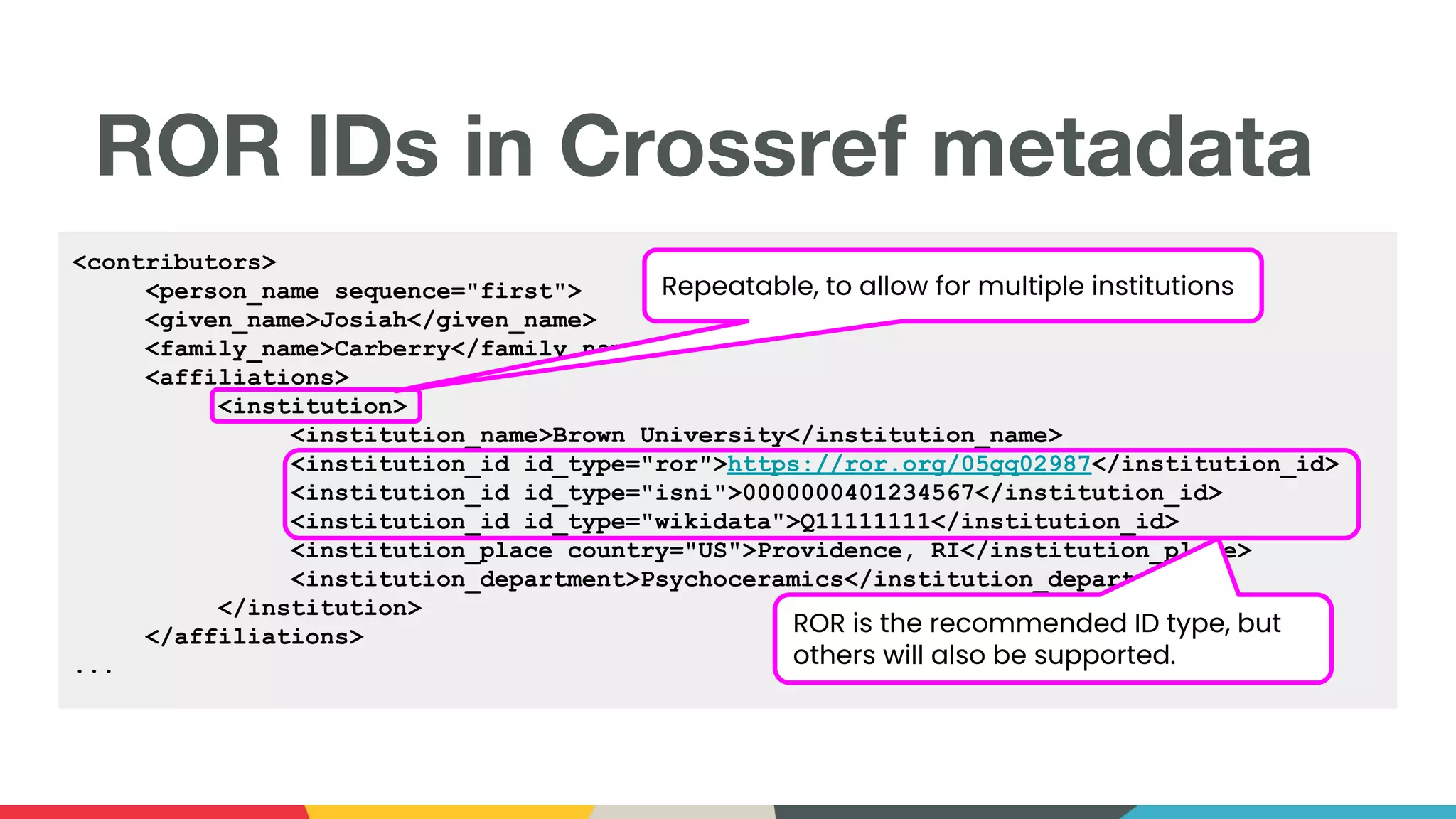
<contributors>
<person_name sequence="first">
<given_name>Josiah</given_name>
<family_name>Carberry</family_name>
<affiliations>
<institution>
<institution_name>Brown University</institution_name>
<institution_id id_type="ror">https://ror.org/05gq02987</institution_id>
<institution_id id_type="isni">0000000401234567</institution_id>
<institution_id id_type="wikidata">Q11111111</institution_id>
<institution_place country="US">Providence, RI</institution_place>
<institution_department>Psychoceramics</institution_department>
</institution>
</affiliations>
...
Repeatable, to allow for multiple institutions
ROR is the recommended ID type, but
others will also be supported.
ROR IDs in Crossref metadata
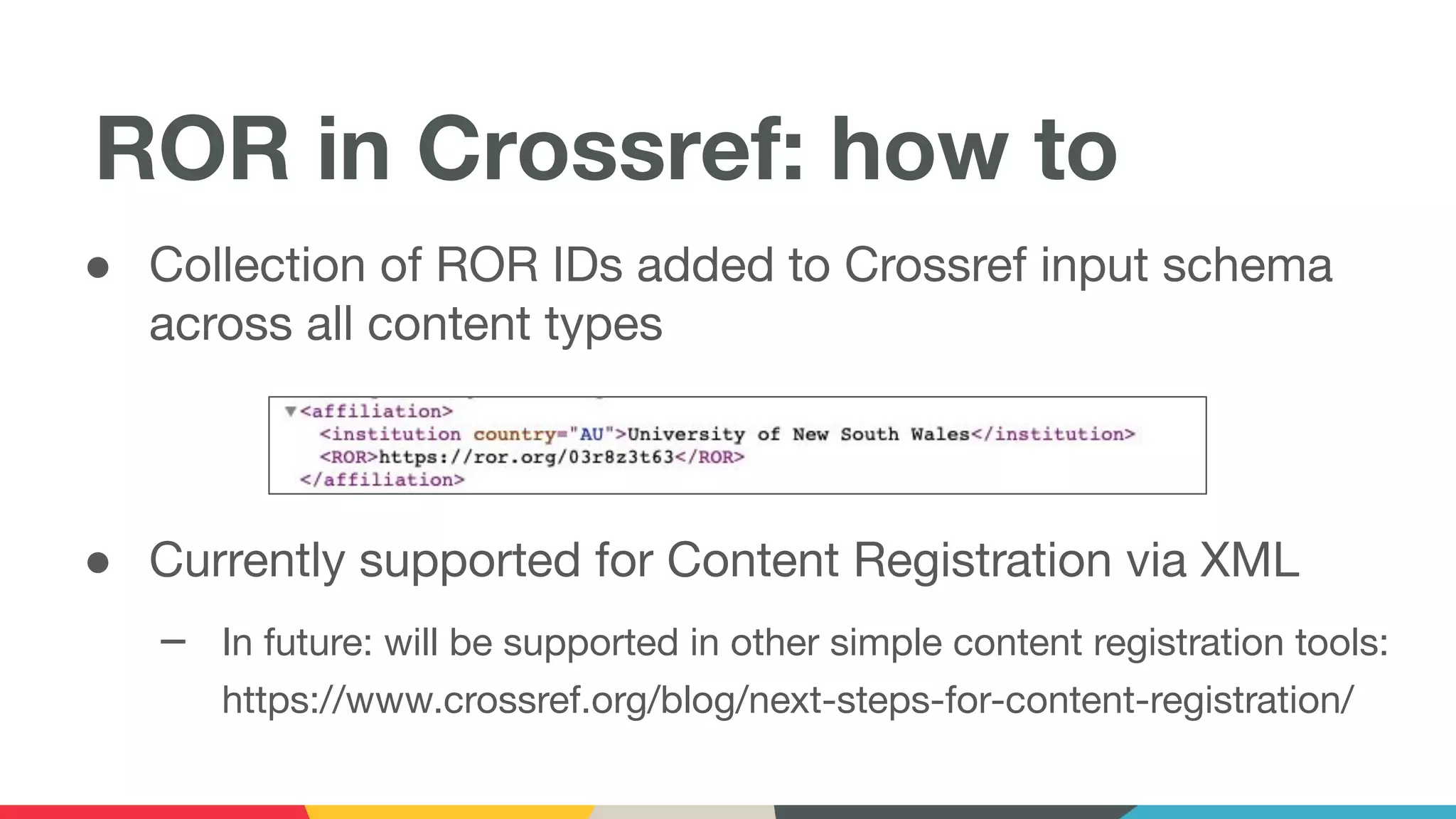
● Collection of ROR IDs added to Crossref input schema
across all content types
● Currently supported for Content Registration via XML
– In future: will be supported in other simple content registration tools:
https://www.crossref.org/blog/next-steps-for-content-registration/
ROR in Crossref: how to
ROR in Crossref: next steps
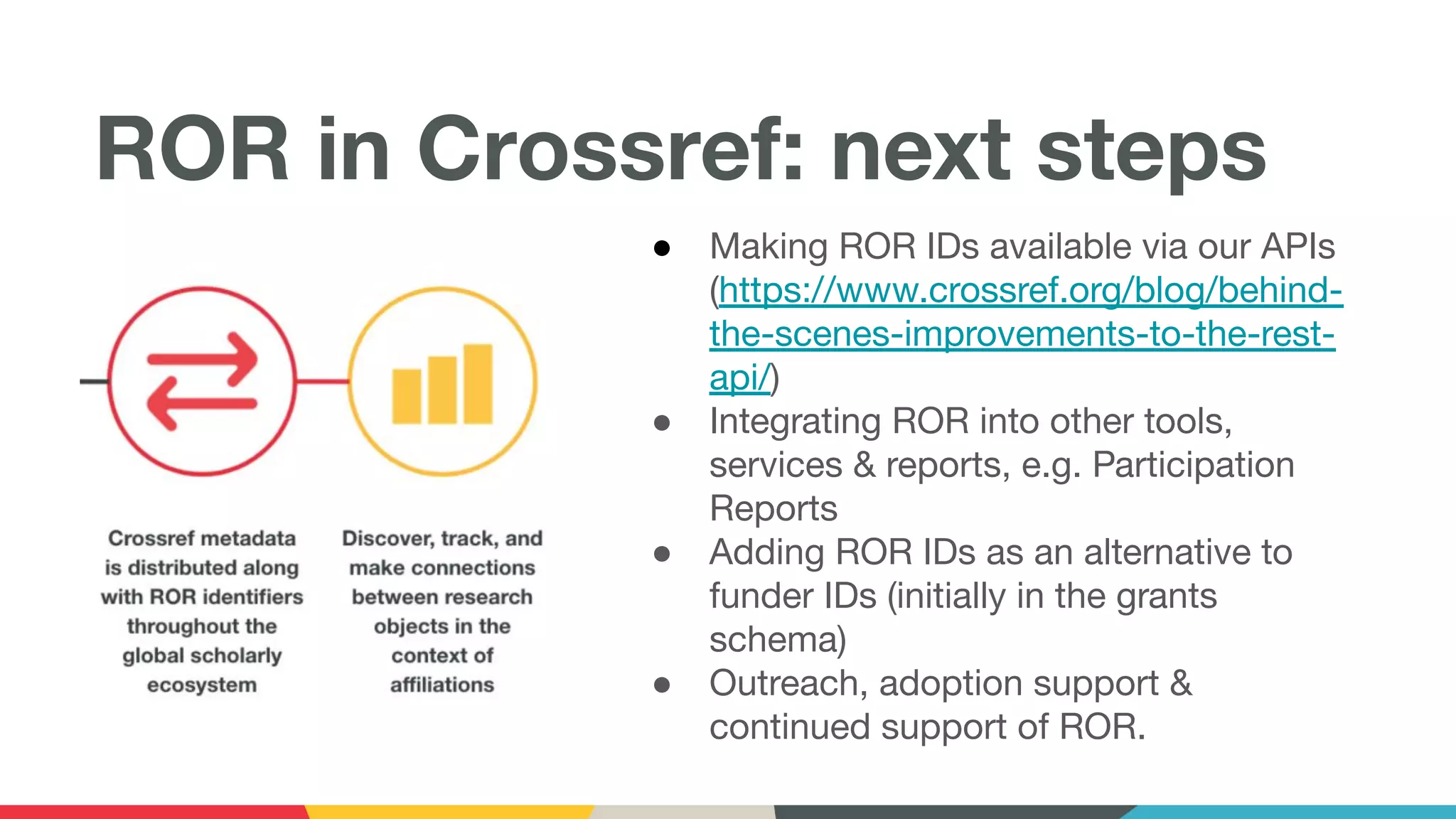
● Making ROR IDs available via our APIs
(https://www.crossref.org/blog/behind-
the-scenes-improvements-to-the-rest-
api/)
● Integrating ROR into other tools,
services & reports, e.g. Participation
Reports
● Adding ROR IDs as an alternative to
funder IDs (initially in the grants
schema)
● Outreach, adoption support &
continued support of ROR.
Discussion / Q&A
Find out more about:
ROR itself:
● https://ror.org
● Support documentation for publishers: https://ror.readme.io/docs/publishers
● Technical support discussion group: https://groups.google.com/a/ror.org/g/ror-api-users
● Community group: email info@ror.org to join
● Slack: https://tinyurl.com/ror-slack
● Registry curation: https://github.com/ror-community/ror-updates#readme
● Other questions: info@ror.org
ROR @ Crossref:
● Overview: https://www.crossref.org/community/ror/
● Plans for ROR in Crossref:
https://www.crossref.org/blog/some-rip-roring-news-for-affiliation-metadata/
● Sample files: https://gitlab.com/crossref/schema/-/tree/master/best-practice-examples/
https://gitlab.com/crossref/schema/-/blob/master/best-practice-examples/journal.article5.3.0.xml
● Community Forum: https://community.crossref.org/tag/ror
● Questions: https://www.crossref.org/contact/
Thank you!

Working with ROR as a Crossref member: what you need to know

  • 1.
    Working with ROR asa Crossref member: What you need to know September 29, 2021
  • 2.
    Good to know ●You’re muted but please introduce yourself in the chat – Where are you from? Your organization and where you are in the world – Why were you interested in today’s webinar? ● Ask questions in the Q&A box (not chat) so we can keep track ● The session will be recorded and slides will be shared too ● If you need an attendance certificate, please fill out this form and one will be emailed to you: https://forms.gle/mm8UMPawuXBUZbnT9
  • 3.
    Today’s pride Rachael Lammey (Crossref/ROR) LizKrznarich (ROR/DataCite) Ed Pentz (Crossref/ROR) Maria Gould (ROR/CDL) Andrew Smeall (Hindawi)
  • 4.
    Today’s agenda 1. Whatis ROR? 2. Why is Crossref supporting ROR? 3. Publisher use cases for ROR 4. How to become a ROR adopter 5. Discussion/Q&A
  • 5.
  • 6.
    The Research Organization Registry(ROR) is an open, community-led registry of research organization identifiers and associated metadata. ROR is a collaboration between California Digital Library, Crossref, and DataCite.
  • 7.
    Why ROR? @ResearchOrgs Several IDtypes for research organizations already existed before ROR’s launch: Why another organization ID?!
  • 8.
    Filling a gapin research infrastructure @ResearchOrgs ● Non-commercial, fully open (CC0) registry ● Public API, data dump ● Specifically focused on researcher affiliations ● Connect organizations, researchers & research outputs via OPEN infrastructure ● Community-led initiative
  • 9.
  • 10.
    Why is Crossrefsupporting ROR?
  • 11.
    How does RORwork? Researcher submits article/dataset to system integrated with ROR Identify affiliation from ROR’s controlled list Metadata for research output includes ROR ID Track and discover research by affiliation
  • 12.
    1. Capture affiliationsusing ROR @ResearchOrgs
  • 13.
    2. Include RORID in DOI metadata @ResearchOrgs
  • 14.
    3. Find connectionsbetween organizations and outputs @ResearchOrgs Example: DataCite Commons shows connections between organizations & outputs using ROR IDs in DOI metadata Publications, data, grants, etc; also connections to people and other organizations (like funders)
  • 15.
    Why is Crossrefsupporting ROR? ● Affiliations identified w/ a unique, open, sustainable persistent identifier will: – Add value to open scholarly infrastructure and research ecosystem – Add value to the Crossref metadata by filling out the scholarly record and the research nexus - connecting publications, citations, funders, grants, authors, and affiliations ● Crossref metadata users want it - abstracts first, affiliations second ● Members want it - Crossref LIVE19 - ROR clear top priority
  • 16.
    Publisher use casesfor ROR ● Add value by reliably connecting submissions with institutions – Compliance with funder and institution mandates/requirements – Streamline OA workflows - repository deposit, payments – Better reporting ● Enhance discoverability by including in Crossref metadata ● Improve the scholarly research ecosystem
  • 17.
    The Hindawi case ●Simplify the submission process ● Replace user supplied free text with an identifier ● Match papers to institutions more accurately ● Support institutional payments and reporting DEMO
  • 18.
    ROR in Crossrefmetadata & more
  • 19.
    ROR IDs inCrossref metadata
  • 20.
    ROR IDs inCrossref metadata OJS 3.3 plugin gallery: https://github.com/withanage/ror ● For new submissions/registrations: Add typeahead fields that are populated using ROR data to your manuscript submission/user registration system forms. ● For existing affiliation information in your system: Match institution names to ROR IDs using our matching tools or existing DOIs with ROR IDs!). https://ror.readme.io/
  • 21.
    <contributors> <person_name sequence="first"> <given_name>Josiah</given_name> <family_name>Carberry</family_name> <affiliations> <institution> <institution_name>Brown University</institution_name> <institution_idid_type="ror">https://ror.org/05gq02987</institution_id> <institution_id id_type="isni">0000000401234567</institution_id> <institution_id id_type="wikidata">Q11111111</institution_id> <institution_place country="US">Providence, RI</institution_place> <institution_department>Psychoceramics</institution_department> </institution> </affiliations> ... Repeatable, to allow for multiple institutions ROR is the recommended ID type, but others will also be supported. ROR IDs in Crossref metadata
  • 22.
    ● Collection ofROR IDs added to Crossref input schema across all content types ● Currently supported for Content Registration via XML – In future: will be supported in other simple content registration tools: https://www.crossref.org/blog/next-steps-for-content-registration/ ROR in Crossref: how to
  • 23.
    ROR in Crossref:next steps ● Making ROR IDs available via our APIs (https://www.crossref.org/blog/behind- the-scenes-improvements-to-the-rest- api/) ● Integrating ROR into other tools, services & reports, e.g. Participation Reports ● Adding ROR IDs as an alternative to funder IDs (initially in the grants schema) ● Outreach, adoption support & continued support of ROR.
  • 24.
  • 25.
    Find out moreabout: ROR itself: ● https://ror.org ● Support documentation for publishers: https://ror.readme.io/docs/publishers ● Technical support discussion group: https://groups.google.com/a/ror.org/g/ror-api-users ● Community group: email info@ror.org to join ● Slack: https://tinyurl.com/ror-slack ● Registry curation: https://github.com/ror-community/ror-updates#readme ● Other questions: info@ror.org ROR @ Crossref: ● Overview: https://www.crossref.org/community/ror/ ● Plans for ROR in Crossref: https://www.crossref.org/blog/some-rip-roring-news-for-affiliation-metadata/ ● Sample files: https://gitlab.com/crossref/schema/-/tree/master/best-practice-examples/ https://gitlab.com/crossref/schema/-/blob/master/best-practice-examples/journal.article5.3.0.xml ● Community Forum: https://community.crossref.org/tag/ror ● Questions: https://www.crossref.org/contact/
  • 26.