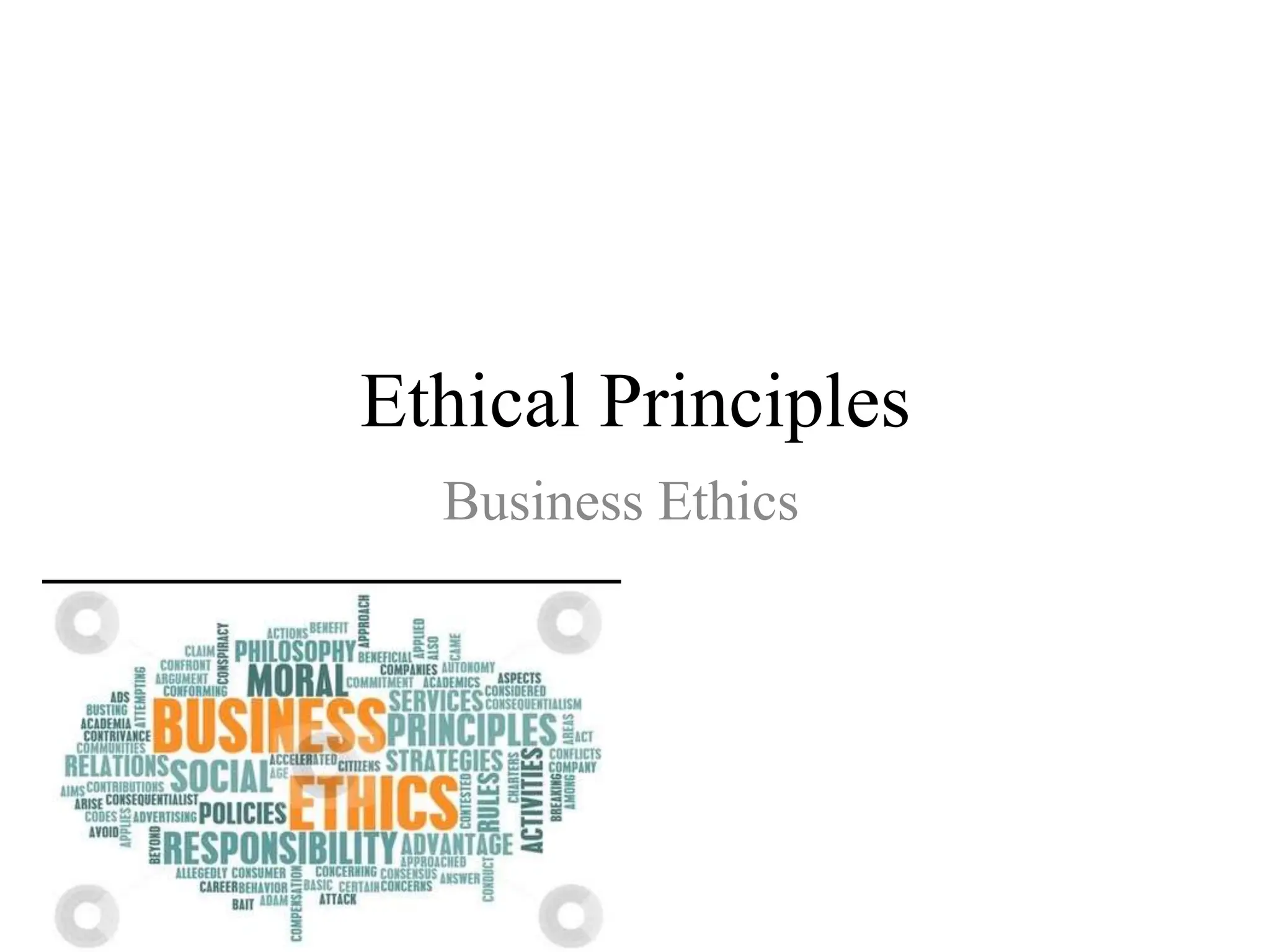
Ethical Principles
Business Ethics
PRINCIPLE OF AUTONOMY
• moral principle which holds to respect for
the individual’s autonomy (self-
governance/determination)
• The person is understood as exercising
his or her decision regarding the way his
or her treatment goes “free from deceit,
duress, constraint or coercion”
PRINCIPLE OF INFORMED
CONSENT
• a moral principle that has an imperative
call that is an individual must be sufficed
with sufficient and certain information
before he/she is asked for his/her consent
to anything that he/she has to undertake.
PRINCIPLE OF BENEFICENCE
• taking action to promote the well-being of
others. To seek the good of the person in
all circumstances.
• Four elements of Principle of beneficence
– One ought to promote good
– One ought to prevent evil or harm
– One ought to remove evil or harm
– One ought not to inflict evil or harm
PRINCIPLE OF NON-
MALEFICENCE
• a moral principle which calls to
avoid/refrain from inflicting harm in the
course of doing good to the person.
PRINCIPLE OF PATERNALISM
• a moral principle that holds to protect and
advance the interest of its recipient.
PRINCIPLE OF JUSTICE
• a moral principle which observes the just
act as giving what is due to a person.
• Justice is giving due care to each and
every individual.
PRINCIPE OF VERACITY
• a moral principle which demands a
categorical imperative - tell the truth and
nothing but the truth.
• It is a moral obligation to be truthful in our
dealings with others.
PRINCIPLE OF
CONFIDENTIALITY
• an ethical principle that requires
nondisclosure of private or secret
information with which one is entrusted.
• It binds the practitioner to hold in strict
confidence the information he or she
obtained.
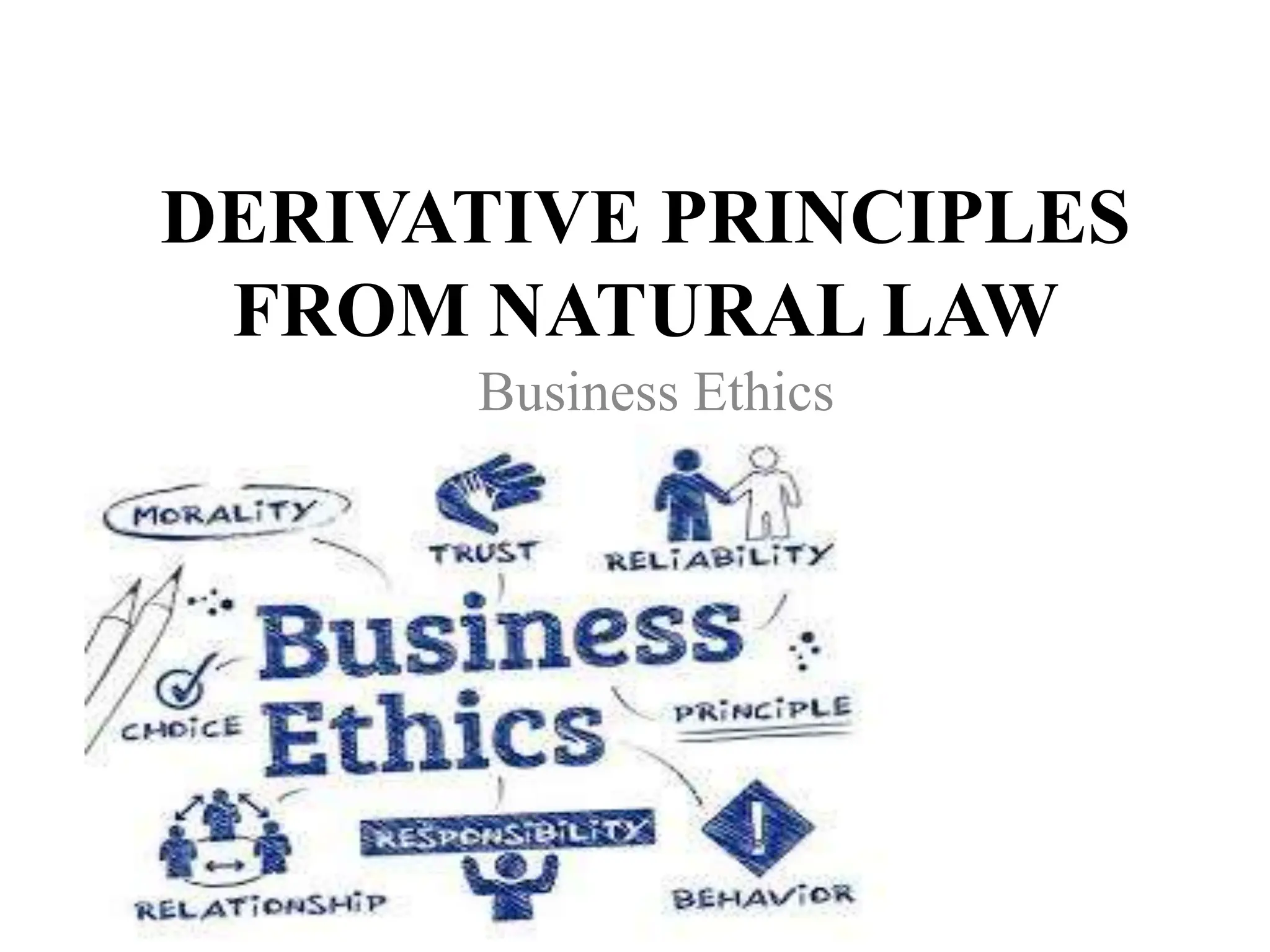
DERIVATIVE PRINCIPLES
FROM NATURAL LAW
Business Ethics
PRINCIPLE OF DOUBLE EFFECT
• a moral principle that considers moral
values and allows an act that necessarily
has evil and good effects. The dual effects
are expected although the evil is not
intended.
PRINCIPLE OF TOTALITY
• a moral principle that holds as man is a
holistic/total being not being a part of but a
whole part. Every part of the human body has
existed for the good of the whole.
• Each person has a natural right to live and to
continue in existence.
PRINCIPLE OF STEWARDSHIP
• a moral principle that holds as no one
could claim that he or she is the owner of
anything in the world and that of his/her
own body.
• To take good care of the creation and do
not have the sole authority to do whatever
what man wants.
PRINCIPLE OF INVIOLABILITY
OF LIFE
• a principle that holds as every human life,
is of infinite value as it is a sacred and
precious gift from the almighty creator.
• Every life, no matter how it is lived, an
equal worth and dignity to every other.
PRINCIPLE OF FORFEITURE
• a moral principle which ceases the right
and inclination of the object (self-
preservation) over the subject
(threathened), who does the act.

Ethical Principles1.pptx

  • 1.
  • 2.
    PRINCIPLE OF AUTONOMY •moral principle which holds to respect for the individual’s autonomy (self- governance/determination) • The person is understood as exercising his or her decision regarding the way his or her treatment goes “free from deceit, duress, constraint or coercion”
  • 3.
    PRINCIPLE OF INFORMED CONSENT •a moral principle that has an imperative call that is an individual must be sufficed with sufficient and certain information before he/she is asked for his/her consent to anything that he/she has to undertake.
  • 4.
    PRINCIPLE OF BENEFICENCE •taking action to promote the well-being of others. To seek the good of the person in all circumstances. • Four elements of Principle of beneficence – One ought to promote good – One ought to prevent evil or harm – One ought to remove evil or harm – One ought not to inflict evil or harm
  • 5.
    PRINCIPLE OF NON- MALEFICENCE •a moral principle which calls to avoid/refrain from inflicting harm in the course of doing good to the person.
  • 6.
    PRINCIPLE OF PATERNALISM •a moral principle that holds to protect and advance the interest of its recipient.
  • 7.
    PRINCIPLE OF JUSTICE •a moral principle which observes the just act as giving what is due to a person. • Justice is giving due care to each and every individual.
  • 8.
    PRINCIPE OF VERACITY •a moral principle which demands a categorical imperative - tell the truth and nothing but the truth. • It is a moral obligation to be truthful in our dealings with others.
  • 9.
    PRINCIPLE OF CONFIDENTIALITY • anethical principle that requires nondisclosure of private or secret information with which one is entrusted. • It binds the practitioner to hold in strict confidence the information he or she obtained.
  • 10.
  • 11.
    PRINCIPLE OF DOUBLEEFFECT • a moral principle that considers moral values and allows an act that necessarily has evil and good effects. The dual effects are expected although the evil is not intended.
  • 12.
    PRINCIPLE OF TOTALITY •a moral principle that holds as man is a holistic/total being not being a part of but a whole part. Every part of the human body has existed for the good of the whole. • Each person has a natural right to live and to continue in existence.
  • 13.
    PRINCIPLE OF STEWARDSHIP •a moral principle that holds as no one could claim that he or she is the owner of anything in the world and that of his/her own body. • To take good care of the creation and do not have the sole authority to do whatever what man wants.
  • 14.
    PRINCIPLE OF INVIOLABILITY OFLIFE • a principle that holds as every human life, is of infinite value as it is a sacred and precious gift from the almighty creator. • Every life, no matter how it is lived, an equal worth and dignity to every other.
  • 15.
    PRINCIPLE OF FORFEITURE •a moral principle which ceases the right and inclination of the object (self- preservation) over the subject (threathened), who does the act.