Local Anaesthesia
and Exodontia in
Children
Dr Nameeda K S
Contents
Local anaesthesia
1. Classification
2. Composition
3. Mechanism of action
4. Theories
5. ASA Classification
6. Techniques for anesthesization
Maxillary and Mandibular
primary teeth
7. Complications
8.Dosage consideration
2
◆ AAPD guidelines
◆ Recent techniques for pain
less
Local Anaesthesia
◆ It is defined as a transient loss of sensation to a painful or
potentially painful stimulus, resulting from a reversible
interruption of peripheral conduction along a specific neural
pathway to its central integration and perception in the brain.
◆ Local anaesthesia has been defined as loss of sensation in a
circumscribed area of the body caused by a depression of
excitation in nerve endings or an inhibition in the conduction
process of peripheral nerves.
3
Covino BG, Vassallo HG: local anesthetics: mechanisms of acion and clinical use, New York, 1976, Grune and Stratton.
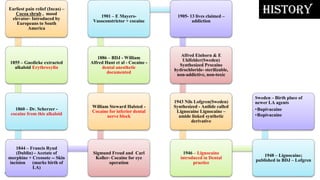
History
4
Earliest pain relief (Incas) –
Cocoa shrub , mood
elevator- Introduced by
Europeans to South
America
1855 – Gaedicke extracted
alkaloid Erythroxylin
1860 – Dr. Scherzer -
cocaine from this alkaloid
1844 – Francis Rynd
(Dublin) - Acetate of
morphine + Creosote -- Skin
incision (marks birth of
LA)
Sigmund Freud and Carl
Koller- Cocaine for eye
operation
William Steward Halsted -
Cocaine for inferior dental
nerve block
1886 – BDJ - William
Alfred Hunt et al - Cocaine -
dental anesthetic
documented
1901 – E Mayers-
Vasoconstrictor + cocaine
1905- 13 lives claimed –
addiction
Alfred Einhorn & E
Uhlfelder(Sweden)
Synthesized Procaine
hydrochloride- sterilizable,
non-addictive, non-toxic
1943 Nils Lofgren(Sweden)
Synthesized - Anilide called
Lignocaine Lignocaine –
amide linked synthetic
derivative
1946 – Lignocaine
introduced in Dental
practice
1948 – Lignocaine;
published in BDJ – Lofgren
Sweden – Birth place of
newer LA agents
•Bupivacaine
•Ropivacaine
History
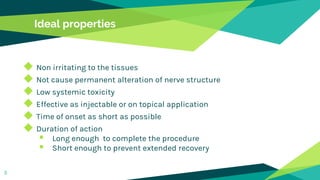
Ideal properties
◆ Non irritating to the tissues
◆ Not cause permanent alteration of nerve structure
◆ Low systemic toxicity
◆ Effective as injectable or on topical application
◆ Time of onset as short as possible
◆ Duration of action
 Long enough to complete the procedure
 Short enough to prevent extended recovery
5
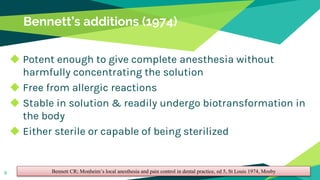
Bennett’s additions (1974)
◆ Potent enough to give complete anesthesia without
harmfully concentrating the solution
◆ Free from allergic reactions
◆ Stable in solution & readily undergo biotransformation in
the body
◆ Either sterile or capable of being sterilized
6 Bennett CR; Monheim’s local anesthesia and pain control in dental practice, ed 5, St Louis 1974, Mosby
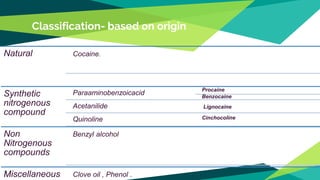
Classification- based on origin
7
Natural Cocaine.
Synthetic
nitrogenous
compound
Paraaminobenzoicacid Procaine
Benzocaine
Acetanilide Lignocaine
Quinoline Cinchocoline
Non
Nitrogenous
compounds
Benzyl alcohol
Miscellaneous Clove oil , Phenol .
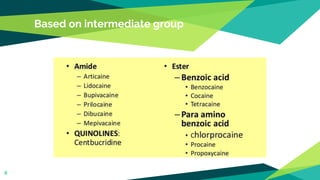
Based on intermediate group
8
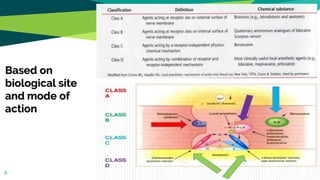
Based on
biological site
and mode of
action
9
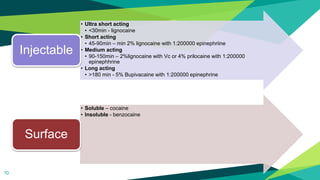
10
• Ultra short acting
• <30min - lignocaine
• Short acting
• 45-90min – min 2% lignocaine with 1:200000 epinephriine
• Medium acting
• 90-150min – 2%lignocaine with Vc or 4% prilocaine with 1:200000
epinephhrine
• Long acting
• >180 min - 5% Bupivacaine with 1:200000 epinephrine
Injectable
• Soluble – cocaine
• Insoluble - benzocaine
Surface
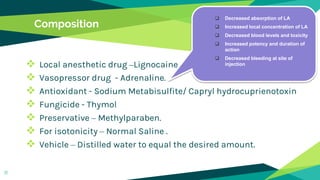
Composition
 Local anesthetic drug –Lignocaine
 Vasopressor drug - Adrenaline.
 Antioxidant - Sodium Metabisulfite/ Capryl hydrocuprienotoxin
 Fungicide - Thymol
 Preservative – Methylparaben.
 For isotonicity – Normal Saline .
 Vehicle – Distilled water to equal the desired amount.
11
 Decreased absorption of LA
 Increased local concentration of LA
 Decreased blood levels and toxicity
 Increased potency and duration of
action
 Decreased bleeding at site of
injection
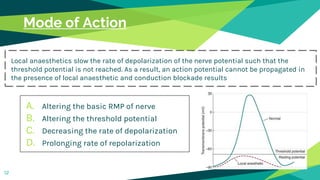
Mode of Action
12
Local anaesthetics slow the rate of depolarization of the nerve potential such that the
threshold potential is not reached. As a result, an action potential cannot be propagated in
the presence of local anaesthetic and conduction blockade results
A. Altering the basic RMP of nerve
B. Altering the threshold potential
C. Decreasing the rate of depolarization
D. Prolonging rate of repolarization
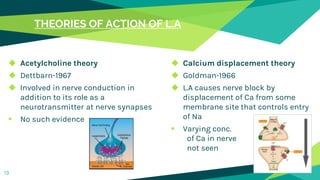
THEORIES OF ACTION OF L.A
◆ Acetylcholine theory
◆ Dettbarn-1967
◆ Involved in nerve conduction in
addition to its role as a
neurotransmitter at nerve synapses
 No such evidence
◆ Calcium displacement theory
◆ Goldman-1966
◆ L.A causes nerve block by
displacement of Ca from some
membrane site that controls entry
of Na
 Varying conc.
of Ca in nerve
not seen
13
14
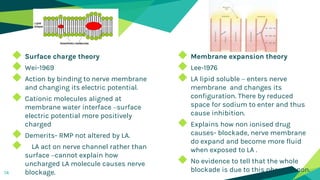
◆ Surface charge theory
◆ Wei-1969
◆ Action by binding to nerve membrane
and changing its electric potential.
◆ Cationic molecules aligned at
membrane water interface –surface
electric potential more positively
charged
◆ Demerits- RMP not altered by LA.
◆ LA act on nerve channel rather than
surface –cannot explain how
uncharged LA molecule causes nerve
blockage.
◆ Membrane expansion theory
◆ Lee-1976
◆ LA lipid soluble – enters nerve
membrane and changes its
configuration. There by reduced
space for sodium to enter and thus
cause inhibition.
◆ Explains how non ionised drug
causes- blockade, nerve membrane
do expand and become more fluid
when exposed to LA .
◆ No evidence to tell that the whole
blockade is due to this phenomenon.
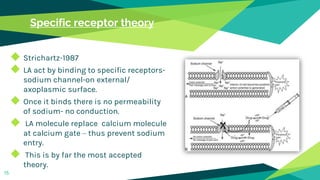
Specific receptor theory
◆ Strichartz-1987
◆ LA act by binding to specific receptors-
sodium channel-on external/
axoplasmic surface.
◆ Once it binds there is no permeability
of sodium- no conduction.
◆ LA molecule replace calcium molecule
at calcium gate – thus prevent sodium
entry.
◆ This is by far the most accepted
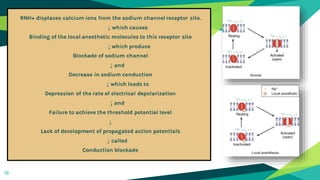
theory.
15
16
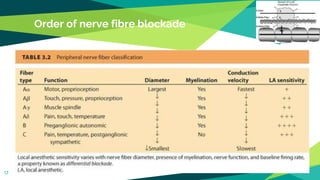
Order of nerve fibre blockade
17
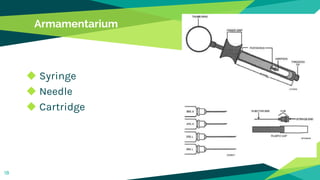
Armamentarium
◆ Syringe
◆ Needle
◆ Cartridge
18
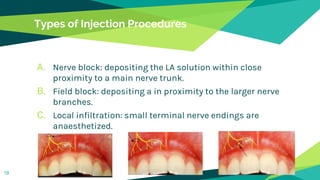
Types of Injection Procedures
A. Nerve block: depositing the LA solution within close
proximity to a main nerve trunk.
B. Field block: depositing a in proximity to the larger nerve
branches.
C. Local infiltration: small terminal nerve endings are
anaesthetized.
19
Anaesthetic Techniques
In Paediatric Patients
20
21
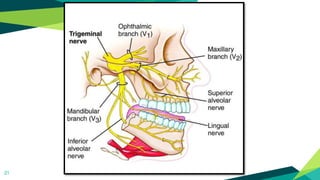
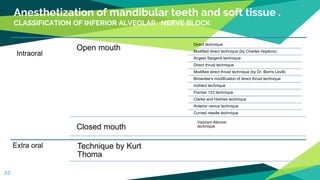
Anesthetization of mandibular teeth and soft tissue .
CLASSIFICATION OF INFERIOR ALVEOLAR NERVE BLOCK
22
Intraoral
Open mouth
Direct technique
Modified direct technique (by Charles Hopkins)
Angelo Sargenti technique
Direct thrust technique
Modified direct thrust technique (by Dr. Borris Levill)
Brownlee’s modification of direct thrust technique
Indirect technique
Fischer 123 technique
Clarke and Holmes technique
Anterior ramus technique
Curved needle technique
Closed mouth
Vazirani-Akinosi
technique
Extra oral Technique by Kurt
Thoma
23
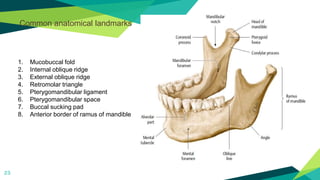
Common anatomical landmarks
1. Mucobuccal fold
2. Internal oblique ridge
3. External oblique ridge
4. Retromolar triangle
5. Pterygomandibular ligament
6. Pterygomandibular space
7. Buccal sucking pad
8. Anterior border of ramus of mandible
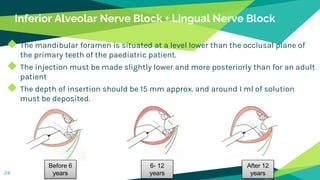
Inferior Alveolar Nerve Block + Lingual Nerve Block
◆ The mandibular foramen is situated at a level lower than the occlusal plane of
the primary teeth of the paediatric patient.
◆ The injection must be made slightly lower and more posteriorly than for an adult
patient
◆ The depth of insertion should be 15 mm approx. and around I ml of solution
must be deposited.
24
Before 6
years
6- 12
years
After 12
years
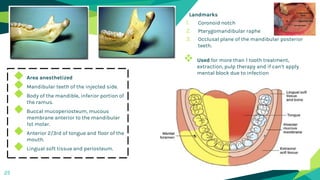
Landmarks
1. Coronoid notch
2. Pterygomandibular raphe
3. Occlusal plane of the mandibular posterior
teeth.
25
◆ Area anesthetized
◆ Mandibular teeth of the injected side.
◆ Body of the mandible, inferior portion of
the ramus.
◆ Buccal mucoperiosteum, mucous
membrane anterior to the mandibular
1st molar.
◆ Anterior 2/3rd of tongue and floor of the
mouth.
◆ Lingual soft tissue and periosteum.
 Used for more than 1 tooth treatment,
extraction, pulp therapy and if can’t apply
mental block due to infection
26
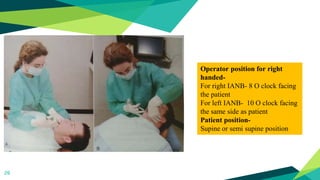
Operator position for right
handed-
For right IANB- 8 O clock facing
the patient
For left IANB- 10 O clock facing
the same side as patient
Patient position-
Supine or semi supine position
Techniques for paediatric patients
1. Inverted triangle concept (by Mathewson)
2. Thumb concept (by Wright)
3. Lingula technique
27
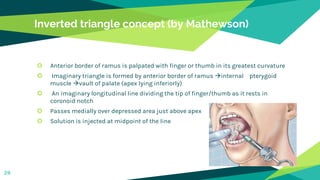
Inverted triangle concept (by Mathewson)
 Anterior border of ramus is palpated with finger or thumb in its greatest curvature
 Imaginary triangle is formed by anterior border of ramus internal pterygoid
muscle vault of palate (apex lying inferiorly)
 An imaginary longitudinal line dividing the tip of finger/thumb as it rests in
coronoid notch
 Passes medially over depressed area just above apex
 Solution is injected at midpoint of the line
28
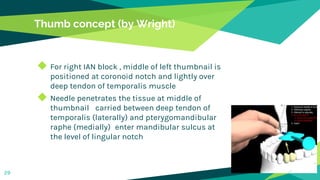
Thumb concept (by Wright)
◆ For right IAN block , middle of left thumbnail is
positioned at coronoid notch and lightly over
deep tendon of temporalis muscle
◆ Needle penetrates the tissue at middle of
thumbnail carried between deep tendon of
temporalis (laterally) and pterygomandibular
raphe (medially) enter mandibular sulcus at
the level of lingular notch
29
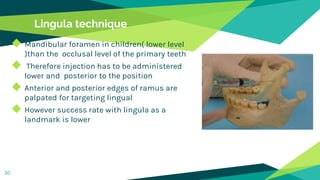
Lingula technique
◆ Mandibular foramen in children( lower level
)than the occlusal level of the primary teeth
◆ Therefore injection has to be administered
lower and posterior to the position
◆ Anterior and posterior edges of ramus are
palpated for targeting lingual
◆ However success rate with lingula as a
landmark is lower
30
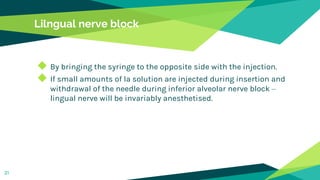
Lilngual nerve block
◆ By bringing the syringe to the opposite side with the injection.
◆ If small amounts of la solution are injected during insertion and
withdrawal of the needle during inferior alveolar nerve block –
lingual nerve will be invariably anesthetised.
31
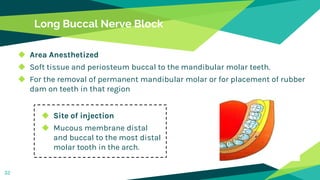
Long Buccal Nerve Block
◆ Site of injection
◆ Mucous membrane distal
and buccal to the most distal
molar tooth in the arch.
◆ Area Anesthetized
◆ Soft tissue and periosteum buccal to the mandibular molar teeth.
◆ For the removal of permanent mandibular molar or for placement of rubber
dam on teeth in that region
32
Infiltration anaesthesia for primary mandibular molars
◆ Mandibular infiltration is an effective technique when performing a
class I or II amalgam or an SSC restoration in a primary molar, both in
primary and mixed dentition.
◆ When a pulpotomy was attempted, infiltration was effective in only 61%
of the teeth evaluated as anesthetized upon probing, rubber dam
placement, and preparation. Therefore, the technique cannot be
considered to be reliable in the case of a pulpotomy
◆ Mandibular infiltration anaesthesia produces adequate anaesthesia in
mandibular deciduous molars for most restorative procedures.
33
The effectiveness of mandibular infiltration compared to mandibular block anesthesia in treating primary molars in children
Constantine J. Oulis, DDS, MS George P. Vadiakas, DDS, MS Aspa Vasilopoulou, DDS : Pediatric Dentistry - 18:4, 1996 American
Academy ofPediatric Dentis
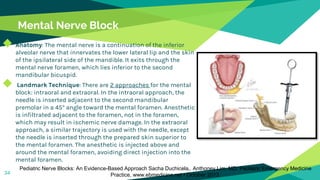
Mental Nerve Block
◆ Anatomy: The mental nerve is a continuation of the inferior
alveolar nerve that innervates the lower lateral lip and the skin
of the ipsilateral side of the mandible. It exits through the
mental nerve foramen, which lies inferior to the second
mandibular bicuspid.
◆ Landmark Technique: There are 2 approaches for the mental
block: intraoral and extraoral. In the intraoral approach, the
needle is inserted adjacent to the second mandibular
premolar in a 45° angle toward the mental foramen. Anesthetic
is infiltrated adjacent to the foramen, not in the foramen,
which may result in ischemic nerve damage. In the extraoral
approach, a similar trajectory is used with the needle, except
the needle is inserted through the prepared skin superior to
the mental foramen. The anesthetic is injected above and
around the mental foramen, avoiding direct injection into the
mental foramen.
34
Pediatric Nerve Blocks: An Evidence-Based Approach Sacha Duchicela,. Anthoney Lim, MD: Pediatric Emergency Medicine
Practice, www.ebmedicine.net • October 2013.
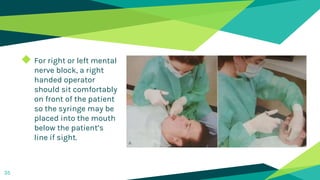
◆ For right or left mental
nerve block, a right
handed operator
should sit comfortably
on front of the patient
so the syringe may be
placed into the mouth
below the patient’s
line if sight.
35
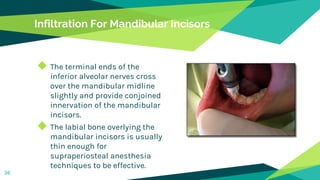
Infiltration For Mandibular Incisors
◆ The terminal ends of the
inferior alveolar nerves cross
over the mandibular midline
slightly and provide conjoined
innervation of the mandibular
incisors.
◆ The labial bone overlying the
mandibular incisors is usually
thin enough for
supraperiosteal anesthesia
techniques to be effective.
36
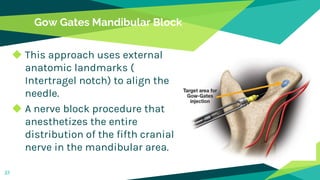
Gow Gates Mandibular Block
◆ This approach uses external
anatomic landmarks (
Intertragel notch) to align the
needle.
◆ A nerve block procedure that
anesthetizes the entire
distribution of the fifth cranial
nerve in the mandibular area.
37
38
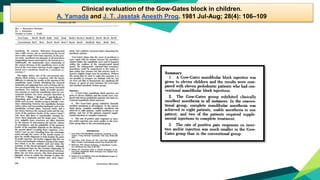
Clinical evaluation of the Gow-Gates block in children.
A. Yamada and J. T. Jasstak Anesth Prog. 1981 Jul-Aug; 28(4): 106–109
Anaesthetization of maxillary teeth and soft
tissue
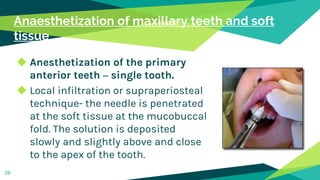
◆ Anesthetization of the primary
anterior teeth – single tooth.
◆ Local infiltration or supraperiosteal
technique- the needle is penetrated
at the soft tissue at the mucobuccal
fold. The solution is deposited
slowly and slightly above and close
to the apex of the tooth.
39
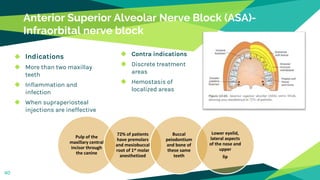
Anterior Superior Alveolar Nerve Block (ASA)-
Infraorbital nerve block
◆ Indications
◆ More than two maxillay
teeth
◆ Inflammation and
infection
◆ When supraperiosteal
injections are ineffective
◆ Contra indications
◆ Discrete treatment
areas
◆ Hemostasis of
localized areas
40
Pulp of the
maxillary central
incisor through
the canine
72% of patients
have premolars
and mesiobuccal
root of 1st molar
anesthetized
Buccal
peiodontium
and bone of
these same
teeth
Lower eyelid,
lateral aspects
of the nose and
upper
lip
41
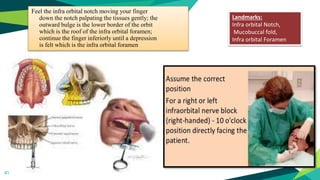
Landmarks:
Infra orbital Notch,
Mucobuccal fold,
Infra orbital Foramen
Feel the infra orbital notch moving your finger
down the notch palpating the tissues gently; the
outward bulge is the lower border of the orbit
which is the roof of the infra orbital foramen;
continue the finger inferiorly until a depression
is felt which is the infra orbital foramen
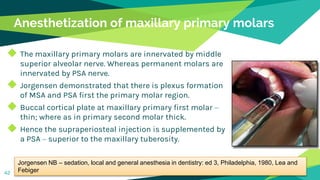
Anesthetization of maxillary primary molars
◆ The maxillary primary molars are innervated by middle
superior alveolar nerve. Whereas permanent molars are
innervated by PSA nerve.
◆ Jorgensen demonstrated that there is plexus formation
of MSA and PSA first the primary molar region.
◆ Buccal cortical plate at maxillary primary first molar –
thin; where as in primary second molar thick.
◆ Hence the supraperiosteal injection is supplemented by
a PSA – superior to the maxillary tuberosity.
42
Jorgensen NB – sedation, local and general anesthesia in dentistry: ed 3, Philadelphia, 1980, Lea and
Febiger
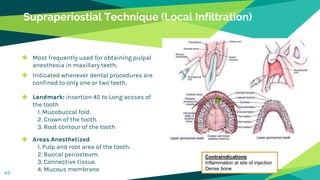
Supraperiostial Technique (Local Infiltration)
◆ Most frequently used for obtaining pulpal
anesthesia in maxillary teeth.
◆ Indicated whenever dental procedures are
confined to only one or two teeth.
◆ Landmark: insertion 45 to Long acsses of
the tooth
1. Mucobuccal fold.
2. Crown of the tooth.
3. Root contour of the tooth
◆ Areas Anesthetized
1. Pulp and root area of the tooth.
2. Buccal periosteum.
3. Connective tissue.
4. Mucous membrane
43
Contraindications
Inflammation at site of injection
Dense bone
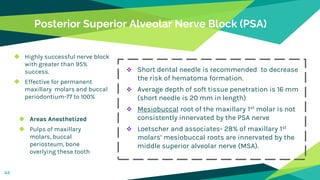
Posterior Superior Alveolar Nerve Block (PSA)
◆ Highly successful nerve block
with greater than 95%
success.
◆ Effective for permanent
maxillary molars and buccal
periodontium-77 to 100%
 Short dental needle is recommended to decrease
the risk of hematoma formation.
 Average depth of soft tissue penetration is 16 mm
(short needle is 20 mm in length)
 Mesiobuccal root of the maxillary 1st molar is not
consistently innervated by the PSA nerve
 Loetscher and associates- 28% of maxillary 1st
molars’ mesiobuccal roots are innervated by the
middle superior alveolar nerve (MSA).
◆ Areas Anesthetized
◆ Pulps of maxillary
molars, buccal
periosteum, bone
overlying these tooth
44
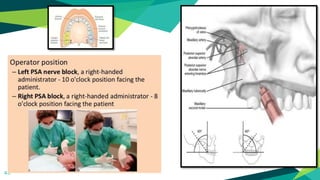
45
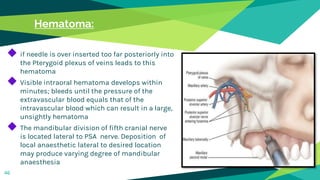
Hematoma:
◆ if needle is over inserted too far posteriorly into
the Pterygoid plexus of veins leads to this
hematoma
◆ Visible intraoral hematoma develops within
minutes; bleeds until the pressure of the
extravascular blood equals that of the
intravascular blood which can result in a large,
unsightly hematoma
◆ The mandibular division of fifth cranial nerve
is located lateral to PSA nerve. Deposition of
local anaesthetic lateral to desired location
may produce varying degree of mandibular
anaesthesia
46
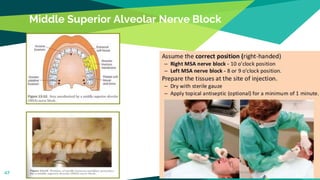
Middle Superior Alveolar Nerve Block
47
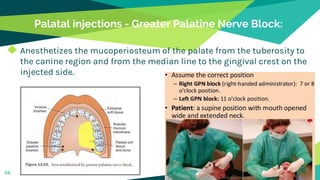
Palatal injections - Greater Palatine Nerve Block:
◆ Anesthetizes the mucoperiosteum of the palate from the tuberosity to
the canine region and from the median line to the gingival crest on the
injected side.
48
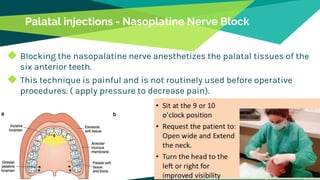
Palatal injections - Nasoplatine Nerve Block
◆ Blocking the nasopalatine nerve anesthetizes the palatal tissues of the
six anterior teeth.
◆ This technique is painful and is not routinely used before operative
procedures. ( apply pressure to decrease pain).
49
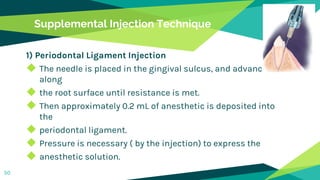
Supplemental Injection Technique
1) Periodontal Ligament Injection
◆ The needle is placed in the gingival sulcus, and advanced
along
◆ the root surface until resistance is met.
◆ Then approximately 0.2 mL of anesthetic is deposited into
the
◆ periodontal ligament.
◆ Pressure is necessary ( by the injection) to express the
◆ anesthetic solution.
50
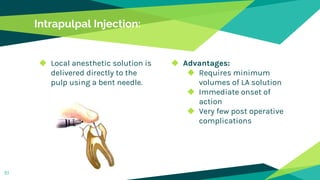
Intrapulpal Injection:
◆ Local anesthetic solution is
delivered directly to the
pulp using a bent needle.
◆ Advantages:
◆ Requires minimum
volumes of LA solution
◆ Immediate onset of
action
◆ Very few post operative
complications
51
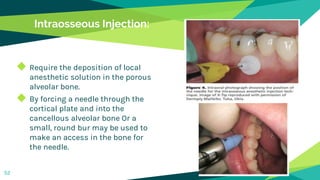
Intraosseous Injection:
◆ Require the deposition of local
anesthetic solution in the porous
alveolar bone.
◆ By forcing a needle through the
cortical plate and into the
cancellous alveolar bone Or a
small, round bur may be used to
make an access in the bone for
the needle.
52
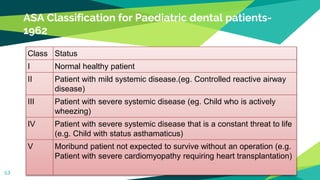
ASA Classification for Paediatric dental patients-
1962
53
Class Status
I Normal healthy patient
II Patient with mild systemic disease.(eg. Controlled reactive airway
disease)
III Patient with severe systemic disease (eg. Child who is actively
wheezing)
IV Patient with severe systemic disease that is a constant threat to life
(e.g. Child with status asthamaticus)
V Moribund patient not expected to survive without an operation (e.g.
Patient with severe cardiomyopathy requiring heart transplantation)
54
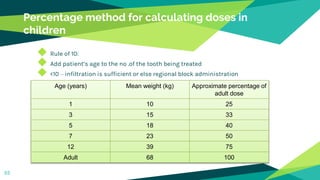
Percentage method for calculating doses in
children
◆ Rule of 10:
◆ Add patient’s age to the no .of the tooth being treated
◆ <10 – infiltration is sufficient or else regional block administration
55
Age (years) Mean weight (kg) Approximate percentage of
adult dose
1 10 25
3 15 33
5 18 40
7 23 50
12 39 75
Adult 68 100
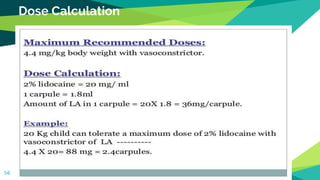
Dose Calculation
56
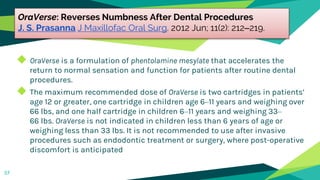
OraVerse: Reverses Numbness After Dental Procedures
J. S. Prasanna J Maxillofac Oral Surg. 2012 Jun; 11(2): 212–219.
◆ OraVerse is a formulation of phentolamine mesylate that accelerates the
return to normal sensation and function for patients after routine dental
procedures.
◆ The maximum recommended dose of OraVerse is two cartridges in patients’
age 12 or greater, one cartridge in children age 6–11 years and weighing over
66 lbs, and one half cartridge in children 6–11 years and weighing 33–
66 lbs. OraVerse is not indicated in children less than 6 years of age or
weighing less than 33 lbs. It is not recommended to use after invasive
procedures such as endodontic treatment or surgery, where post-operative
discomfort is anticipated
57
“Guideline on Use of Local Anesthesia for
Pediatric Dental Patients
AMERICAN ACADEMY OF PEDIATRIC DENTISTRY
Adopted
2005
Revised
2009, 2015
58
Topical anesthetic
◆ Topical anesthetic is effective on surface tissues (up to two to three mm in depth) to
reduce painful needle penetration of the oral mucosa.
◆ Topical anesthetic agents are available in gel, liquid, ointment, patch, and aerosol forms.
◆ The US Food and Drug Administration (FDA) has issued a warning about the use of
compounded topical anesthetics and the risk of methemoglobinemia.
◆ Risk of acquired methe-moglobinemia has been associated primarily with two local
anesthetics: prilocaine and benzocaine. There is no evidence of other local anesthetics
contributing to the etiology of methemoglobinemia.
◆ Benzocaine, the most commonly used topical anesthetic, is available in concentrations
up to 20 per-cent and comes in liquid, spray, and gel forms.
59
Recommendations- Topical anesthetics
1. Topical anesthetic may be used prior to the injection of a local
anesthetic to reduce discomfort associated with needle penetration.
2. The pharmacological properties of the topical agent should be
understood.
3. A metered spray is recommended if an aerosol preparation is selected.
4. Systemic absorption of the drugs in topical anesthetics must be
considered when calculating the total amount of anesthetic
administered
60
Selection of syringes and needles
◆ The American Dental Association (ADA) has long standing standards for
aspirating syringes for use in the administration of local anesthesia.
◆ Dental needles are available in three lengths: long (32 mm), short (20 mm), and
ultrashort (10 mm). Needle gauges range from size 23 to 30.
61
Recommendations: syringes
1. Any 23- through 30-gauge needle may be used for intraoral injections, since blood
can be aspirated through all of them. Aspiration can be more difficult, however,
when smaller gauge needles are used. An extra-short, 30-gauge is appropriate for
certain infiltration injections.
2. Needles should not be bent if they are to be inserted into soft tissue to a depth of
greater than five millimeters or inserted to their hub for injections to avoid needle
breakage
62
Injectable local anesthetic agents- Recommendations:
1. Selection of local anesthetic agents should be based upon:
— the patient’s medical history and mental/develop- mental status;
— the anticipated duration of the dental procedure;
— the need for hemorrhage control;
— the planned administration of other agents (eg, nitrous oxide, sedative agents, general anesthesia)
— the practitioner’s knowledge of the anesthetic agent.
2. Use of vasoconstrictors in local anesthetics is recommended to decrease the risk of toxicity of the anes-
thetic agent, especially when treatment extends to two or more quadrants in a single visit.
3. In cases of bisulfate allergy, use of a local anesthetic without a vasoconstrictor is indicated. A local anes-
thetic without a vasoconstrictor also can be used for shorter treatment needs but should be used with
caution to minimize the risk of toxicity of the anesthetic agents.
4. The established maximum dosage for any anesthetic should not be exceeded.
5. Administration of local anesthetic should be based on the weight/body mass index (BMI) of the patient,
not to exceed AAPD recommendations.
63
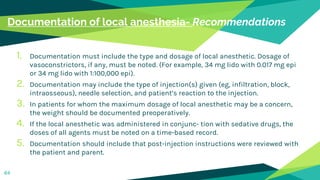
Documentation of local anesthesia- Recommendations
1. Documentation must include the type and dosage of local anesthetic. Dosage of
vasoconstrictors, if any, must be noted. (For example, 34 mg lido with 0.017 mg epi
or 34 mg lido with 1:100,000 epi).
2. Documentation may include the type of injection(s) given (eg, infiltration, block,
intraosseous), needle selection, and patient’s reaction to the injection.
3. In patients for whom the maximum dosage of local anesthetic may be a concern,
the weight should be documented preoperatively.
4. If the local anesthetic was administered in conjunc- tion with sedative drugs, the
doses of all agents must be noted on a time-based record.
5. Documentation should include that post-injection instructions were reviewed with
the patient and parent.
64
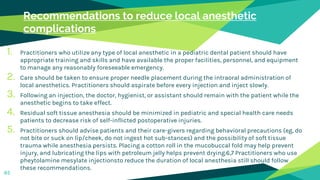
Recommendations to reduce local anesthetic
complications
1. Practitioners who utilize any type of local anesthetic in a pediatric dental patient should have
appropriate training and skills and have available the proper facilities, personnel, and equipment
to manage any reasonably foreseeable emergency.
2. Care should be taken to ensure proper needle placement during the intraoral administration of
local anesthetics. Practitioners should aspirate before every injection and inject slowly.
3. Following an injection, the doctor, hygienist, or assistant should remain with the patient while the
anesthetic begins to take effect.
4. Residual soft tissue anesthesia should be minimized in pediatric and special health care needs
patients to decrease risk of self-inflicted postoperative injuries.
5. Practitioners should advise patients and their care-givers regarding behavioral precautions (eg, do
not bite or suck on lip/cheek, do not ingest hot sub-stances) and the possibility of soft tissue
trauma while anesthesia persists. Placing a cotton roll in the mucobuccal fold may help prevent
injury, and lubricating the lips with petroleum jelly helps prevent drying.6,7 Practitioners who use
pheytolamine mesylate injectionsto reduce the duration of local anesthesia still should follow
these recommendations.
65
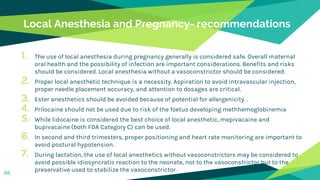
Local Anesthesia and Pregnancy- recommendations
1. The use of local anesthesia during pregnancy generally is considered safe. Overall maternal
oral health and the possibility of infection are important considerations. Benefits and risks
should be considered. Local anesthesia without a vasoconstrictor should be considered.
2. Proper local anesthetic technique is a necessity. Aspiration to avoid intravascular injection,
proper needle placement accuracy, and attention to dosages are critical.
3. Ester anesthetics should be avoided because of potential for allergenicity. .
4. Prilocaine should not be used due to risk of the foetus developing methhemoglobinemia
5. While lidocaine is considered the best choice of local anesthetic, mepivacaine and
bupivacaine (both FDA Category C) can be used.
6. In second and third trimesters, proper positioning and heart rate monitoring are important to
avoid postural hypotension.
7. During lactation, the use of local anesthetics without vasoconstrictors may be considered to
avoid possible idiosyncratic reaction to the neonate, not to the vasoconstrictor but to the
preservative used to stabilize the vasoconstrictor.66
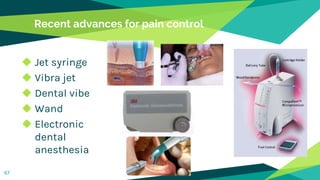
Recent advances for pain control
◆ Jet syringe
◆ Vibra jet
◆ Dental vibe
◆ Wand
◆ Electronic
dental
anesthesia
67
LOCAL COMPLICATIONS
◆ Needle breakage
◆ Pain on injection
◆ Burning on injection
◆ Persistent anaesthesia or paresthesia
◆ Trismus
◆ Hematoma
◆ Sloughing of the tissue / soft tissue injury
◆ Facial nerve paralysis
68
SYSTEMIC COMPLICATIONS
◆ Toxicity
◆ Idiosyncracy
◆ Allergy
◆ Anaphylactoid reaction
◆ Syncope
69
References
◆Mcdonald and Avery’s Dentistry for the child and adolescent 10th edition .
◆Fundamentals of Pediatric Dentistry , 2nd revised edition ,
Mathewson/Primosch/Robertson.
◆Chaurasia BD.Human Anatomy- regional and applied dissection and clinical- vol 3, 4th
edition, CBS publishers
◆C. Richard Bennett. Monheim’s local anaesthesia and pain control in dental practice
Seventh Ed.1990. CBS Publishers, New Delhi.
◆Stanley Malamed. Handbook of Local Anaesthesia 6th edition.
◆D H Roberts, J H Sowray ‘local analgesia in dentistry” 2nd edition John Wright sons,
limited publications. 1954
◆Textbook of paediatric dentistry Nikhil Marwah edition 3.
70
Thank You
71

Local anesthesia in children

  • 1.
    Local Anaesthesia and Exodontiain Children Dr Nameeda K S
  • 2.
    Contents Local anaesthesia 1. Classification 2.Composition 3. Mechanism of action 4. Theories 5. ASA Classification 6. Techniques for anesthesization Maxillary and Mandibular primary teeth 7. Complications 8.Dosage consideration 2 ◆ AAPD guidelines ◆ Recent techniques for pain less
  • 3.
    Local Anaesthesia ◆ Itis defined as a transient loss of sensation to a painful or potentially painful stimulus, resulting from a reversible interruption of peripheral conduction along a specific neural pathway to its central integration and perception in the brain. ◆ Local anaesthesia has been defined as loss of sensation in a circumscribed area of the body caused by a depression of excitation in nerve endings or an inhibition in the conduction process of peripheral nerves. 3 Covino BG, Vassallo HG: local anesthetics: mechanisms of acion and clinical use, New York, 1976, Grune and Stratton.
  • 4.
    History 4 Earliest pain relief(Incas) – Cocoa shrub , mood elevator- Introduced by Europeans to South America 1855 – Gaedicke extracted alkaloid Erythroxylin 1860 – Dr. Scherzer - cocaine from this alkaloid 1844 – Francis Rynd (Dublin) - Acetate of morphine + Creosote -- Skin incision (marks birth of LA) Sigmund Freud and Carl Koller- Cocaine for eye operation William Steward Halsted - Cocaine for inferior dental nerve block 1886 – BDJ - William Alfred Hunt et al - Cocaine - dental anesthetic documented 1901 – E Mayers- Vasoconstrictor + cocaine 1905- 13 lives claimed – addiction Alfred Einhorn & E Uhlfelder(Sweden) Synthesized Procaine hydrochloride- sterilizable, non-addictive, non-toxic 1943 Nils Lofgren(Sweden) Synthesized - Anilide called Lignocaine Lignocaine – amide linked synthetic derivative 1946 – Lignocaine introduced in Dental practice 1948 – Lignocaine; published in BDJ – Lofgren Sweden – Birth place of newer LA agents •Bupivacaine •Ropivacaine History
  • 5.
    Ideal properties ◆ Nonirritating to the tissues ◆ Not cause permanent alteration of nerve structure ◆ Low systemic toxicity ◆ Effective as injectable or on topical application ◆ Time of onset as short as possible ◆ Duration of action  Long enough to complete the procedure  Short enough to prevent extended recovery 5
  • 6.
    Bennett’s additions (1974) ◆Potent enough to give complete anesthesia without harmfully concentrating the solution ◆ Free from allergic reactions ◆ Stable in solution & readily undergo biotransformation in the body ◆ Either sterile or capable of being sterilized 6 Bennett CR; Monheim’s local anesthesia and pain control in dental practice, ed 5, St Louis 1974, Mosby
  • 7.
    Classification- based onorigin 7 Natural Cocaine. Synthetic nitrogenous compound Paraaminobenzoicacid Procaine Benzocaine Acetanilide Lignocaine Quinoline Cinchocoline Non Nitrogenous compounds Benzyl alcohol Miscellaneous Clove oil , Phenol .
  • 8.
  • 9.
  • 10.
    10 • Ultra shortacting • <30min - lignocaine • Short acting • 45-90min – min 2% lignocaine with 1:200000 epinephriine • Medium acting • 90-150min – 2%lignocaine with Vc or 4% prilocaine with 1:200000 epinephhrine • Long acting • >180 min - 5% Bupivacaine with 1:200000 epinephrine Injectable • Soluble – cocaine • Insoluble - benzocaine Surface
  • 11.
    Composition  Local anestheticdrug –Lignocaine  Vasopressor drug - Adrenaline.  Antioxidant - Sodium Metabisulfite/ Capryl hydrocuprienotoxin  Fungicide - Thymol  Preservative – Methylparaben.  For isotonicity – Normal Saline .  Vehicle – Distilled water to equal the desired amount. 11  Decreased absorption of LA  Increased local concentration of LA  Decreased blood levels and toxicity  Increased potency and duration of action  Decreased bleeding at site of injection
  • 12.
    Mode of Action 12 Localanaesthetics slow the rate of depolarization of the nerve potential such that the threshold potential is not reached. As a result, an action potential cannot be propagated in the presence of local anaesthetic and conduction blockade results A. Altering the basic RMP of nerve B. Altering the threshold potential C. Decreasing the rate of depolarization D. Prolonging rate of repolarization
  • 13.
    THEORIES OF ACTIONOF L.A ◆ Acetylcholine theory ◆ Dettbarn-1967 ◆ Involved in nerve conduction in addition to its role as a neurotransmitter at nerve synapses  No such evidence ◆ Calcium displacement theory ◆ Goldman-1966 ◆ L.A causes nerve block by displacement of Ca from some membrane site that controls entry of Na  Varying conc. of Ca in nerve not seen 13
  • 14.
    14 ◆ Surface chargetheory ◆ Wei-1969 ◆ Action by binding to nerve membrane and changing its electric potential. ◆ Cationic molecules aligned at membrane water interface –surface electric potential more positively charged ◆ Demerits- RMP not altered by LA. ◆ LA act on nerve channel rather than surface –cannot explain how uncharged LA molecule causes nerve blockage. ◆ Membrane expansion theory ◆ Lee-1976 ◆ LA lipid soluble – enters nerve membrane and changes its configuration. There by reduced space for sodium to enter and thus cause inhibition. ◆ Explains how non ionised drug causes- blockade, nerve membrane do expand and become more fluid when exposed to LA . ◆ No evidence to tell that the whole blockade is due to this phenomenon.
  • 15.
    Specific receptor theory ◆Strichartz-1987 ◆ LA act by binding to specific receptors- sodium channel-on external/ axoplasmic surface. ◆ Once it binds there is no permeability of sodium- no conduction. ◆ LA molecule replace calcium molecule at calcium gate – thus prevent sodium entry. ◆ This is by far the most accepted theory. 15
  • 16.
  • 17.
    Order of nervefibre blockade 17
  • 18.
  • 19.
    Types of InjectionProcedures A. Nerve block: depositing the LA solution within close proximity to a main nerve trunk. B. Field block: depositing a in proximity to the larger nerve branches. C. Local infiltration: small terminal nerve endings are anaesthetized. 19
  • 20.
  • 21.
  • 22.
    Anesthetization of mandibularteeth and soft tissue . CLASSIFICATION OF INFERIOR ALVEOLAR NERVE BLOCK 22 Intraoral Open mouth Direct technique Modified direct technique (by Charles Hopkins) Angelo Sargenti technique Direct thrust technique Modified direct thrust technique (by Dr. Borris Levill) Brownlee’s modification of direct thrust technique Indirect technique Fischer 123 technique Clarke and Holmes technique Anterior ramus technique Curved needle technique Closed mouth Vazirani-Akinosi technique Extra oral Technique by Kurt Thoma
  • 23.
    23 Common anatomical landmarks 1.Mucobuccal fold 2. Internal oblique ridge 3. External oblique ridge 4. Retromolar triangle 5. Pterygomandibular ligament 6. Pterygomandibular space 7. Buccal sucking pad 8. Anterior border of ramus of mandible
  • 24.
    Inferior Alveolar NerveBlock + Lingual Nerve Block ◆ The mandibular foramen is situated at a level lower than the occlusal plane of the primary teeth of the paediatric patient. ◆ The injection must be made slightly lower and more posteriorly than for an adult patient ◆ The depth of insertion should be 15 mm approx. and around I ml of solution must be deposited. 24 Before 6 years 6- 12 years After 12 years
  • 25.
    Landmarks 1. Coronoid notch 2.Pterygomandibular raphe 3. Occlusal plane of the mandibular posterior teeth. 25 ◆ Area anesthetized ◆ Mandibular teeth of the injected side. ◆ Body of the mandible, inferior portion of the ramus. ◆ Buccal mucoperiosteum, mucous membrane anterior to the mandibular 1st molar. ◆ Anterior 2/3rd of tongue and floor of the mouth. ◆ Lingual soft tissue and periosteum.  Used for more than 1 tooth treatment, extraction, pulp therapy and if can’t apply mental block due to infection
  • 26.
    26 Operator position forright handed- For right IANB- 8 O clock facing the patient For left IANB- 10 O clock facing the same side as patient Patient position- Supine or semi supine position
  • 27.
    Techniques for paediatricpatients 1. Inverted triangle concept (by Mathewson) 2. Thumb concept (by Wright) 3. Lingula technique 27
  • 28.
    Inverted triangle concept(by Mathewson)  Anterior border of ramus is palpated with finger or thumb in its greatest curvature  Imaginary triangle is formed by anterior border of ramus internal pterygoid muscle vault of palate (apex lying inferiorly)  An imaginary longitudinal line dividing the tip of finger/thumb as it rests in coronoid notch  Passes medially over depressed area just above apex  Solution is injected at midpoint of the line 28
  • 29.
    Thumb concept (byWright) ◆ For right IAN block , middle of left thumbnail is positioned at coronoid notch and lightly over deep tendon of temporalis muscle ◆ Needle penetrates the tissue at middle of thumbnail carried between deep tendon of temporalis (laterally) and pterygomandibular raphe (medially) enter mandibular sulcus at the level of lingular notch 29
  • 30.
    Lingula technique ◆ Mandibularforamen in children( lower level )than the occlusal level of the primary teeth ◆ Therefore injection has to be administered lower and posterior to the position ◆ Anterior and posterior edges of ramus are palpated for targeting lingual ◆ However success rate with lingula as a landmark is lower 30
  • 31.
    Lilngual nerve block ◆By bringing the syringe to the opposite side with the injection. ◆ If small amounts of la solution are injected during insertion and withdrawal of the needle during inferior alveolar nerve block – lingual nerve will be invariably anesthetised. 31
  • 32.
    Long Buccal NerveBlock ◆ Site of injection ◆ Mucous membrane distal and buccal to the most distal molar tooth in the arch. ◆ Area Anesthetized ◆ Soft tissue and periosteum buccal to the mandibular molar teeth. ◆ For the removal of permanent mandibular molar or for placement of rubber dam on teeth in that region 32
  • 33.
    Infiltration anaesthesia forprimary mandibular molars ◆ Mandibular infiltration is an effective technique when performing a class I or II amalgam or an SSC restoration in a primary molar, both in primary and mixed dentition. ◆ When a pulpotomy was attempted, infiltration was effective in only 61% of the teeth evaluated as anesthetized upon probing, rubber dam placement, and preparation. Therefore, the technique cannot be considered to be reliable in the case of a pulpotomy ◆ Mandibular infiltration anaesthesia produces adequate anaesthesia in mandibular deciduous molars for most restorative procedures. 33 The effectiveness of mandibular infiltration compared to mandibular block anesthesia in treating primary molars in children Constantine J. Oulis, DDS, MS George P. Vadiakas, DDS, MS Aspa Vasilopoulou, DDS : Pediatric Dentistry - 18:4, 1996 American Academy ofPediatric Dentis
  • 34.
    Mental Nerve Block ◆Anatomy: The mental nerve is a continuation of the inferior alveolar nerve that innervates the lower lateral lip and the skin of the ipsilateral side of the mandible. It exits through the mental nerve foramen, which lies inferior to the second mandibular bicuspid. ◆ Landmark Technique: There are 2 approaches for the mental block: intraoral and extraoral. In the intraoral approach, the needle is inserted adjacent to the second mandibular premolar in a 45° angle toward the mental foramen. Anesthetic is infiltrated adjacent to the foramen, not in the foramen, which may result in ischemic nerve damage. In the extraoral approach, a similar trajectory is used with the needle, except the needle is inserted through the prepared skin superior to the mental foramen. The anesthetic is injected above and around the mental foramen, avoiding direct injection into the mental foramen. 34 Pediatric Nerve Blocks: An Evidence-Based Approach Sacha Duchicela,. Anthoney Lim, MD: Pediatric Emergency Medicine Practice, www.ebmedicine.net • October 2013.
  • 35.
    ◆ For rightor left mental nerve block, a right handed operator should sit comfortably on front of the patient so the syringe may be placed into the mouth below the patient’s line if sight. 35
  • 36.
    Infiltration For MandibularIncisors ◆ The terminal ends of the inferior alveolar nerves cross over the mandibular midline slightly and provide conjoined innervation of the mandibular incisors. ◆ The labial bone overlying the mandibular incisors is usually thin enough for supraperiosteal anesthesia techniques to be effective. 36
  • 37.
    Gow Gates MandibularBlock ◆ This approach uses external anatomic landmarks ( Intertragel notch) to align the needle. ◆ A nerve block procedure that anesthetizes the entire distribution of the fifth cranial nerve in the mandibular area. 37
  • 38.
    38 Clinical evaluation ofthe Gow-Gates block in children. A. Yamada and J. T. Jasstak Anesth Prog. 1981 Jul-Aug; 28(4): 106–109
  • 39.
    Anaesthetization of maxillaryteeth and soft tissue ◆ Anesthetization of the primary anterior teeth – single tooth. ◆ Local infiltration or supraperiosteal technique- the needle is penetrated at the soft tissue at the mucobuccal fold. The solution is deposited slowly and slightly above and close to the apex of the tooth. 39
  • 40.
    Anterior Superior AlveolarNerve Block (ASA)- Infraorbital nerve block ◆ Indications ◆ More than two maxillay teeth ◆ Inflammation and infection ◆ When supraperiosteal injections are ineffective ◆ Contra indications ◆ Discrete treatment areas ◆ Hemostasis of localized areas 40 Pulp of the maxillary central incisor through the canine 72% of patients have premolars and mesiobuccal root of 1st molar anesthetized Buccal peiodontium and bone of these same teeth Lower eyelid, lateral aspects of the nose and upper lip
  • 41.
    41 Landmarks: Infra orbital Notch, Mucobuccalfold, Infra orbital Foramen Feel the infra orbital notch moving your finger down the notch palpating the tissues gently; the outward bulge is the lower border of the orbit which is the roof of the infra orbital foramen; continue the finger inferiorly until a depression is felt which is the infra orbital foramen
  • 42.
    Anesthetization of maxillaryprimary molars ◆ The maxillary primary molars are innervated by middle superior alveolar nerve. Whereas permanent molars are innervated by PSA nerve. ◆ Jorgensen demonstrated that there is plexus formation of MSA and PSA first the primary molar region. ◆ Buccal cortical plate at maxillary primary first molar – thin; where as in primary second molar thick. ◆ Hence the supraperiosteal injection is supplemented by a PSA – superior to the maxillary tuberosity. 42 Jorgensen NB – sedation, local and general anesthesia in dentistry: ed 3, Philadelphia, 1980, Lea and Febiger
  • 43.
    Supraperiostial Technique (LocalInfiltration) ◆ Most frequently used for obtaining pulpal anesthesia in maxillary teeth. ◆ Indicated whenever dental procedures are confined to only one or two teeth. ◆ Landmark: insertion 45 to Long acsses of the tooth 1. Mucobuccal fold. 2. Crown of the tooth. 3. Root contour of the tooth ◆ Areas Anesthetized 1. Pulp and root area of the tooth. 2. Buccal periosteum. 3. Connective tissue. 4. Mucous membrane 43 Contraindications Inflammation at site of injection Dense bone
  • 44.
    Posterior Superior AlveolarNerve Block (PSA) ◆ Highly successful nerve block with greater than 95% success. ◆ Effective for permanent maxillary molars and buccal periodontium-77 to 100%  Short dental needle is recommended to decrease the risk of hematoma formation.  Average depth of soft tissue penetration is 16 mm (short needle is 20 mm in length)  Mesiobuccal root of the maxillary 1st molar is not consistently innervated by the PSA nerve  Loetscher and associates- 28% of maxillary 1st molars’ mesiobuccal roots are innervated by the middle superior alveolar nerve (MSA). ◆ Areas Anesthetized ◆ Pulps of maxillary molars, buccal periosteum, bone overlying these tooth 44
  • 45.
  • 46.
    Hematoma: ◆ if needleis over inserted too far posteriorly into the Pterygoid plexus of veins leads to this hematoma ◆ Visible intraoral hematoma develops within minutes; bleeds until the pressure of the extravascular blood equals that of the intravascular blood which can result in a large, unsightly hematoma ◆ The mandibular division of fifth cranial nerve is located lateral to PSA nerve. Deposition of local anaesthetic lateral to desired location may produce varying degree of mandibular anaesthesia 46
  • 47.
  • 48.
    Palatal injections -Greater Palatine Nerve Block: ◆ Anesthetizes the mucoperiosteum of the palate from the tuberosity to the canine region and from the median line to the gingival crest on the injected side. 48
  • 49.
    Palatal injections -Nasoplatine Nerve Block ◆ Blocking the nasopalatine nerve anesthetizes the palatal tissues of the six anterior teeth. ◆ This technique is painful and is not routinely used before operative procedures. ( apply pressure to decrease pain). 49
  • 50.
    Supplemental Injection Technique 1)Periodontal Ligament Injection ◆ The needle is placed in the gingival sulcus, and advanced along ◆ the root surface until resistance is met. ◆ Then approximately 0.2 mL of anesthetic is deposited into the ◆ periodontal ligament. ◆ Pressure is necessary ( by the injection) to express the ◆ anesthetic solution. 50
  • 51.
    Intrapulpal Injection: ◆ Localanesthetic solution is delivered directly to the pulp using a bent needle. ◆ Advantages: ◆ Requires minimum volumes of LA solution ◆ Immediate onset of action ◆ Very few post operative complications 51
  • 52.
    Intraosseous Injection: ◆ Requirethe deposition of local anesthetic solution in the porous alveolar bone. ◆ By forcing a needle through the cortical plate and into the cancellous alveolar bone Or a small, round bur may be used to make an access in the bone for the needle. 52
  • 53.
    ASA Classification forPaediatric dental patients- 1962 53 Class Status I Normal healthy patient II Patient with mild systemic disease.(eg. Controlled reactive airway disease) III Patient with severe systemic disease (eg. Child who is actively wheezing) IV Patient with severe systemic disease that is a constant threat to life (e.g. Child with status asthamaticus) V Moribund patient not expected to survive without an operation (e.g. Patient with severe cardiomyopathy requiring heart transplantation)
  • 54.
  • 55.
    Percentage method forcalculating doses in children ◆ Rule of 10: ◆ Add patient’s age to the no .of the tooth being treated ◆ <10 – infiltration is sufficient or else regional block administration 55 Age (years) Mean weight (kg) Approximate percentage of adult dose 1 10 25 3 15 33 5 18 40 7 23 50 12 39 75 Adult 68 100
  • 56.
  • 57.
    OraVerse: Reverses NumbnessAfter Dental Procedures J. S. Prasanna J Maxillofac Oral Surg. 2012 Jun; 11(2): 212–219. ◆ OraVerse is a formulation of phentolamine mesylate that accelerates the return to normal sensation and function for patients after routine dental procedures. ◆ The maximum recommended dose of OraVerse is two cartridges in patients’ age 12 or greater, one cartridge in children age 6–11 years and weighing over 66 lbs, and one half cartridge in children 6–11 years and weighing 33– 66 lbs. OraVerse is not indicated in children less than 6 years of age or weighing less than 33 lbs. It is not recommended to use after invasive procedures such as endodontic treatment or surgery, where post-operative discomfort is anticipated 57
  • 58.
    “Guideline on Useof Local Anesthesia for Pediatric Dental Patients AMERICAN ACADEMY OF PEDIATRIC DENTISTRY Adopted 2005 Revised 2009, 2015 58
  • 59.
    Topical anesthetic ◆ Topicalanesthetic is effective on surface tissues (up to two to three mm in depth) to reduce painful needle penetration of the oral mucosa. ◆ Topical anesthetic agents are available in gel, liquid, ointment, patch, and aerosol forms. ◆ The US Food and Drug Administration (FDA) has issued a warning about the use of compounded topical anesthetics and the risk of methemoglobinemia. ◆ Risk of acquired methe-moglobinemia has been associated primarily with two local anesthetics: prilocaine and benzocaine. There is no evidence of other local anesthetics contributing to the etiology of methemoglobinemia. ◆ Benzocaine, the most commonly used topical anesthetic, is available in concentrations up to 20 per-cent and comes in liquid, spray, and gel forms. 59
  • 60.
    Recommendations- Topical anesthetics 1.Topical anesthetic may be used prior to the injection of a local anesthetic to reduce discomfort associated with needle penetration. 2. The pharmacological properties of the topical agent should be understood. 3. A metered spray is recommended if an aerosol preparation is selected. 4. Systemic absorption of the drugs in topical anesthetics must be considered when calculating the total amount of anesthetic administered 60
  • 61.
    Selection of syringesand needles ◆ The American Dental Association (ADA) has long standing standards for aspirating syringes for use in the administration of local anesthesia. ◆ Dental needles are available in three lengths: long (32 mm), short (20 mm), and ultrashort (10 mm). Needle gauges range from size 23 to 30. 61 Recommendations: syringes 1. Any 23- through 30-gauge needle may be used for intraoral injections, since blood can be aspirated through all of them. Aspiration can be more difficult, however, when smaller gauge needles are used. An extra-short, 30-gauge is appropriate for certain infiltration injections. 2. Needles should not be bent if they are to be inserted into soft tissue to a depth of greater than five millimeters or inserted to their hub for injections to avoid needle breakage
  • 62.
    62 Injectable local anestheticagents- Recommendations: 1. Selection of local anesthetic agents should be based upon: — the patient’s medical history and mental/develop- mental status; — the anticipated duration of the dental procedure; — the need for hemorrhage control; — the planned administration of other agents (eg, nitrous oxide, sedative agents, general anesthesia) — the practitioner’s knowledge of the anesthetic agent. 2. Use of vasoconstrictors in local anesthetics is recommended to decrease the risk of toxicity of the anes- thetic agent, especially when treatment extends to two or more quadrants in a single visit. 3. In cases of bisulfate allergy, use of a local anesthetic without a vasoconstrictor is indicated. A local anes- thetic without a vasoconstrictor also can be used for shorter treatment needs but should be used with caution to minimize the risk of toxicity of the anesthetic agents. 4. The established maximum dosage for any anesthetic should not be exceeded. 5. Administration of local anesthetic should be based on the weight/body mass index (BMI) of the patient, not to exceed AAPD recommendations.
  • 63.
  • 64.
    Documentation of localanesthesia- Recommendations 1. Documentation must include the type and dosage of local anesthetic. Dosage of vasoconstrictors, if any, must be noted. (For example, 34 mg lido with 0.017 mg epi or 34 mg lido with 1:100,000 epi). 2. Documentation may include the type of injection(s) given (eg, infiltration, block, intraosseous), needle selection, and patient’s reaction to the injection. 3. In patients for whom the maximum dosage of local anesthetic may be a concern, the weight should be documented preoperatively. 4. If the local anesthetic was administered in conjunc- tion with sedative drugs, the doses of all agents must be noted on a time-based record. 5. Documentation should include that post-injection instructions were reviewed with the patient and parent. 64
  • 65.
    Recommendations to reducelocal anesthetic complications 1. Practitioners who utilize any type of local anesthetic in a pediatric dental patient should have appropriate training and skills and have available the proper facilities, personnel, and equipment to manage any reasonably foreseeable emergency. 2. Care should be taken to ensure proper needle placement during the intraoral administration of local anesthetics. Practitioners should aspirate before every injection and inject slowly. 3. Following an injection, the doctor, hygienist, or assistant should remain with the patient while the anesthetic begins to take effect. 4. Residual soft tissue anesthesia should be minimized in pediatric and special health care needs patients to decrease risk of self-inflicted postoperative injuries. 5. Practitioners should advise patients and their care-givers regarding behavioral precautions (eg, do not bite or suck on lip/cheek, do not ingest hot sub-stances) and the possibility of soft tissue trauma while anesthesia persists. Placing a cotton roll in the mucobuccal fold may help prevent injury, and lubricating the lips with petroleum jelly helps prevent drying.6,7 Practitioners who use pheytolamine mesylate injectionsto reduce the duration of local anesthesia still should follow these recommendations. 65
  • 66.
    Local Anesthesia andPregnancy- recommendations 1. The use of local anesthesia during pregnancy generally is considered safe. Overall maternal oral health and the possibility of infection are important considerations. Benefits and risks should be considered. Local anesthesia without a vasoconstrictor should be considered. 2. Proper local anesthetic technique is a necessity. Aspiration to avoid intravascular injection, proper needle placement accuracy, and attention to dosages are critical. 3. Ester anesthetics should be avoided because of potential for allergenicity. . 4. Prilocaine should not be used due to risk of the foetus developing methhemoglobinemia 5. While lidocaine is considered the best choice of local anesthetic, mepivacaine and bupivacaine (both FDA Category C) can be used. 6. In second and third trimesters, proper positioning and heart rate monitoring are important to avoid postural hypotension. 7. During lactation, the use of local anesthetics without vasoconstrictors may be considered to avoid possible idiosyncratic reaction to the neonate, not to the vasoconstrictor but to the preservative used to stabilize the vasoconstrictor.66
  • 67.
    Recent advances forpain control ◆ Jet syringe ◆ Vibra jet ◆ Dental vibe ◆ Wand ◆ Electronic dental anesthesia 67
  • 68.
    LOCAL COMPLICATIONS ◆ Needlebreakage ◆ Pain on injection ◆ Burning on injection ◆ Persistent anaesthesia or paresthesia ◆ Trismus ◆ Hematoma ◆ Sloughing of the tissue / soft tissue injury ◆ Facial nerve paralysis 68
  • 69.
    SYSTEMIC COMPLICATIONS ◆ Toxicity ◆Idiosyncracy ◆ Allergy ◆ Anaphylactoid reaction ◆ Syncope 69
  • 70.
    References ◆Mcdonald and Avery’sDentistry for the child and adolescent 10th edition . ◆Fundamentals of Pediatric Dentistry , 2nd revised edition , Mathewson/Primosch/Robertson. ◆Chaurasia BD.Human Anatomy- regional and applied dissection and clinical- vol 3, 4th edition, CBS publishers ◆C. Richard Bennett. Monheim’s local anaesthesia and pain control in dental practice Seventh Ed.1990. CBS Publishers, New Delhi. ◆Stanley Malamed. Handbook of Local Anaesthesia 6th edition. ◆D H Roberts, J H Sowray ‘local analgesia in dentistry” 2nd edition John Wright sons, limited publications. 1954 ◆Textbook of paediatric dentistry Nikhil Marwah edition 3. 70
  • 71.