G U I D E D B Y : D R . R A J A S H R I K O L T E
P R E S E N T E D B Y : D R . P R A C H I R A T H I
LOCAL ANESTHESIA
CONTENTS
 Introduction
 Historical background
 Classification
 Composition of LA
 Vasoconstrictors
 Mechanism of action
 Absorption and Distribution
 Metabolism and Excretion
 Local anesthetic solutions
 Techniques of inducing LA
 Complications
 Special care groups
 Future trends
 Conclusion
Loss of sensation in a circumscribed area of the body caused by
depression of excitation in nerve endings or an inhibition of conduction
process in peripherl nerves.
Introduction
“loss of sensation without inducing loss of consciousness”
Desirable properties of Local Anesthetics
 Irritating to the tissue to which it is
applied.
 Permanent alterations of nerve
structure.
 Systemic toxicity.
 Allergic reaction.
 Short duration of action.
 Effective whether injected or applied
topically.
 Short onset of anesthesia.
 Sufficient potency.
 Sterile or capable of being sterilized.
 Stable in solution.
 Undergo biotransformation.
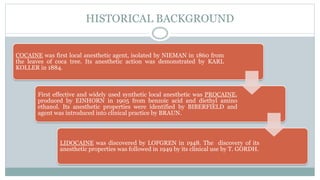
HISTORICAL BACKGROUND
COCAINE was first local anesthetic agent, isolated by NIEMAN in 1860 from
the leaves of coca tree. Its anesthetic action was demonstrated by KARL
KOLLER in 1884.
First effective and widely used synthetic local anesthetic was PROCAINE,
produced by EINHORN in 1905 from benzoic acid and diethyl amino
ethanol. Its anesthetic properties were identified by BIBERFIELD and
agent was introduced into clinical practice by BRAUN.
LIDOCAINE was discovered by LOFGREN in 1948. The discovery of its
anesthetic properties was followed in 1949 by its clinical use by T. GORDH.
Classification
of
Local Anesthetics
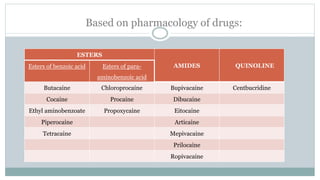
Based on pharmacology of drugs:
ESTERS
AMIDES QUINOLINE
Esters of benzoic acid Esters of para-
aminobenzoic acid
Butacaine Chloroprocaine Bupivacaine Centbucridine
Cocaine Procaine Dibucaine
Ethyl aminobenzoate Propoxycaine Eitocaine
Piperocaine Articaine
Tetracaine Mepivacaine
Prilocaine
Ropivacaine
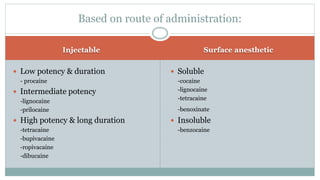
Injectable Surface anesthetic
 Low potency & duration
- procaine
 Intermediate potency
-lignocaine
-prilocaine
 High potency & long duration
-tetracaine
-bupivacaine
-ropivacaine
-dibucaine
 Soluble
-cocaine
-lignocaine
-tetracaine
-benoxinate
 Insoluble
-benzocaine
Based on route of administration:
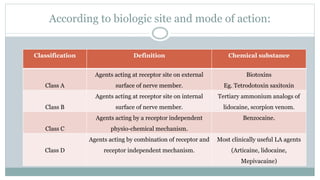
According to biologic site and mode of action:
Classification Definition Chemical substance
Class A
Agents acting at receptor site on external
surface of nerve member.
Biotoxins
Eg. Tetrodotoxin saxitoxin
Class B
Agents acting at receptor site on internal
surface of nerve member.
Tertiary ammonium analogs of
lidocaine, scorpion venom.
Class C
Agents acting by a receptor independent
physio-chemical mechanism.
Benzocaine.
Class D
Agents acting by combination of receptor and
receptor independent mechanism.
Most clinically useful LA agents
(Articaine, lidocaine,
Mepivacaine)
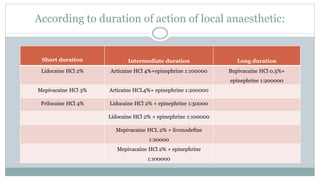
According to duration of action of local anaesthetic:
Short duration Intermediate duration Long duration
Lidocaine HCl 2% Articaine HCl 4%+epinephrine 1:100000 Bupivacaine HCl 0.5%+
epinephrine 1:200000
Mepivacaine HCl 3% Articaine HCL4%+ epinephrine 1:200000
Prilocaine HCl 4% Lidocaine HCl 2% + epinephrine 1:50000
Lidocaine HCl 2% + epinephrine 1:100000
Mepivacaine HCL 2% + livonodefine
1:20000
Mepivacaine HCl 2% + epinephrine
1:100000
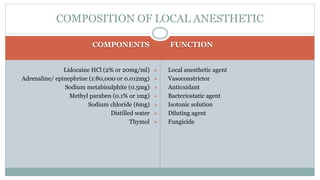
COMPONENTS FUNCTION
Lidocaine HCl (2% or 20mg/ml)
Adrenaline/ epinephrine (1:80,000 or 0.012mg)
Sodium metabisulphite (0.5mg)
Methyl paraben (0.1% or 1mg)
Sodium chloride (6mg)
Distilled water
Thymol
 Local anesthetic agent
 Vasoconstrictor
 Antioxidant
 Bacteriostatic agent
 Isotonic solution
 Diluting agent
 Fungicide
COMPOSITION OF LOCAL ANESTHETIC
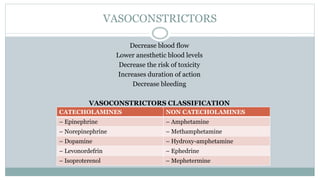
VASOCONSTRICTORS
Decrease blood flow
Lower anesthetic blood levels
Decrease the risk of toxicity
Increases duration of action
Decrease bleeding
VASOCONSTRICTORS CLASSIFICATION
CATECHOLAMINES NON CATECHOLAMINES
– Epinephrine – Amphetamine
– Norepinephrine – Methamphetamine
– Dopamine – Hydroxy-amphetamine
– Levonordefrin – Ephedrine
– Isoproterenol – Mephetermine
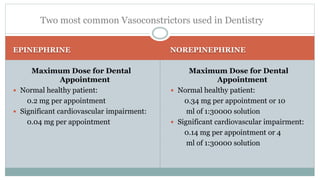
EPINEPHRINE NOREPINEPHRINE
Maximum Dose for Dental
Appointment
 Normal healthy patient:
0.2 mg per appointment
 Significant cardiovascular impairment:
0.04 mg per appointment
Maximum Dose for Dental
Appointment
 Normal healthy patient:
0.34 mg per appointment or 10
ml of 1:30000 solution
 Significant cardiovascular impairment:
0.14 mg per appointment or 4
ml of 1:30000 solution
Two most common Vasoconstrictors used in Dentistry
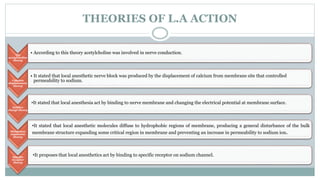
THEORIES OF L.A ACTION
The
acetylcholine
theory
• According to this theory acetylcholine was involved in nerve conduction.
Calcium
displacement
theory
• It stated that local anesthetic nerve block was produced by the displacement of calcium from membrane site that controlled
permeability to sodium.
Surface
charge theory
Membrane
expansion
theory
Specific
receptor
theory
•It stated that local anesthesia act by binding to nerve membrane and changing the electrical potential at membrane surface.
•It stated that local anesthetic molecules diffuse to hydrophobic regions of membrane, producing a general disturbance of the bulk
membrane structure expanding some critical region in membrane and preventing an increase in permeability to sodium ion.
•It proposes that local anesthetics act by binding to specific receptor on sodium channel.
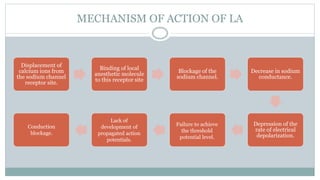
MECHANISM OF ACTION OF LA
Displacement of
calcium ions from
the sodium channel
receptor site.
Binding of local
anesthetic molecule
to this receptor site
Blockage of the
sodium channel.
Decrease in sodium
conductance.
Depression of the
rate of electrical
depolarization.
Failure to achieve
the threshold
potential level.
Lack of
development of
propagated action
potentials.
Conduction
blockage.
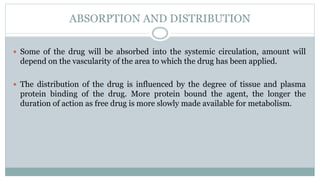
ABSORPTION AND DISTRIBUTION
 Some of the drug will be absorbed into the systemic circulation, amount will
depend on the vascularity of the area to which the drug has been applied.
 The distribution of the drug is influenced by the degree of tissue and plasma
protein binding of the drug. More protein bound the agent, the longer the
duration of action as free drug is more slowly made available for metabolism.
METABOLISM AND EXCRETION
 Esters (except cocaine) are broken down rapidly by plasma esterases to inactive
compounds and consequently have a short half life. Cocaine is hydrolysed in the
liver. Ester metabolite excretion is renal.
 Amides are metabolised hepatically by amidases. This is a slower process, hence
their half-life is longer and they can accumulate if given in repeated doses or by
infusion.
Procaine Lidocaine
 Vasodilation- clean surgical field
difficult to maintain because of
increased bleeding.
 Procaine is used in cases of
inadvertent intra-arterial(IA)
injection of a drug; vasodilating
properties are used to aid in
breaking arteriospasm.
 Compared with procaine, lidocaine
possesses a significantly more rapid
onset of action, produces more
profound anesthesia, has a longer
duration of action, and has a greater
potency.
LOCAL ANESTHETIC SOLUTIONS
Mepivacaine Articaine
 Provide longer duration of
anesthesia than most other local
anesthetics when the drug is
administered without a
vasoconstrictor.
 Mepivacaine plain is the most used
local anesthetic in pediatric patients
& is often quite appropriate in the
management of geriatric patients.
 Clinically, it is claimed that
maxillary buccal infiltration of
Articaine, provides palatal soft
tissue anesthesia, obliterating the
need for the more traumatic palatal
anesthesia.
 Also claimed that it can provide
pulpal and lingual anesthesia when
administered by infiltration in adult
mandible.
Bupivacaine & Etidocaine Topical Anesthetics
 Lengthy dental procedures for
which pulpal anesthesia in excess of
90 minutes is necessary.
 Difference between the two is that
Etidocaine has an onset of action of
about 3 minutes, whereas
Bupivacaine has an onset of 6 to 10
minutes.
 It diffuse through the mucous
membranes and injured skin to
reach the free nerve endings. But
the diffusion is limited and they are
rapidly absorbed in the circulation,
thus effective block is not obtained.
 Thus, to increase their efficacy, their
concentration is increased.
 5% or 10% lidocaine,1% or 2%
tetracaine-most common.
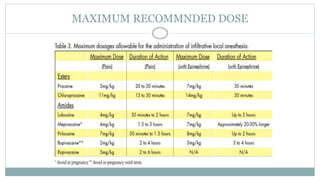
MAXIMUM RECOMMNDED DOSE
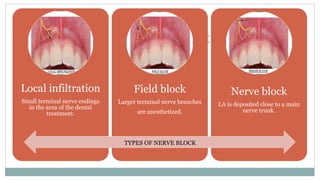
TYPES OF BLOCK
Local infiltration
Small terminal nerve endings
in the area of the dental
treatment.
Field block
Larger terminal nerve branches
are anesthetized.
Nerve block
LA is deposited close to a main
nerve trunk.
TYPES OF NERVE BLOCK
TECHNIQUES OF INJECTING LOCAL ANESTHESIA
 Supraperiosteal [infiltration], recommended for limited treatment protocols.
 Periodontal ligament [ PDL, intraligamentary] injection, recommended as adjunct to
other techniques.
 Intraseptal injection, recommended primarily for periodontal surgical techniques.
 Intracrestal injection, recommended for single teeth [primarily mandibular molars].
 Intraosseous injection, recommended for single teeth [primarily mandibular molars].
Maxillary Nerve
Block
Posterior superior alveolar
[PSA] nerve block
Middle superior alveolar
[MSA] nerve block
Anterior superior alveolar
[ASA, infraorbital] nerve
block
Greater palatine nerve block
Nasopalatine nerve block
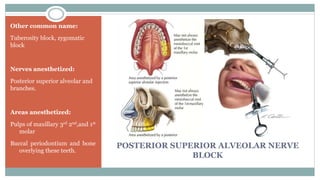
POSTERIOR SUPERIOR ALVEOLAR NERVE
BLOCK
Other common name:
Tuberosity block, zygomatic
block
Nerves anesthetized:
Posterior superior alveolar and
branches.
Areas anesthetized:
Pulps of maxillary 3rd 2nd,and 1st
molar
Buccal periodontium and bone
overlying these teeth.
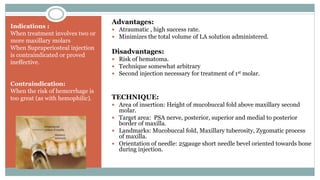
Advantages:
 Atraumatic , high success rate.
 Minimizes the total volume of LA solution administered.
Disadvantages:
 Risk of hematoma.
 Technique somewhat arbitrary
 Second injection necessary for treatment of 1st molar.
TECHNIQUE:
 Area of insertion: Height of mucobuccal fold above maxillary second
molar.
 Target area: PSA nerve, posterior, superior and medial to posterior
border of maxilla.
 Landmarks: Mucobuccal fold, Maxillary tuberosity, Zygomatic process
of maxilla.
 Orientation of needle: 25gauge short needle bevel oriented towards bone
during injection.
Indications :
When treatment involves two or
more maxillary molars
When Supraperiosteal injection
is contraindicated or proved
ineffective.
Contraindication:
When the risk of hemorrhage is
too great (as with hemophilic).
SIGNS AND SYMPTOMS:
1. Subjective: usually none.
2. Objective: absence of pain during
dental treatment.
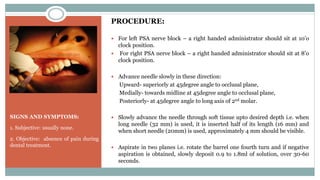
PROCEDURE:
 For left PSA nerve block – a right handed administrator should sit at 10’o
clock position.
 For right PSA nerve block – a right handed administrator should sit at 8’o
clock position.
 Advance needle slowly in these direction:
Upward- superiorly at 45degree angle to occlusal plane,
Medially- towards midline at 45degree angle to occlusal plane,
Posteriorly- at 45degree angle to long axis of 2nd molar.
 Slowly advance the needle through soft tissue upto desired depth i.e. when
long needle (32 mm) is used, it is inserted half of its length (16 mm) and
when short needle (20mm) is used, approximately 4 mm should be visible.
 Aspirate in two planes i.e. rotate the barrel one fourth turn and if negative
aspiration is obtained, slowly deposit 0.9 to 1.8ml of solution, over 30-60
seconds.
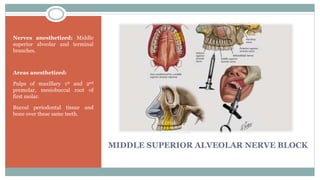
MIDDLE SUPERIOR ALVEOLAR NERVE BLOCK
Nerves anesthetized: Middle
superior alveolar and terminal
branches.
Areas anesthetized:
Pulps of maxillary 1st and 2nd
premolar, mesiobuccal root of
first molar.
Buccal periodontal tissue and
bone over these same teeth.
INDICATIONS:
When infraorbital nerve block
fails to provide pulpal anesthesia
distal to maxillary canine.
Dental procedures involving
both maxillary premolars only.
CONTRAINDICATIONS:
Infections or inflammations in
the area of injection or needle
insertion or drug deposition.
ADVANTAGES:
 Minimize the number of injection and volume of solution.
DISADVANTAGES:
 None
TECHNIQUE:
 Area of insertion: height of mucobuccal fold above maxillary second
premolar.
 Target area: maxillary area above apex of maxillary second premolar.
 Landmarks: mucobuccal fold above maxillary premolar.
 Orientation of needle: towards the bone.
 A 25 gauge short or long needle is recommended. However, a 27gauge
short needle is more likely to be available and is perfectly acceptable.
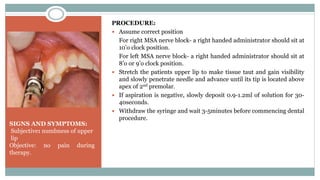
PROCEDURE:
 Assume correct position
For right MSA nerve block- a right handed administrator should sit at
10’o clock position.
For left MSA nerve block- a right handed administrator should sit at
8’o or 9’o clock position.
 Stretch the patients upper lip to make tissue taut and gain visibility
and slowly penetrate needle and advance until its tip is located above
apex of 2nd premolar.
 If aspiration is negative, slowly deposit 0.9-1.2ml of solution for 30-
40seconds.
 Withdraw the syringe and wait 3-5minutes before commencing dental
procedure.
SIGNS AND SYMPTOMS:
Subjective: numbness of upper
lip
Objective: no pain during
therapy.
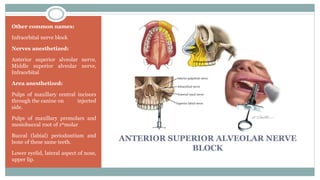
ANTERIOR SUPERIOR ALVEOLAR NERVE
BLOCK
Other common names:
Infraorbital nerve block
Nerves anesthetized:
Anterior superior alveolar nerve,
Middle superior alveolar nerve,
Infraorbital
Area anesthetized:
Pulps of maxillary central incisors
through the canine on injected
side.
Pulps of maxillary premolars and
mesiobuccal root of 1stmolar
Buccal (labial) periodontium and
bone of these same teeth.
Lower eyelid, lateral aspect of nose,
upper lip.
INDICATIONS:
Dental procedures involving more
than 2 maxillary teeth & their
overlying buccal tissues.
Infections or inflammation
Supraperiosteal injection have been
ineffective because of dense cortical
bone.
CONTRAINDICATIONS:
Hemostasis of localized areas
ADVANTAGES:
 Comparatively simple procedure.
 Comparatively safe, minimized volume of solutions used.
DISADVANTAGES:
 Anatomical- difficulty in defining landmarks.
 Administrator-Initial fear of injury to patient’s eye.
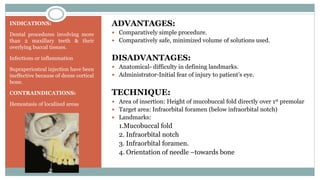
TECHNIQUE:
 Area of insertion: Height of mucobuccal fold directly over 1st premolar
 Target area: Infraorbital foramen (below infraorbital notch)
 Landmarks:
1.Mucobuccal fold
2. Infraorbital notch
3. Infraorbital foramen.
4. Orientation of needle –towards bone
SIGNS AND SYMPTOMS:
Subjective: Tingling and
numbness of lower eyelid, side of
nose and upper lip indicate
anesthesia of infraorbital nerve.
Objective: no pain during dental
therapy.
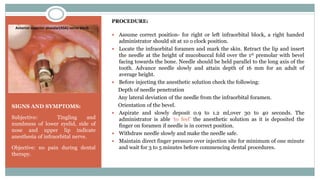
PROCEDURE:
 Assume correct position- for right or left infraorbital block, a right handed
administrator should sit at 10 o clock position.
 Locate the infraorbital foramen and mark the skin. Retract the lip and insert
the needle at the height of mucobuccal fold over the 1st premolar with bevel
facing towards the bone. Needle should be held parallel to the long axis of the
tooth. Advance needle slowly and attain depth of 16 mm for an adult of
average height.
 Before injecting the anesthetic solution check the following:
Depth of needle penetration
Any lateral deviation of the needle from the infraorbital foramen.
Orientation of the bevel.
 Aspirate and slowly deposit 0.9 to 1.2 ml,over 30 to 40 seconds. The
administrator is able ‘to feel’ the anesthetic solution as it is deposited the
finger on foramen if needle is in correct position.
 Withdraw needle slowly and make the needle safe.
 Maintain direct finger pressure over injection site for minimum of one minute
and wait for 3 to 5 minutes before commencing dental procedures.
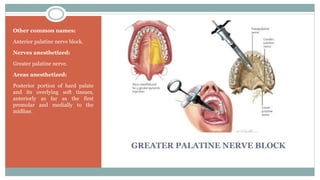
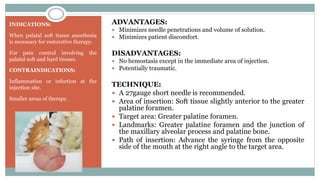
GREATER PALATINE NERVE BLOCK
Other common names:
Anterior palatine nerve block.
Nerves anesthetized:
Greater palatine nerve.
Areas anesthetized:
Posterior portion of hard palate
and its overlying soft tissues,
anteriorly as far as the first
premolar and medially to the
midline.
INDICATIONS:
When palatal soft tissue anesthesia
is necessary for restorative therapy.
For pain control involving the
palatal soft and hard tissues.
CONTRAINDICATIONS:
Inflammation or infection at the
injection site.
Smaller areas of therapy.
ADVANTAGES:
 Minimizes needle penetrations and volume of solution.
 Minimizes patient discomfort.
DISADVANTAGES:
 No hemostasis except in the immediate area of injection.
 Potentially traumatic.
TECHNIQUE:
 A 27gauge short needle is recommended.
 Area of insertion: Soft tissue slightly anterior to the greater
palatine foramen.
 Target area: Greater palatine foramen.
 Landmarks: Greater palatine foramen and the junction of
the maxillary alveolar process and palatine bone.
 Path of insertion: Advance the syringe from the opposite
side of the mouth at the right angle to the target area.
SIGNS AND SYMPTOMS:
Subjective: Numbness in the
posterior portion of palate.
Objective: No pain during dental
therapy.
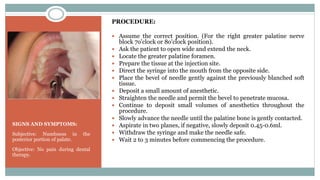
PROCEDURE:
 Assume the correct position. (For the right greater palatine nerve
block 7o'clock or 8o'clock position).
 Ask the patient to open wide and extend the neck.
 Locate the greater palatine foramen.
 Prepare the tissue at the injection site.
 Direct the syringe into the mouth from the opposite side.
 Place the bevel of needle gently against the previously blanched soft
tissue.
 Deposit a small amount of anesthetic.
 Straighten the needle and permit the bevel to penetrate mucosa.
 Continue to deposit small volumes of anesthetics throughout the
procedure.
 Slowly advance the needle until the palatine bone is gently contacted.
 Aspirate in two planes, if negative, slowly deposit 0.45-0.6ml.
 Withdraw the syringe and make the needle safe.
 Wait 2 to 3 minutes before commencing the procedure.
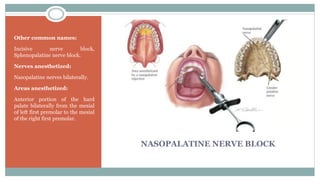
NASOPALATINE NERVE BLOCK
Other common names:
Incisive nerve block,
Sphenopalatine nerve block.
Nerves anesthetized:
Nasopalatine nerves bilaterally.
Areas anesthetized:
Anterior portion of the hard
palate bilaterally from the mesial
of left first premolar to the mesial
of the right first premolar.
INDICATIONS:
When palatal soft tissue anesthesia
is necessary for restorative therapy
on more than two teeth.
For pain control during periodontal
or oral surgical procedures
involving palatal soft and hard
tissues.
CONTARINDICATIONS:
Inflammation or infection at the
injection site.
ADVANTAGES:
 Minimizes needle penetration and volume of solution.
 Minimal patient discomfort from multiple needle penetration.
DISADVANTAGES:
 No hemostasis except in the immediate area of injection.
 Potentially most traumatic intraoral injection.
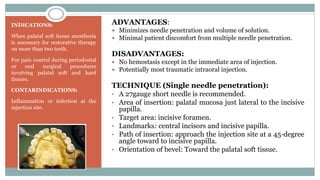
TECHNIQUE (Single needle penetration):
• A 27gauge short needle is recommended.
• Area of insertion: palatal mucosa just lateral to the incisive
papilla.
• Target area: incisive foramen.
• Landmarks: central incisors and incisive papilla.
• Path of insertion: approach the injection site at a 45-degree
angle toward to incisive papilla.
• Orientation of bevel: Toward the palatal soft tissue.
SIGNS AND SYMPTOMS:
Subjective: Numbness in the
anterior portion of palate.
Objective: No pain during dental
therapy.
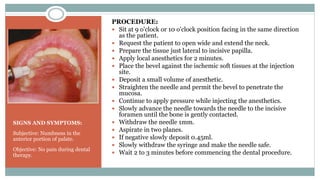
PROCEDURE:
 Sit at 9 o'clock or 10 o'clock position facing in the same direction
as the patient.
 Request the patient to open wide and extend the neck.
 Prepare the tissue just lateral to incisive papilla.
 Apply local anesthetics for 2 minutes.
 Place the bevel against the ischemic soft tissues at the injection
site.
 Deposit a small volume of anesthetic.
 Straighten the needle and permit the bevel to penetrate the
mucosa.
 Continue to apply pressure while injecting the anesthetics.
 Slowly advance the needle towards the needle to the incisive
foramen until the bone is gently contacted.
 Withdraw the needle 1mm.
 Aspirate in two planes.
 If negative slowly deposit 0.45ml.
 Slowly withdraw the syringe and make the needle safe.
 Wait 2 to 3 minutes before commencing the dental procedure.
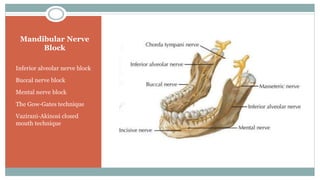
Mandibular Nerve
Block
Inferior alveolar nerve block
Buccal nerve block
Mental nerve block
The Gow-Gates technique
Vazirani-Akinosi closed
mouth technique
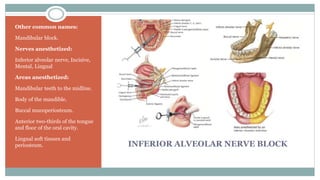
INFERIOR ALVEOLAR NERVE BLOCK
Other common names:
Mandibular block.
Nerves anesthetized:
Inferior alveolar nerve, Incisive,
Mental, Lingual
Areas anesthetized:
Mandibular teeth to the midline.
Body of the mandible.
Buccal mucoperiosteum.
Anterior two-thirds of the tongue
and floor of the oral cavity.
Lingual soft tissues and
periosteum.
INDICATIONS:
Procedures on multiple mandibular
teeth in one quadrant.
When buccal soft tissue anesthesia
is necessary.
When lingual soft tissue anesthesia
is necessary.
CONTRAINDICATIONS:
Infection or acute inflammation in
the area of injection.
Patients who are more likely to bite
their lip or tongue.
ADVANTAGES:
 One injection provides a wide area of anesthesia.
DISADVANTAGES:
 Wide area of anesthesia.
 Rate of inadequate anesthesia.
 Intraoral landmarks not consistently reliable.
 Positive aspiration.
 Lingual and lower lip anesthesia discomforting too many patients.
TECHNIQUE:
 A long dental needle is recommended.
 Area of insertion: Mucous membrane on the mesial side of mandibular
ramus.
 Target area: Inferior alveolar nerve.
 Landmarks: Coronoid notch, Pterygomandibular raphe, Occlusal plane
of the mandibular posterior teeth.
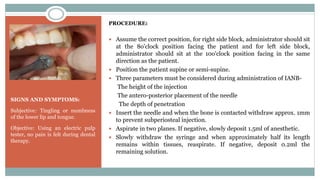
SIGNS AND SYMPTOMS:
Subjective: Tingling or numbness
of the lower lip and tongue.
Objective: Using an electric pulp
tester, no pain is felt during dental
therapy.
PROCEDURE:
 Assume the correct position, for right side block, administrator should sit
at the 8o'clock position facing the patient and for left side block,
administrator should sit at the 10o'clock position facing in the same
direction as the patient.
 Position the patient supine or semi-supine.
 Three parameters must be considered during administration of IANB-
The height of the injection
The antero-posterior placement of the needle
The depth of penetration
 Insert the needle and when the bone is contacted withdraw approx. 1mm
to prevent subperiosteal injection.
 Aspirate in two planes. If negative, slowly deposit 1.5ml of anesthetic.
 Slowly withdraw the syringe and when approximately half its length
remains within tissues, reaspirate. If negative, deposit 0.2ml the
remaining solution.
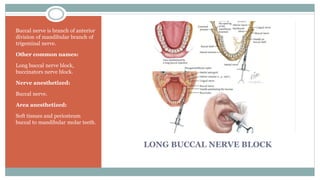
LONG BUCCAL NERVE BLOCK
Buccal nerve is branch of anterior
division of mandibular branch of
trigeminal nerve.
Other common names:
Long buccal nerve block,
buccinators nerve block.
Nerve anesthetized:
Buccal nerve.
Area anesthetized:
Soft tissues and periosteum
buccal to mandibular molar teeth.
INDICATIONS:
When buccal soft tissue anesthesia
is necessary for dental procedures
in mandibular molar region.
CONTRAINDICATION:
Infection or acute inflammation in
the area of injection.
ADVANTAGES:
 High success rate
 Technically easy
DISADVANTAGES:
 Potential for pain if needle contacts.
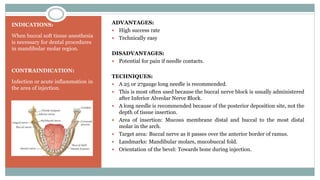
TECHNIQUES:
 A 25 or 27gauge long needle is recommended.
 This is most often used because the buccal nerve block is usually administered
after Inferior Alveolar Nerve Block.
 A long needle is recommended because of the posterior deposition site, not the
depth of tissue insertion.
 Area of insertion: Mucous membrane distal and buccal to the most distal
molar in the arch.
 Target area: Buccal nerve as it passes over the anterior border of ramus.
 Landmarks: Mandibular molars, mucobuccal fold.
 Orientation of the bevel: Towards bone during injection.
SIGNS AND SYMPTOMS:
Subjective: Because of the location
and small size of the anaesthetized
area, patient rarely experiences any
subjective symptoms.
Objective: Instrumentation in the
anaesthetized area without pain
indicative of pain control.
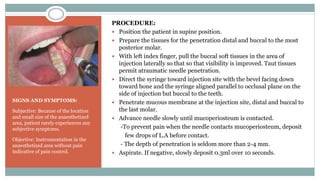
PROCEDURE:
 Position the patient in supine position.
 Prepare the tissues for the penetration distal and buccal to the most
posterior molar.
 With left index finger, pull the buccal soft tissues in the area of
injection laterally so that so that visibility is improved. Taut tissues
permit atraumatic needle penetration.
 Direct the syringe toward injection site with the bevel facing down
toward bone and the syringe aligned parallel to occlusal plane on the
side of injection but buccal to the teeth.
 Penetrate mucous membrane at the injection site, distal and buccal to
the last molar.
 Advance needle slowly until mucoperiosteum is contacted.
-To prevent pain when the needle contacts mucoperiosteum, deposit
few drops of L.A before contact.
- The depth of penetration is seldom more than 2-4 mm.
 Aspirate. If negative, slowly deposit 0.3ml over 10 seconds.
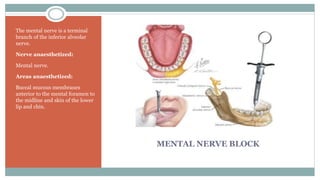
MENTAL NERVE BLOCK
The mental nerve is a terminal
branch of the inferior alveolar
nerve.
Nerve anaesthetized:
Mental nerve.
Areas anaesthetized:
Buccal mucous membranes
anterior to the mental foramen to
the midline and skin of the lower
lip and chin.
INDICATIONS:
When buccal soft tissue anesthesia
is necessary for procedures in the
mandible anterior to mental
foramen such as in case of:
Soft tissue biopsies.
Suturing of soft tissues.
CONTRAINDICATIONS:
Infection or acute inflammation in
the area of injection.
ADVANTAGES:
 High success rate.
 Technically easy.
 Usually entirely atraumatic.
DISADVANTAGES:
 Hematoma.
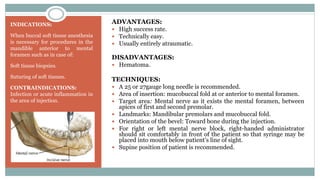
TECHNIQUES:
 A 25 or 27gauge long needle is recommended.
 Area of insertion: mucobuccal fold at or anterior to mental foramen.
 Target area: Mental nerve as it exists the mental foramen, between
apices of first and second premolar.
 Landmarks: Mandibular premolars and mucobuccal fold.
 Orientation of the bevel: Toward bone during the injection.
 For right or left mental nerve block, right-handed administrator
should sit comfortably in front of the patient so that syringe may be
placed into mouth below patient’s line of sight.
 Supine position of patient is recommended.
SIGNS AND SYMPTOMS:
Subjective: Tingling or numbness
of lower lip.
Objective: No pain during
treatment.
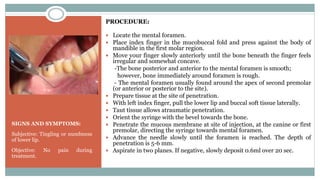
PROCEDURE:
 Locate the mental foramen.
 Place index finger in the mucobuccal fold and press against the body of
mandible in the first molar region.
 Move your finger slowly anteriorly until the bone beneath the finger feels
irregular and somewhat concave.
-The bone posterior and anterior to the mental foramen is smooth;
however, bone immediately around foramen is rough.
- The mental foramen usually found around the apex of second premolar
(or anterior or posterior to the site).
 Prepare tissue at the site of penetration.
 With left index finger, pull the lower lip and buccal soft tissue laterally.
 Taut tissue allows atraumatic penetration.
 Orient the syringe with the bevel towards the bone.
 Penetrate the mucous membrane at site of injection, at the canine or first
premolar, directing the syringe towards mental foramen.
 Advance the needle slowly until the foramen is reached. The depth of
penetration is 5-6 mm.
 Aspirate in two planes. If negative, slowly deposit 0.6ml over 20 sec.
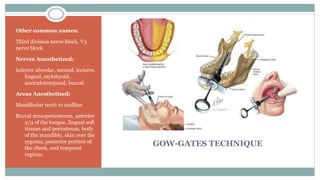
GOW-GATES TECHNIQUE
Other common names:
Third division nerve block, V3
nerve block
Nerves Anesthetized:
Inferior alveolar, mental, incisive,
lingual, mylohyoid,
auriculotemporal, buccal.
Areas Anesthetized:
Mandibular teeth to midline
Buccal mucoperiosteum, anterior
2/3 of the tongue, lingual soft
tissues and periosteum, body
of the mandible, skin over the
zygoma, posterior portion of
the cheek, and temporal
regions.
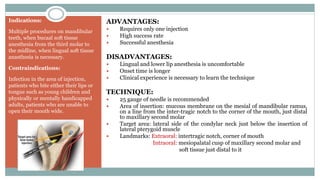
Indications:
Multiple procedures on mandibular
teeth, when bucaal soft tissue
anesthesia from the third molar to
the midline, when lingual soft tissue
anasthesia is necessary.
Contraindications:
Infection in the area of injection,
patients who bite either their lips or
tongue such as young children and
physically or mentally handicapped
adults, patients who are unable to
open their mouth wide.
ADVANTAGES:
 Requires only one injection
 High success rate
 Successful anesthesia
DISADVANTAGES:
 Lingual and lower lip anesthesia is uncomfortable
 Onset time is longer
 Clinical experience is necessary to learn the technique
TECHNIQUE:
 25 gauge of needle is recommended
 Area of insertion: mucous membrane on the mesial of mandibular ramus,
on a line from the inter-tragic notch to the corner of the mouth, just distal
to maxillary second molar
 Target area: lateral side of the condylar neck just below the insertion of
lateral pterygoid muscle
 Landmarks: Extraoral: intertragic notch, corner of mouth
Intraoral: mesiopalatal cusp of maxillary second molar and
soft tissue just distal to it
Signs and Symptoms:
Subjective: Tingling or
numbness of lower lip and
tongue
Objective: No pain is felt during
dental treatment
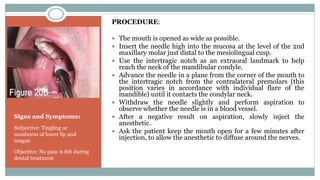
PROCEDURE:
 The mouth is opened as wide as possible.
 Insert the needle high into the mucosa at the level of the 2nd
maxillary molar just distal to the mesiolingual cusp.
 Use the intertragic notch as an extraoral landmark to help
reach the neck of the mandibular condyle.
 Advance the needle in a plane from the corner of the mouth to
the intertragic notch from the contralateral premolars (this
position varies in accordance with individual flare of the
mandible) until it contacts the condylar neck.
 Withdraw the needle slightly and perform aspiration to
observe whether the needle is in a blood vessel.
 After a negative result on aspiration, slowly inject the
anesthetic.
 Ask the patient keep the mouth open for a few minutes after
injection, to allow the anesthetic to diffuse around the nerves.
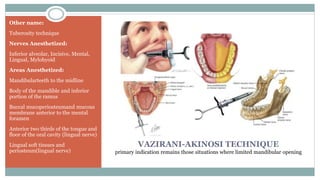
VAZIRANI-AKINOSI TECHNIQUE
primary indication remains those situations where limited mandibular opening
Other name:
Tuberosity technique
Nerves Anesthetized:
Inferior alveolar, Incisive, Mental,
Lingual, Mylohyoid
Areas Anesthetized:
Mandibularteeth to the midline
Body of the mandible and inferior
portion of the ramus
Buccal mucoperiosteumand mucous
membrane anterior to the mental
foramen
Anterior two thirds of the tongue and
floor of the oral cavity (lingual nerve)
Lingual soft tissues and
periosteum(lingual nerve)
Indications:
Limited mandibular opening
Inability to visualize landmarks for
IANB (e.g., because of large tongue)
Contraindications:
Patients who might bite their lip or
their tongue, such as young children
and physically or mentally
handicapped adults
Inability to visualize or gain access
to the lingual aspect of the ramus
ADVANTAGES:
 Relatively atraumatic
 Patient need not be able to open the mouth.
 Provides successful anesthesia where a bifid inferior alveolar nerve
and bifid mandibular canals are present
DISADVANTAGES:
 Difficult to visualize the path of the needle and the depth of insertion
 No bony contact; depth of penetration somewhat arbitrary
 Potentially traumatic if the needle is too close to the periosteum
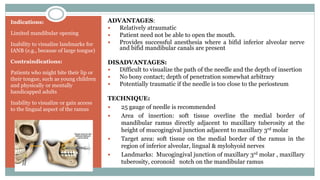
TECHNIQUE:
 25 gauge of needle is recommended
 Area of insertion: soft tissue overline the medial border of
mandibular ramus directly adjacent to maxillary tuberosity at the
height of mucogingival junction adjacent to maxillary 3rd molar
 Target area: soft tissue on the medial border of the ramus in the
region of inferior alveolar, lingual & mylohyoid nerves
 Landmarks: Mucogingival junction of maxillary 3rd molar , maxillary
tuberosity, coronoid notch on the mandibular ramus
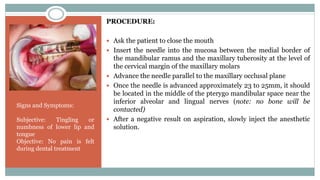
PROCEDURE:
 Ask the patient to close the mouth
 Insert the needle into the mucosa between the medial border of
the mandibular ramus and the maxillary tuberosity at the level of
the cervical margin of the maxillary molars
 Advance the needle parallel to the maxillary occlusal plane
 Once the needle is advanced approximately 23 to 25mm, it should
be located in the middle of the pterygo mandibular space near the
inferior alveolar and lingual nerves (note: no bone will be
contacted)
 After a negative result on aspiration, slowly inject the anesthetic
solution.
Signs and Symptoms:
Subjective: Tingling or
numbness of lower lip and
tongue
Objective: No pain is felt
during dental treatment
COMPLICATIONS
LOCAL
 Needle breakage
 Persistent anesthesia
 Trismus
 Soft-tissue injury
 Hematoma
 Pain on injection
 Burning on injection
 Infection
 Facial nerve paralysis
SYSTEMIC
 Overdose
 Allergy
 Syncope
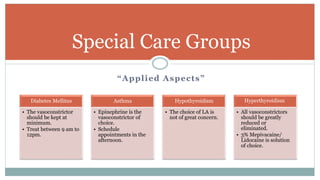
“Applied Aspects”
Special Care Groups
Diabetes Mellitus
• The vasoconstrictor
should be kept at
minimum.
• Treat between 9 am to
12pm.
Asthma
• Epinephrine is the
vasoconstrictor of
choice.
• Schedule
appointments in the
afternoon.
Hypothyroidism
• The choice of LA is
not of great concern.
• All vasoconstrictors
should be greatly
reduced or
eliminated.
• 3% Mepivacaine/
Lidocaine is solution
of choice.
Hyperthyroidism
Which type of LA should be given in inflammation?
 Mepivacaine is suitable for infected areas which have acidic medium, because it has less
pKa(7.6).
What if the patient is allergic to both groups?
 Antihistamines like diphenhydramine can be given for Local anesthetic action.
What happens in case of alcoholics & smokers?
 In case of acute alcoholics there is vasodilatation present at the site so rapid absorption
of LA into circulation resulting in decreased depth and decreased duration of
anesthesia.
 In cases of chronic alcoholics the pain threshold is raised also resulting in decreased
depth of anesthesia & need for larger doses which may lead to increased chances of
overdose reactions.
 In smokers , there is peripheral vasoconstriction present= increased duration of action
and increased intensity of LA.
Centbucridine Ropivacaine
 Quinoline derivative
 Five to eight times the potency of
lidocaine
 Rapid onset and an equivalent
duration of action
 Does not affect the central nervous
system or cardiovascular system
 Long acting amide anesthetic
 Structurally similar to mepivacaine
and bupivacaine.
 Unique in that it is prepared as an
isomer rather than as a racemic
mixture.
 Has demonstrated decreased
cardiotoxicity.
 Potential for use in dentistry appears
great, but awaits clinical evaluation.
FUTURE TRENDS
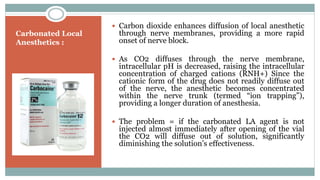
Carbonated Local
Anesthetics :
 Carbon dioxide enhances diffusion of local anesthetic
through nerve membranes, providing a more rapid
onset of nerve block.
 As CO2 diffuses through the nerve membrane,
intracellular pH is decreased, raising the intracellular
concentration of charged cations (RNH+) Since the
cationic form of the drug does not readily diffuse out
of the nerve, the anesthetic becomes concentrated
within the nerve trunk (termed “ion trapping”),
providing a longer duration of anesthesia.
 The problem = if the carbonated LA agent is not
injected almost immediately after opening of the vial
the CO2 will diffuse out of solution, significantly
diminishing the solution’s effectiveness.
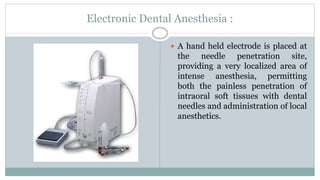
Electronic Dental Anesthesia :
 A hand held electrode is placed at
the needle penetration site,
providing a very localized area of
intense anesthesia, permitting
both the painless penetration of
intraoral soft tissues with dental
needles and administration of local
anesthetics.
CONCLUSION
Painful experiences and poor/prominent surgical scars are the two most important
aspects of surgical procedure for a patient. If one can provide a nearly painless
surgical procedure without the use of general anesthesia then we have won half
the battle.
POINTS TO REMEMBER!!!
No drug ever exerts a single action.
No clinically useful drug is entirely devoid of toxicity.
The potential toxicity of a drug rests in the hands of the user.
References
1. Handbook of Local Anesthesia ; Stanley F. Malamed.
2. Monheim’s Handbook of Local Anesthesia.
3. History of Periodontology ; Fermin carranza, Vincenzo Guerini
4. History of the development & evolution of local anesthesia since the coca leaf; Calatayud, Jesus, Journal
of Anesthesiology, June 2003:98-6: 1503-1508
Thank You

local anesthesia: Uses, Types, Side effects and Safety

  • 1.
    G U ID E D B Y : D R . R A J A S H R I K O L T E P R E S E N T E D B Y : D R . P R A C H I R A T H I LOCAL ANESTHESIA
  • 2.
    CONTENTS  Introduction  Historicalbackground  Classification  Composition of LA  Vasoconstrictors  Mechanism of action  Absorption and Distribution  Metabolism and Excretion  Local anesthetic solutions  Techniques of inducing LA  Complications  Special care groups  Future trends  Conclusion
  • 3.
    Loss of sensationin a circumscribed area of the body caused by depression of excitation in nerve endings or an inhibition of conduction process in peripherl nerves. Introduction “loss of sensation without inducing loss of consciousness”
  • 4.
    Desirable properties ofLocal Anesthetics  Irritating to the tissue to which it is applied.  Permanent alterations of nerve structure.  Systemic toxicity.  Allergic reaction.  Short duration of action.  Effective whether injected or applied topically.  Short onset of anesthesia.  Sufficient potency.  Sterile or capable of being sterilized.  Stable in solution.  Undergo biotransformation.
  • 5.
    HISTORICAL BACKGROUND COCAINE wasfirst local anesthetic agent, isolated by NIEMAN in 1860 from the leaves of coca tree. Its anesthetic action was demonstrated by KARL KOLLER in 1884. First effective and widely used synthetic local anesthetic was PROCAINE, produced by EINHORN in 1905 from benzoic acid and diethyl amino ethanol. Its anesthetic properties were identified by BIBERFIELD and agent was introduced into clinical practice by BRAUN. LIDOCAINE was discovered by LOFGREN in 1948. The discovery of its anesthetic properties was followed in 1949 by its clinical use by T. GORDH.
  • 6.
  • 7.
    Based on pharmacologyof drugs: ESTERS AMIDES QUINOLINE Esters of benzoic acid Esters of para- aminobenzoic acid Butacaine Chloroprocaine Bupivacaine Centbucridine Cocaine Procaine Dibucaine Ethyl aminobenzoate Propoxycaine Eitocaine Piperocaine Articaine Tetracaine Mepivacaine Prilocaine Ropivacaine
  • 8.
    Injectable Surface anesthetic Low potency & duration - procaine  Intermediate potency -lignocaine -prilocaine  High potency & long duration -tetracaine -bupivacaine -ropivacaine -dibucaine  Soluble -cocaine -lignocaine -tetracaine -benoxinate  Insoluble -benzocaine Based on route of administration:
  • 9.
    According to biologicsite and mode of action: Classification Definition Chemical substance Class A Agents acting at receptor site on external surface of nerve member. Biotoxins Eg. Tetrodotoxin saxitoxin Class B Agents acting at receptor site on internal surface of nerve member. Tertiary ammonium analogs of lidocaine, scorpion venom. Class C Agents acting by a receptor independent physio-chemical mechanism. Benzocaine. Class D Agents acting by combination of receptor and receptor independent mechanism. Most clinically useful LA agents (Articaine, lidocaine, Mepivacaine)
  • 10.
    According to durationof action of local anaesthetic: Short duration Intermediate duration Long duration Lidocaine HCl 2% Articaine HCl 4%+epinephrine 1:100000 Bupivacaine HCl 0.5%+ epinephrine 1:200000 Mepivacaine HCl 3% Articaine HCL4%+ epinephrine 1:200000 Prilocaine HCl 4% Lidocaine HCl 2% + epinephrine 1:50000 Lidocaine HCl 2% + epinephrine 1:100000 Mepivacaine HCL 2% + livonodefine 1:20000 Mepivacaine HCl 2% + epinephrine 1:100000
  • 11.
    COMPONENTS FUNCTION Lidocaine HCl(2% or 20mg/ml) Adrenaline/ epinephrine (1:80,000 or 0.012mg) Sodium metabisulphite (0.5mg) Methyl paraben (0.1% or 1mg) Sodium chloride (6mg) Distilled water Thymol  Local anesthetic agent  Vasoconstrictor  Antioxidant  Bacteriostatic agent  Isotonic solution  Diluting agent  Fungicide COMPOSITION OF LOCAL ANESTHETIC
  • 12.
    VASOCONSTRICTORS Decrease blood flow Loweranesthetic blood levels Decrease the risk of toxicity Increases duration of action Decrease bleeding VASOCONSTRICTORS CLASSIFICATION CATECHOLAMINES NON CATECHOLAMINES – Epinephrine – Amphetamine – Norepinephrine – Methamphetamine – Dopamine – Hydroxy-amphetamine – Levonordefrin – Ephedrine – Isoproterenol – Mephetermine
  • 13.
    EPINEPHRINE NOREPINEPHRINE Maximum Dosefor Dental Appointment  Normal healthy patient: 0.2 mg per appointment  Significant cardiovascular impairment: 0.04 mg per appointment Maximum Dose for Dental Appointment  Normal healthy patient: 0.34 mg per appointment or 10 ml of 1:30000 solution  Significant cardiovascular impairment: 0.14 mg per appointment or 4 ml of 1:30000 solution Two most common Vasoconstrictors used in Dentistry
  • 14.
    THEORIES OF L.AACTION The acetylcholine theory • According to this theory acetylcholine was involved in nerve conduction. Calcium displacement theory • It stated that local anesthetic nerve block was produced by the displacement of calcium from membrane site that controlled permeability to sodium. Surface charge theory Membrane expansion theory Specific receptor theory •It stated that local anesthesia act by binding to nerve membrane and changing the electrical potential at membrane surface. •It stated that local anesthetic molecules diffuse to hydrophobic regions of membrane, producing a general disturbance of the bulk membrane structure expanding some critical region in membrane and preventing an increase in permeability to sodium ion. •It proposes that local anesthetics act by binding to specific receptor on sodium channel.
  • 15.
    MECHANISM OF ACTIONOF LA Displacement of calcium ions from the sodium channel receptor site. Binding of local anesthetic molecule to this receptor site Blockage of the sodium channel. Decrease in sodium conductance. Depression of the rate of electrical depolarization. Failure to achieve the threshold potential level. Lack of development of propagated action potentials. Conduction blockage.
  • 16.
    ABSORPTION AND DISTRIBUTION Some of the drug will be absorbed into the systemic circulation, amount will depend on the vascularity of the area to which the drug has been applied.  The distribution of the drug is influenced by the degree of tissue and plasma protein binding of the drug. More protein bound the agent, the longer the duration of action as free drug is more slowly made available for metabolism.
  • 17.
    METABOLISM AND EXCRETION Esters (except cocaine) are broken down rapidly by plasma esterases to inactive compounds and consequently have a short half life. Cocaine is hydrolysed in the liver. Ester metabolite excretion is renal.  Amides are metabolised hepatically by amidases. This is a slower process, hence their half-life is longer and they can accumulate if given in repeated doses or by infusion.
  • 18.
    Procaine Lidocaine  Vasodilation-clean surgical field difficult to maintain because of increased bleeding.  Procaine is used in cases of inadvertent intra-arterial(IA) injection of a drug; vasodilating properties are used to aid in breaking arteriospasm.  Compared with procaine, lidocaine possesses a significantly more rapid onset of action, produces more profound anesthesia, has a longer duration of action, and has a greater potency. LOCAL ANESTHETIC SOLUTIONS
  • 19.
    Mepivacaine Articaine  Providelonger duration of anesthesia than most other local anesthetics when the drug is administered without a vasoconstrictor.  Mepivacaine plain is the most used local anesthetic in pediatric patients & is often quite appropriate in the management of geriatric patients.  Clinically, it is claimed that maxillary buccal infiltration of Articaine, provides palatal soft tissue anesthesia, obliterating the need for the more traumatic palatal anesthesia.  Also claimed that it can provide pulpal and lingual anesthesia when administered by infiltration in adult mandible.
  • 20.
    Bupivacaine & EtidocaineTopical Anesthetics  Lengthy dental procedures for which pulpal anesthesia in excess of 90 minutes is necessary.  Difference between the two is that Etidocaine has an onset of action of about 3 minutes, whereas Bupivacaine has an onset of 6 to 10 minutes.  It diffuse through the mucous membranes and injured skin to reach the free nerve endings. But the diffusion is limited and they are rapidly absorbed in the circulation, thus effective block is not obtained.  Thus, to increase their efficacy, their concentration is increased.  5% or 10% lidocaine,1% or 2% tetracaine-most common.
  • 21.
  • 22.
    TYPES OF BLOCK Localinfiltration Small terminal nerve endings in the area of the dental treatment. Field block Larger terminal nerve branches are anesthetized. Nerve block LA is deposited close to a main nerve trunk. TYPES OF NERVE BLOCK
  • 23.
    TECHNIQUES OF INJECTINGLOCAL ANESTHESIA  Supraperiosteal [infiltration], recommended for limited treatment protocols.  Periodontal ligament [ PDL, intraligamentary] injection, recommended as adjunct to other techniques.  Intraseptal injection, recommended primarily for periodontal surgical techniques.  Intracrestal injection, recommended for single teeth [primarily mandibular molars].  Intraosseous injection, recommended for single teeth [primarily mandibular molars].
  • 24.
    Maxillary Nerve Block Posterior superioralveolar [PSA] nerve block Middle superior alveolar [MSA] nerve block Anterior superior alveolar [ASA, infraorbital] nerve block Greater palatine nerve block Nasopalatine nerve block
  • 25.
    POSTERIOR SUPERIOR ALVEOLARNERVE BLOCK Other common name: Tuberosity block, zygomatic block Nerves anesthetized: Posterior superior alveolar and branches. Areas anesthetized: Pulps of maxillary 3rd 2nd,and 1st molar Buccal periodontium and bone overlying these teeth.
  • 26.
    Advantages:  Atraumatic ,high success rate.  Minimizes the total volume of LA solution administered. Disadvantages:  Risk of hematoma.  Technique somewhat arbitrary  Second injection necessary for treatment of 1st molar. TECHNIQUE:  Area of insertion: Height of mucobuccal fold above maxillary second molar.  Target area: PSA nerve, posterior, superior and medial to posterior border of maxilla.  Landmarks: Mucobuccal fold, Maxillary tuberosity, Zygomatic process of maxilla.  Orientation of needle: 25gauge short needle bevel oriented towards bone during injection. Indications : When treatment involves two or more maxillary molars When Supraperiosteal injection is contraindicated or proved ineffective. Contraindication: When the risk of hemorrhage is too great (as with hemophilic).
  • 27.
    SIGNS AND SYMPTOMS: 1.Subjective: usually none. 2. Objective: absence of pain during dental treatment. PROCEDURE:  For left PSA nerve block – a right handed administrator should sit at 10’o clock position.  For right PSA nerve block – a right handed administrator should sit at 8’o clock position.  Advance needle slowly in these direction: Upward- superiorly at 45degree angle to occlusal plane, Medially- towards midline at 45degree angle to occlusal plane, Posteriorly- at 45degree angle to long axis of 2nd molar.  Slowly advance the needle through soft tissue upto desired depth i.e. when long needle (32 mm) is used, it is inserted half of its length (16 mm) and when short needle (20mm) is used, approximately 4 mm should be visible.  Aspirate in two planes i.e. rotate the barrel one fourth turn and if negative aspiration is obtained, slowly deposit 0.9 to 1.8ml of solution, over 30-60 seconds.
  • 28.
    MIDDLE SUPERIOR ALVEOLARNERVE BLOCK Nerves anesthetized: Middle superior alveolar and terminal branches. Areas anesthetized: Pulps of maxillary 1st and 2nd premolar, mesiobuccal root of first molar. Buccal periodontal tissue and bone over these same teeth.
  • 29.
    INDICATIONS: When infraorbital nerveblock fails to provide pulpal anesthesia distal to maxillary canine. Dental procedures involving both maxillary premolars only. CONTRAINDICATIONS: Infections or inflammations in the area of injection or needle insertion or drug deposition. ADVANTAGES:  Minimize the number of injection and volume of solution. DISADVANTAGES:  None TECHNIQUE:  Area of insertion: height of mucobuccal fold above maxillary second premolar.  Target area: maxillary area above apex of maxillary second premolar.  Landmarks: mucobuccal fold above maxillary premolar.  Orientation of needle: towards the bone.  A 25 gauge short or long needle is recommended. However, a 27gauge short needle is more likely to be available and is perfectly acceptable.
  • 30.
    PROCEDURE:  Assume correctposition For right MSA nerve block- a right handed administrator should sit at 10’o clock position. For left MSA nerve block- a right handed administrator should sit at 8’o or 9’o clock position.  Stretch the patients upper lip to make tissue taut and gain visibility and slowly penetrate needle and advance until its tip is located above apex of 2nd premolar.  If aspiration is negative, slowly deposit 0.9-1.2ml of solution for 30- 40seconds.  Withdraw the syringe and wait 3-5minutes before commencing dental procedure. SIGNS AND SYMPTOMS: Subjective: numbness of upper lip Objective: no pain during therapy.
  • 31.
    ANTERIOR SUPERIOR ALVEOLARNERVE BLOCK Other common names: Infraorbital nerve block Nerves anesthetized: Anterior superior alveolar nerve, Middle superior alveolar nerve, Infraorbital Area anesthetized: Pulps of maxillary central incisors through the canine on injected side. Pulps of maxillary premolars and mesiobuccal root of 1stmolar Buccal (labial) periodontium and bone of these same teeth. Lower eyelid, lateral aspect of nose, upper lip.
  • 32.
    INDICATIONS: Dental procedures involvingmore than 2 maxillary teeth & their overlying buccal tissues. Infections or inflammation Supraperiosteal injection have been ineffective because of dense cortical bone. CONTRAINDICATIONS: Hemostasis of localized areas ADVANTAGES:  Comparatively simple procedure.  Comparatively safe, minimized volume of solutions used. DISADVANTAGES:  Anatomical- difficulty in defining landmarks.  Administrator-Initial fear of injury to patient’s eye. TECHNIQUE:  Area of insertion: Height of mucobuccal fold directly over 1st premolar  Target area: Infraorbital foramen (below infraorbital notch)  Landmarks: 1.Mucobuccal fold 2. Infraorbital notch 3. Infraorbital foramen. 4. Orientation of needle –towards bone
  • 33.
    SIGNS AND SYMPTOMS: Subjective:Tingling and numbness of lower eyelid, side of nose and upper lip indicate anesthesia of infraorbital nerve. Objective: no pain during dental therapy. PROCEDURE:  Assume correct position- for right or left infraorbital block, a right handed administrator should sit at 10 o clock position.  Locate the infraorbital foramen and mark the skin. Retract the lip and insert the needle at the height of mucobuccal fold over the 1st premolar with bevel facing towards the bone. Needle should be held parallel to the long axis of the tooth. Advance needle slowly and attain depth of 16 mm for an adult of average height.  Before injecting the anesthetic solution check the following: Depth of needle penetration Any lateral deviation of the needle from the infraorbital foramen. Orientation of the bevel.  Aspirate and slowly deposit 0.9 to 1.2 ml,over 30 to 40 seconds. The administrator is able ‘to feel’ the anesthetic solution as it is deposited the finger on foramen if needle is in correct position.  Withdraw needle slowly and make the needle safe.  Maintain direct finger pressure over injection site for minimum of one minute and wait for 3 to 5 minutes before commencing dental procedures.
  • 34.
    GREATER PALATINE NERVEBLOCK Other common names: Anterior palatine nerve block. Nerves anesthetized: Greater palatine nerve. Areas anesthetized: Posterior portion of hard palate and its overlying soft tissues, anteriorly as far as the first premolar and medially to the midline.
  • 35.
    INDICATIONS: When palatal softtissue anesthesia is necessary for restorative therapy. For pain control involving the palatal soft and hard tissues. CONTRAINDICATIONS: Inflammation or infection at the injection site. Smaller areas of therapy. ADVANTAGES:  Minimizes needle penetrations and volume of solution.  Minimizes patient discomfort. DISADVANTAGES:  No hemostasis except in the immediate area of injection.  Potentially traumatic. TECHNIQUE:  A 27gauge short needle is recommended.  Area of insertion: Soft tissue slightly anterior to the greater palatine foramen.  Target area: Greater palatine foramen.  Landmarks: Greater palatine foramen and the junction of the maxillary alveolar process and palatine bone.  Path of insertion: Advance the syringe from the opposite side of the mouth at the right angle to the target area.
  • 36.
    SIGNS AND SYMPTOMS: Subjective:Numbness in the posterior portion of palate. Objective: No pain during dental therapy. PROCEDURE:  Assume the correct position. (For the right greater palatine nerve block 7o'clock or 8o'clock position).  Ask the patient to open wide and extend the neck.  Locate the greater palatine foramen.  Prepare the tissue at the injection site.  Direct the syringe into the mouth from the opposite side.  Place the bevel of needle gently against the previously blanched soft tissue.  Deposit a small amount of anesthetic.  Straighten the needle and permit the bevel to penetrate mucosa.  Continue to deposit small volumes of anesthetics throughout the procedure.  Slowly advance the needle until the palatine bone is gently contacted.  Aspirate in two planes, if negative, slowly deposit 0.45-0.6ml.  Withdraw the syringe and make the needle safe.  Wait 2 to 3 minutes before commencing the procedure.
  • 37.
    NASOPALATINE NERVE BLOCK Othercommon names: Incisive nerve block, Sphenopalatine nerve block. Nerves anesthetized: Nasopalatine nerves bilaterally. Areas anesthetized: Anterior portion of the hard palate bilaterally from the mesial of left first premolar to the mesial of the right first premolar.
  • 38.
    INDICATIONS: When palatal softtissue anesthesia is necessary for restorative therapy on more than two teeth. For pain control during periodontal or oral surgical procedures involving palatal soft and hard tissues. CONTARINDICATIONS: Inflammation or infection at the injection site. ADVANTAGES:  Minimizes needle penetration and volume of solution.  Minimal patient discomfort from multiple needle penetration. DISADVANTAGES:  No hemostasis except in the immediate area of injection.  Potentially most traumatic intraoral injection. TECHNIQUE (Single needle penetration): • A 27gauge short needle is recommended. • Area of insertion: palatal mucosa just lateral to the incisive papilla. • Target area: incisive foramen. • Landmarks: central incisors and incisive papilla. • Path of insertion: approach the injection site at a 45-degree angle toward to incisive papilla. • Orientation of bevel: Toward the palatal soft tissue.
  • 39.
    SIGNS AND SYMPTOMS: Subjective:Numbness in the anterior portion of palate. Objective: No pain during dental therapy. PROCEDURE:  Sit at 9 o'clock or 10 o'clock position facing in the same direction as the patient.  Request the patient to open wide and extend the neck.  Prepare the tissue just lateral to incisive papilla.  Apply local anesthetics for 2 minutes.  Place the bevel against the ischemic soft tissues at the injection site.  Deposit a small volume of anesthetic.  Straighten the needle and permit the bevel to penetrate the mucosa.  Continue to apply pressure while injecting the anesthetics.  Slowly advance the needle towards the needle to the incisive foramen until the bone is gently contacted.  Withdraw the needle 1mm.  Aspirate in two planes.  If negative slowly deposit 0.45ml.  Slowly withdraw the syringe and make the needle safe.  Wait 2 to 3 minutes before commencing the dental procedure.
  • 40.
    Mandibular Nerve Block Inferior alveolarnerve block Buccal nerve block Mental nerve block The Gow-Gates technique Vazirani-Akinosi closed mouth technique
  • 41.
    INFERIOR ALVEOLAR NERVEBLOCK Other common names: Mandibular block. Nerves anesthetized: Inferior alveolar nerve, Incisive, Mental, Lingual Areas anesthetized: Mandibular teeth to the midline. Body of the mandible. Buccal mucoperiosteum. Anterior two-thirds of the tongue and floor of the oral cavity. Lingual soft tissues and periosteum.
  • 42.
    INDICATIONS: Procedures on multiplemandibular teeth in one quadrant. When buccal soft tissue anesthesia is necessary. When lingual soft tissue anesthesia is necessary. CONTRAINDICATIONS: Infection or acute inflammation in the area of injection. Patients who are more likely to bite their lip or tongue. ADVANTAGES:  One injection provides a wide area of anesthesia. DISADVANTAGES:  Wide area of anesthesia.  Rate of inadequate anesthesia.  Intraoral landmarks not consistently reliable.  Positive aspiration.  Lingual and lower lip anesthesia discomforting too many patients. TECHNIQUE:  A long dental needle is recommended.  Area of insertion: Mucous membrane on the mesial side of mandibular ramus.  Target area: Inferior alveolar nerve.  Landmarks: Coronoid notch, Pterygomandibular raphe, Occlusal plane of the mandibular posterior teeth.
  • 43.
    SIGNS AND SYMPTOMS: Subjective:Tingling or numbness of the lower lip and tongue. Objective: Using an electric pulp tester, no pain is felt during dental therapy. PROCEDURE:  Assume the correct position, for right side block, administrator should sit at the 8o'clock position facing the patient and for left side block, administrator should sit at the 10o'clock position facing in the same direction as the patient.  Position the patient supine or semi-supine.  Three parameters must be considered during administration of IANB- The height of the injection The antero-posterior placement of the needle The depth of penetration  Insert the needle and when the bone is contacted withdraw approx. 1mm to prevent subperiosteal injection.  Aspirate in two planes. If negative, slowly deposit 1.5ml of anesthetic.  Slowly withdraw the syringe and when approximately half its length remains within tissues, reaspirate. If negative, deposit 0.2ml the remaining solution.
  • 44.
    LONG BUCCAL NERVEBLOCK Buccal nerve is branch of anterior division of mandibular branch of trigeminal nerve. Other common names: Long buccal nerve block, buccinators nerve block. Nerve anesthetized: Buccal nerve. Area anesthetized: Soft tissues and periosteum buccal to mandibular molar teeth.
  • 45.
    INDICATIONS: When buccal softtissue anesthesia is necessary for dental procedures in mandibular molar region. CONTRAINDICATION: Infection or acute inflammation in the area of injection. ADVANTAGES:  High success rate  Technically easy DISADVANTAGES:  Potential for pain if needle contacts. TECHNIQUES:  A 25 or 27gauge long needle is recommended.  This is most often used because the buccal nerve block is usually administered after Inferior Alveolar Nerve Block.  A long needle is recommended because of the posterior deposition site, not the depth of tissue insertion.  Area of insertion: Mucous membrane distal and buccal to the most distal molar in the arch.  Target area: Buccal nerve as it passes over the anterior border of ramus.  Landmarks: Mandibular molars, mucobuccal fold.  Orientation of the bevel: Towards bone during injection.
  • 46.
    SIGNS AND SYMPTOMS: Subjective:Because of the location and small size of the anaesthetized area, patient rarely experiences any subjective symptoms. Objective: Instrumentation in the anaesthetized area without pain indicative of pain control. PROCEDURE:  Position the patient in supine position.  Prepare the tissues for the penetration distal and buccal to the most posterior molar.  With left index finger, pull the buccal soft tissues in the area of injection laterally so that so that visibility is improved. Taut tissues permit atraumatic needle penetration.  Direct the syringe toward injection site with the bevel facing down toward bone and the syringe aligned parallel to occlusal plane on the side of injection but buccal to the teeth.  Penetrate mucous membrane at the injection site, distal and buccal to the last molar.  Advance needle slowly until mucoperiosteum is contacted. -To prevent pain when the needle contacts mucoperiosteum, deposit few drops of L.A before contact. - The depth of penetration is seldom more than 2-4 mm.  Aspirate. If negative, slowly deposit 0.3ml over 10 seconds.
  • 47.
    MENTAL NERVE BLOCK Themental nerve is a terminal branch of the inferior alveolar nerve. Nerve anaesthetized: Mental nerve. Areas anaesthetized: Buccal mucous membranes anterior to the mental foramen to the midline and skin of the lower lip and chin.
  • 48.
    INDICATIONS: When buccal softtissue anesthesia is necessary for procedures in the mandible anterior to mental foramen such as in case of: Soft tissue biopsies. Suturing of soft tissues. CONTRAINDICATIONS: Infection or acute inflammation in the area of injection. ADVANTAGES:  High success rate.  Technically easy.  Usually entirely atraumatic. DISADVANTAGES:  Hematoma. TECHNIQUES:  A 25 or 27gauge long needle is recommended.  Area of insertion: mucobuccal fold at or anterior to mental foramen.  Target area: Mental nerve as it exists the mental foramen, between apices of first and second premolar.  Landmarks: Mandibular premolars and mucobuccal fold.  Orientation of the bevel: Toward bone during the injection.  For right or left mental nerve block, right-handed administrator should sit comfortably in front of the patient so that syringe may be placed into mouth below patient’s line of sight.  Supine position of patient is recommended.
  • 49.
    SIGNS AND SYMPTOMS: Subjective:Tingling or numbness of lower lip. Objective: No pain during treatment. PROCEDURE:  Locate the mental foramen.  Place index finger in the mucobuccal fold and press against the body of mandible in the first molar region.  Move your finger slowly anteriorly until the bone beneath the finger feels irregular and somewhat concave. -The bone posterior and anterior to the mental foramen is smooth; however, bone immediately around foramen is rough. - The mental foramen usually found around the apex of second premolar (or anterior or posterior to the site).  Prepare tissue at the site of penetration.  With left index finger, pull the lower lip and buccal soft tissue laterally.  Taut tissue allows atraumatic penetration.  Orient the syringe with the bevel towards the bone.  Penetrate the mucous membrane at site of injection, at the canine or first premolar, directing the syringe towards mental foramen.  Advance the needle slowly until the foramen is reached. The depth of penetration is 5-6 mm.  Aspirate in two planes. If negative, slowly deposit 0.6ml over 20 sec.
  • 50.
    GOW-GATES TECHNIQUE Other commonnames: Third division nerve block, V3 nerve block Nerves Anesthetized: Inferior alveolar, mental, incisive, lingual, mylohyoid, auriculotemporal, buccal. Areas Anesthetized: Mandibular teeth to midline Buccal mucoperiosteum, anterior 2/3 of the tongue, lingual soft tissues and periosteum, body of the mandible, skin over the zygoma, posterior portion of the cheek, and temporal regions.
  • 51.
    Indications: Multiple procedures onmandibular teeth, when bucaal soft tissue anesthesia from the third molar to the midline, when lingual soft tissue anasthesia is necessary. Contraindications: Infection in the area of injection, patients who bite either their lips or tongue such as young children and physically or mentally handicapped adults, patients who are unable to open their mouth wide. ADVANTAGES:  Requires only one injection  High success rate  Successful anesthesia DISADVANTAGES:  Lingual and lower lip anesthesia is uncomfortable  Onset time is longer  Clinical experience is necessary to learn the technique TECHNIQUE:  25 gauge of needle is recommended  Area of insertion: mucous membrane on the mesial of mandibular ramus, on a line from the inter-tragic notch to the corner of the mouth, just distal to maxillary second molar  Target area: lateral side of the condylar neck just below the insertion of lateral pterygoid muscle  Landmarks: Extraoral: intertragic notch, corner of mouth Intraoral: mesiopalatal cusp of maxillary second molar and soft tissue just distal to it
  • 52.
    Signs and Symptoms: Subjective:Tingling or numbness of lower lip and tongue Objective: No pain is felt during dental treatment PROCEDURE:  The mouth is opened as wide as possible.  Insert the needle high into the mucosa at the level of the 2nd maxillary molar just distal to the mesiolingual cusp.  Use the intertragic notch as an extraoral landmark to help reach the neck of the mandibular condyle.  Advance the needle in a plane from the corner of the mouth to the intertragic notch from the contralateral premolars (this position varies in accordance with individual flare of the mandible) until it contacts the condylar neck.  Withdraw the needle slightly and perform aspiration to observe whether the needle is in a blood vessel.  After a negative result on aspiration, slowly inject the anesthetic.  Ask the patient keep the mouth open for a few minutes after injection, to allow the anesthetic to diffuse around the nerves.
  • 53.
    VAZIRANI-AKINOSI TECHNIQUE primary indicationremains those situations where limited mandibular opening Other name: Tuberosity technique Nerves Anesthetized: Inferior alveolar, Incisive, Mental, Lingual, Mylohyoid Areas Anesthetized: Mandibularteeth to the midline Body of the mandible and inferior portion of the ramus Buccal mucoperiosteumand mucous membrane anterior to the mental foramen Anterior two thirds of the tongue and floor of the oral cavity (lingual nerve) Lingual soft tissues and periosteum(lingual nerve)
  • 54.
    Indications: Limited mandibular opening Inabilityto visualize landmarks for IANB (e.g., because of large tongue) Contraindications: Patients who might bite their lip or their tongue, such as young children and physically or mentally handicapped adults Inability to visualize or gain access to the lingual aspect of the ramus ADVANTAGES:  Relatively atraumatic  Patient need not be able to open the mouth.  Provides successful anesthesia where a bifid inferior alveolar nerve and bifid mandibular canals are present DISADVANTAGES:  Difficult to visualize the path of the needle and the depth of insertion  No bony contact; depth of penetration somewhat arbitrary  Potentially traumatic if the needle is too close to the periosteum TECHNIQUE:  25 gauge of needle is recommended  Area of insertion: soft tissue overline the medial border of mandibular ramus directly adjacent to maxillary tuberosity at the height of mucogingival junction adjacent to maxillary 3rd molar  Target area: soft tissue on the medial border of the ramus in the region of inferior alveolar, lingual & mylohyoid nerves  Landmarks: Mucogingival junction of maxillary 3rd molar , maxillary tuberosity, coronoid notch on the mandibular ramus
  • 55.
    PROCEDURE:  Ask thepatient to close the mouth  Insert the needle into the mucosa between the medial border of the mandibular ramus and the maxillary tuberosity at the level of the cervical margin of the maxillary molars  Advance the needle parallel to the maxillary occlusal plane  Once the needle is advanced approximately 23 to 25mm, it should be located in the middle of the pterygo mandibular space near the inferior alveolar and lingual nerves (note: no bone will be contacted)  After a negative result on aspiration, slowly inject the anesthetic solution. Signs and Symptoms: Subjective: Tingling or numbness of lower lip and tongue Objective: No pain is felt during dental treatment
  • 56.
    COMPLICATIONS LOCAL  Needle breakage Persistent anesthesia  Trismus  Soft-tissue injury  Hematoma  Pain on injection  Burning on injection  Infection  Facial nerve paralysis SYSTEMIC  Overdose  Allergy  Syncope
  • 57.
    “Applied Aspects” Special CareGroups Diabetes Mellitus • The vasoconstrictor should be kept at minimum. • Treat between 9 am to 12pm. Asthma • Epinephrine is the vasoconstrictor of choice. • Schedule appointments in the afternoon. Hypothyroidism • The choice of LA is not of great concern. • All vasoconstrictors should be greatly reduced or eliminated. • 3% Mepivacaine/ Lidocaine is solution of choice. Hyperthyroidism
  • 58.
    Which type ofLA should be given in inflammation?  Mepivacaine is suitable for infected areas which have acidic medium, because it has less pKa(7.6). What if the patient is allergic to both groups?  Antihistamines like diphenhydramine can be given for Local anesthetic action. What happens in case of alcoholics & smokers?  In case of acute alcoholics there is vasodilatation present at the site so rapid absorption of LA into circulation resulting in decreased depth and decreased duration of anesthesia.  In cases of chronic alcoholics the pain threshold is raised also resulting in decreased depth of anesthesia & need for larger doses which may lead to increased chances of overdose reactions.  In smokers , there is peripheral vasoconstriction present= increased duration of action and increased intensity of LA.
  • 59.
    Centbucridine Ropivacaine  Quinolinederivative  Five to eight times the potency of lidocaine  Rapid onset and an equivalent duration of action  Does not affect the central nervous system or cardiovascular system  Long acting amide anesthetic  Structurally similar to mepivacaine and bupivacaine.  Unique in that it is prepared as an isomer rather than as a racemic mixture.  Has demonstrated decreased cardiotoxicity.  Potential for use in dentistry appears great, but awaits clinical evaluation. FUTURE TRENDS
  • 60.
    Carbonated Local Anesthetics : Carbon dioxide enhances diffusion of local anesthetic through nerve membranes, providing a more rapid onset of nerve block.  As CO2 diffuses through the nerve membrane, intracellular pH is decreased, raising the intracellular concentration of charged cations (RNH+) Since the cationic form of the drug does not readily diffuse out of the nerve, the anesthetic becomes concentrated within the nerve trunk (termed “ion trapping”), providing a longer duration of anesthesia.  The problem = if the carbonated LA agent is not injected almost immediately after opening of the vial the CO2 will diffuse out of solution, significantly diminishing the solution’s effectiveness.
  • 61.
    Electronic Dental Anesthesia:  A hand held electrode is placed at the needle penetration site, providing a very localized area of intense anesthesia, permitting both the painless penetration of intraoral soft tissues with dental needles and administration of local anesthetics.
  • 62.
    CONCLUSION Painful experiences andpoor/prominent surgical scars are the two most important aspects of surgical procedure for a patient. If one can provide a nearly painless surgical procedure without the use of general anesthesia then we have won half the battle. POINTS TO REMEMBER!!! No drug ever exerts a single action. No clinically useful drug is entirely devoid of toxicity. The potential toxicity of a drug rests in the hands of the user.
  • 63.
    References 1. Handbook ofLocal Anesthesia ; Stanley F. Malamed. 2. Monheim’s Handbook of Local Anesthesia. 3. History of Periodontology ; Fermin carranza, Vincenzo Guerini 4. History of the development & evolution of local anesthesia since the coca leaf; Calatayud, Jesus, Journal of Anesthesiology, June 2003:98-6: 1503-1508
  • 64.