BIL and Insulation Coordination
Bilal Alam
Department of Electrical Engineering
ZH collage of Engineering and Technology
AMU, Aligarh
Content
• Introduction
• Definitions
• Requirement of Insulations
• Determination of Line Insulation
• BIL & Insulation Level Selection of Various Equipment
• Selection of lighting arrestor
• Procedure for Insulation
• Data Required for Insulation Coordination Study
Introduction
• The selection of suitable values for the insulation levels of the various
components in any electrical system and their arrangement in a rational
manner is called insulation coordination.
• The insulation level of an apparatus is defined as that combination of
voltage values (both power frequency and impulse) which characterize it
insulation with regard to its capability of withstanding the dielectric stress
• In its simplest form, Insulation Coordination is 'The selection of insulation
strength’
Contd…
• The overall aim of insulation coordination is to reduce to an economically
and operationally acceptable level the cost and disturbance caused by
insulation failure. In insulation coordination method, the insulation of the
various parts of the system must be so graded that flash over if occurs it
must be at intended points.
Insulation Coordination- Defination
• The selection of the insulation strength of equipment in relation to the voltages,
which can appear on the system for which the equipment is intended and taking
into account the service environment and the characteristics of the available
protective devices
• Or
• Selection of the dielectric strength of equipment in relation to the operating
voltages and over-voltages which can appear on the system for which the
equipment is intended, taking into account the service environment and the
characteristics of thE available preventing and protective devices.
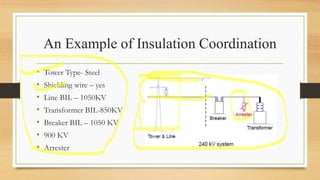
An Example of Insulation Coordination
• Tower Type- Steel
• Shielding wire – yes
• Line BIL – 1050KV
• Transformer BIL-850KV
• Breaker BIL – 1050 KV
• 900 KV
• Arrester
Requirement of Insulation
• Highest Power Frequency System Voltage
• The AC power network has different nominal
power frequency voltage level like 400V, 3.3KV,
6.6k, etc. When the system is lightly loaded the
power frequency voltage at the receiving end of
the line rises
• The equipment of the power system is designed
and tested to withstand under highest power
frequency system voltage (440 V, 3.6K, 7.2K,etc.)
without internal or external insulation failure
Contd…
• Transient Overvoltage Surge
• The transient over voltage surges in the
power system can be caused by lightning,
switching, restrikes travelling waves, etc. The
surge of the power system has the high peak,
high rate of rising and last for a few
tens/hundreds of microseconds and are
therefore called the transients.
BIL & insulation level selection of various
equipment's
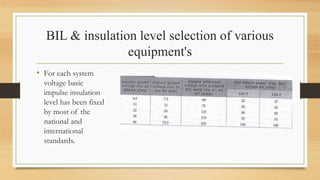
• For each system
voltage basic
impulse insulation
level has been fixed
by most of the
national and
international
standards.
Contd…
• The major substation equipment viz, transformers, breakeis. isolating switches,
current trans formers, potential transformers are manufactured for the same
insulation level, expect where transformers may be manufacturing for a lower
step of insulation level in consideration of the economy possible.
• Sometimes, where the lightning arresters are installed right on the terminals of
transformers, some of the substation equipment may fall outside the protective
zone determined from the Withstand level of the equipment. discharge voltage of
the lightning arresters and the distance between the equipment and the lightning
arrester, and
Selection of lighting Arrestors.
• For simplify, the process of making an arrester application may be reduced to seven
steps.
• To determine the magnitude of the power frequency phase to ground voltage
expected at the proposed arrester location during phase to ground fault, or other
abnormal conditions which cause higher voltages to ground than normal
• To make a tentative selection of the power frequency voltage rating of the arrester.
This selection may have to be reconsidered after step (6) ls completed.
Power System Over-Voltages
• The power frequency voltage which may appear across an arrester becomes greater than
maximum operating phase to ground voltage for one or more of the following reasons :
1. System Fault
2. Regulation
3. Over spaced
4. Switching Transients
5. Interaction of transformer magnetizing reactance and line capacitance
6. Use of salient pole machine without damper winding
Contd…
• For the purpose of selection of voltage rating of lightning arrester three
types of earthling are considered viz.
1. Effectively earthed
2. Non Effectively earthed and
3. Isolated natural I. Effectively earthed system
Data Required for Insulation Coordination
Study
• The data collected for a study is dependent on the purpose of the study , but the
following are example of required data.
1. Collect BIL, CFO data of all insulation
2. Collect Arrester characteristics and installed location if applicable
3. Obtain one line diagram of system with distances between all insulators and
arresters
4. Insulator counts and locations in particular if a switching study is the goal.
5. Ground resistances where possible.
Thank you

Bil and insulation coordination ppt

  • 1.
    BIL and InsulationCoordination Bilal Alam Department of Electrical Engineering ZH collage of Engineering and Technology AMU, Aligarh
  • 2.
    Content • Introduction • Definitions •Requirement of Insulations • Determination of Line Insulation • BIL & Insulation Level Selection of Various Equipment • Selection of lighting arrestor • Procedure for Insulation • Data Required for Insulation Coordination Study
  • 3.
    Introduction • The selectionof suitable values for the insulation levels of the various components in any electrical system and their arrangement in a rational manner is called insulation coordination. • The insulation level of an apparatus is defined as that combination of voltage values (both power frequency and impulse) which characterize it insulation with regard to its capability of withstanding the dielectric stress • In its simplest form, Insulation Coordination is 'The selection of insulation strength’
  • 4.
    Contd… • The overallaim of insulation coordination is to reduce to an economically and operationally acceptable level the cost and disturbance caused by insulation failure. In insulation coordination method, the insulation of the various parts of the system must be so graded that flash over if occurs it must be at intended points.
  • 5.
    Insulation Coordination- Defination •The selection of the insulation strength of equipment in relation to the voltages, which can appear on the system for which the equipment is intended and taking into account the service environment and the characteristics of the available protective devices • Or • Selection of the dielectric strength of equipment in relation to the operating voltages and over-voltages which can appear on the system for which the equipment is intended, taking into account the service environment and the characteristics of thE available preventing and protective devices.
  • 6.
    An Example ofInsulation Coordination • Tower Type- Steel • Shielding wire – yes • Line BIL – 1050KV • Transformer BIL-850KV • Breaker BIL – 1050 KV • 900 KV • Arrester
  • 7.
    Requirement of Insulation •Highest Power Frequency System Voltage • The AC power network has different nominal power frequency voltage level like 400V, 3.3KV, 6.6k, etc. When the system is lightly loaded the power frequency voltage at the receiving end of the line rises • The equipment of the power system is designed and tested to withstand under highest power frequency system voltage (440 V, 3.6K, 7.2K,etc.) without internal or external insulation failure
  • 8.
    Contd… • Transient OvervoltageSurge • The transient over voltage surges in the power system can be caused by lightning, switching, restrikes travelling waves, etc. The surge of the power system has the high peak, high rate of rising and last for a few tens/hundreds of microseconds and are therefore called the transients.
  • 9.
    BIL & insulationlevel selection of various equipment's • For each system voltage basic impulse insulation level has been fixed by most of the national and international standards.
  • 10.
    Contd… • The majorsubstation equipment viz, transformers, breakeis. isolating switches, current trans formers, potential transformers are manufactured for the same insulation level, expect where transformers may be manufacturing for a lower step of insulation level in consideration of the economy possible. • Sometimes, where the lightning arresters are installed right on the terminals of transformers, some of the substation equipment may fall outside the protective zone determined from the Withstand level of the equipment. discharge voltage of the lightning arresters and the distance between the equipment and the lightning arrester, and
  • 11.
    Selection of lightingArrestors. • For simplify, the process of making an arrester application may be reduced to seven steps. • To determine the magnitude of the power frequency phase to ground voltage expected at the proposed arrester location during phase to ground fault, or other abnormal conditions which cause higher voltages to ground than normal • To make a tentative selection of the power frequency voltage rating of the arrester. This selection may have to be reconsidered after step (6) ls completed.
  • 12.
    Power System Over-Voltages •The power frequency voltage which may appear across an arrester becomes greater than maximum operating phase to ground voltage for one or more of the following reasons : 1. System Fault 2. Regulation 3. Over spaced 4. Switching Transients 5. Interaction of transformer magnetizing reactance and line capacitance 6. Use of salient pole machine without damper winding
  • 13.
    Contd… • For thepurpose of selection of voltage rating of lightning arrester three types of earthling are considered viz. 1. Effectively earthed 2. Non Effectively earthed and 3. Isolated natural I. Effectively earthed system
  • 14.
    Data Required forInsulation Coordination Study • The data collected for a study is dependent on the purpose of the study , but the following are example of required data. 1. Collect BIL, CFO data of all insulation 2. Collect Arrester characteristics and installed location if applicable 3. Obtain one line diagram of system with distances between all insulators and arresters 4. Insulator counts and locations in particular if a switching study is the goal. 5. Ground resistances where possible.
  • 15.