Building Economy ARE 431
Dr. Mohammad A. Hassanain 1
Time Value of Money
Multiple Factors
2
Multiple Factors.
Example Illustrating the Use of Multiple Factors.
Calculations Involving Uniform-Series and Randomly
Distributed Amounts
Today’s Lecture
Building Economy ARE 431
Dr. Mohammad A. Hassanain 2
3
Multiple Factors
When a uniform series of payment (A) begins at a time other
than the end of year 1, several methods can be used to find
the present worth (P). For example, given:
We can use the following methods:
1. Use the single-payment present worth factor (P/F, i%, n) to
find the present worth of each disbursement at year Zero,
then add them.
A = $50
642
0
1 3 5 7 8 9 10 11 12 13P = ?
4
Multiple Factors
2. Use the single-payment compound-amount factor (F/P,
i%, n) to find the future worth of each disbursement in
year 13, add them, and then find the present worth of the
total using P = F(P/F, i%, 13).
3. Use the uniform-series compound-amount factor (F/A, i%,
n) to find the future amount by F = A(F/A, i%, 10) and
then find the present worth using P = F(P/F, i%, 13).
A = $50
642
0
1 3 5 7 8 9 10 11 12 13P = ?
Building Economy ARE 431
Dr. Mohammad A. Hassanain 3
5
Multiple Factors
4. Use the uniform-series present-worth factor (P/A, i%, n) to
compute the present worth at year 3 and then find the
present worth in year Zero by using the (P/F, i%, n) factor.
A = $50
642
0
1 3 5 7 8 9 10 11 12 13P = ?
6
Multiple Factors
Note:
It is very important to remember that the present worth is
always located One year prior to the first annual payment
when using the uniform-series present-worth factor (P/A,
i%, n).
On the other hand, the uniform-series compound-amount
factor (F/A, i%, n) was derived with the future worth “F”
located in the same year as the last payment.
It is always important to remember that the number of
years n that should be used with the P/A or F/A factors is
equal to the number of payments. It is generally helpful to
re-number the cash-flow diagram to avoid counting
errors.
Building Economy ARE 431
Dr. Mohammad A. Hassanain 4
7
Multiple Factors
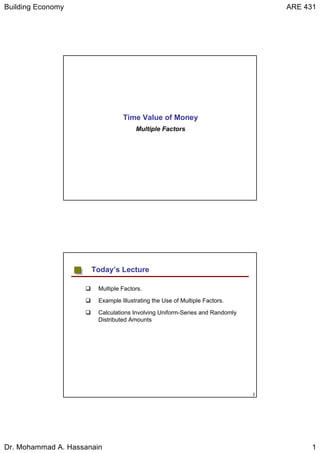
Example: A person buys a piece of property for $5,000 down-
payment and deferred annual payments of $500 a year for six
years starting three years from now. What is present worth of
the investment if the interest rate is 8%?
A = $500
642
0
1 3 5 7 8
PT = ? PA1 = ?
PA = ?
P1 = $5,000
8
Multiple Factors
A = $500
642
0
1 3 5 7 8
PT = ? PA1 = ?
PA = ?
P1 = $5,000
PA1 = The present worth of a uniform-series.
PA = The present worth at a time other than zero.
PT = Total present worth at time zero.
Building Economy ARE 431
Dr. Mohammad A. Hassanain 5
9
Multiple Factors
A = $500
642
0
1 3 5 7 8
PT = ? PA1 = ?
PA = ?
P1 = $5,000
PA1 = 500 (P/A, 8%, 6)
PA = PA1 (P/F, 8%, 2)
PT = P1 + PA
PT = $5,000 + $500 (P/A, 8%, 2) = $5,000 + $500 (0.8573)
PT = $6,981.60
10
Multiple Factors
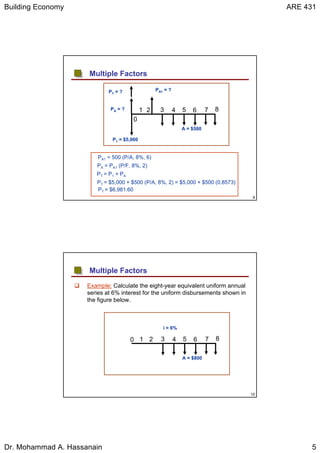
Example: Calculate the eight-year equivalent uniform annual
series at 6% interest for the uniform disbursements shown in
the figure below.
A = $800
6420 1 3 5 7 8
i = 6%
Building Economy ARE 431
Dr. Mohammad A. Hassanain 6
11
Multiple Factors
A = $800
64
20
1 3 5 7 8
i = 6%
PA1 = ?
PT
A = $800
6420 1 3 5 7 8
i = 6%
12
Multiple Factors
A’ = ?
6420 1 3 5 7 8
i = 6%
PA1 = 800 (P/A, 6%, 6)
PT = PA1 (P/F, 6%, 2) = $3,501.12
A’ = PT(A/P, 6%, 8)
A’ = $563.82
Building Economy ARE 431
Dr. Mohammad A. Hassanain 7
13
Calculations Involving Uniform-Series
and Randomly Distributed Amounts
P = $20,000 (P/A, 6%, 20) + $10,000 (P/F, 6%, 6) +
$15,000 (P/F, 6%, 16)
P = $242,352
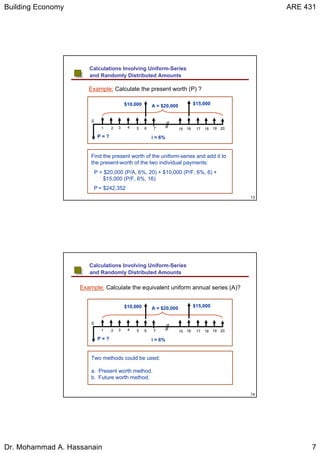
Find the present worth of the uniform-series and add it to
the present-worth of the two individual payments:
642
0
1 3 5 7 1816 2015
A = $20,000
17 19
$15,000$10,000
P = ? i = 6%
Example: Calculate the present worth (P) ?
14
Calculations Involving Uniform-Series
and Randomly Distributed Amounts
Two methods could be used:
a. Present worth method.
b. Future worth method.
642
0
1 3 5 7 1816 2015
A = $20,000
17 19
$15,000$10,000
P = ? i = 6%
Example: Calculate the equivalent uniform annual series (A)?
Building Economy ARE 431
Dr. Mohammad A. Hassanain 8
15
Calculations Involving Uniform-Series
and Randomly Distributed Amounts
Present worth method:
A = $20,000 + $10,000(P/F, 6%, 6) (A/P, 6%, 20) +
$15,000(P/F, 6%, 16) (A/P, 6%, 20)
A = $21,129 per year
642
0
1 3 5 7 1816 2015
A = $20,000
17 19
$15,000$10,000
P = ? i = 6%
16
Calculations Involving Uniform-Series
and Randomly Distributed Amounts
Future worth method:
A = $20,000 + $10,000(F/P, 6%, 14) (A/F, 6%, 20) +
$15,000(F/P, 6%, 4) (A/F, 6%, 20)
A = $21,129 per year
642
0
1 3 5 7 1816 2015
A = $20,000
17 19
$15,000$10,000
P = ? i = 6%
Building Economy ARE 431
Dr. Mohammad A. Hassanain 9
17
Calculations Involving Uniform-Series
and Randomly Distributed Amounts
+ $4606
- $5,0007
+ $4605
+ $4604
+ $4603
+ $4602
+ $4601
+ $4600
Cash FlowYear
Example: Calculate the present worth of the following series of
cash flows if i = 8%?
0
F = $5,000
A = $460
6421 3 5
i = 8%
P = ?
P = P1 + PA – PF
P = $460 + $460(P/A, 8%, 6) –
$5,000(P/F, 8%, 7)
P = -$331
7

6.4 multiple factors

  • 1.
    Building Economy ARE431 Dr. Mohammad A. Hassanain 1 Time Value of Money Multiple Factors 2 Multiple Factors. Example Illustrating the Use of Multiple Factors. Calculations Involving Uniform-Series and Randomly Distributed Amounts Today’s Lecture
  • 2.
    Building Economy ARE431 Dr. Mohammad A. Hassanain 2 3 Multiple Factors When a uniform series of payment (A) begins at a time other than the end of year 1, several methods can be used to find the present worth (P). For example, given: We can use the following methods: 1. Use the single-payment present worth factor (P/F, i%, n) to find the present worth of each disbursement at year Zero, then add them. A = $50 642 0 1 3 5 7 8 9 10 11 12 13P = ? 4 Multiple Factors 2. Use the single-payment compound-amount factor (F/P, i%, n) to find the future worth of each disbursement in year 13, add them, and then find the present worth of the total using P = F(P/F, i%, 13). 3. Use the uniform-series compound-amount factor (F/A, i%, n) to find the future amount by F = A(F/A, i%, 10) and then find the present worth using P = F(P/F, i%, 13). A = $50 642 0 1 3 5 7 8 9 10 11 12 13P = ?
  • 3.
    Building Economy ARE431 Dr. Mohammad A. Hassanain 3 5 Multiple Factors 4. Use the uniform-series present-worth factor (P/A, i%, n) to compute the present worth at year 3 and then find the present worth in year Zero by using the (P/F, i%, n) factor. A = $50 642 0 1 3 5 7 8 9 10 11 12 13P = ? 6 Multiple Factors Note: It is very important to remember that the present worth is always located One year prior to the first annual payment when using the uniform-series present-worth factor (P/A, i%, n). On the other hand, the uniform-series compound-amount factor (F/A, i%, n) was derived with the future worth “F” located in the same year as the last payment. It is always important to remember that the number of years n that should be used with the P/A or F/A factors is equal to the number of payments. It is generally helpful to re-number the cash-flow diagram to avoid counting errors.
  • 4.
    Building Economy ARE431 Dr. Mohammad A. Hassanain 4 7 Multiple Factors Example: A person buys a piece of property for $5,000 down- payment and deferred annual payments of $500 a year for six years starting three years from now. What is present worth of the investment if the interest rate is 8%? A = $500 642 0 1 3 5 7 8 PT = ? PA1 = ? PA = ? P1 = $5,000 8 Multiple Factors A = $500 642 0 1 3 5 7 8 PT = ? PA1 = ? PA = ? P1 = $5,000 PA1 = The present worth of a uniform-series. PA = The present worth at a time other than zero. PT = Total present worth at time zero.
  • 5.
    Building Economy ARE431 Dr. Mohammad A. Hassanain 5 9 Multiple Factors A = $500 642 0 1 3 5 7 8 PT = ? PA1 = ? PA = ? P1 = $5,000 PA1 = 500 (P/A, 8%, 6) PA = PA1 (P/F, 8%, 2) PT = P1 + PA PT = $5,000 + $500 (P/A, 8%, 2) = $5,000 + $500 (0.8573) PT = $6,981.60 10 Multiple Factors Example: Calculate the eight-year equivalent uniform annual series at 6% interest for the uniform disbursements shown in the figure below. A = $800 6420 1 3 5 7 8 i = 6%
  • 6.
    Building Economy ARE431 Dr. Mohammad A. Hassanain 6 11 Multiple Factors A = $800 64 20 1 3 5 7 8 i = 6% PA1 = ? PT A = $800 6420 1 3 5 7 8 i = 6% 12 Multiple Factors A’ = ? 6420 1 3 5 7 8 i = 6% PA1 = 800 (P/A, 6%, 6) PT = PA1 (P/F, 6%, 2) = $3,501.12 A’ = PT(A/P, 6%, 8) A’ = $563.82
  • 7.
    Building Economy ARE431 Dr. Mohammad A. Hassanain 7 13 Calculations Involving Uniform-Series and Randomly Distributed Amounts P = $20,000 (P/A, 6%, 20) + $10,000 (P/F, 6%, 6) + $15,000 (P/F, 6%, 16) P = $242,352 Find the present worth of the uniform-series and add it to the present-worth of the two individual payments: 642 0 1 3 5 7 1816 2015 A = $20,000 17 19 $15,000$10,000 P = ? i = 6% Example: Calculate the present worth (P) ? 14 Calculations Involving Uniform-Series and Randomly Distributed Amounts Two methods could be used: a. Present worth method. b. Future worth method. 642 0 1 3 5 7 1816 2015 A = $20,000 17 19 $15,000$10,000 P = ? i = 6% Example: Calculate the equivalent uniform annual series (A)?
  • 8.
    Building Economy ARE431 Dr. Mohammad A. Hassanain 8 15 Calculations Involving Uniform-Series and Randomly Distributed Amounts Present worth method: A = $20,000 + $10,000(P/F, 6%, 6) (A/P, 6%, 20) + $15,000(P/F, 6%, 16) (A/P, 6%, 20) A = $21,129 per year 642 0 1 3 5 7 1816 2015 A = $20,000 17 19 $15,000$10,000 P = ? i = 6% 16 Calculations Involving Uniform-Series and Randomly Distributed Amounts Future worth method: A = $20,000 + $10,000(F/P, 6%, 14) (A/F, 6%, 20) + $15,000(F/P, 6%, 4) (A/F, 6%, 20) A = $21,129 per year 642 0 1 3 5 7 1816 2015 A = $20,000 17 19 $15,000$10,000 P = ? i = 6%
  • 9.
    Building Economy ARE431 Dr. Mohammad A. Hassanain 9 17 Calculations Involving Uniform-Series and Randomly Distributed Amounts + $4606 - $5,0007 + $4605 + $4604 + $4603 + $4602 + $4601 + $4600 Cash FlowYear Example: Calculate the present worth of the following series of cash flows if i = 8%? 0 F = $5,000 A = $460 6421 3 5 i = 8% P = ? P = P1 + PA – PF P = $460 + $460(P/A, 8%, 6) – $5,000(P/F, 8%, 7) P = -$331 7