Downloaded 11 times


![Zawawi Daud , Abd Aziz Abdul Latif, Lee Mao Rui / International Journal of Engineering
Research and Applications (IJERA) ISSN: 2248-9622 www.ijera.com
Vol. 2, Issue4, July-august 2012, pp.1929-1934
removal of pollutants was increased with increasing V. CONCLUSION
coagulant dosage up to an optimum dosage and Results showed that the ferric chloride was
beyond which the removal percentage of pollutants more effective in leachate treatment compared with
decreased slowly (Park et al., 2008; Makhtar et al., alum. Alum was categories as low efficiency in
2010). leachate treatment. However, alum was achieved
Ferric chloride exhibited good performance higher percentage removal in colour.
in removing color comparing to other parameter. The results showed the percentage change in the
When the dosage of ferric chloride was increased removal of suspended solid (SS), colour, COD, and
beyond 3000 mg/L, the removal efficiency decreased. ammoniacal nitrogen in the sample of leachate treated
With the addition of larger dosage of the coagulant, by using 2000 mg/L alum and 2000 mg/L ferric
the surface charge of the particle gets reversed due to chloride for optimum pH. SS, color, COD and
continued adsorption of mono- and polynuclear ammoniacal nitrogen removal as a function of alum
hydrolysis species of ferric chloride. As the colloidal and ferric chloride dosage is shown at different pH
particles become positively charged, they cannot be values (from pH 2 to pH 12). The highest percentage
removed by perikinetic flocculation. The removal of of removal in SS, colour, COD and ammoniacal
color increased drastically with an increase of ferric nitrogen are 68%, 78%, 33% and 14% for alum and
chloride dose at pH 7. The results obtained from jar 92%, 82%, 28% and 26% for ferric chloride. The
test experiment by comparing the performance of percentage of alum and ferric chloride were increased
ferric chloride alum in removing SS, color, COD and until achieved optimum dose and decrease slowly after
ammoniacal nitrogen at different dosages of ferric that. Ferric chloride provides the highest percentage
chloride and alum of removal in SS, colour, COD and ammoniacal
nitrogen compared with alum. Dose optimum alum
and ferric chloride was 9000 mg/L and 3000 mg/L
respectively.
ACKNOWLEDGMENT
A very special thanks and appreciation to my
supervisor, Dr Zawawi Daud for being the most
understanding, helpful and patient. I would also like
to express my deep gratitude to my co-supervisor, Prof
Abd Aziz Abdul Latif for his encouragement
throughout the study. I am also grateful to all my
family members.
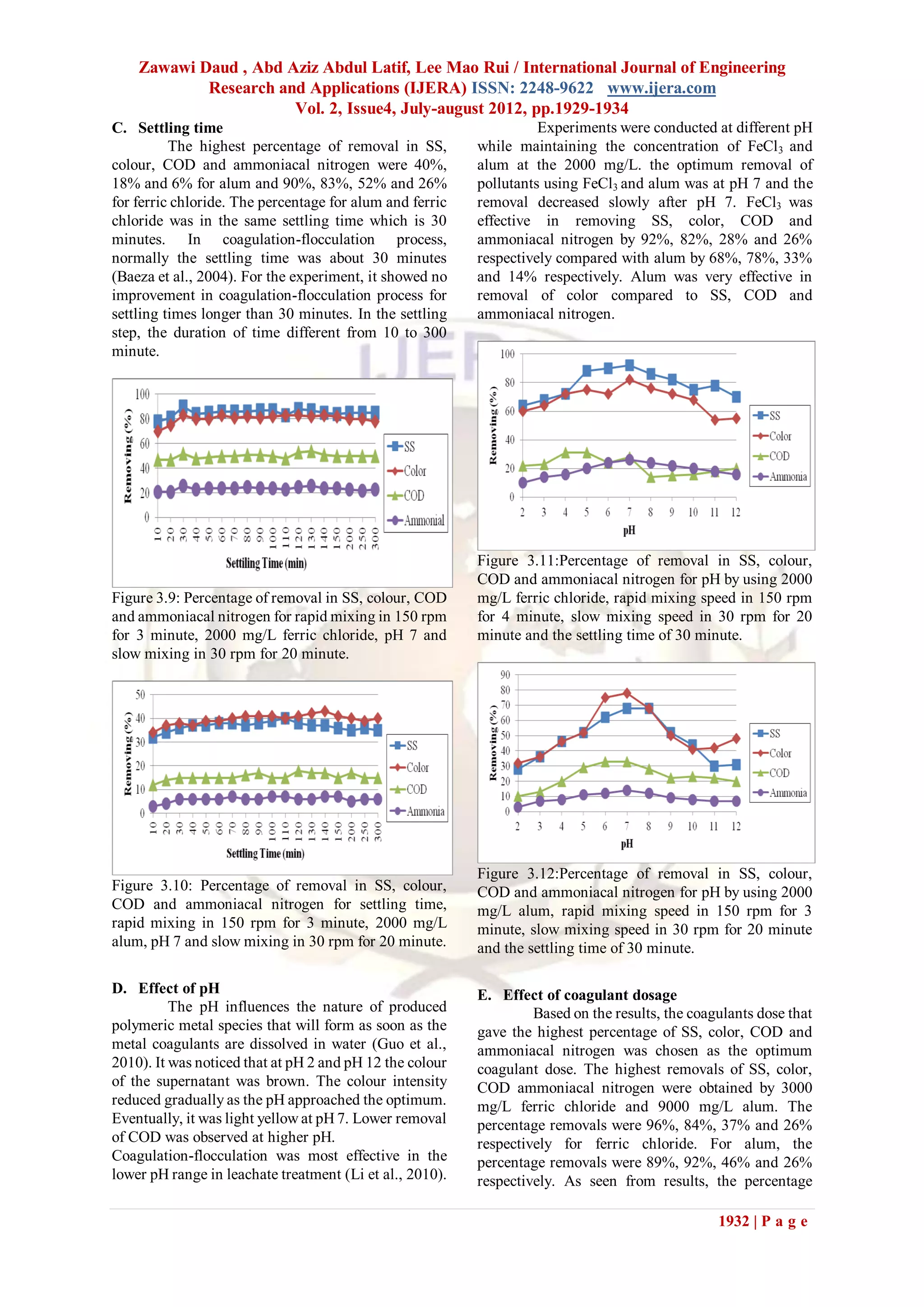
Figure 3.13: Percentage of removal in SS, colour, REFERENCES
COD and ammoniacal nitrogen for dose ferric [1] A, I, Zoubolis, M, D, Petala, “Performance of
chloride in pH 7, rapid mixing speed 150 rpm for 4 VSEP vibratory membrane filtration system
minute, slow mixing speed 30 rpm for 20 minute and during the treatment of landfill leachates,”
the settling time of 30 minute. Desalination, 222, 2008, pp. 165-175.
[2] P.H. Chen, “Assessment of leachates from
sanitary landfills: impact of age, rainfall, and
treatment,” Environment International, vol.
22, 1996, pp. 225-237.
[3] S, D, Parkes, D, F, Jolley and S, R, Wilson,
“Inorganic nitrogen transformation in the
treatment of landfill leachate with a high
ammonium load: A case study,” Environ
Monit Assess, 124, 2007, pp. 51-61.
[4] A, M, Cook & S, J, Fritz, “Environmental
impact of acid leachate derived from
coal-storage piles upon groundwater,” Water,
Air and Soil Pollution, 135, 2002, pp.
Figure 3.14: Percentage of removal in SS, colour, 371-388.
COD and ammoniacal nitrogen for dose alum in pH 7, [5] S, Mor, K, Ravindra, R, P, Dahiya and A,
rapid mixing speed 150 rpm for 3 minute, slow Chandra, “Leachate characterization and
mixing speed 30 rpm for 20 minute and the settling assessment of groundwater pollution near
time of 30 minute. municipal solid waste landfill site,”
1933 | P a g e](https://image.slidesharecdn.com/lm2419291934-121002055421-phpapp01/75/Lm2419291934-5-2048.jpg)
![Zawawi Daud , Abd Aziz Abdul Latif, Lee Mao Rui / International Journal of Engineering
Research and Applications (IJERA) ISSN: 2248-9622 www.ijera.com
Vol. 2, Issue4, July-august 2012, pp.1929-1934
Environmental Monitoring and Assessment, [16] X, J, Wang, S, Chen, X, Y, Gu and K, Y,
118, 2006, pp. 435-456. Wang, ``Pilot study on the advanced
[6] M, Sartaj, M, Ahmadifar and A,K, Jashni, treatment of landfill leachate using a
“Assessment of in-situ aerobic treatment of combined coagulation, fenton oxidation and
municipal landfill leachate at laboratory biological aerated filter process,” Waste
scale,” Iranian Journal of Science & Management, 29, 2009, pp. 1354-1358.
Technology, Transaction B, Engineering, 34 [17] M, Rossini, J, G, Garrido and M, Galluzzo,
(B1),2010, pp. 107-116. “Optimization of the
[7] S, Veli, T, Ozturk and A, Dimoglo, coagulation-flocculation treatment:
“Treatment of municipal solid wastes influence of rapid mix parameters,” Water
leachate by means of chemical- and Res, 3, 1999, pp. 1817-1826.
electro-coagulation,” Separation and [18] F, J, Rivas, F, Beltran, F, Carvalho, Acedo,
Purification Technology, 62, 2008, pp. B and Gimeno, O, “Stabilized leachate:
82-88. sequential coagulation-flocculation +
[8] A, A, Abdulhussain, J,S, Guo, Z,P, Liu, Y, Y, chemical oxidation process,” Journal of
Pan and W, S, Al-Rekabi,``Reniew on Hazardous Materials, B116, 2004, pp.
landfill leachate treatments,” American 95-102.
Journal of Applied Science, 6(4), 2009, pp. [19] A, Amokrane, C, Comel, J, Veron, “Landfill
672-684. leachates pretreatment by
[9] S, Ghafari, H,A, Aziz, and M,J,K, coagulation-flocculation,” Water Res, 31,
Bashir,``The use of poly-aluminium chloride 1997, pp. 2775.
and alum for the treatment of partially [20] A, Baeza, M, Fernandez, M, Herranz, F,
stabilized leachate: A comparative study,” Legarda, C, Micro and A, Salas,
Desalination, 257, 2010, pp. 110-116. “Elimination of man-made radionuclides
[10] E, Neczaj, E, Okoniewska, M, from natural waters by applying a standard
Kacprzak,“Treatment of landfill leachate by coagulation-flocculation process,” Journal
sequencing batch reactor,” Desalination, of Radionalytical and Nuclear Chemistry,
185, pp. 357-362. 260, 2, 2004, pp. 321-326.
[11] M, J, K, Bashir, H, A, Aziz and M, S, Yusoff, [21] J, S, Guo, A, A, Abbas, Y, P, Chen, Z, P, Liu,
“New sequential treatment for mature F, Fang and P, Chen, “Treatment of landfill
landfill leachate by cationic/anionic and leachate using a combined stripping, fenton,
anionic/cationic processes: Optimization and SBR, and coagulation process,” Journal of
comparative study,” Journal of Hazardous Hazardous Materials, 178, 2010, pp.
Materials, 186, 2011, pp. 92-102. 699-705.
[12] E. Durmusoglu,C, Yilmaz, “Evaluation and [22] W, Li, T, Hua, Q, X, Zhou, S, G, Zhang and
temporal variation of raw and pre-treated F, X, Li, “Treatment of stabilized landfill
leachate quality from an active solid waste leachate by the combined process of
landfill,” Water, Air and Soil Pollution, 171, coagulation/flocculation and powder
2006, pp. 359-382. activated carbon adsorption, Desalination,
[13] A, Ozkan & M, Yekeler, “Coagulation and 264, 2010, pp. 56-62.
flocculation characteristics of celestite with [23] S, Y, Park, H, Bae and C, W, Kim, “Decision
different inorganic salts and polymers,” model for coagulant dosage using genetic
Chemical Engineering and Processing, 43, programming and multivariate statistical
2004, pp. 873-879. analysis for coagulation/flocculation at water
[14] K, Gnandi, G, Tchangbedji, K, Kili, G, Baba treatment process,” Korean J. Chem. Eng, 25,
and O, Salim, “Processing of phosphate mine 6, 2008, pp. 1372-1376.
tailings by coagulation flocculation to reduce [24] S, M, Z, Makhtar, N, Ibrahim and M, T,
marine pollution in Togo: laboratory tests,” “Removal of colour from landfill by solar
Mine Water and the Environment, 24, 2005, photocatalytic,” Journal of Applied Sciences,
pp. 215-221. 10, 21, 2010, pp. 2721-2724.
[15] K, J, Choi, S, G, Kim, C,W, kim and J, K,
Park, “ Removal efficiencies of endocrine
disrupting chemicals by
coagulation/flocculation, ozonation,
powdered/granular activated carbon
adsorption, and chlorination,” Korean J.
Chem. Eng, 23(3), 2006, pp. 399-408.
1934 | P a g e](https://image.slidesharecdn.com/lm2419291934-121002055421-phpapp01/75/Lm2419291934-6-2048.jpg)

The study evaluates the effectiveness of coagulation-flocculation using ferric chloride and alum in treating landfill leachate to reduce pollutants like suspended solids, chemical oxygen demand, and ammoniacal nitrogen. Results indicate that ferric chloride outperforms alum, achieving up to 96% removal efficiency for suspended solids, while the optimal pH for treatment was found to be 7. The paper highlights the significance of coagulant dosage and mixing conditions on treatment efficiency.


