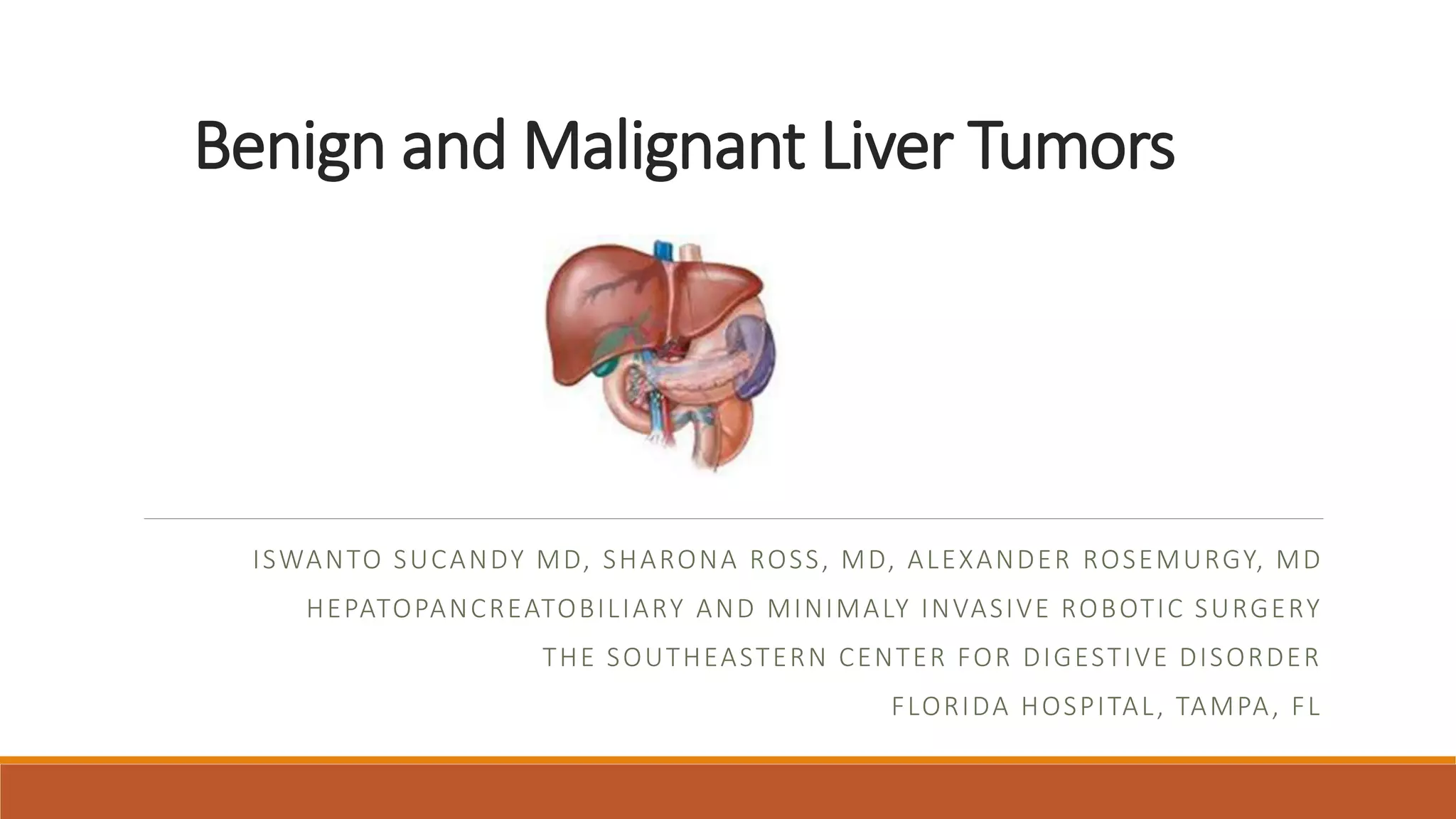
Benign and Malignant Liver Tumors
ISWANTO SUCANDY MD, SHARONA ROSS, MD, ALEXANDER ROSEMURGY, MD
HEPATOPANCREATOBILIARY AND MINIMALY INVASIVE ROBOTIC SURGERY
THE SOUTHEASTERN CENTER FOR DIGESTIVE DISORDER
FLORIDA HOSPITAL, TAMPA, FL
BENIGN LIVER MASS
Hepatic Adenoma
Focal Nodular Hyperplasia
Liver Hemangioma
Liver Cysts
◦ Simple cyst
◦ Cystadenoma
MALIGNANT LIVER MASS
Hepatocellular carcinoma (95% in Liver Cirrhosis)
Intrahepatic Cholangiocarcinoma
Metastatic cancer to the liver
◦ Colon and rectal cancer
◦ Neuroendocrine cancer (NET)
◦ Soft tissue sarcoma
◦ Breast cancer
◦ Ovarian/Prostate cancers
◦ Others
Liver Mass
Most without symptoms upon presentation
Incidental findings on abdominal CT scan or MRI
Symptoms :
◦ Right upper quadrant fullness/discomfort/pain
◦ Elevated liver enzymes
◦ Jaundice
Diagnostic Work-Up
Liver enzymes (ALT, AST, Tbili, Alkaline phosphatase)
Triple tumor markers (AFP, CA 19-9, CEA)
Triphasic Liver CT scan (arterial, portal, washout phase)
Liver MRI (lesions <2cm)
Liver mass seen on Ultrasonography needs a Triphasic Liver CT scan
Available Treatment Modalities
Liver Resection (Robotic, Laparoscopic, Open, Hybrid technique)
Radiofrequency Ablation (Laparoscopic, Percutaneous, Open for lesions
< 3.5 cm diameter)
Regional Liver Therapy
◦ Transarterial Chemoembolization
◦ Transarterial Radioembolization
◦ Hepatic Artery Infusion Pump / Isolated Hepatic Perfusion Therapy
Focused External Beam Radiation
Liver Transplantation (shortage of donor, limited eligibility criterias, lifelong immunosuppression post
transplantation)
Hepatic Adenoma
Young female in reproductive age
Estrogen dependent (Oral contraception/Injection
most common)
Malignant degeneration and risk of
rupture/bleeding as size increases
Liver resection indicated for size > 4-5cm
Focal Nodular Hyperplasia
Benign
Nonhormonally dependent
Symptomatic with size increase
“Central scar” on CT scan
Liver resection indicated for symptomatic
lesion
Liver Hemangioma
Benign
Nonhormonally dependent
Symptomatic with size increase
Gradual centripetal arterial enhancement
Liver resection indicated for
symptomatic/consumptive lesion
Liver Cyst
Benign
Right upper quadrant discomfort from capsular
stretch
Can be very large >10cm in size / > 1 gallon of
fluid
Frequently multiple in both hemilivers
Robotic or Laparoscopic cyst wall resection /
fenestration
Hepatocellular Carcinoma
95% occur in background liver cirrhosis
In the US : Alcohol, Hepatitis C
Typical appearance on CT scan
Liver resection / Radiofrequency Ablation /
Liver Transplantation depending on stage
Intrahepatic Cholangiocarcinoma
Malignancy of intrahepatic bile duct
Normal background liver
Tend to spread to portal lymphnodes
Response to standard chemotherapy only 40%
Liver resection with negative margin --> only
potentially curative treatment
Metastatic Cancer to the Liver
Most common origin is colon and rectal cancer (60%)
Most are found incidentally during CT scan A/P
Most centers gives neoadjuvant 2-3 months followed
by surgery
No limit on number of lesions resected
Liver resection ± Radiofrequency ablation
Evolution of Liver Surgery
Traditional Liver Surgery Minimally Invasive Robotic/Laparoscopic Liver
Surgery
Minimally Invasive Robotic/Laparoscopic Liver Surgery
1. Less postoperative pain
2. Less blood loss
3. Shorter hospital stay
4. Lower perioperative complications & improved recovery
5. Lower wound-related complications (Infection and hernia)
6. Similar oncologic outcomes
7. Better cosmesis
Florida Hospital Tampa
The Southeastern Center for Digestive Disorder
Minimally Invasive Robotic and Laparoscopic Liver Surgery Program for Benign and Malignant Liver
Diseases
Call for Referral : (813) 615 – 7030
Office Location : 3000 Medical Park Drive, Suite 500, Lifehope Medical Building, Tampa, FL 33613

Liver Tumors

  • 1.
    Benign and MalignantLiver Tumors ISWANTO SUCANDY MD, SHARONA ROSS, MD, ALEXANDER ROSEMURGY, MD HEPATOPANCREATOBILIARY AND MINIMALY INVASIVE ROBOTIC SURGERY THE SOUTHEASTERN CENTER FOR DIGESTIVE DISORDER FLORIDA HOSPITAL, TAMPA, FL
  • 2.
    BENIGN LIVER MASS HepaticAdenoma Focal Nodular Hyperplasia Liver Hemangioma Liver Cysts ◦ Simple cyst ◦ Cystadenoma MALIGNANT LIVER MASS Hepatocellular carcinoma (95% in Liver Cirrhosis) Intrahepatic Cholangiocarcinoma Metastatic cancer to the liver ◦ Colon and rectal cancer ◦ Neuroendocrine cancer (NET) ◦ Soft tissue sarcoma ◦ Breast cancer ◦ Ovarian/Prostate cancers ◦ Others
  • 3.
    Liver Mass Most withoutsymptoms upon presentation Incidental findings on abdominal CT scan or MRI Symptoms : ◦ Right upper quadrant fullness/discomfort/pain ◦ Elevated liver enzymes ◦ Jaundice
  • 4.
    Diagnostic Work-Up Liver enzymes(ALT, AST, Tbili, Alkaline phosphatase) Triple tumor markers (AFP, CA 19-9, CEA) Triphasic Liver CT scan (arterial, portal, washout phase) Liver MRI (lesions <2cm) Liver mass seen on Ultrasonography needs a Triphasic Liver CT scan
  • 5.
    Available Treatment Modalities LiverResection (Robotic, Laparoscopic, Open, Hybrid technique) Radiofrequency Ablation (Laparoscopic, Percutaneous, Open for lesions < 3.5 cm diameter) Regional Liver Therapy ◦ Transarterial Chemoembolization ◦ Transarterial Radioembolization ◦ Hepatic Artery Infusion Pump / Isolated Hepatic Perfusion Therapy Focused External Beam Radiation Liver Transplantation (shortage of donor, limited eligibility criterias, lifelong immunosuppression post transplantation)
  • 6.
    Hepatic Adenoma Young femalein reproductive age Estrogen dependent (Oral contraception/Injection most common) Malignant degeneration and risk of rupture/bleeding as size increases Liver resection indicated for size > 4-5cm
  • 7.
    Focal Nodular Hyperplasia Benign Nonhormonallydependent Symptomatic with size increase “Central scar” on CT scan Liver resection indicated for symptomatic lesion
  • 8.
    Liver Hemangioma Benign Nonhormonally dependent Symptomaticwith size increase Gradual centripetal arterial enhancement Liver resection indicated for symptomatic/consumptive lesion
  • 9.
    Liver Cyst Benign Right upperquadrant discomfort from capsular stretch Can be very large >10cm in size / > 1 gallon of fluid Frequently multiple in both hemilivers Robotic or Laparoscopic cyst wall resection / fenestration
  • 10.
    Hepatocellular Carcinoma 95% occurin background liver cirrhosis In the US : Alcohol, Hepatitis C Typical appearance on CT scan Liver resection / Radiofrequency Ablation / Liver Transplantation depending on stage
  • 11.
    Intrahepatic Cholangiocarcinoma Malignancy ofintrahepatic bile duct Normal background liver Tend to spread to portal lymphnodes Response to standard chemotherapy only 40% Liver resection with negative margin --> only potentially curative treatment
  • 12.
    Metastatic Cancer tothe Liver Most common origin is colon and rectal cancer (60%) Most are found incidentally during CT scan A/P Most centers gives neoadjuvant 2-3 months followed by surgery No limit on number of lesions resected Liver resection ± Radiofrequency ablation
  • 13.
    Evolution of LiverSurgery Traditional Liver Surgery Minimally Invasive Robotic/Laparoscopic Liver Surgery
  • 14.
    Minimally Invasive Robotic/LaparoscopicLiver Surgery 1. Less postoperative pain 2. Less blood loss 3. Shorter hospital stay 4. Lower perioperative complications & improved recovery 5. Lower wound-related complications (Infection and hernia) 6. Similar oncologic outcomes 7. Better cosmesis
  • 15.
    Florida Hospital Tampa TheSoutheastern Center for Digestive Disorder Minimally Invasive Robotic and Laparoscopic Liver Surgery Program for Benign and Malignant Liver Diseases Call for Referral : (813) 615 – 7030 Office Location : 3000 Medical Park Drive, Suite 500, Lifehope Medical Building, Tampa, FL 33613