Dr. Naveed AshrafRadiologic Pictorial Review
Focal liver lesions:
Practical magnetic resonance imaging approach
António P Matos, Fernanda Velloni, Miguel Ramalho, Mamdoh AlObaidy,
Aruna Rajapaksha, Richard C Semelka
1
Dr. Naveed Ashraf
Teaching Points
Radiologic Pictorial Review2
The state of the art MRI protocols rely on a combination of fat-suppressed and non-fat-suppressed T2-weighted images (T2-WI), in- and opposed-phase
(IP/OP) T1-WI and dynamic pre- and post-contrast fat suppressed T1-WI.
The predominant information provided by T2-WI is about fluid content, fibrotic tissue and iron content (reflected by high, low, and very low signal
intensity, respectively). Fat suppression is generally applied for at least one set of images in order to increase lesions conspicuity.
Pre-contrast T1-WIs are extremely important in lesion characterization. Most focal liver lesions are mildly or moderately low in signal intensity. Lesions
with high-fluid or fibrous tissue content are moderately or substantially low in signal intensity. Hemorrhagic lesions, and those with high protein or fat
content, are high in signal intensity on T1-WI.
The two echo times are chosen so that fat and water peaks are IP and OP, respectively. OP images are useful to detect small amounts of intracellular fat
in liver lesions and in hepatic parenchyma. If fat and water are in the same voxel, the signal intensity decreases on the OP images, with maximal signal
loss occurring when fat and water are in equal proportion.
Gadolinium-enhanced images are performed routinely in a multiphasic dynamic fashion, using three dimensional (3D) fat-suppressed GRE breath-hold
T1- WI. The acquired phases include late arterial, portal venous, interstitial, and delayed phases; which allow the assessment of enhancement kinetics (a
reflection of both vascularity and permeability).
Most diagnostic information can be derived from the late hepatic arterial phase, also called hepatic-arterial dominant phase, with the correct timing
characterized by observing contrast enhancement in the portal vein branches and no enhancement in the hepatic veins.
Dr. Naveed AshrafRadiologic Pictorial Review
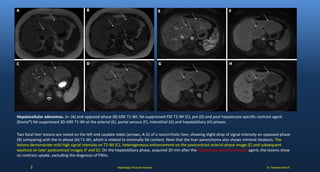
Hepatocellular adenomas. In- (A) and opposed-phase (B) GRE T1-WI, fat-suppressed FSE T2-WI (C), pre (D) and post hepatocyte-specific contrast agent
(Eovist®) fat-suppressed 3D-GRE T1-WI at the arterial (E), portal venous (F), interstitial (G) and hepatobiliary (H) phases.
Two focal liver lesions are noted on the left and caudate lobes (arrows, A-G) of a noncirrhotic liver, showing slight drop of signal intensity on opposed-phase
(B) comparing with the in-phase (A) T1-WI, which is related to minimally fat content. Note that the liver parenchyma also shows minimal steatosis. The
lesions demonstrate mild high signal intensity on T2-WI (C), heterogeneous enhancement on the postcontrast arterial phase image (E) and subsequent
washout on later postcontrast images (F and G). On the hepatobiliary phase, acquired 20 min after the hepatocyte-specific contrast agent, the lesions show
no contrast uptake, excluding the diagnosis of FNHs.
3
Dr. Naveed AshrafRadiologic Pictorial Review
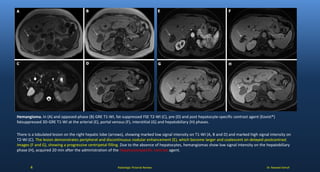
Hemangioma. In (A) and opposed-phase (B) GRE T1-WI, fat-suppressed FSE T2-WI (C), pre (D) and post hepatocyte-specific contrast agent (Eovist®)
fatsuppressed 3D-GRE T1-WI at the arterial (E), portal venous (F), interstitial (G) and hepatobiliary (H) phases.
There is a lobulated lesion on the right hepatic lobe (arrows), showing marked low signal intensity on T1-WI (A, B and D) and marked high signal intensity on
T2-WI (C). The lesion demonstrates peripheral and discontinuous nodular enhancement (E), which become larger and coalescent on delayed postcontrast
images (F and G), showing a progressive centripetal filling. Due to the absence of hepatocytes, hemangiomas show low signal intensity on the hepatobiliary
phase (H), acquired 20 min after the administration of the hepatocytespecific contrast agent.
4
Dr. Naveed AshrafRadiologic Pictorial Review
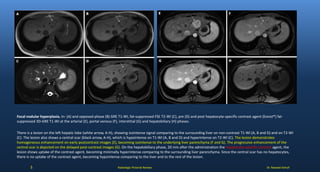
Focal nodular hyperplasia. In- (A) and opposed-phase (B) GRE T1-WI, fat-suppressed FSE T2-WI (C), pre (D) and post hepatocyte-specific contrast agent (Eovist®) fat-
suppressed 3D-GRE T1-WI at the arterial (E), portal venous (F), interstitial (G) and hepatobiliary (H) phases.
There is a lesion on the left hepatic lobe (white arrow, A-H), showing isointense signal comparing to the surrounding liver on non-contrast T1-WI (A, B and D) and on T2-WI
(C). The lesion also shows a central scar (black arrow, A-H), which is hypointense on T1-WI (A, B and D) and hyperintense on T2-WI (C). The lesion demonstrates
homogeneous enhancement on early postcontrast images (E), becoming isointense to the underlying liver parenchyma (F and G). The progressive enhancement of the
central scar is depicted on the delayed post-contrast images (G). On the hepatobiliary phase, 20 min after the administration the hepatocyte-specific contrast agent, the
lesion shows uptake of the contrast agent, becoming minimally hyperintense comparing to the surrounding liver parenchyma. Since the central scar has no hepatocytes,
there is no uptake of the contrast agent, becoming hypointense comparing to the liver and to the rest of the lesion.
5
Dr. Naveed AshrafRadiologic Pictorial Review
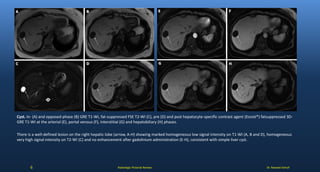
Cyst. In- (A) and opposed-phase (B) GRE T1-WI, fat-suppressed FSE T2-WI (C), pre (D) and post hepatocyte-specific contrast agent (Eovist®) fatsuppressed 3D-
GRE T1-WI at the arterial (E), portal venous (F), interstitial (G) and hepatobiliary (H) phases.
There is a well-defined lesion on the right hepatic lobe (arrow, A-H) showing marked homogeneous low signal intensity on T1-WI (A, B and D), homogeneous
very high signal intensity on T2-WI (C) and no enhancement after gadolinium administration (E-H), consistent with simple liver cyst.
6
Dr. Naveed AshrafRadiologic Pictorial Review
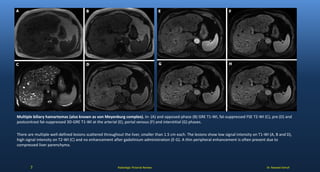
Multiple biliary hamartomas (also known as von Meyenburg complex). In- (A) and opposed-phase (B) GRE T1-WI, fat-suppressed FSE T2-WI (C), pre (D) and
postcontrast fat-suppressed 3D-GRE T1-WI at the arterial (E), portal venous (F) and interstitial (G) phases.
There are multiple well-defined lesions scattered throughout the liver, smaller than 1.5 cm each. The lesions show low signal intensity on T1-WI (A, B and D),
high signal intensity on T2-WI (C) and no enhancement after gadolinium administration (E-G). A thin peripheral enhancement is often present due to
compressed liver parenchyma.
7
Dr. Naveed AshrafRadiologic Pictorial Review
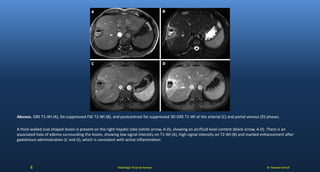
Abscess. GRE T1-WI (A), fat-suppressed FSE T2-WI (B), and postcontrast fat-suppressed 3D-GRE T1-WI at the arterial (C) and portal venous (D) phases.
A thick-walled oval shaped lesion is present on the right hepatic lobe (white arrow, A-D), showing an air/fluid level content (black arrow, A-D). There is an
associated halo of edema surrounding the lesion, showing low signal intensity on T1-WI (A), high signal intensity on T2-WI (B) and marked enhancement after
gadolinium administration (C and D), which is consistent with active inflammation.
8
Dr. Naveed AshrafRadiologic Pictorial Review
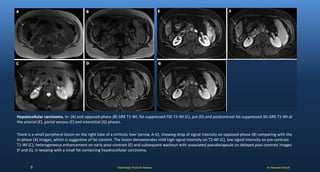
Hepatocellular carcinoma. In- (A) and opposed-phase (B) GRE T1-WI, fat-suppressed FSE T2-WI (C), pre (D) and postcontrast fat-suppressed 3D-GRE T1-WI at
the arterial (E), portal venous (F) and interstitial (G) phases.
There is a small peripheral lesion on the right lobe of a cirrhotic liver (arrow, A-G), showing drop of signal intensity on opposed-phase (B) comparing with the
in-phase (A) images, which is suggestive of fat content. The lesion demonstrates mild high signal intensity on T2-WI (C), low signal intensity on pre-contrast
T1-WI (C), heterogeneous enhancement on early post-contrast (E) and subsequent washout with associated pseudocapsule on delayed post-contrast images
(F and G), in keeping with a small fat-containing hepatocellular carcinoma.
9
Dr. Naveed AshrafRadiologic Pictorial Review
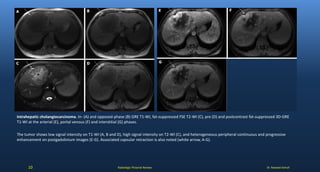
Intrahepatic cholangiocarcinoma. In- (A) and opposed-phase (B) GRE T1-WI, fat-suppressed FSE T2-WI (C), pre (D) and postcontrast fat-suppressed 3D-GRE
T1-WI at the arterial (E), portal venous (F) and interstitial (G) phases.
The tumor shows low signal intensity on T1-WI (A, B and D), high signal intensity on T2-WI (C), and heterogeneous peripheral continuous and progressive
enhancement on postgadolinium images (E-G). Associated capsular retraction is also noted (white arrow, A-G).
10
Dr. Naveed AshrafRadiologic Pictorial Review
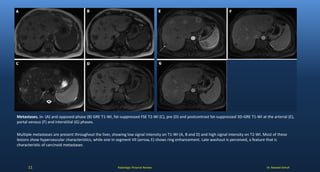
Metastases. In- (A) and opposed-phase (B) GRE T1-WI, fat-suppressed FSE T2-WI (C), pre (D) and postcontrast fat-suppressed 3D-GRE T1-WI at the arterial (E),
portal venous (F) and interstitial (G) phases.
Multiple metastases are present throughout the liver, showing low signal intensity on T1-WI (A, B and D) and high signal intensity on T2-WI. Most of these
lesions show hypervascular characteristics, while one in segment VII (arrow, E) shows ring enhancement. Late washout is perceived, a feature that is
characteristic of carcinoid metastases
11
Dr. Naveed AshrafRadiologic Pictorial Review
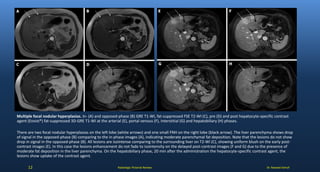
Multiple focal nodular hyperplasias. In- (A) and opposed-phase (B) GRE T1-WI, fat-suppressed FSE T2-WI (C), pre (D) and post hepatocyte-specific contrast
agent (Eovist®) fat-suppressed 3D-GRE T1-WI at the arterial (E), portal venous (F), interstitial (G) and hepatobiliary (H) phases.
There are two focal nodular hyperplasias on the left lobe (white arrows) and one small FNH on the right lobe (black arrow). The liver parenchyma shows drop
of signal in the opposed-phase (B) comparing to the in-phase images (A), indicating moderate parenchymal fat deposition. Note that the lesions do not show
drop in signal in the opposed-phase (B). All lesions are isointense comparing to the surrounding liver on T2-WI (C), showing uniform blush on the early post-
contrast images (E). In this case the lesions enhancement do not fade to isointensity on the delayed post-contrast images (F and G) due to the presence of
moderate fat deposition in the liver parenchyma. On the hepatobiliary phase, 20 min after the administration the hepatocyte-specific contrast agent, the
lesions show uptake of the contrast agent.
12
Dr. Naveed AshrafRadiologic Pictorial Review
Adenomatosis. In- (A) and opposed-phase (B) GRE T1-WI, fat-suppressed FSE T2-WI (C), pre (D) and post hepatocyte-specific contrast agent (Eovist®) fat-
suppressed 3D-GRE T1-WI at the arterial (E), portal venous (F), interstitial (G) and hepatobiliary (H) phases.
There are multiple lesions (> 10 in number) scattered throughout the hepatic parenchyma, barely visible on unenhanced T1-WI (A, B and D) and hyperintense
on T2-WI (C). The lesions show arterial enhancement (E), which fades to almost isointensity on the delayed post-contrast images (F and G). On the
hepatobiliary phase, acquired 20 min after the hepatocyte-specific contrast agent, all lesions appear with low signal intensity comparing to the surrounding
liver.
13

Liver lesions on mri

  • 1.
    Dr. Naveed AshrafRadiologicPictorial Review Focal liver lesions: Practical magnetic resonance imaging approach António P Matos, Fernanda Velloni, Miguel Ramalho, Mamdoh AlObaidy, Aruna Rajapaksha, Richard C Semelka 1
  • 2.
    Dr. Naveed Ashraf TeachingPoints Radiologic Pictorial Review2 The state of the art MRI protocols rely on a combination of fat-suppressed and non-fat-suppressed T2-weighted images (T2-WI), in- and opposed-phase (IP/OP) T1-WI and dynamic pre- and post-contrast fat suppressed T1-WI. The predominant information provided by T2-WI is about fluid content, fibrotic tissue and iron content (reflected by high, low, and very low signal intensity, respectively). Fat suppression is generally applied for at least one set of images in order to increase lesions conspicuity. Pre-contrast T1-WIs are extremely important in lesion characterization. Most focal liver lesions are mildly or moderately low in signal intensity. Lesions with high-fluid or fibrous tissue content are moderately or substantially low in signal intensity. Hemorrhagic lesions, and those with high protein or fat content, are high in signal intensity on T1-WI. The two echo times are chosen so that fat and water peaks are IP and OP, respectively. OP images are useful to detect small amounts of intracellular fat in liver lesions and in hepatic parenchyma. If fat and water are in the same voxel, the signal intensity decreases on the OP images, with maximal signal loss occurring when fat and water are in equal proportion. Gadolinium-enhanced images are performed routinely in a multiphasic dynamic fashion, using three dimensional (3D) fat-suppressed GRE breath-hold T1- WI. The acquired phases include late arterial, portal venous, interstitial, and delayed phases; which allow the assessment of enhancement kinetics (a reflection of both vascularity and permeability). Most diagnostic information can be derived from the late hepatic arterial phase, also called hepatic-arterial dominant phase, with the correct timing characterized by observing contrast enhancement in the portal vein branches and no enhancement in the hepatic veins.
  • 3.
    Dr. Naveed AshrafRadiologicPictorial Review Hepatocellular adenomas. In- (A) and opposed-phase (B) GRE T1-WI, fat-suppressed FSE T2-WI (C), pre (D) and post hepatocyte-specific contrast agent (Eovist®) fat-suppressed 3D-GRE T1-WI at the arterial (E), portal venous (F), interstitial (G) and hepatobiliary (H) phases. Two focal liver lesions are noted on the left and caudate lobes (arrows, A-G) of a noncirrhotic liver, showing slight drop of signal intensity on opposed-phase (B) comparing with the in-phase (A) T1-WI, which is related to minimally fat content. Note that the liver parenchyma also shows minimal steatosis. The lesions demonstrate mild high signal intensity on T2-WI (C), heterogeneous enhancement on the postcontrast arterial phase image (E) and subsequent washout on later postcontrast images (F and G). On the hepatobiliary phase, acquired 20 min after the hepatocyte-specific contrast agent, the lesions show no contrast uptake, excluding the diagnosis of FNHs. 3
  • 4.
    Dr. Naveed AshrafRadiologicPictorial Review Hemangioma. In (A) and opposed-phase (B) GRE T1-WI, fat-suppressed FSE T2-WI (C), pre (D) and post hepatocyte-specific contrast agent (Eovist®) fatsuppressed 3D-GRE T1-WI at the arterial (E), portal venous (F), interstitial (G) and hepatobiliary (H) phases. There is a lobulated lesion on the right hepatic lobe (arrows), showing marked low signal intensity on T1-WI (A, B and D) and marked high signal intensity on T2-WI (C). The lesion demonstrates peripheral and discontinuous nodular enhancement (E), which become larger and coalescent on delayed postcontrast images (F and G), showing a progressive centripetal filling. Due to the absence of hepatocytes, hemangiomas show low signal intensity on the hepatobiliary phase (H), acquired 20 min after the administration of the hepatocytespecific contrast agent. 4
  • 5.
    Dr. Naveed AshrafRadiologicPictorial Review Focal nodular hyperplasia. In- (A) and opposed-phase (B) GRE T1-WI, fat-suppressed FSE T2-WI (C), pre (D) and post hepatocyte-specific contrast agent (Eovist®) fat- suppressed 3D-GRE T1-WI at the arterial (E), portal venous (F), interstitial (G) and hepatobiliary (H) phases. There is a lesion on the left hepatic lobe (white arrow, A-H), showing isointense signal comparing to the surrounding liver on non-contrast T1-WI (A, B and D) and on T2-WI (C). The lesion also shows a central scar (black arrow, A-H), which is hypointense on T1-WI (A, B and D) and hyperintense on T2-WI (C). The lesion demonstrates homogeneous enhancement on early postcontrast images (E), becoming isointense to the underlying liver parenchyma (F and G). The progressive enhancement of the central scar is depicted on the delayed post-contrast images (G). On the hepatobiliary phase, 20 min after the administration the hepatocyte-specific contrast agent, the lesion shows uptake of the contrast agent, becoming minimally hyperintense comparing to the surrounding liver parenchyma. Since the central scar has no hepatocytes, there is no uptake of the contrast agent, becoming hypointense comparing to the liver and to the rest of the lesion. 5
  • 6.
    Dr. Naveed AshrafRadiologicPictorial Review Cyst. In- (A) and opposed-phase (B) GRE T1-WI, fat-suppressed FSE T2-WI (C), pre (D) and post hepatocyte-specific contrast agent (Eovist®) fatsuppressed 3D- GRE T1-WI at the arterial (E), portal venous (F), interstitial (G) and hepatobiliary (H) phases. There is a well-defined lesion on the right hepatic lobe (arrow, A-H) showing marked homogeneous low signal intensity on T1-WI (A, B and D), homogeneous very high signal intensity on T2-WI (C) and no enhancement after gadolinium administration (E-H), consistent with simple liver cyst. 6
  • 7.
    Dr. Naveed AshrafRadiologicPictorial Review Multiple biliary hamartomas (also known as von Meyenburg complex). In- (A) and opposed-phase (B) GRE T1-WI, fat-suppressed FSE T2-WI (C), pre (D) and postcontrast fat-suppressed 3D-GRE T1-WI at the arterial (E), portal venous (F) and interstitial (G) phases. There are multiple well-defined lesions scattered throughout the liver, smaller than 1.5 cm each. The lesions show low signal intensity on T1-WI (A, B and D), high signal intensity on T2-WI (C) and no enhancement after gadolinium administration (E-G). A thin peripheral enhancement is often present due to compressed liver parenchyma. 7
  • 8.
    Dr. Naveed AshrafRadiologicPictorial Review Abscess. GRE T1-WI (A), fat-suppressed FSE T2-WI (B), and postcontrast fat-suppressed 3D-GRE T1-WI at the arterial (C) and portal venous (D) phases. A thick-walled oval shaped lesion is present on the right hepatic lobe (white arrow, A-D), showing an air/fluid level content (black arrow, A-D). There is an associated halo of edema surrounding the lesion, showing low signal intensity on T1-WI (A), high signal intensity on T2-WI (B) and marked enhancement after gadolinium administration (C and D), which is consistent with active inflammation. 8
  • 9.
    Dr. Naveed AshrafRadiologicPictorial Review Hepatocellular carcinoma. In- (A) and opposed-phase (B) GRE T1-WI, fat-suppressed FSE T2-WI (C), pre (D) and postcontrast fat-suppressed 3D-GRE T1-WI at the arterial (E), portal venous (F) and interstitial (G) phases. There is a small peripheral lesion on the right lobe of a cirrhotic liver (arrow, A-G), showing drop of signal intensity on opposed-phase (B) comparing with the in-phase (A) images, which is suggestive of fat content. The lesion demonstrates mild high signal intensity on T2-WI (C), low signal intensity on pre-contrast T1-WI (C), heterogeneous enhancement on early post-contrast (E) and subsequent washout with associated pseudocapsule on delayed post-contrast images (F and G), in keeping with a small fat-containing hepatocellular carcinoma. 9
  • 10.
    Dr. Naveed AshrafRadiologicPictorial Review Intrahepatic cholangiocarcinoma. In- (A) and opposed-phase (B) GRE T1-WI, fat-suppressed FSE T2-WI (C), pre (D) and postcontrast fat-suppressed 3D-GRE T1-WI at the arterial (E), portal venous (F) and interstitial (G) phases. The tumor shows low signal intensity on T1-WI (A, B and D), high signal intensity on T2-WI (C), and heterogeneous peripheral continuous and progressive enhancement on postgadolinium images (E-G). Associated capsular retraction is also noted (white arrow, A-G). 10
  • 11.
    Dr. Naveed AshrafRadiologicPictorial Review Metastases. In- (A) and opposed-phase (B) GRE T1-WI, fat-suppressed FSE T2-WI (C), pre (D) and postcontrast fat-suppressed 3D-GRE T1-WI at the arterial (E), portal venous (F) and interstitial (G) phases. Multiple metastases are present throughout the liver, showing low signal intensity on T1-WI (A, B and D) and high signal intensity on T2-WI. Most of these lesions show hypervascular characteristics, while one in segment VII (arrow, E) shows ring enhancement. Late washout is perceived, a feature that is characteristic of carcinoid metastases 11
  • 12.
    Dr. Naveed AshrafRadiologicPictorial Review Multiple focal nodular hyperplasias. In- (A) and opposed-phase (B) GRE T1-WI, fat-suppressed FSE T2-WI (C), pre (D) and post hepatocyte-specific contrast agent (Eovist®) fat-suppressed 3D-GRE T1-WI at the arterial (E), portal venous (F), interstitial (G) and hepatobiliary (H) phases. There are two focal nodular hyperplasias on the left lobe (white arrows) and one small FNH on the right lobe (black arrow). The liver parenchyma shows drop of signal in the opposed-phase (B) comparing to the in-phase images (A), indicating moderate parenchymal fat deposition. Note that the lesions do not show drop in signal in the opposed-phase (B). All lesions are isointense comparing to the surrounding liver on T2-WI (C), showing uniform blush on the early post- contrast images (E). In this case the lesions enhancement do not fade to isointensity on the delayed post-contrast images (F and G) due to the presence of moderate fat deposition in the liver parenchyma. On the hepatobiliary phase, 20 min after the administration the hepatocyte-specific contrast agent, the lesions show uptake of the contrast agent. 12
  • 13.
    Dr. Naveed AshrafRadiologicPictorial Review Adenomatosis. In- (A) and opposed-phase (B) GRE T1-WI, fat-suppressed FSE T2-WI (C), pre (D) and post hepatocyte-specific contrast agent (Eovist®) fat- suppressed 3D-GRE T1-WI at the arterial (E), portal venous (F), interstitial (G) and hepatobiliary (H) phases. There are multiple lesions (> 10 in number) scattered throughout the hepatic parenchyma, barely visible on unenhanced T1-WI (A, B and D) and hyperintense on T2-WI (C). The lesions show arterial enhancement (E), which fades to almost isointensity on the delayed post-contrast images (F and G). On the hepatobiliary phase, acquired 20 min after the hepatocyte-specific contrast agent, all lesions appear with low signal intensity comparing to the surrounding liver. 13