Course Code: (6461)
(Day 2)
(Educational Research and Statistics)
Types of Research (Unit 2)
Classification of Research by Method
(Historical, Descriptive Research, Experimental Research)
Literature Review (Unit 3)
Introduction, Importance, Sources, Citation & Referencing)
• Concept of Research in Education
• Need and Scope of Research in Education
Muhammad Jameel
PhD Scholar (Education)
03004255912
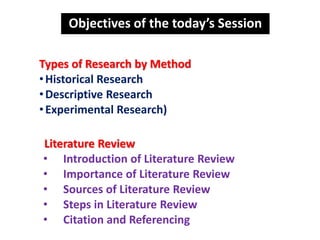
Objectives of the today’s Session
Types of Research by Method
•Historical Research
•Descriptive Research
•Experimental Research)
Literature Review
• Introduction of Literature Review
• Importance of Literature Review
• Sources of Literature Review
• Steps in Literature Review
• Citation and Referencing
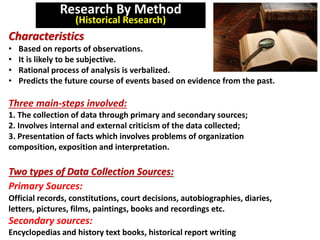
Research By Method
(Historical Research)
Characteristics
• Based on reports of observations.
• It is likely to be subjective.
• Rational process of analysis is verbalized.
• Predicts the future course of events based on evidence from the past.
Three main-steps involved:
1. The collection of data through primary and secondary sources;
2. Involves internal and external criticism of the data collected;
3. Presentation of facts which involves problems of organization
composition, exposition and interpretation.
Two types of Data Collection Sources:
Primary Sources:
Official records, constitutions, court decisions, autobiographies, diaries,
letters, pictures, films, paintings, books and recordings etc.
Secondary sources:
Encyclopedias and history text books, historical report writing
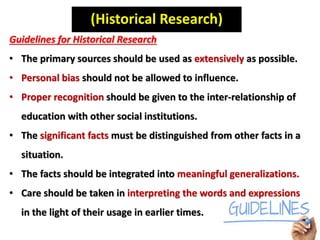
(Historical Research)
Guidelines for Historical Research
• The primary sources should be used as extensively as possible.
• Personal bias should not be allowed to influence.
• Proper recognition should be given to the inter-relationship of
education with other social institutions.
• The significant facts must be distinguished from other facts in a
situation.
• The facts should be integrated into meaningful generalizations.
• Care should be taken in interpreting the words and expressions
in the light of their usage in earlier times.
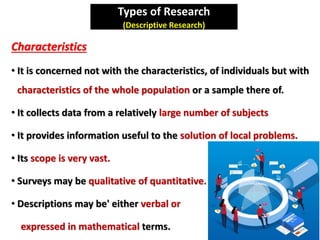
Types of Research
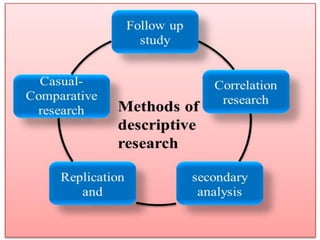
(Descriptive Research)
Characteristics
• It is concerned not with the characteristics, of individuals but with
characteristics of the whole population or a sample there of.
• It collects data from a relatively large number of subjects
• It provides information useful to the solution of local problems.
• Its scope is very vast.
• Surveys may be qualitative of quantitative.
• Descriptions may be' either verbal or
expressed in mathematical terms.
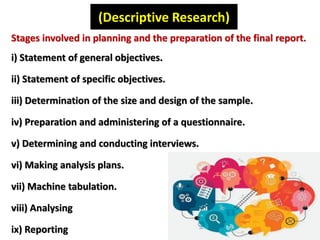
(Descriptive Research)
Stages involved in planning and the preparation of the final report.
i) Statement of general objectives.
ii) Statement of specific objectives.
iii) Determination of the size and design of the sample.
iv) Preparation and administering of a questionnaire.
v) Determining and conducting interviews.
vi) Making analysis plans.
vii) Machine tabulation.
viii) Analysing
ix) Reporting
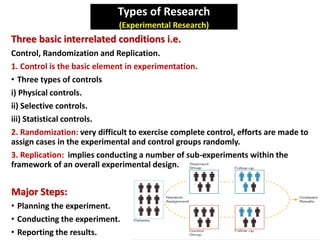
Types of Research
(Experimental Research)
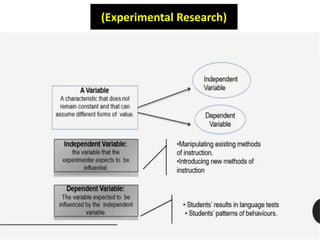
Three basic interrelated conditions i.e.
Control, Randomization and Replication.
1. Control is the basic element in experimentation.
• Three types of controls
i) Physical controls.
ii) Selective controls.
iii) Statistical controls.
2. Randomization: very difficult to exercise complete control, efforts are made to
assign cases in the experimental and control groups randomly.
3. Replication: implies conducting a number of sub-experiments within the
framework of an overall experimental design.
Major Steps:
• Planning the experiment.
• Conducting the experiment.
• Reporting the results.
(Experimental Research)
Unit 3: Literature Review
• Literature review discusses and analyses published
information in a particular selected area of study.
• Literature review is more than the search for information
• All works included in the review must be read, evaluated and
analyzed.
• Relationships between the literature must also be identified and
articulated, in relation to your field of research.
• A literature review is a written summary of journal articles, books,
and other documents describes the past and current state of
information on the topic of your research
• A good review, however, might also contain other
information drawn from conference papers,
books, and government documents.
• May cite articles that are both quantitative and
qualitative studies.
Importance of Literature Review
• To document how your study adds to the existing literature
• Systematic identification, location, and analysis of documents
• Discover research strategies and specific data collection approaches
A good literature review will help you to:
• To define and limit your research.
• To place your study in an historical perspective.
• To avoid unnecessary duplication.
• To evaluate research methods.
• To relate your findings to previous knowledge and suggest further
research.
Sources of Literature Review
Primary Sources:
• Diaries
• Interviews
• Letters
• Original works of art
• Photographs
• Works of literature
• The original research reports, articles, journals, or books.
• Secondary Sources:
• Biographies
• Dissertations
• Indexes, Abstracts, Bibliographies (used to locate a secondary source)
• Journal Articles
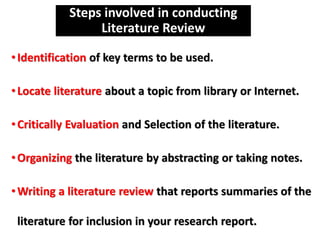
Steps involved in conducting
Literature Review
•Identification of key terms to be used.
•Locate literature about a topic from library or Internet.
•Critically Evaluation and Selection of the literature.
•Organizing the literature by abstracting or taking notes.
•Writing a literature review that reports summaries of the
literature for inclusion in your research report.
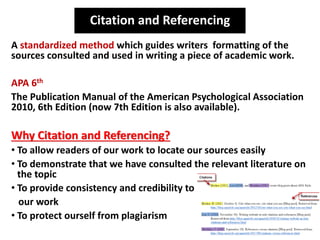
A standardized method which guides writers formatting of the
sources consulted and used in writing a piece of academic work.
APA 6th
The Publication Manual of the American Psychological Association
2010, 6th Edition (now 7th Edition is also available).
Why Citation and Referencing?
• To allow readers of our work to locate our sources easily
• To demonstrate that we have consulted the relevant literature on
the topic
• To provide consistency and credibility to
our work
• To protect ourself from plagiarism
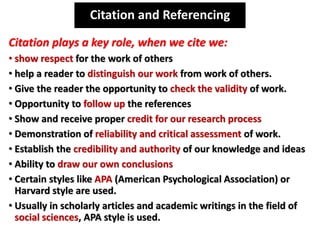
Citation and Referencing
Citation plays a key role, when we cite we:
• show respect for the work of others
• help a reader to distinguish our work from work of others.
• Give the reader the opportunity to check the validity of work.
• Opportunity to follow up the references
• Show and receive proper credit for our research process
• Demonstration of reliability and critical assessment of work.
• Establish the credibility and authority of our knowledge and ideas
• Ability to draw our own conclusions
• Certain styles like APA (American Psychological Association) or
Harvard style are used.
• Usually in scholarly articles and academic writings in the field of
social sciences, APA style is used.
Citation and Referencing
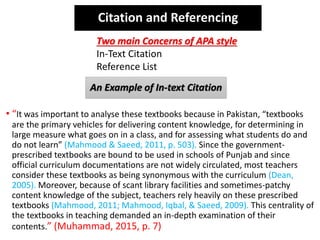
An Example of In-text Citation
• “It was important to analyse these textbooks because in Pakistan, “textbooks
are the primary vehicles for delivering content knowledge, for determining in
large measure what goes on in a class, and for assessing what students do and
do not learn” (Mahmood & Saeed, 2011, p. 503). Since the government-
prescribed textbooks are bound to be used in schools of Punjab and since
official curriculum documentations are not widely circulated, most teachers
consider these textbooks as being synonymous with the curriculum (Dean,
2005). Moreover, because of scant library facilities and sometimes-patchy
content knowledge of the subject, teachers rely heavily on these prescribed
textbooks (Mahmood, 2011; Mahmood, Iqbal, & Saeed, 2009). This centrality of
the textbooks in teaching demanded an in-depth examination of their
contents.” (Muhammad, 2015, p. 7)
Two main Concerns of APA style
In-Text Citation
Reference List
Citation and Referencing
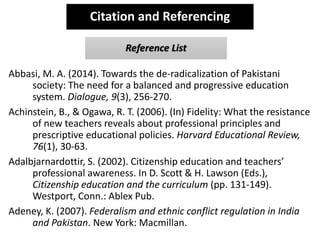
Abbasi, M. A. (2014). Towards the de-radicalization of Pakistani
society: The need for a balanced and progressive education
system. Dialogue, 9(3), 256-270.
Achinstein, B., & Ogawa, R. T. (2006). (In) Fidelity: What the resistance
of new teachers reveals about professional principles and
prescriptive educational policies. Harvard Educational Review,
76(1), 30-63.
Adalbjarnardottir, S. (2002). Citizenship education and teachers’
professional awareness. In D. Scott & H. Lawson (Eds.),
Citizenship education and the curriculum (pp. 131-149).
Westport, Conn.: Ablex Pub.
Adeney, K. (2007). Federalism and ethnic conflict regulation in India
and Pakistan. New York: Macmillan.
Citation and Referencing
Reference List
Jameel 6461 day 2.pdf

Jameel 6461 day 2.pdf

  • 1.
    Course Code: (6461) (Day2) (Educational Research and Statistics) Types of Research (Unit 2) Classification of Research by Method (Historical, Descriptive Research, Experimental Research) Literature Review (Unit 3) Introduction, Importance, Sources, Citation & Referencing) • Concept of Research in Education • Need and Scope of Research in Education Muhammad Jameel PhD Scholar (Education) 03004255912
  • 2.
    Objectives of thetoday’s Session Types of Research by Method •Historical Research •Descriptive Research •Experimental Research) Literature Review • Introduction of Literature Review • Importance of Literature Review • Sources of Literature Review • Steps in Literature Review • Citation and Referencing
  • 3.
    Research By Method (HistoricalResearch) Characteristics • Based on reports of observations. • It is likely to be subjective. • Rational process of analysis is verbalized. • Predicts the future course of events based on evidence from the past. Three main-steps involved: 1. The collection of data through primary and secondary sources; 2. Involves internal and external criticism of the data collected; 3. Presentation of facts which involves problems of organization composition, exposition and interpretation. Two types of Data Collection Sources: Primary Sources: Official records, constitutions, court decisions, autobiographies, diaries, letters, pictures, films, paintings, books and recordings etc. Secondary sources: Encyclopedias and history text books, historical report writing
  • 4.
    (Historical Research) Guidelines forHistorical Research • The primary sources should be used as extensively as possible. • Personal bias should not be allowed to influence. • Proper recognition should be given to the inter-relationship of education with other social institutions. • The significant facts must be distinguished from other facts in a situation. • The facts should be integrated into meaningful generalizations. • Care should be taken in interpreting the words and expressions in the light of their usage in earlier times.
  • 5.
    Types of Research (DescriptiveResearch) Characteristics • It is concerned not with the characteristics, of individuals but with characteristics of the whole population or a sample there of. • It collects data from a relatively large number of subjects • It provides information useful to the solution of local problems. • Its scope is very vast. • Surveys may be qualitative of quantitative. • Descriptions may be' either verbal or expressed in mathematical terms.
  • 7.
    (Descriptive Research) Stages involvedin planning and the preparation of the final report. i) Statement of general objectives. ii) Statement of specific objectives. iii) Determination of the size and design of the sample. iv) Preparation and administering of a questionnaire. v) Determining and conducting interviews. vi) Making analysis plans. vii) Machine tabulation. viii) Analysing ix) Reporting
  • 8.
    Types of Research (ExperimentalResearch) Three basic interrelated conditions i.e. Control, Randomization and Replication. 1. Control is the basic element in experimentation. • Three types of controls i) Physical controls. ii) Selective controls. iii) Statistical controls. 2. Randomization: very difficult to exercise complete control, efforts are made to assign cases in the experimental and control groups randomly. 3. Replication: implies conducting a number of sub-experiments within the framework of an overall experimental design. Major Steps: • Planning the experiment. • Conducting the experiment. • Reporting the results.
  • 9.
  • 10.
    Unit 3: LiteratureReview • Literature review discusses and analyses published information in a particular selected area of study. • Literature review is more than the search for information • All works included in the review must be read, evaluated and analyzed. • Relationships between the literature must also be identified and articulated, in relation to your field of research. • A literature review is a written summary of journal articles, books, and other documents describes the past and current state of information on the topic of your research • A good review, however, might also contain other information drawn from conference papers, books, and government documents. • May cite articles that are both quantitative and qualitative studies.
  • 11.
    Importance of LiteratureReview • To document how your study adds to the existing literature • Systematic identification, location, and analysis of documents • Discover research strategies and specific data collection approaches A good literature review will help you to: • To define and limit your research. • To place your study in an historical perspective. • To avoid unnecessary duplication. • To evaluate research methods. • To relate your findings to previous knowledge and suggest further research.
  • 12.
    Sources of LiteratureReview Primary Sources: • Diaries • Interviews • Letters • Original works of art • Photographs • Works of literature • The original research reports, articles, journals, or books. • Secondary Sources: • Biographies • Dissertations • Indexes, Abstracts, Bibliographies (used to locate a secondary source) • Journal Articles
  • 13.
    Steps involved inconducting Literature Review •Identification of key terms to be used. •Locate literature about a topic from library or Internet. •Critically Evaluation and Selection of the literature. •Organizing the literature by abstracting or taking notes. •Writing a literature review that reports summaries of the literature for inclusion in your research report.
  • 14.
    A standardized methodwhich guides writers formatting of the sources consulted and used in writing a piece of academic work. APA 6th The Publication Manual of the American Psychological Association 2010, 6th Edition (now 7th Edition is also available). Why Citation and Referencing? • To allow readers of our work to locate our sources easily • To demonstrate that we have consulted the relevant literature on the topic • To provide consistency and credibility to our work • To protect ourself from plagiarism Citation and Referencing
  • 15.
    Citation plays akey role, when we cite we: • show respect for the work of others • help a reader to distinguish our work from work of others. • Give the reader the opportunity to check the validity of work. • Opportunity to follow up the references • Show and receive proper credit for our research process • Demonstration of reliability and critical assessment of work. • Establish the credibility and authority of our knowledge and ideas • Ability to draw our own conclusions • Certain styles like APA (American Psychological Association) or Harvard style are used. • Usually in scholarly articles and academic writings in the field of social sciences, APA style is used. Citation and Referencing
  • 16.
    An Example ofIn-text Citation • “It was important to analyse these textbooks because in Pakistan, “textbooks are the primary vehicles for delivering content knowledge, for determining in large measure what goes on in a class, and for assessing what students do and do not learn” (Mahmood & Saeed, 2011, p. 503). Since the government- prescribed textbooks are bound to be used in schools of Punjab and since official curriculum documentations are not widely circulated, most teachers consider these textbooks as being synonymous with the curriculum (Dean, 2005). Moreover, because of scant library facilities and sometimes-patchy content knowledge of the subject, teachers rely heavily on these prescribed textbooks (Mahmood, 2011; Mahmood, Iqbal, & Saeed, 2009). This centrality of the textbooks in teaching demanded an in-depth examination of their contents.” (Muhammad, 2015, p. 7) Two main Concerns of APA style In-Text Citation Reference List Citation and Referencing
  • 17.
    Abbasi, M. A.(2014). Towards the de-radicalization of Pakistani society: The need for a balanced and progressive education system. Dialogue, 9(3), 256-270. Achinstein, B., & Ogawa, R. T. (2006). (In) Fidelity: What the resistance of new teachers reveals about professional principles and prescriptive educational policies. Harvard Educational Review, 76(1), 30-63. Adalbjarnardottir, S. (2002). Citizenship education and teachers’ professional awareness. In D. Scott & H. Lawson (Eds.), Citizenship education and the curriculum (pp. 131-149). Westport, Conn.: Ablex Pub. Adeney, K. (2007). Federalism and ethnic conflict regulation in India and Pakistan. New York: Macmillan. Citation and Referencing Reference List