How important is literacy to student success?
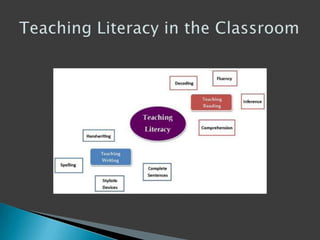
 Queensland Education describe literacy as the ability to
read, view, write, design, speak and listen in a way that allows us
to communicate effectively and to make sense of the world.
Literacy is what allows us to decode
text, pictures, maps, audio, signs etc. to be able to understand
the meaning attached to message. Literacy can be broken down
into five types:-
- Multiliteracies referring to multiple kinds of literacies being
used.
- Visual Literacy meaning the understanding of visual texts
- Critical Literacy involving the questioning, analysing and
critiquing of texts
- Subject-specific Literacy meaning understanding the
specific vocabulary and linguistic features commonly used in each
subject.
- Technological Literacy meaning the ability to be able to
construct, deconstruct and reconstruct text using the new
technologies (Wing Jan, 2011).
 Dimension 4 is the stage after we acquire the knowledge and
how we then use this knowledge meaningfully to assist in
making informed decisions. By involving students in this process
allows for their own personal growth and the greater the
motivation the higher the proficiency and understanding related
to that knowledge.
 Dimension 4 is broken up into six reasoning processes these are
- Decision Making
- Problem Solving
- Invention
- Experimental Inquiry
- Investigation
- System Analysis
The process which we will look at further is the Investigation
process.
 Help students understand the process of
investigation
 Give students a model for the process of
investigation, and create opportunities for
them to practice using the process.
 Help them focus on critical steps and difficult
aspects of the process.
 Provide students with graphic organisers
 Use teacher-structured and student
structured tasks
 What value do you place on literacy
concerning education?
 Do you feel that literacy is an important
component for every subject?
 Does literacy assessments help identify areas
of concern?
 Does a literacy assessment reflect literacy
inadequacies across a range of subjects?
 Are there any suggestions as to how you
might improve the system?
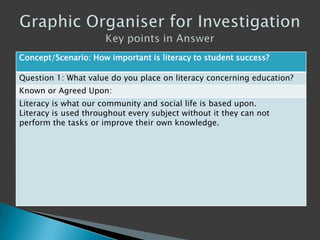
Concept/Scenario: How important is literacy to student success?
Question 1: What value do you place on literacy concerning education?
Known or Agreed Upon:
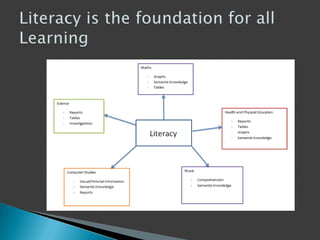
Literacy is what our community and social life is based upon.
Literacy is used throughout every subject without it they can not
perform the tasks or improve their own knowledge.
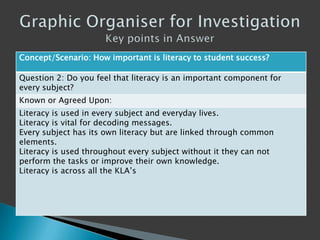
Concept/Scenario: How important is literacy to student success?
Question 2: Do you feel that literacy is an important component for
every subject?
Known or Agreed Upon:
Literacy is used in every subject and everyday lives.
Literacy is vital for decoding messages.
Every subject has its own literacy but are linked through common
elements.
Literacy is used throughout every subject without it they can not
perform the tasks or improve their own knowledge.
Literacy is across all the KLA‟s
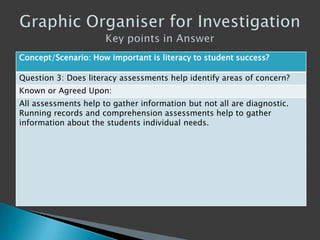
Concept/Scenario: How important is literacy to student success?
Question 3: Does literacy assessments help identify areas of concern?
Known or Agreed Upon:
All assessments help to gather information but not all are diagnostic.
Running records and comprehension assessments help to gather
information about the students individual needs.
Concept/Scenario: How important is literacy to student success?
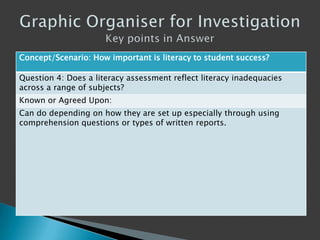
Question 4: Does a literacy assessment reflect literacy inadequacies
across a range of subjects?
Known or Agreed Upon:
Can do depending on how they are set up especially through using
comprehension questions or types of written reports.
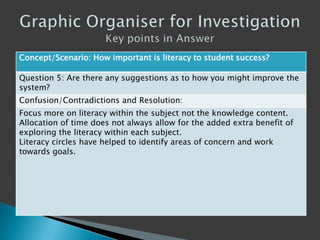
Concept/Scenario: How important is literacy to student success?
Question 5: Are there any suggestions as to how you might improve the
system?
Confusion/Contradictions and Resolution:
Focus more on literacy within the subject not the knowledge content.
Allocation of time does not always allow for the added extra benefit of
exploring the literacy within each subject.
Literacy circles have helped to identify areas of concern and work
towards goals.
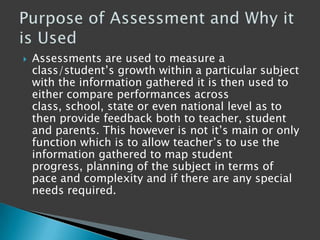
 Assessments are used to measure a
class/student‟s growth within a particular subject
with the information gathered it is then used to
either compare performances across
class, school, state or even national level as to
then provide feedback both to teacher, student
and parents. This however is not it‟s main or only
function which is to allow teacher‟s to use the
information gathered to map student
progress, planning of the subject in terms of
pace and complexity and if there are any special
needs required.
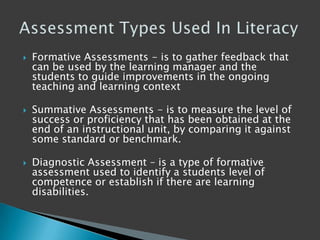
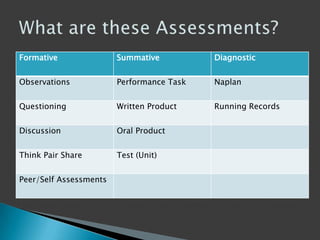
 Formative Assessments - is to gather feedback that
can be used by the learning manager and the
students to guide improvements in the ongoing
teaching and learning context
 Summative Assessments - is to measure the level of
success or proficiency that has been obtained at the
end of an instructional unit, by comparing it against
some standard or benchmark.
 Diagnostic Assessment – is a type of formative
assessment used to identify a students level of
competence or establish if there are learning
disabilities.
Formative Summative Diagnostic
Observations Performance Task Naplan
Questioning Written Product Running Records
Discussion Oral Product
Think Pair Share Test (Unit)
Peer/Self Assessments
With the release of the C2C in Queensland schools there has been a push
for content to be taught and due to the time constraints put on teacher‟s
to complete module‟s there leaves little time to reflect and focus on the
literacy aspects within each subject thus leaving a gap within the student‟s
learning progression. School‟s within the region have begun to focus on
using reading groups that are conducted in some schools from 3-5 days a
week which can focus on anything from English based work to literacy
skills. Some ideas being used in reading groups are as below:
 Literature circles
 Comprehension skills
 Writing Tasks
Reading groups are not the only strategy that can be employed within the
classrooms but other activities can also be incorporated within your daily
lessons like below:
 Word Walls
 Rhyming Games
 Think alouds
 Concept maps
 Summarizing
The government has also reorganised the English curriculum into
three closely interrelated strands: Language („Knowing about the
English language‟), Literature („Understanding, appreciating,
responding to, analysing and creating literature‟), and Literacy
(„Growing a repertoire of English usage‟)(Winch, 2011). Student‟s
are now becoming regularly in contact with a variety of literature
such as novels, poetry, short stories, plays, fiction, picture books
and multimodal texts. It is through this contact that student‟s are
able to build upon their own critical understandings such as :-
 The social, historical and cultural contexts of texts
 The text‟s formal, creative and aesthetic qualities
 Ways in which argument and viewpoint are presented and
supported through a text
 How a text‟s features reflect the perspectives from which it can
be interpreted
 How different perspectives are associated with different uses of
language (Winch, 2011).
The Year 2 Diagnostic Net is a process of assessment and
intervention to support children's literacy and numeracy
development during the early years of schooling in Queensland. It
identifies and provides additional support for, those children who
are experiencing difficulties in literacy and numeracy (Education
Queensland)
This program has four steps that are involved these being:-
 observe and map children's progress using developmental
continua for literacy and numeracy
 involve identified Year 2 children in specifically designed
assessment tasks and identify children who require intervention
 provide support to children requiring additional assistance
 report to parents about their child's development in literacy
It is through these observations that teachers are then able to
monitor a child‟s progress through aligning with key indicators that
are grouped into phases to identify where each student is along the
reading or writing developmental continuum.
“ Literacy is pretty much everything, without
literacy you can not do anything”(Dianne Philp)
which is why it is vitally important that these
skills are constantly monitored and assessed as
to continue to provide planning for both class
and individual student progress. Literacy is
linked to individual success as it determines a
student‟s ability to be able to communicate
and interpret information which is a necessary
skill within any environment be it school or
everyday life.
 Marzano. R.J, (1997). Dimensions of Learning. Aurora: McREL
 Brady. L, (). Assessment and Reporting. Frenchs Forest: Pearson
Australia
 Winch. G, (2011). Literacy reading, writing & children‟s literature.
Melbourne: Oxford University Press
 Wing Jan. L, (2011). Write Ways. Melbourne: Oxford University
Press
 Qld Government. (2012) Year 2 Diagnostic Net. Retrieved from
http://education.qld.gov.au/students/policy/assessment/y2dn/
 Qld Government. (2012) Literacy and Numeracy Fact Sheet.
Retrieved from
http://education.qld.gov.au/literacyandnumeracy/pdf/factsheet-
l-n.pdf

Literacy Assessment and the importance

  • 1.
    How important isliteracy to student success?
  • 2.
     Queensland Educationdescribe literacy as the ability to read, view, write, design, speak and listen in a way that allows us to communicate effectively and to make sense of the world. Literacy is what allows us to decode text, pictures, maps, audio, signs etc. to be able to understand the meaning attached to message. Literacy can be broken down into five types:- - Multiliteracies referring to multiple kinds of literacies being used. - Visual Literacy meaning the understanding of visual texts - Critical Literacy involving the questioning, analysing and critiquing of texts - Subject-specific Literacy meaning understanding the specific vocabulary and linguistic features commonly used in each subject. - Technological Literacy meaning the ability to be able to construct, deconstruct and reconstruct text using the new technologies (Wing Jan, 2011).
  • 5.
     Dimension 4is the stage after we acquire the knowledge and how we then use this knowledge meaningfully to assist in making informed decisions. By involving students in this process allows for their own personal growth and the greater the motivation the higher the proficiency and understanding related to that knowledge.  Dimension 4 is broken up into six reasoning processes these are - Decision Making - Problem Solving - Invention - Experimental Inquiry - Investigation - System Analysis The process which we will look at further is the Investigation process.
  • 6.
     Help studentsunderstand the process of investigation  Give students a model for the process of investigation, and create opportunities for them to practice using the process.  Help them focus on critical steps and difficult aspects of the process.  Provide students with graphic organisers  Use teacher-structured and student structured tasks
  • 7.
     What valuedo you place on literacy concerning education?  Do you feel that literacy is an important component for every subject?  Does literacy assessments help identify areas of concern?  Does a literacy assessment reflect literacy inadequacies across a range of subjects?  Are there any suggestions as to how you might improve the system?
  • 11.
    Concept/Scenario: How importantis literacy to student success? Question 1: What value do you place on literacy concerning education? Known or Agreed Upon: Literacy is what our community and social life is based upon. Literacy is used throughout every subject without it they can not perform the tasks or improve their own knowledge.
  • 12.
    Concept/Scenario: How importantis literacy to student success? Question 2: Do you feel that literacy is an important component for every subject? Known or Agreed Upon: Literacy is used in every subject and everyday lives. Literacy is vital for decoding messages. Every subject has its own literacy but are linked through common elements. Literacy is used throughout every subject without it they can not perform the tasks or improve their own knowledge. Literacy is across all the KLA‟s
  • 13.
    Concept/Scenario: How importantis literacy to student success? Question 3: Does literacy assessments help identify areas of concern? Known or Agreed Upon: All assessments help to gather information but not all are diagnostic. Running records and comprehension assessments help to gather information about the students individual needs.
  • 14.
    Concept/Scenario: How importantis literacy to student success? Question 4: Does a literacy assessment reflect literacy inadequacies across a range of subjects? Known or Agreed Upon: Can do depending on how they are set up especially through using comprehension questions or types of written reports.
  • 15.
    Concept/Scenario: How importantis literacy to student success? Question 5: Are there any suggestions as to how you might improve the system? Confusion/Contradictions and Resolution: Focus more on literacy within the subject not the knowledge content. Allocation of time does not always allow for the added extra benefit of exploring the literacy within each subject. Literacy circles have helped to identify areas of concern and work towards goals.
  • 16.
     Assessments areused to measure a class/student‟s growth within a particular subject with the information gathered it is then used to either compare performances across class, school, state or even national level as to then provide feedback both to teacher, student and parents. This however is not it‟s main or only function which is to allow teacher‟s to use the information gathered to map student progress, planning of the subject in terms of pace and complexity and if there are any special needs required.
  • 17.
     Formative Assessments- is to gather feedback that can be used by the learning manager and the students to guide improvements in the ongoing teaching and learning context  Summative Assessments - is to measure the level of success or proficiency that has been obtained at the end of an instructional unit, by comparing it against some standard or benchmark.  Diagnostic Assessment – is a type of formative assessment used to identify a students level of competence or establish if there are learning disabilities.
  • 18.
    Formative Summative Diagnostic ObservationsPerformance Task Naplan Questioning Written Product Running Records Discussion Oral Product Think Pair Share Test (Unit) Peer/Self Assessments
  • 19.
    With the releaseof the C2C in Queensland schools there has been a push for content to be taught and due to the time constraints put on teacher‟s to complete module‟s there leaves little time to reflect and focus on the literacy aspects within each subject thus leaving a gap within the student‟s learning progression. School‟s within the region have begun to focus on using reading groups that are conducted in some schools from 3-5 days a week which can focus on anything from English based work to literacy skills. Some ideas being used in reading groups are as below:  Literature circles  Comprehension skills  Writing Tasks Reading groups are not the only strategy that can be employed within the classrooms but other activities can also be incorporated within your daily lessons like below:  Word Walls  Rhyming Games  Think alouds  Concept maps  Summarizing
  • 20.
    The government hasalso reorganised the English curriculum into three closely interrelated strands: Language („Knowing about the English language‟), Literature („Understanding, appreciating, responding to, analysing and creating literature‟), and Literacy („Growing a repertoire of English usage‟)(Winch, 2011). Student‟s are now becoming regularly in contact with a variety of literature such as novels, poetry, short stories, plays, fiction, picture books and multimodal texts. It is through this contact that student‟s are able to build upon their own critical understandings such as :-  The social, historical and cultural contexts of texts  The text‟s formal, creative and aesthetic qualities  Ways in which argument and viewpoint are presented and supported through a text  How a text‟s features reflect the perspectives from which it can be interpreted  How different perspectives are associated with different uses of language (Winch, 2011).
  • 21.
    The Year 2Diagnostic Net is a process of assessment and intervention to support children's literacy and numeracy development during the early years of schooling in Queensland. It identifies and provides additional support for, those children who are experiencing difficulties in literacy and numeracy (Education Queensland) This program has four steps that are involved these being:-  observe and map children's progress using developmental continua for literacy and numeracy  involve identified Year 2 children in specifically designed assessment tasks and identify children who require intervention  provide support to children requiring additional assistance  report to parents about their child's development in literacy It is through these observations that teachers are then able to monitor a child‟s progress through aligning with key indicators that are grouped into phases to identify where each student is along the reading or writing developmental continuum.
  • 22.
    “ Literacy ispretty much everything, without literacy you can not do anything”(Dianne Philp) which is why it is vitally important that these skills are constantly monitored and assessed as to continue to provide planning for both class and individual student progress. Literacy is linked to individual success as it determines a student‟s ability to be able to communicate and interpret information which is a necessary skill within any environment be it school or everyday life.
  • 23.
     Marzano. R.J,(1997). Dimensions of Learning. Aurora: McREL  Brady. L, (). Assessment and Reporting. Frenchs Forest: Pearson Australia  Winch. G, (2011). Literacy reading, writing & children‟s literature. Melbourne: Oxford University Press  Wing Jan. L, (2011). Write Ways. Melbourne: Oxford University Press  Qld Government. (2012) Year 2 Diagnostic Net. Retrieved from http://education.qld.gov.au/students/policy/assessment/y2dn/  Qld Government. (2012) Literacy and Numeracy Fact Sheet. Retrieved from http://education.qld.gov.au/literacyandnumeracy/pdf/factsheet- l-n.pdf