The Literate
     Environment
            Lauren Schipper
            October 12, 2012
            Walden University
EDUC 6706: The Beginning Reader, Pre K-3
     Instructor: Dr. Bernice Gregory
The Literate Environment
 A literate environment is one that promotes reading and
writing by integrating foundational knowledge, instructional
      practices, approaches and methods, curriculum
     materials, and the appropriate use of assessments
         (International Reading Association, 2010).
Contents

Getting to Know Literacy Learners

Selecting Texts

Literacy Lesson: The Interactive Perspective

Literacy Lesson: The Critical & Response Perspectives

References
Getting to Know Literacy
                 Learners
    “Effective teachers understand how students learn” (Tompkins, 2009, p.5)

A combination of cognitive and non-cognitive tools is key to
accurately assess students’ literacy learning.

  Cognitive Assessments – Tools focused on the skills and
  strategies used by students as they develop as readers.
  These skills and strategies are those that students use in
  decoding, understanding words, and constructing
  meaning (Afflerbach, 2007).

  Non-Cognitive Assessments – Tools focused on assessing
  students’ motivation to read, the reader’s self-
  concept, reading attitudes, an reader attributions
  (Afflerbach, 2007).
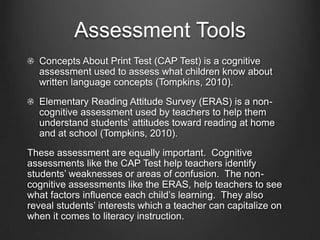
Assessment Tools
  Concepts About Print Test (CAP Test) is a cognitive
  assessment used to assess what children know about
  written language concepts (Tompkins, 2010).
  Elementary Reading Attitude Survey (ERAS) is a non-
  cognitive assessment used by teachers to help them
  understand students’ attitudes toward reading at home
  and at school (Tompkins, 2010).
These assessment are equally important. Cognitive
assessments like the CAP Test help teachers identify
students’ weaknesses or areas of confusion. The non-
cognitive assessments like the ERAS, help teachers to see
what factors influence each child’s learning. They also
reveal students’ interests which a teacher can capitalize on
when it comes to literacy instruction.
Selecting Texts
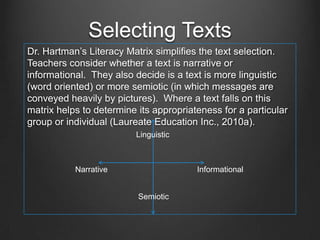
Dr. Hartman’s Literacy Matrix simplifies the text selection.
Teachers consider whether a text is narrative or
informational. They also decide is a text is more linguistic
(word oriented) or more semiotic (in which messages are
conveyed heavily by pictures). Where a text falls on this
matrix helps to determine its appropriateness for a particular
group or individual (Laureate Education Inc., 2010a).
                         Linguistic


           Narrative                    Informational


                          Semiotic
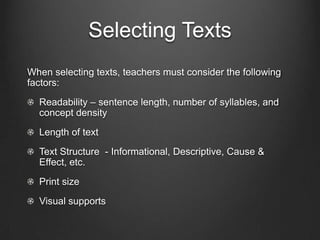
Selecting Texts
When selecting texts, teachers must consider the following
factors:
  Readability – sentence length, number of syllables, and
  concept density
  Length of text
  Text Structure - Informational, Descriptive, Cause &
  Effect, etc.
  Print size
  Visual supports
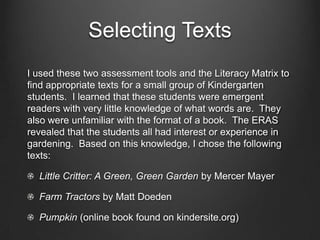
Selecting Texts
I used these two assessment tools, the Literacy Matrix and the
“Checklist for Choosing Informational Books for Young Children”
(Stephens, 2008) to find appropriate texts for a small group of
Kindergarten students. I learned that these students were
emergent readers with very little knowledge of what words are.
They also were unfamiliar with the format of a book. The ERAS
revealed that the students all had interest or experience in
gardening. Based on this knowledge, I chose the following texts:

   Little Critter: A Green, Green Garden by Mercer Mayer

   Farm Tractors by Matt Doeden

   Pumpkin (online book found on kindersite.org)
Literacy Lesson: The
         Interactive Perspective
The ultimate goal of the Interactive Perspective is to teach students
how to be literate learners who are able to navigate text
independently (Laureate Education Inc., 2010c). We want to teach
them to be strategic and metacognitive readers and writers. To do
so, it must be a part of all five pillars of reading instruction:

   Phonic Awareness

   Phonics & Concepts about Print

   Fluency

   Vocabulary

   Comprehension
Literacy Lesson: The
        Interactive Perspective
In a recent lesson, I utilized the book King Bidgood’s in the
Bathtub by Audrey Wood to have students work on
comprehension and word concepts.

  Learning objectives: Students will practice critical thinking
  by predicting what would happen in the story by using the
  illustrations and a few word cues. They will also ask and
  answer questions about the text.

  Strategies: Shared reading, grand conversation, picture
  walk, and teacher generated questions.
Literacy Lesson: The
        Interactive Perspective
                Analysis
The students successfully met my learning objectives for this
lesson. Shared reading is a strategy widely used in
kindergarten classrooms (Stahl, 2004). Accompanying this
with a picture walk, teacher generated questions, prediction
making, and grand conversations ensured that the students
thoroughly comprehended the text.

Every lesson is trial and error, and every group of students
responds differently. This lesson worked for this group
because it suited their literacy learning needs and their
interests.
Literacy Lesson: Critical &
      Response Perspectives
The Critical and Response Perspectives are vital to literacy
instruction. In the Critical Perspective, students critically
examine and evaluate text through multiple perspectives
(Laureate Education Inc., 2010b). The Response
Perspective allows students to be thoughtful and reflective
about texts.

In a recent lesson with kindergarten students, I was able to
incorporate both these perspectives using the book Enemy
Pie by Derek Munson. This book was chosen based upon a
recent school-wide activity about bullying that the students
participated in.
Literacy Lesson: Critical &
   Response Perspectives
Learning Objectives: Students will ask and answer
questions about a text. They will react to characters and
events in the story. The students will make connections
between the story and their own world. They will also
express feelings and opinions about the story.
Finally, students will understand the different perspectives
of the characters in the story.

Strategies: Shared reading, grand conversation, picture
walk, and teacher generated questions.
Literacy Lesson: Critical &
      Response Perspectives
              Analysis
Overall, this lesson was a success. I feel that the students related
to Enemy Pie, especially given their prior knowledge that they
gained from their school-wide activity about bullying. They were
able to connect the story to their own lives easily. It seemed that
with each page read, the students had a story to tell or a question
to ask. They also were drawn to the two main characters, and
were empathetic toward them. At the end of the story, the students
discussed what this story reminded them of and drew a picture to
illustrate their thoughts. According to Dr. Vacca, writing (drawing
being the equivalent of at the kindergarten level) lead to new
discoveries about a text (Laureate Education Inc., 2010d). In this
lesson, the student were able to critically analyze the text and their
responses demonstrate what they learned.
References
Afflerbach, P. (2007). Understanding and Using Reading Assessment, K-12 (2nd ed.). Newark, DE: International Reading Association.


International Reading Association (IRA). (2010). Standards for reading professionals – revised 2010. Retrieved from http://www.reading.org/General/CurrentResearch/Standards/ProfessionalStandards.aspx


Laureate Education Inc., (Producer). (2010). Analyzing and selecting texts. [Video Webcast]. Retrieved from
https://class.waldenu.edu/webapps/portal/frameset.jsp?tab_tab_group_id=_2_1&url=%2Fwebapps%2Fblackboard%2Fexecute%2Flauncher%3Ftype%3DCourse%26id%3D_1374068_1%26url%3D


Laureate Education Inc., (Producer). (2010). Critical Perspectives. [Video Webcast]. Retrieved from
https://class.waldenu.edu/webapps/portal/frameset.jsp?tab_tab_group_id=_2_1&url=%2Fwebapps%2Fblackboard%2Fexecute%2Flauncher%3Ftype%3DCourse%26id%3D_1374068_1%26url%3D


Laureate Education Inc., (Producer). (2010). Interactive Perspective: Strategic Processing. [Video Webcast]. Retrieved from
https://class.waldenu.edu/webapps/portal/frameset.jsp?tab_tab_group_id=_2_1&url=%2Fwebapps%2Fblackboard%2Fexecute%2Flauncher%3Ftype%3DCourse%26id%3D_1374068_1%26url%3D


Laureate Education Inc., (Producer). (2010). Response Perspective: Reading-Writing Connection. [Video Webcast]. Retrieved from
https://class.waldenu.edu/webapps/portal/frameset.jsp?tab_tab_group_id=_2_1&url=%2Fwebapps%2Fblackboard%2Fexecute%2Flauncher%3Ftype%3DCourse%26id%3D_1374068_1%26url%3D


Munson, D. (2000). Enemy Pie. San Francisco, CA: Chronicle Books LLC.


Stahl, K.A.D. (2004). Proof, practice, and promise: Comprehension strategy instruction in the primary grades. The Reading Teacher. 57(7). 598-608.


Stephens, K.E. (2008). A quick guide to selecting great informational books for young children. The Reading Teacher, 61(6), 488-490.


Tompkins, G.E. (2010). Literacy for the 21st century: A balanced approach (5th ed.). Boston: Allyn & Bacon.


Wood , A. (1985). King Bidgood’s in the Bathtub. San Diego, CA: Harcourt Brace & Company.