1 (a)
MATHS

very low………………………………………………………………average……………………………………………………………very high

//

School
National

1
Examples of questions
(a) 77 + 42 =
(b) Increase 27 by 6
(c) 21.23 – 12.4 =
(d) Calculate 12% of 20

200m

(e) Measure the perimeter of this field
50m

(f) 2 + 2
5 3

=

32
(a)
By working with small groups
MATHS LITERACY – SUMMARY OF 29 STUDENT RESPONSES

A p p e n d ix 1 .4 : In te r v ie w s c h e d u le s

I N E R V IE W S C H E D U L E : U M E R A C Y
SUBJECT TDEPARTMENTNREVIEW OF
NUMERACY ACROSSS THE CURRICULUM
Representative Group/
Subject Departm
ent
DATE: 3/10/12

Interviewer

DEPARTMENT: SUMMARY

Identifiers

Date
E V A L U A T IO N T H E M E : N U M E R A C Y A C R O S S T H E C U R R IC U L U M A N D / O R IN S U B J E C T X

H o w s u c c e s s f u l a r e w e in in t e g r a t in g t h e d e v e lo p m e n t o f n u m e r a c y in t o o u r s u b je c t ?

It depends on the subject but we should try when we can, we probably should do more.
H o w c lo s e ly d o w e c o lla b o r a te w ith th e m a th e m a tic s d e p a r t m e n t in p la n n in g o u r d e liv e r y s c h e d u le ?

Not closely at all. No time for meetings.

A r e w e h a p p y th a t o u r p r a c tic e in c a r r y in g o u t c a lc u la tio n s a n d o t h e r m a th e m a tic a l p r o c e d u r e s a n d th e u s e
o f m a t h e m a t ic a l s y m b o ls a n d t e r m in o l o g y is c o n s is t e n t w it h t h a t p r e s c r ib e d b y t h e m a t h e m a t ic s
d e p a rtm e n t?

Not sure, don’t know what they do.

W h a t is w o r k in g w e ll?

Students like using the LUVE2CU problem solving approach and pair work.
A r e t h e r e a n y p r o b le m a r e a s ?

Use of Maths language, understanding Maths terms & symbols, general carelessness.
W h a t a c tio n c a n w e ta k e to im p r o v e ?

More links with Maths dept, key words, posters, insist on students checking their work.

H o w e f f e c t iv e a r e w e in d e v e lo p in g s t u d e n t s ’ p r o b le m - s o l v in g s k ills in o u r le s s o n s ? A r e t h e r e a n y
d i f f ic u l t ie s ? H o w c a n w e im p r o v e t h e t e a c h in g a n d le a r n in g o f p r o b le m - s o lv i n g ?

Using LUVE2CU and pair and group work, group work can be difficult with some classes.
W h a t s t r a te g ie s a r e m o s t s u c c e s s f u l in e n h a n c in g t h e n u m e r a c y s k ills o f s tu d e n t s w ith s p e c ia l e d u c a t io n
n e e d s ? Differentiation, concrete resources, peer tutoring, on-line games such as freerice.com.
W h a t a r e th e m o s t e ffe c tiv e te a c h in g a n d le a r n in g s t r a te g ie s fo r fu r th e r d e v e lo p in g th e n u m e r a c y o f
s t u d e n t s w it h v e r y g o o d m a t h e m a t ic s a b ilit y ?

Extension exercises, on-line programmes, peer tutoring.

D o w e p r o v id e o p p o r t u n it ie s f o r t h e a s s e s s m e n t o f n u m e r a c y w h e n a s s e s s in g s t u d e n t s ’ le a r n in g in t h is
s u b j e c t ? Sometimes, it depends on the subject.

• Review subject plans to identify numeracy needs of each topic.
• CPD from Maths department.
Visualiser, IWB,Ensure we do not leave the Maths elements of ourgraphs/charts in magazines.
• on-line games, IXL free practices, freerice.com, subject to the Maths
W h a t c h a n g e s s h odepartment sto eteach. u r p r a c t i c e t o f u r t h e r f a c i l i t a t e n u m e r a c y d e v e l o p m e n t i n o u r
u ld w e c o n id r in o
le s s o n s ?
• Make links with what is done in Maths where possible.
• Have a copy of the Maths dept plan in our own plans so we know when certain
H o w e f f e c t i v e i s o u topics are tbeing taught. c o n s o l i d a t i n g s t u d e n t s ’ l e a r n i n g o f n u m e r a c y i n o u r s u b j e c t ?
r a p p r o a c h o h o m e w o rk in
• Common use of calculator.
• Let students work out their own percentages for test results
W h a t r e s o u r c e s , in c lu d in g IC T , a r e m o s t u s e f u l in e n h a n c in g t h e t e a c h in g o f n u m e r a c y in o u r s u b je c t ?

3 (b)

4

63
Diagnostic Window Review
Numeracy
List the strengths

List the areas for improvement

1. Learner outcomes
Attainment of curriculum objectives

1. Learner outcomes
Attainment of curriculum objectives

2. Learning experience
Engagement in learning

2. Learning experience
Engagement in learning

3. Teachers’ practice
Teaching approaches

3. Teachers’ practice
Teaching approaches

List your findings from the data

What further questions do we have?

Sources of Evidence Used:

Source: adapted from Michael Fullan “School Self-Assessment The Road to School
Effectiveness”

5
Sample School Self-Evaluation Report for
Post-Primary Numeracy Worked Example
1. Introduction
1.1 The focus of the evaluation
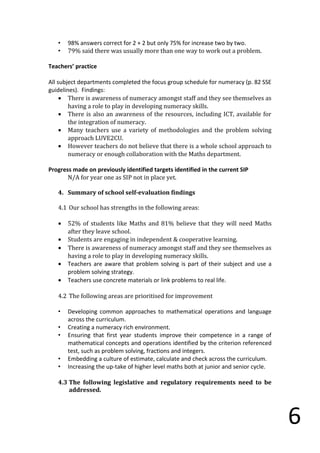
A school self-evaluation of teaching & learning in school X was undertaken in the
first term of 2012. During the evaluation Maths and how the teaching and
learning in all other subjects support the acquisition of numeracy skills in 1 st Year
were reviewed.
This is a report on the finding of the evaluation
1.2 School context
This is an urban, DEIS, mixed school with 300 students and approximately
45 EAL students. We have an excellent tradition of school development
planning. We provide a varied curriculum including JCSP, TY, LCA
programmes.
2. The Findings
Learner Outcomes
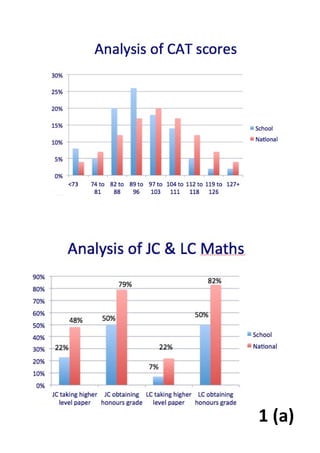
• A Cognitive Ability Test (CAT) was administered to all 1 st Year students
and the results for the cohort are well below the national norms.
• A Maths competency test for 1st Years was designed and administered by
the numeracy link teacher and Maths department in September which
identified scope for improvement in the mastery of a range of specific
skills in the cohort sampled.
• All subject departments used the PDST tool for analysing results in the
Leaving and Junior Certificate exams and analysed the trend over the last
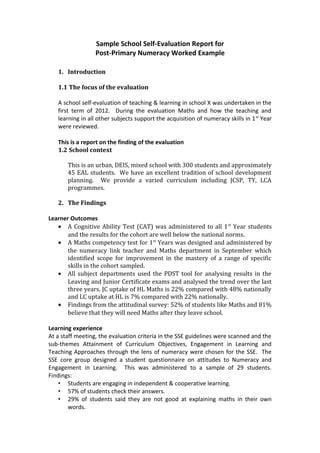
three years. JC uptake of HL Maths is 22% compared with 48% nationally
and LC uptake at HL is 7% compared with 22% nationally.
• Findings from the attitudinal survey: 52% of students like Maths and 81%
believe that they will need Maths after they leave school.
Learning experience
At a staff meeting, the evaluation criteria in the SSE guidelines were scanned and the
sub-themes Attainment of Curriculum Objectives, Engagement in Learning and
Teaching Approaches through the lens of numeracy were chosen for the SSE. The
SSE core group designed a student questionnaire on attitudes to Numeracy and
Engagement in Learning. This was administered to a sample of 29 students.
Findings:
• Students are engaging in independent & cooperative learning.
• 57% of students check their answers.
• 29% of students said they are not good at explaining maths in their own
words.
•
•

98% answers correct for 2 + 2 but only 75% for increase two by two.
79% said there was usually more than one way to work out a problem.

Teachers’ practice
All subject departments completed the focus group schedule for numeracy (p. 82 SSE
guidelines). Findings:
• There is awareness of numeracy amongst staff and they see themselves as
having a role to play in developing numeracy skills.
• There is also an awareness of the resources, including ICT, available for
the integration of numeracy.
• Many teachers use a variety of methodologies and the problem solving
approach LUVE2CU.
• However teachers do not believe that there is a whole school approach to
numeracy or enough collaboration with the Maths department.
Progress made on previously identified targets identified in the current SIP
N/A for year one as SIP not in place yet.
4. Summary of school self-evaluation findings
4.1 Our school has strengths in the following areas:
•
•
•
•
•

52% of students like Maths and 81% believe that they will need Maths
after they leave school.
Students are engaging in independent & cooperative learning.
There is awareness of numeracy amongst staff and they see themselves as
having a role to play in developing numeracy skills.
Teachers are aware that problem solving is part of their subject and use a
problem solving strategy.
Teachers use concrete materials or link problems to real life.

4.2 The following areas are prioritised for improvement
•
•
•

•
•

Developing common approaches to mathematical operations and language
across the curriculum.
Creating a numeracy rich environment.
Ensuring that first year students improve their competence in a range of
mathematical concepts and operations identified by the criterion referenced
test, such as problem solving, fractions and integers.
Embedding a culture of estimate, calculate and check across the curriculum.
Increasing the up-take of higher level maths both at junior and senior cycle.

4.3 The following legislative and regulatory requirements need to be
addressed.

6
The school needs to ensure that parent-teacher meetings are organised in full
compliance with circular 58/04
Sample School Improvement Plan for Post-Primary Numeracy – Worked Example
•
•

All subject departments have analysed Junior Certificate and Leaving Certificate results using the PDST tool and they are recorded in the
respective subject department plans.
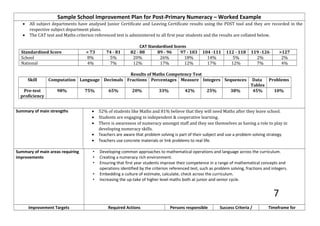
The CAT test and Maths criterion referenced test is administered to all first year students and the results are collated below.

Standardised Score
School
National
Skill
Pre-test
proficiency

< 73
8%
4%

74 - 81
5%
7%

CAT Standardised Scores
82 - 88
89 - 96
97 - 103
20%
26%
18%
12%
17%
12%

104 -111
14%
17%

112 - 118
5%
12%

Results of Maths Competency Test
Computation Language Decimals Fractions Percentages Measure Integers Sequences
98%

75%

Summary of main strengths

•
•
•
•
•

Summary of main areas requiring
improvements

•
•
•
•
•

65%

20%

33%

42%

25%

38%

119 -126
2%
7%

>127
2%
4%

Data
Problems
Tables
45%
10%

52% of students like Maths and 81% believe that they will need Maths after they leave school.
Students are engaging in independent & cooperative learning.
There is awareness of numeracy amongst staff and they see themselves as having a role to play in
developing numeracy skills.
Teachers are aware that problem solving is part of their subject and use a problem solving strategy.
Teachers use concrete materials or link problems to real life.
Developing common approaches to mathematical operations and language across the curriculum.
Creating a numeracy rich environment.
Ensuring that first year students improve their competence in a range of mathematical concepts and
operations identified by the criterion referenced test, such as problem solving, fractions and integers.
Embedding a culture of estimate, calculate, check across the curriculum.
Increasing the up-take of higher level maths both at junior and senior cycle.

7
Improvement Targets

Required Actions

Persons responsible

Success Criteria /

Timeframe for
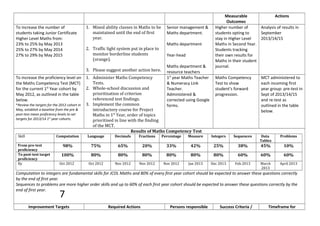
To increase the number of
students taking Junior Certificate
Higher Level Maths from:
23% to 25% by May 2013
25% to 27% by May 2014
27% to 29% by May 2015

1. Mixed ability classes in Maths to be
maintained until the end of first
year.
2. Traffic light system put in place to
monitor borderline students
(orange).
3. Please suggest another action here.

To increase the proficiency level on
the Maths Competency Test (MCT)
for the current 1st Year cohort by
May 2012, as outlined in the table
below.
*Review the targets for the 2012 cohort in
May, establish a baseline from the pre &
post-test mean proficiency levels to set
targets for 2013/14 1st year cohorts.

Skill

Senior management &
Maths department.
Maths department
Year-head
Maths department &
resource teachers
1st year Maths Teacher
& Numeracy Link
Teacher.
Administered &
corrected using Google
forms.

1. Administer Maths Competency
Tests.
2. Whole-school discussion and
prioritisation of criterion
referenced test findings.
3. Implement the common
introductory course for Project
Maths in 1st Year, order of topics
prioritised in line with the finding
of the MCT.
Results of Maths Competency Test

Measurable
Actions
Outcomes
Higher number of
Analysis of results in
students opting to
September
stay in Higher Level
2013/14/15
Maths in Second Year.
Students tracking
their own results for
Maths in their student
journal.
Maths Competency
Test to show
student’s forward
progression.

MCT administered to
each incoming first
year group: pre-test in
Sept of 2013/14/15
and re-test as
outlined in the table
below.

Computation

From pre-test
proficiency
To post-test target
proficiency
By

Language

Decimals

Fractions

Percentage

Measure

Integers

Sequences

Data
Tables

Problems

98%

75%

65%

20%

33%

42%

25%

38%

45%

10%

100%

80%

80%

80%

80%

80%

80%

60%

60%

60%

Oct 2012

Oct 2012

Nov 2012

Nov 2012

Nov 2012

Jan 2013

Dec 2013

Feb 2013

March
2013

April 2013

Computation to integers are fundamental skills for JCOL Maths and 80% of every first year cohort should be expected to answer these questions correctly
by the end of first year.
Sequences to problems are more higher order skills and up to 60% of each first year cohort should be expected to answer these questions correctly by the
end of first year.

7

Improvement Targets

Required Actions

Persons responsible

Success Criteria /

Timeframe for
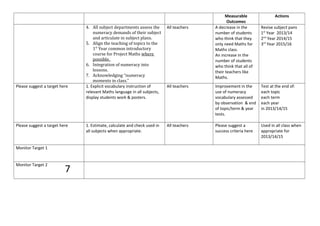
Please suggest a target here

Please suggest a target here

Monitor Target 1
Monitor Target 2

7

Measurable
Outcomes
A decrease in the
number of students
who think that they
only need Maths for
Maths class.
An increase in the
number of students
who think that all of
their teachers like
Maths.

Actions

4. All subject departments assess the
numeracy demands of their subject
and articulate in subject plans.
5. Align the teaching of topics to the
1st Year common introductory
course for Project Maths where
possible.
6. Integration of numeracy into
lessons.
7. Acknowledging “numeracy
moments in class.”
1. Explicit vocabulary instruction of
relevant Maths language in all subjects,
display students work & posters.

All teachers

All teachers

Improvement in the
use of numeracy
vocabulary assessed
by observation & end
of topic/term & year
tests.

Test at the end of:
each topic
each term
each year
in 2013/14/15

1. Estimate, calculate and check used in
all subjects when appropriate.

All teachers

Please suggest a
success criteria here

Used in all class when
appropriate for
2013/14/15

Revise subject pans
1st Year 2013/14
2nd Year 2014/15
3rd Year 2015/16
Numeracy worked example 15th dec 2012 0

Numeracy worked example 15th dec 2012 0

  • 1.
  • 2.
  • 3.
    Examples of questions (a)77 + 42 = (b) Increase 27 by 6 (c) 21.23 – 12.4 = (d) Calculate 12% of 20 200m (e) Measure the perimeter of this field 50m (f) 2 + 2 5 3 = 32 (a) By working with small groups
  • 4.
    MATHS LITERACY –SUMMARY OF 29 STUDENT RESPONSES A p p e n d ix 1 .4 : In te r v ie w s c h e d u le s I N E R V IE W S C H E D U L E : U M E R A C Y SUBJECT TDEPARTMENTNREVIEW OF NUMERACY ACROSSS THE CURRICULUM Representative Group/ Subject Departm ent DATE: 3/10/12 Interviewer DEPARTMENT: SUMMARY Identifiers Date E V A L U A T IO N T H E M E : N U M E R A C Y A C R O S S T H E C U R R IC U L U M A N D / O R IN S U B J E C T X H o w s u c c e s s f u l a r e w e in in t e g r a t in g t h e d e v e lo p m e n t o f n u m e r a c y in t o o u r s u b je c t ? It depends on the subject but we should try when we can, we probably should do more. H o w c lo s e ly d o w e c o lla b o r a te w ith th e m a th e m a tic s d e p a r t m e n t in p la n n in g o u r d e liv e r y s c h e d u le ? Not closely at all. No time for meetings. A r e w e h a p p y th a t o u r p r a c tic e in c a r r y in g o u t c a lc u la tio n s a n d o t h e r m a th e m a tic a l p r o c e d u r e s a n d th e u s e o f m a t h e m a t ic a l s y m b o ls a n d t e r m in o l o g y is c o n s is t e n t w it h t h a t p r e s c r ib e d b y t h e m a t h e m a t ic s d e p a rtm e n t? Not sure, don’t know what they do. W h a t is w o r k in g w e ll? Students like using the LUVE2CU problem solving approach and pair work. A r e t h e r e a n y p r o b le m a r e a s ? Use of Maths language, understanding Maths terms & symbols, general carelessness. W h a t a c tio n c a n w e ta k e to im p r o v e ? More links with Maths dept, key words, posters, insist on students checking their work. H o w e f f e c t iv e a r e w e in d e v e lo p in g s t u d e n t s ’ p r o b le m - s o l v in g s k ills in o u r le s s o n s ? A r e t h e r e a n y d i f f ic u l t ie s ? H o w c a n w e im p r o v e t h e t e a c h in g a n d le a r n in g o f p r o b le m - s o lv i n g ? Using LUVE2CU and pair and group work, group work can be difficult with some classes. W h a t s t r a te g ie s a r e m o s t s u c c e s s f u l in e n h a n c in g t h e n u m e r a c y s k ills o f s tu d e n t s w ith s p e c ia l e d u c a t io n n e e d s ? Differentiation, concrete resources, peer tutoring, on-line games such as freerice.com. W h a t a r e th e m o s t e ffe c tiv e te a c h in g a n d le a r n in g s t r a te g ie s fo r fu r th e r d e v e lo p in g th e n u m e r a c y o f s t u d e n t s w it h v e r y g o o d m a t h e m a t ic s a b ilit y ? Extension exercises, on-line programmes, peer tutoring. D o w e p r o v id e o p p o r t u n it ie s f o r t h e a s s e s s m e n t o f n u m e r a c y w h e n a s s e s s in g s t u d e n t s ’ le a r n in g in t h is s u b j e c t ? Sometimes, it depends on the subject. • Review subject plans to identify numeracy needs of each topic. • CPD from Maths department. Visualiser, IWB,Ensure we do not leave the Maths elements of ourgraphs/charts in magazines. • on-line games, IXL free practices, freerice.com, subject to the Maths W h a t c h a n g e s s h odepartment sto eteach. u r p r a c t i c e t o f u r t h e r f a c i l i t a t e n u m e r a c y d e v e l o p m e n t i n o u r u ld w e c o n id r in o le s s o n s ? • Make links with what is done in Maths where possible. • Have a copy of the Maths dept plan in our own plans so we know when certain H o w e f f e c t i v e i s o u topics are tbeing taught. c o n s o l i d a t i n g s t u d e n t s ’ l e a r n i n g o f n u m e r a c y i n o u r s u b j e c t ? r a p p r o a c h o h o m e w o rk in • Common use of calculator. • Let students work out their own percentages for test results W h a t r e s o u r c e s , in c lu d in g IC T , a r e m o s t u s e f u l in e n h a n c in g t h e t e a c h in g o f n u m e r a c y in o u r s u b je c t ? 3 (b) 4 63
  • 5.
    Diagnostic Window Review Numeracy Listthe strengths List the areas for improvement 1. Learner outcomes Attainment of curriculum objectives 1. Learner outcomes Attainment of curriculum objectives 2. Learning experience Engagement in learning 2. Learning experience Engagement in learning 3. Teachers’ practice Teaching approaches 3. Teachers’ practice Teaching approaches List your findings from the data What further questions do we have? Sources of Evidence Used: Source: adapted from Michael Fullan “School Self-Assessment The Road to School Effectiveness” 5
  • 6.
    Sample School Self-EvaluationReport for Post-Primary Numeracy Worked Example 1. Introduction 1.1 The focus of the evaluation A school self-evaluation of teaching & learning in school X was undertaken in the first term of 2012. During the evaluation Maths and how the teaching and learning in all other subjects support the acquisition of numeracy skills in 1 st Year were reviewed. This is a report on the finding of the evaluation 1.2 School context This is an urban, DEIS, mixed school with 300 students and approximately 45 EAL students. We have an excellent tradition of school development planning. We provide a varied curriculum including JCSP, TY, LCA programmes. 2. The Findings Learner Outcomes • A Cognitive Ability Test (CAT) was administered to all 1 st Year students and the results for the cohort are well below the national norms. • A Maths competency test for 1st Years was designed and administered by the numeracy link teacher and Maths department in September which identified scope for improvement in the mastery of a range of specific skills in the cohort sampled. • All subject departments used the PDST tool for analysing results in the Leaving and Junior Certificate exams and analysed the trend over the last three years. JC uptake of HL Maths is 22% compared with 48% nationally and LC uptake at HL is 7% compared with 22% nationally. • Findings from the attitudinal survey: 52% of students like Maths and 81% believe that they will need Maths after they leave school. Learning experience At a staff meeting, the evaluation criteria in the SSE guidelines were scanned and the sub-themes Attainment of Curriculum Objectives, Engagement in Learning and Teaching Approaches through the lens of numeracy were chosen for the SSE. The SSE core group designed a student questionnaire on attitudes to Numeracy and Engagement in Learning. This was administered to a sample of 29 students. Findings: • Students are engaging in independent & cooperative learning. • 57% of students check their answers. • 29% of students said they are not good at explaining maths in their own words.
  • 7.
    • • 98% answers correctfor 2 + 2 but only 75% for increase two by two. 79% said there was usually more than one way to work out a problem. Teachers’ practice All subject departments completed the focus group schedule for numeracy (p. 82 SSE guidelines). Findings: • There is awareness of numeracy amongst staff and they see themselves as having a role to play in developing numeracy skills. • There is also an awareness of the resources, including ICT, available for the integration of numeracy. • Many teachers use a variety of methodologies and the problem solving approach LUVE2CU. • However teachers do not believe that there is a whole school approach to numeracy or enough collaboration with the Maths department. Progress made on previously identified targets identified in the current SIP N/A for year one as SIP not in place yet. 4. Summary of school self-evaluation findings 4.1 Our school has strengths in the following areas: • • • • • 52% of students like Maths and 81% believe that they will need Maths after they leave school. Students are engaging in independent & cooperative learning. There is awareness of numeracy amongst staff and they see themselves as having a role to play in developing numeracy skills. Teachers are aware that problem solving is part of their subject and use a problem solving strategy. Teachers use concrete materials or link problems to real life. 4.2 The following areas are prioritised for improvement • • • • • Developing common approaches to mathematical operations and language across the curriculum. Creating a numeracy rich environment. Ensuring that first year students improve their competence in a range of mathematical concepts and operations identified by the criterion referenced test, such as problem solving, fractions and integers. Embedding a culture of estimate, calculate and check across the curriculum. Increasing the up-take of higher level maths both at junior and senior cycle. 4.3 The following legislative and regulatory requirements need to be addressed. 6
  • 8.
    The school needsto ensure that parent-teacher meetings are organised in full compliance with circular 58/04
  • 9.
    Sample School ImprovementPlan for Post-Primary Numeracy – Worked Example • • All subject departments have analysed Junior Certificate and Leaving Certificate results using the PDST tool and they are recorded in the respective subject department plans. The CAT test and Maths criterion referenced test is administered to all first year students and the results are collated below. Standardised Score School National Skill Pre-test proficiency < 73 8% 4% 74 - 81 5% 7% CAT Standardised Scores 82 - 88 89 - 96 97 - 103 20% 26% 18% 12% 17% 12% 104 -111 14% 17% 112 - 118 5% 12% Results of Maths Competency Test Computation Language Decimals Fractions Percentages Measure Integers Sequences 98% 75% Summary of main strengths • • • • • Summary of main areas requiring improvements • • • • • 65% 20% 33% 42% 25% 38% 119 -126 2% 7% >127 2% 4% Data Problems Tables 45% 10% 52% of students like Maths and 81% believe that they will need Maths after they leave school. Students are engaging in independent & cooperative learning. There is awareness of numeracy amongst staff and they see themselves as having a role to play in developing numeracy skills. Teachers are aware that problem solving is part of their subject and use a problem solving strategy. Teachers use concrete materials or link problems to real life. Developing common approaches to mathematical operations and language across the curriculum. Creating a numeracy rich environment. Ensuring that first year students improve their competence in a range of mathematical concepts and operations identified by the criterion referenced test, such as problem solving, fractions and integers. Embedding a culture of estimate, calculate, check across the curriculum. Increasing the up-take of higher level maths both at junior and senior cycle. 7 Improvement Targets Required Actions Persons responsible Success Criteria / Timeframe for
  • 10.
    To increase thenumber of students taking Junior Certificate Higher Level Maths from: 23% to 25% by May 2013 25% to 27% by May 2014 27% to 29% by May 2015 1. Mixed ability classes in Maths to be maintained until the end of first year. 2. Traffic light system put in place to monitor borderline students (orange). 3. Please suggest another action here. To increase the proficiency level on the Maths Competency Test (MCT) for the current 1st Year cohort by May 2012, as outlined in the table below. *Review the targets for the 2012 cohort in May, establish a baseline from the pre & post-test mean proficiency levels to set targets for 2013/14 1st year cohorts. Skill Senior management & Maths department. Maths department Year-head Maths department & resource teachers 1st year Maths Teacher & Numeracy Link Teacher. Administered & corrected using Google forms. 1. Administer Maths Competency Tests. 2. Whole-school discussion and prioritisation of criterion referenced test findings. 3. Implement the common introductory course for Project Maths in 1st Year, order of topics prioritised in line with the finding of the MCT. Results of Maths Competency Test Measurable Actions Outcomes Higher number of Analysis of results in students opting to September stay in Higher Level 2013/14/15 Maths in Second Year. Students tracking their own results for Maths in their student journal. Maths Competency Test to show student’s forward progression. MCT administered to each incoming first year group: pre-test in Sept of 2013/14/15 and re-test as outlined in the table below. Computation From pre-test proficiency To post-test target proficiency By Language Decimals Fractions Percentage Measure Integers Sequences Data Tables Problems 98% 75% 65% 20% 33% 42% 25% 38% 45% 10% 100% 80% 80% 80% 80% 80% 80% 60% 60% 60% Oct 2012 Oct 2012 Nov 2012 Nov 2012 Nov 2012 Jan 2013 Dec 2013 Feb 2013 March 2013 April 2013 Computation to integers are fundamental skills for JCOL Maths and 80% of every first year cohort should be expected to answer these questions correctly by the end of first year. Sequences to problems are more higher order skills and up to 60% of each first year cohort should be expected to answer these questions correctly by the end of first year. 7 Improvement Targets Required Actions Persons responsible Success Criteria / Timeframe for
  • 11.
    Please suggest atarget here Please suggest a target here Monitor Target 1 Monitor Target 2 7 Measurable Outcomes A decrease in the number of students who think that they only need Maths for Maths class. An increase in the number of students who think that all of their teachers like Maths. Actions 4. All subject departments assess the numeracy demands of their subject and articulate in subject plans. 5. Align the teaching of topics to the 1st Year common introductory course for Project Maths where possible. 6. Integration of numeracy into lessons. 7. Acknowledging “numeracy moments in class.” 1. Explicit vocabulary instruction of relevant Maths language in all subjects, display students work & posters. All teachers All teachers Improvement in the use of numeracy vocabulary assessed by observation & end of topic/term & year tests. Test at the end of: each topic each term each year in 2013/14/15 1. Estimate, calculate and check used in all subjects when appropriate. All teachers Please suggest a success criteria here Used in all class when appropriate for 2013/14/15 Revise subject pans 1st Year 2013/14 2nd Year 2014/15 3rd Year 2015/16