The 2-role model of
affect from Deleuze
David R Cole
WSU
The 2 traditions
 The history of philosophy
 Applied social science (psychiatry)
 Why does Deleuze set out to rewrite the history of
philosophy?
 How/why does the project differ when he writes
with Félix Guattari?
 2 role model of affect (Cole)
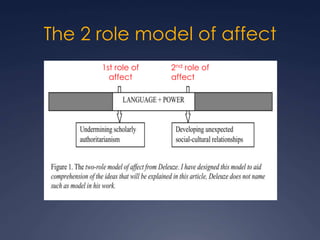
The 2 role model of affect
1st role of
affect
2nd role of
affect
Talking with Unconscious-affect
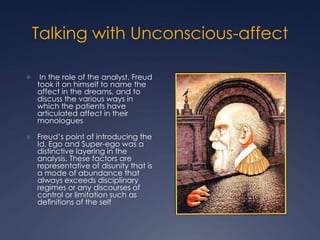
 In the role of the analyst, Freud
took it on himself to name the
affect in the dreams, and to
discuss the various ways in
which the patients have
articulated affect in their
monologues
 Freud’s point of introducing the
Id, Ego and Super-ego was a
distinctive layering in the
analysis. These factors are
representative of disunity that is
a mode of abundance that
always exceeds disciplinary
regimes or any discourses of
control or limitation such as
definitions of the self
The first role from Freud
 Deleuze & Guattari have worked to remove the
Oedipal and Elektra interpretive templates from the
dreams of the analysed subject in contrast to the
power of the analyst
 …when we look for affect in the power of language
in education, we cannot place ourselves in the role of
examining the emotional moods or tendencies of a
particular student or cohort or institutional discourse
 Rather, we should examine our own emotional
proclivities, and articulate the ways in which they are
factors in any analysis of the phenomena involved
with educational research
Becoming
 Becoming, [while happening in a gap], is
nonetheless an extreme contiguity within [the]
coupling of two sensations without resemblance,
or, [it could be figured as] a light that captures
both of the resemblances in a single reflection ...
It is a zone of indetermination, as if things, beasts,
and persons endlessly reach that point that
immediately precedes their natural
differentiation. This is what is called an affect.
Becoming and affect
 In a similar way to Peter Clough, who has used
affect as constitutive of the social context of
learning through the writing of educational
narratives, the aspect of becoming that we may
take from the role model of affect in Deleuze will
include fictional elements and the narrative re-
creation of life
 Whenever one speaks in an educational
context, new connective apparatuses appear
that will communicate unconscious affect that
spreads on turbulent planes that depend on the
learning that occurs…
Teaching and Learning with
Language-affect
 Context is important as affect is grounded in the
situational points of intensity under scrutiny.
Practice is thoroughly connected to language
by the affect that one may produce due to the
synthesis, analysis and representation of any
repetition of an action…
 The Deleuzian analysis at this point relies heavily
on the work of socio-linguists such as William
Labov, who had discovered that some of the
rules of language, that he called ‘variable rules’
can generate systematic, endogenous or
‘grown from within’ variation
Teacher’s affect
 The word of the teacher is
principally about the first role of
affect. The teacher’s language
will transmit power according
to Deleuze as a function of its
affect…
 There will be an
undifferentiated plane in the
educational context between
the students that will draw in
parts of their social lives and
perhaps not actively involve
the teacher. This plane will also
define power relationships,
language and the second role
of affect.
Best practice?
 The first role of affect is important in terms of the
validity and accuracy of the account and the power
of the language used by the teacher, the second
role of affect takes place in the description of the
teaching and learning context as an understanding
of systematic endogenous variations in the lesson will
add to the plausibility of the ‘best practice’ as it
should be possible to repeat this one off great piece
of pedagogy. The teacher will not only have to think
about the formal impact of his or her writing style, and
the suitability for academic consumption, but also the
ways in which the writing deals with the specific
desires and power relationships as constituted by the
body of the class and how these may be transformed
from within.
Collective assemblage
 ... there is no simple identity between the
statement and the act. If we wish to move to a
real definition of the collective assemblage, we
must ask of what [do] these acts [consist of]
immanent to language [and] that are in
redundancy with statements or that constitute
order-words.
Order-words
 According to the definition of the collective
assemblage of Deleuze & Guattari, the problem that
causes an educational system to buckle and misfire is
the production of order-words, or redundant
instructions and directives that sit between the act
and the statement.
 These order-words are incorporeal transformations
that take on board power and life and circulate
around institutions and places of education like the
routing of electricity in plasterboard walls. The most
obvious example of this is the language involved with
behaviour management issues
Practice theory
 Collectivity also involves the transmission of modes of
working between different parties involved with the
educational action. This transmission is itself a practice
of communication that is open to the two-role model
of affect. Any transformed practice will have to be
represented and understood through language and
the context of the learning.
 Schatzki views social activity as ‘composed of a
mesh of orders and practices’, where orders are
‘arrangements of entities, e.g. people, artefacts,
things’ and practices are ‘organized activities’ and
both of these are present in Deleuze & Guattari’s
conception of ‘order-words’.
The Machinic Phylum
 For a blacksmith ‘it is not a question of imposing a
form upon matter but of elaborating an increasingly
rich and consistent material, the better to tap
coincidentally intense forces’….
 Machinic’ refers to the combinatorial diversity of the
elements of a system. The more diversity and
heterogeneity there is the greater the potential for
novelties to emerge.
 …the ‘phylum’ connotes the processes of self-
organization or the idea of a common body-plan,
which through different operations, for example,
embryological foldings, stretchings, pullings, pushings,
can yield a variety of concrete designs for organisms
or systems.
MF-affects
Erotic Language-affects
 Following on from the positioning of unconscious-
affect, erotic language-affects are a possible way in
which to create a plane of becoming for the two-role
model of affect…
 The bonds (between knowledge, participants and
learning) might be created, preserved and moulded
through use of erotic language-affects. One perhaps
flinches when mentioning such an idea, as erotic
language-affects have rarely figured on the
educationalist’s horizons, and there are moral and
social taboos around bringing up such a topic in a
teaching and learning context…
Philosophy of education
 … erotic language-affects locate and strengthen the
central, bonding elements of the thesis by creating
the conditions whereby contiguity and the ways in
which this continuity is represented may be achieved
and the will to resist interference from administration
and instrumental reason may be heightened.
 … these affects indicate the subjective principles
associated with pleasure and enjoyment that may
build upon the closeness imbued by using language
with power and the inner or intuitive sense of time
that one may derive from developing this ability.
Spinozism
 Philosophers such as Lloyd have taken this idea to
infuse the mind with sexuality, as the Spinozist
positioning of affectus with power leads one away
from desexed, disembodied ideas…
 The coded language of teaching manuals and
professional practice reproduces the body-without-
organs because they may drain the sprightly sexual
body of emergent life through internalisation and the
potential subjectification to inflexible regulation…
 Erotic language-affects give us a way of talking
about these (educative) connections, and applying
the two-role model of affect to the transformations of
the body in the education system…
The diagram
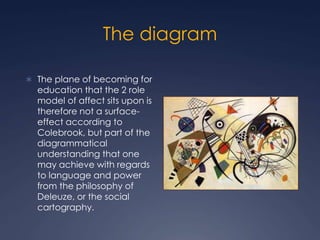
 The plane of becoming for
education that the 2 role
model of affect sits upon is
therefore not a surface-
effect according to
Colebrook, but part of the
diagrammatical
understanding that one
may achieve with regards
to language and power
from the philosophy of
Deleuze, or the social
cartography.
End point
 The two-role model of affect derived from the
work of Deleuze has the potential to open up
education to the extent that it maybe applied in
real teaching and learning situations, as well as
to the study of these situations…
 Deleuze’s two roles of affect gives us a way of
making sense of the passage of power from
speaker to the spoken-to and vice versa in the
collective educational environment.
David.cole@westernsydney.edu.au

The 2 role model of affect

  • 1.
    The 2-role modelof affect from Deleuze David R Cole WSU
  • 2.
    The 2 traditions The history of philosophy  Applied social science (psychiatry)  Why does Deleuze set out to rewrite the history of philosophy?  How/why does the project differ when he writes with Félix Guattari?  2 role model of affect (Cole)
  • 3.
    The 2 rolemodel of affect 1st role of affect 2nd role of affect
  • 4.
    Talking with Unconscious-affect In the role of the analyst, Freud took it on himself to name the affect in the dreams, and to discuss the various ways in which the patients have articulated affect in their monologues  Freud’s point of introducing the Id, Ego and Super-ego was a distinctive layering in the analysis. These factors are representative of disunity that is a mode of abundance that always exceeds disciplinary regimes or any discourses of control or limitation such as definitions of the self
  • 5.
    The first rolefrom Freud  Deleuze & Guattari have worked to remove the Oedipal and Elektra interpretive templates from the dreams of the analysed subject in contrast to the power of the analyst  …when we look for affect in the power of language in education, we cannot place ourselves in the role of examining the emotional moods or tendencies of a particular student or cohort or institutional discourse  Rather, we should examine our own emotional proclivities, and articulate the ways in which they are factors in any analysis of the phenomena involved with educational research
  • 6.
    Becoming  Becoming, [whilehappening in a gap], is nonetheless an extreme contiguity within [the] coupling of two sensations without resemblance, or, [it could be figured as] a light that captures both of the resemblances in a single reflection ... It is a zone of indetermination, as if things, beasts, and persons endlessly reach that point that immediately precedes their natural differentiation. This is what is called an affect.
  • 7.
    Becoming and affect In a similar way to Peter Clough, who has used affect as constitutive of the social context of learning through the writing of educational narratives, the aspect of becoming that we may take from the role model of affect in Deleuze will include fictional elements and the narrative re- creation of life  Whenever one speaks in an educational context, new connective apparatuses appear that will communicate unconscious affect that spreads on turbulent planes that depend on the learning that occurs…
  • 8.
    Teaching and Learningwith Language-affect  Context is important as affect is grounded in the situational points of intensity under scrutiny. Practice is thoroughly connected to language by the affect that one may produce due to the synthesis, analysis and representation of any repetition of an action…  The Deleuzian analysis at this point relies heavily on the work of socio-linguists such as William Labov, who had discovered that some of the rules of language, that he called ‘variable rules’ can generate systematic, endogenous or ‘grown from within’ variation
  • 9.
    Teacher’s affect  Theword of the teacher is principally about the first role of affect. The teacher’s language will transmit power according to Deleuze as a function of its affect…  There will be an undifferentiated plane in the educational context between the students that will draw in parts of their social lives and perhaps not actively involve the teacher. This plane will also define power relationships, language and the second role of affect.
  • 10.
    Best practice?  Thefirst role of affect is important in terms of the validity and accuracy of the account and the power of the language used by the teacher, the second role of affect takes place in the description of the teaching and learning context as an understanding of systematic endogenous variations in the lesson will add to the plausibility of the ‘best practice’ as it should be possible to repeat this one off great piece of pedagogy. The teacher will not only have to think about the formal impact of his or her writing style, and the suitability for academic consumption, but also the ways in which the writing deals with the specific desires and power relationships as constituted by the body of the class and how these may be transformed from within.
  • 11.
    Collective assemblage  ...there is no simple identity between the statement and the act. If we wish to move to a real definition of the collective assemblage, we must ask of what [do] these acts [consist of] immanent to language [and] that are in redundancy with statements or that constitute order-words.
  • 12.
    Order-words  According tothe definition of the collective assemblage of Deleuze & Guattari, the problem that causes an educational system to buckle and misfire is the production of order-words, or redundant instructions and directives that sit between the act and the statement.  These order-words are incorporeal transformations that take on board power and life and circulate around institutions and places of education like the routing of electricity in plasterboard walls. The most obvious example of this is the language involved with behaviour management issues
  • 13.
    Practice theory  Collectivityalso involves the transmission of modes of working between different parties involved with the educational action. This transmission is itself a practice of communication that is open to the two-role model of affect. Any transformed practice will have to be represented and understood through language and the context of the learning.  Schatzki views social activity as ‘composed of a mesh of orders and practices’, where orders are ‘arrangements of entities, e.g. people, artefacts, things’ and practices are ‘organized activities’ and both of these are present in Deleuze & Guattari’s conception of ‘order-words’.
  • 14.
    The Machinic Phylum For a blacksmith ‘it is not a question of imposing a form upon matter but of elaborating an increasingly rich and consistent material, the better to tap coincidentally intense forces’….  Machinic’ refers to the combinatorial diversity of the elements of a system. The more diversity and heterogeneity there is the greater the potential for novelties to emerge.  …the ‘phylum’ connotes the processes of self- organization or the idea of a common body-plan, which through different operations, for example, embryological foldings, stretchings, pullings, pushings, can yield a variety of concrete designs for organisms or systems.
  • 15.
  • 16.
    Erotic Language-affects  Followingon from the positioning of unconscious- affect, erotic language-affects are a possible way in which to create a plane of becoming for the two-role model of affect…  The bonds (between knowledge, participants and learning) might be created, preserved and moulded through use of erotic language-affects. One perhaps flinches when mentioning such an idea, as erotic language-affects have rarely figured on the educationalist’s horizons, and there are moral and social taboos around bringing up such a topic in a teaching and learning context…
  • 17.
    Philosophy of education … erotic language-affects locate and strengthen the central, bonding elements of the thesis by creating the conditions whereby contiguity and the ways in which this continuity is represented may be achieved and the will to resist interference from administration and instrumental reason may be heightened.  … these affects indicate the subjective principles associated with pleasure and enjoyment that may build upon the closeness imbued by using language with power and the inner or intuitive sense of time that one may derive from developing this ability.
  • 18.
    Spinozism  Philosophers suchas Lloyd have taken this idea to infuse the mind with sexuality, as the Spinozist positioning of affectus with power leads one away from desexed, disembodied ideas…  The coded language of teaching manuals and professional practice reproduces the body-without- organs because they may drain the sprightly sexual body of emergent life through internalisation and the potential subjectification to inflexible regulation…  Erotic language-affects give us a way of talking about these (educative) connections, and applying the two-role model of affect to the transformations of the body in the education system…
  • 19.
    The diagram  Theplane of becoming for education that the 2 role model of affect sits upon is therefore not a surface- effect according to Colebrook, but part of the diagrammatical understanding that one may achieve with regards to language and power from the philosophy of Deleuze, or the social cartography.
  • 20.
    End point  Thetwo-role model of affect derived from the work of Deleuze has the potential to open up education to the extent that it maybe applied in real teaching and learning situations, as well as to the study of these situations…  Deleuze’s two roles of affect gives us a way of making sense of the passage of power from speaker to the spoken-to and vice versa in the collective educational environment. David.cole@westernsydney.edu.au