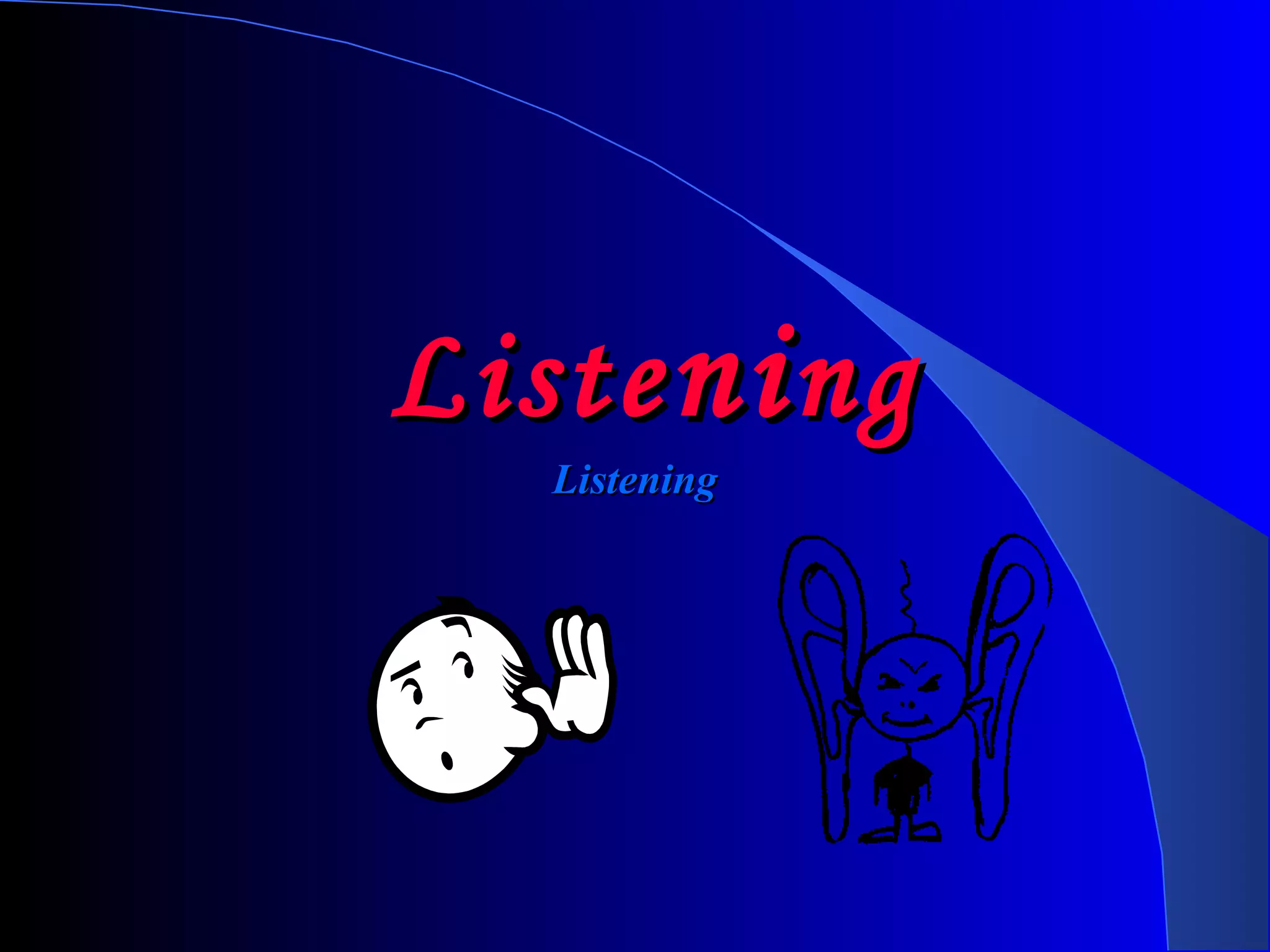
Liste ni ng Listening
Listening skills is a key to success in career and business It is  a process that consists of four stages: sensing and attending, understanding and interpreting, remembering, and responding . . ..
Types of Listening Pretending listening Selective listening Attentive listening Informational listening Appreciative listening Critical listening
Relationship listening Discriminative listening
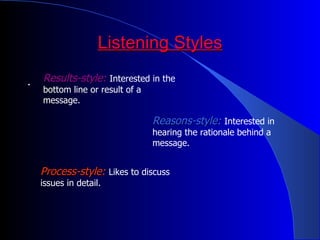
Listening Styles .  Results-style:   Interested in the bottom line or result of a message. Reasons-style:   Interested in hearing the rationale behind a message. Process-style:   Likes to discuss issues in detail.
Barriers  of  Listening
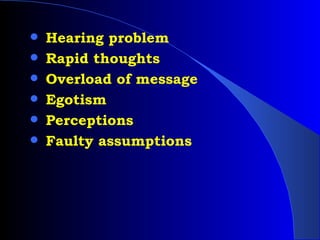
Hearing problem Rapid thoughts Overload of message Egotism Perceptions Faulty assumptions
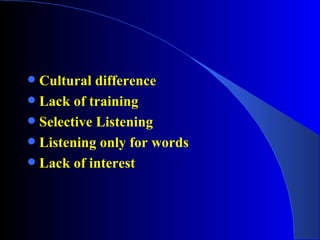
Cultural difference Lack of training Selective Listening  Listening only for words Lack of interest
Noise Poor perception / understanding
Guidelines To  Effective  Listening
Listener to maintain eye contact Avoid uninterested gestures – looking at watch, SMS, reading paper, playing with pen / pencil, etc. Ask questions – shows interest – after the Speaker has finished speaking
Listen patiently – Avoid arguments – Hold your temper Be honest with your answers Listen and understand the total meaning of the message Drop personal biasness
We were given two ears but only one    mouth this is because listening is twice as   hard as talking
Thank You    for listening ….

Listening skills

  • 1.
    Liste ni ngListening
  • 2.
    Listening skills isa key to success in career and business It is a process that consists of four stages: sensing and attending, understanding and interpreting, remembering, and responding . . ..
  • 3.
    Types of ListeningPretending listening Selective listening Attentive listening Informational listening Appreciative listening Critical listening
  • 4.
  • 5.
    Listening Styles . Results-style: Interested in the bottom line or result of a message. Reasons-style: Interested in hearing the rationale behind a message. Process-style: Likes to discuss issues in detail.
  • 6.
    Barriers of Listening
  • 7.
    Hearing problem Rapidthoughts Overload of message Egotism Perceptions Faulty assumptions
  • 8.
    Cultural difference Lackof training Selective Listening Listening only for words Lack of interest
  • 9.
    Noise Poor perception/ understanding
  • 10.
    Guidelines To Effective Listening
  • 11.
    Listener to maintaineye contact Avoid uninterested gestures – looking at watch, SMS, reading paper, playing with pen / pencil, etc. Ask questions – shows interest – after the Speaker has finished speaking
  • 12.
    Listen patiently –Avoid arguments – Hold your temper Be honest with your answers Listen and understand the total meaning of the message Drop personal biasness
  • 13.
    We were giventwo ears but only one mouth this is because listening is twice as hard as talking
  • 14.
    Thank You for listening ….