BUSINESS
COMMUNICATION:
LISTENING SKILLS
By – Shalom Samuel
# BENEFITS OF EFFECTIVE
LISTENING
• Enhances productivity
• Improves relations
• Avoids conflicts
• Improves understanding
• Improves negotiation skills
• Adds to your Image & Personality
1. WHAT IS LISTENING?
• Listening is the ability to accurately receive and
interpret messages in the communication process.
• Listening is key to all effective communication,
without the ability to listen effectively messages are
easily misunderstood.
• Listening is one of the most important skills you can
have.
• An active process of getting information, ideas.
• “Listening is the process of receiving, constructing
meaning from, and responding to spoken.
1. WHAT IS LISTENING?
• Listening is not just about being Quiet while
someone else is speaking, “Listening is with the Mind”.
• Hearing with the senses.
• Listening is conscious.
• To improve our interpersonal & oral exchange.
Just Listening to words is not enough; a good Listener
has to pay attention to the non-verbal communication
of the speaker.
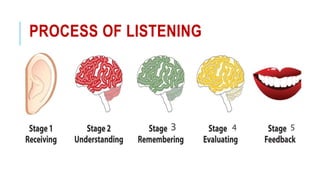
PROCESS OF LISTENING
3 4 5
RECEIVING
• Is the intentional focus on Hearing a speaker’s
message.
• This stage is represented by the ear because it is the
primary tool involved with this stage of the listening
process.
UNDERSTANDING
• In the understanding stage, we attempt to learn the
meaning of the message, which is not always easy.
• Deciding what the message means to you.
REMEMBERING
• Remembering begins with listening; if you can’t
remember something that was said, you might not
have been listening effectively.
• However, even when you are listening attentively,
some messages are more difficult than others to
understand and remember. Highly complex messages
that are filled with detail call for highly developed
listening skills.
RESPONDING
• Responding—sometimes referred to as feedback—is the fifth and
final stage of the listening process.
• Your reaction to the message. It can be emotional and intellectual
• For example, you are giving positive feedback to your instructor if at
the end of class you stay behind to finish a sentence in your notes
or approach the instructor to ask for clarification. The opposite kind
of feedback is given by students who gather their belongings and
rush out the door as soon as class is over.
• This stage is represented by the lips because we often give feedback
in the form of verbal feedback; however, you can just as easily
respond non-verbally.
IMPORTANCE OF LISTENING
• We show that we are serious.
• We display respect to other’s view point.
• Helps us to learn.
• Helps us to adapt and understand.
• Empathize.
• To avoid communication errors.
• Helps to learn something new.
• It is the key to success.
BASIC TYPES OF LISTENING
• Active listening
• Selective listening
• Emphatic listening
• Ignoring listening
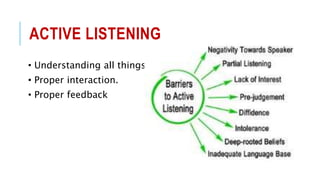
ACTIVE LISTENING
• Understanding all things
• Proper interaction.
• Proper feedback
SELECTIVE LISTENING
• We remember only.
• Selective portion.
• Topic is not To our liking.
EMPATHETIC LISTENING
• When we listen empathetically, we go beyond
sympathy to seek a truer understand how others are
feeling.
• This requires excellent discrimination and close
attention to the nuances of emotional signals.
• When we are being truly empathetic, we actually feel
what they are feeling.
IGNORING LISTENING
• Not listening at all
• Is pretty insulting to others
• It can lead to strained relations
CAN YOU HEAR ME TALKING?
• Does that mean that you are a good listener?
• A person with normal hearing is not necessarily a
good listener.
• Many different things can prevent a speaker’s
message from being received…
These are called barriers to listening.
BARRIERS TO EFFECTIVE
LISTENING
Some common barriers in the process of listening are listed
below.
• Pre-judgments about the speaker.
• Assuming that the speaker is going to give some unimportant
information .
• Arriving late for a speech, presentation or lecture.
• Judging the speaker by his/her mannerisms, voice,
appearance, accent, etc.
• Lack of concentration/interest.
• Avoiding listening to difficult, boring or complex information
and selectively listening only to what is considered interesting.
@HOW TO LISTEN
EFFECTIVELY?
• Stop Talking – Be Silent
• Show Interest
• Empathize
• Ask Questions
• Maintain Eye Contact
• Take notes
• Listen Creatively
• Put Your Entirety
• Send Feedback
• Avoid or eliminate distraction
• Try to gather Information about the topic to develop interest and familiarity.
BENEFITS OF EFFECTIVE
LISTENING
• Enhances productivity
• Improves relations
• Avoids conflicts
• Improves understanding
• Improves negotiation skills
• Adds to your Image & Personality
THANK YOU FOR LISTENING

1 Listening skills.pptx

  • 1.
  • 2.
    # BENEFITS OFEFFECTIVE LISTENING • Enhances productivity • Improves relations • Avoids conflicts • Improves understanding • Improves negotiation skills • Adds to your Image & Personality
  • 3.
    1. WHAT ISLISTENING? • Listening is the ability to accurately receive and interpret messages in the communication process. • Listening is key to all effective communication, without the ability to listen effectively messages are easily misunderstood. • Listening is one of the most important skills you can have. • An active process of getting information, ideas. • “Listening is the process of receiving, constructing meaning from, and responding to spoken.
  • 4.
    1. WHAT ISLISTENING? • Listening is not just about being Quiet while someone else is speaking, “Listening is with the Mind”. • Hearing with the senses. • Listening is conscious. • To improve our interpersonal & oral exchange. Just Listening to words is not enough; a good Listener has to pay attention to the non-verbal communication of the speaker.
  • 5.
  • 6.
    RECEIVING • Is theintentional focus on Hearing a speaker’s message. • This stage is represented by the ear because it is the primary tool involved with this stage of the listening process.
  • 7.
    UNDERSTANDING • In theunderstanding stage, we attempt to learn the meaning of the message, which is not always easy. • Deciding what the message means to you.
  • 8.
    REMEMBERING • Remembering beginswith listening; if you can’t remember something that was said, you might not have been listening effectively. • However, even when you are listening attentively, some messages are more difficult than others to understand and remember. Highly complex messages that are filled with detail call for highly developed listening skills.
  • 9.
    RESPONDING • Responding—sometimes referredto as feedback—is the fifth and final stage of the listening process. • Your reaction to the message. It can be emotional and intellectual • For example, you are giving positive feedback to your instructor if at the end of class you stay behind to finish a sentence in your notes or approach the instructor to ask for clarification. The opposite kind of feedback is given by students who gather their belongings and rush out the door as soon as class is over. • This stage is represented by the lips because we often give feedback in the form of verbal feedback; however, you can just as easily respond non-verbally.
  • 10.
    IMPORTANCE OF LISTENING •We show that we are serious. • We display respect to other’s view point. • Helps us to learn. • Helps us to adapt and understand. • Empathize. • To avoid communication errors. • Helps to learn something new. • It is the key to success.
  • 11.
    BASIC TYPES OFLISTENING • Active listening • Selective listening • Emphatic listening • Ignoring listening
  • 12.
    ACTIVE LISTENING • Understandingall things • Proper interaction. • Proper feedback
  • 13.
    SELECTIVE LISTENING • Weremember only. • Selective portion. • Topic is not To our liking.
  • 14.
    EMPATHETIC LISTENING • Whenwe listen empathetically, we go beyond sympathy to seek a truer understand how others are feeling. • This requires excellent discrimination and close attention to the nuances of emotional signals. • When we are being truly empathetic, we actually feel what they are feeling.
  • 15.
    IGNORING LISTENING • Notlistening at all • Is pretty insulting to others • It can lead to strained relations
  • 16.
    CAN YOU HEARME TALKING? • Does that mean that you are a good listener? • A person with normal hearing is not necessarily a good listener. • Many different things can prevent a speaker’s message from being received… These are called barriers to listening.
  • 17.
    BARRIERS TO EFFECTIVE LISTENING Somecommon barriers in the process of listening are listed below. • Pre-judgments about the speaker. • Assuming that the speaker is going to give some unimportant information . • Arriving late for a speech, presentation or lecture. • Judging the speaker by his/her mannerisms, voice, appearance, accent, etc. • Lack of concentration/interest. • Avoiding listening to difficult, boring or complex information and selectively listening only to what is considered interesting.
  • 18.
    @HOW TO LISTEN EFFECTIVELY? •Stop Talking – Be Silent • Show Interest • Empathize • Ask Questions • Maintain Eye Contact • Take notes • Listen Creatively • Put Your Entirety • Send Feedback • Avoid or eliminate distraction • Try to gather Information about the topic to develop interest and familiarity.
  • 19.
    BENEFITS OF EFFECTIVE LISTENING •Enhances productivity • Improves relations • Avoids conflicts • Improves understanding • Improves negotiation skills • Adds to your Image & Personality
  • 20.
    THANK YOU FORLISTENING