THE EIGHT
LISTENING SKILLS
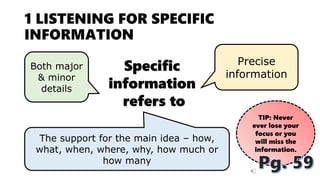
1 LISTENING FOR SPECIFIC
INFORMATION
Both major
& minor
details
Precise
information
The support for the main idea – how,
what, when, where, why, how much or
how many
Specific
information
refers to
TIP: Never
ever lose your
focus or you
will miss the
information.
2 LISTENING FOR MAIN IDEAS
Main Idea • Key point / general idea / gist
Supporting
details
• How, what, when, where, why,
how much, how many
Main idea is usually
stated explicitly – in
the beginning, in
the middle or at the
end
Ask yourself.
What is
this
about?
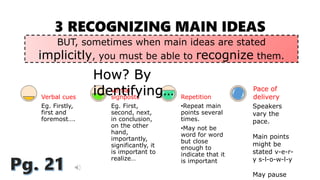
3 RECOGNIZING MAIN IDEAS
Eg. Firstly,
first and
foremost….
Verbal cues
Eg. First,
second, next,
in conclusion,
on the other
hand,
importantly,
significantly, it
is important to
realize…
Verbal
signposts
•Repeat main
points several
times.
•May not be
word for word
but close
enough to
indicate that it
is important
Repetition
Pace of
delivery
Speakers
vary the
pace.
Main points
might be
stated v-e-r-
y s-l-o-w-l-y
May pause
BUT, sometimes when main ideas are stated
implicitly, you must be able to recognize them.
How? By
identifying…
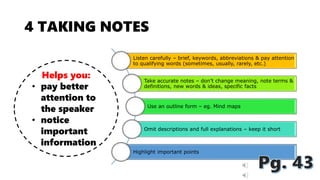
4 TAKING NOTES
Listen carefully – brief, keywords, abbreviations & pay attention
to qualifying words (sometimes, usually, rarely, etc.)
Take accurate notes – don’t change meaning, note terms &
definitions, new words & ideas, specific facts
Use an outline form – eg. Mind maps
Omit descriptions and full explanations – keep it short
Highlight important points
Helps you:
• pay better
attention to
the speaker
• notice
important
information
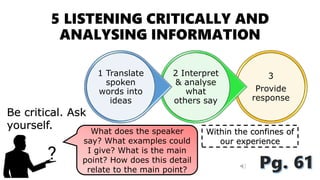
5 LISTENING CRITICALLY AND
ANALYSING INFORMATION
3
Provide
response
2 Interpret
& analyse
what
others say
1 Translate
spoken
words into
ideas
Within the confines of
our experience
Be critical. Ask
yourself. What does the speaker
say? What examples could
I give? What is the main
point? How does this detail
relate to the main point?
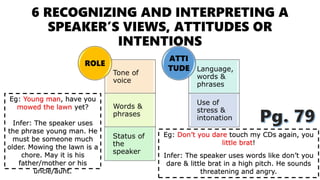
6 RECOGNIZING AND INTERPRETING A
SPEAKER’S VIEWS, ATTITUDES OR
INTENTIONS
Tone of
voice
Words &
phrases
Status of
the
speaker
ROLE
Language,
words &
phrases
Use of
stress &
intonation
ATTI
TUDE
Eg: Young man, have you
mowed the lawn yet?
Infer: The speaker uses
the phrase young man. He
must be someone much
older. Mowing the lawn is a
chore. May it is his
father/mother or his
uncle/aunt.
Eg: Don’t you dare touch my CDs again, you
little brat!
Infer: The speaker uses words like don’t you
dare & little brat in a high pitch. He sounds
threatening and angry.
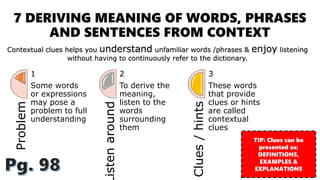
7 DERIVING MEANING OF WORDS, PHRASES
AND SENTENCES FROM CONTEXT
Problem
1
Some words
or expressions
may pose a
problem to full
understanding
istenaround
2
To derive the
meaning,
listen to the
words
surrounding
them
Clues/hints
3
These words
that provide
clues or hints
are called
contextual
clues
Contextual clues helps you understand unfamiliar words /phrases & enjoy listening
without having to continuously refer to the dictionary.
TIP: Clues can be
presented as:
DEFINITIONS,
EXAMPLES &
EXPLANATIONS
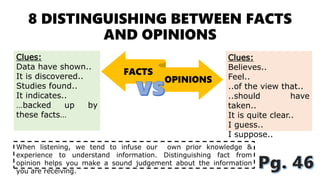
8 DISTINGUISHING BETWEEN FACTS
AND OPINIONS
FACTS
OPINIONS
When listening, we tend to infuse our own prior knowledge &
experience to understand information. Distinguishing fact from
opinion helps you make a sound judgement about the information
you are receiving.
Clues:
Data have shown..
It is discovered..
Studies found..
It indicates..
…backed up by
these facts…
Clues:
Believes..
Feel..
..of the view that..
..should have
taken..
It is quite clear..
I guess..
I suppose..

Listening skills

  • 1.
  • 2.
    1 LISTENING FORSPECIFIC INFORMATION Both major & minor details Precise information The support for the main idea – how, what, when, where, why, how much or how many Specific information refers to TIP: Never ever lose your focus or you will miss the information.
  • 3.
    2 LISTENING FORMAIN IDEAS Main Idea • Key point / general idea / gist Supporting details • How, what, when, where, why, how much, how many Main idea is usually stated explicitly – in the beginning, in the middle or at the end Ask yourself. What is this about?
  • 4.
    3 RECOGNIZING MAINIDEAS Eg. Firstly, first and foremost…. Verbal cues Eg. First, second, next, in conclusion, on the other hand, importantly, significantly, it is important to realize… Verbal signposts •Repeat main points several times. •May not be word for word but close enough to indicate that it is important Repetition Pace of delivery Speakers vary the pace. Main points might be stated v-e-r- y s-l-o-w-l-y May pause BUT, sometimes when main ideas are stated implicitly, you must be able to recognize them. How? By identifying…
  • 5.
    4 TAKING NOTES Listencarefully – brief, keywords, abbreviations & pay attention to qualifying words (sometimes, usually, rarely, etc.) Take accurate notes – don’t change meaning, note terms & definitions, new words & ideas, specific facts Use an outline form – eg. Mind maps Omit descriptions and full explanations – keep it short Highlight important points Helps you: • pay better attention to the speaker • notice important information
  • 6.
    5 LISTENING CRITICALLYAND ANALYSING INFORMATION 3 Provide response 2 Interpret & analyse what others say 1 Translate spoken words into ideas Within the confines of our experience Be critical. Ask yourself. What does the speaker say? What examples could I give? What is the main point? How does this detail relate to the main point?
  • 7.
    6 RECOGNIZING ANDINTERPRETING A SPEAKER’S VIEWS, ATTITUDES OR INTENTIONS Tone of voice Words & phrases Status of the speaker ROLE Language, words & phrases Use of stress & intonation ATTI TUDE Eg: Young man, have you mowed the lawn yet? Infer: The speaker uses the phrase young man. He must be someone much older. Mowing the lawn is a chore. May it is his father/mother or his uncle/aunt. Eg: Don’t you dare touch my CDs again, you little brat! Infer: The speaker uses words like don’t you dare & little brat in a high pitch. He sounds threatening and angry.
  • 8.
    7 DERIVING MEANINGOF WORDS, PHRASES AND SENTENCES FROM CONTEXT Problem 1 Some words or expressions may pose a problem to full understanding istenaround 2 To derive the meaning, listen to the words surrounding them Clues/hints 3 These words that provide clues or hints are called contextual clues Contextual clues helps you understand unfamiliar words /phrases & enjoy listening without having to continuously refer to the dictionary. TIP: Clues can be presented as: DEFINITIONS, EXAMPLES & EXPLANATIONS
  • 9.
    8 DISTINGUISHING BETWEENFACTS AND OPINIONS FACTS OPINIONS When listening, we tend to infuse our own prior knowledge & experience to understand information. Distinguishing fact from opinion helps you make a sound judgement about the information you are receiving. Clues: Data have shown.. It is discovered.. Studies found.. It indicates.. …backed up by these facts… Clues: Believes.. Feel.. ..of the view that.. ..should have taken.. It is quite clear.. I guess.. I suppose..