Listening Strategies
Based on Purpose
OBJECTIVES
After going through the lesson, you are expected
to :
1. Identify the different purpose in listening.
2. Use listening strategies based on purpose,
familiarity with the topic and level of difficulty of
short text listened level.
WHAT I KNOW
True or False. Read each statement carefully
and write TRUE if the statement is correct
and FALSE if the statement is incorrect.
1.Listening is the one skill that you use to
least in everyday life.
3. Listening comprehension is the basis
for your speaking, writing and reading
skill.
4. To develop your listening skill, it is
important to listen actively, which
means actively pay attention to what
you are listening.
4.As one listen she/ he could try to think
ahead: What might happen next? What
might the speakers says, which words might
they use?
5. Taking down notes while listening is not
important.
True or
False
1. Listening comprehension is the basis for
speaking, writing and reading skills.
Yes, it is TRUE!
2. Listening is the one skill that you use the
least in everyday life.
Yes, it is False!
3. To develop listening skills, it is important
to listen actively, which means actively pay
attention to what you are listening to.
Yes, it is TRUE!
4. As one , he/ she could try to think ahead:
What might happen next? What might the
speaker say, which words might they use?
Yes, it is TRUE!
5. Taking down notes while listening is not
important.
Yes, it is FALSE!
What’s In?
What are the things that make listening
difficult based on your experience?
What is it?
Listening Strategies Based on Purpose
 listening is the one skill that you use the
most everyday life.
Listening comprehension is the basis for
your speaking , writing and reading skills.
What is it?
Listening Strategies Based on Purpose
 to train your listening skills, it is important to
listen actively which means to actively pay
attention to what you are listening to.
Make it a habit to listen to audio books,
podcasts, news, songs, ect. and to watch videos
and films in the foreign language.
Types of Activities for
Listening with a Purpose.
1. Listening for the Main Idea
The purpose is to
listen grasp the
main points or
general presented
by the speaker or
from the audio/
video you are
listening to.
2. Listening for Detail
The purpose is to
grasp information,
details that are
relevant, important or
necessary. The goal is
to obtain the detailed
information like
hours, dates, names,
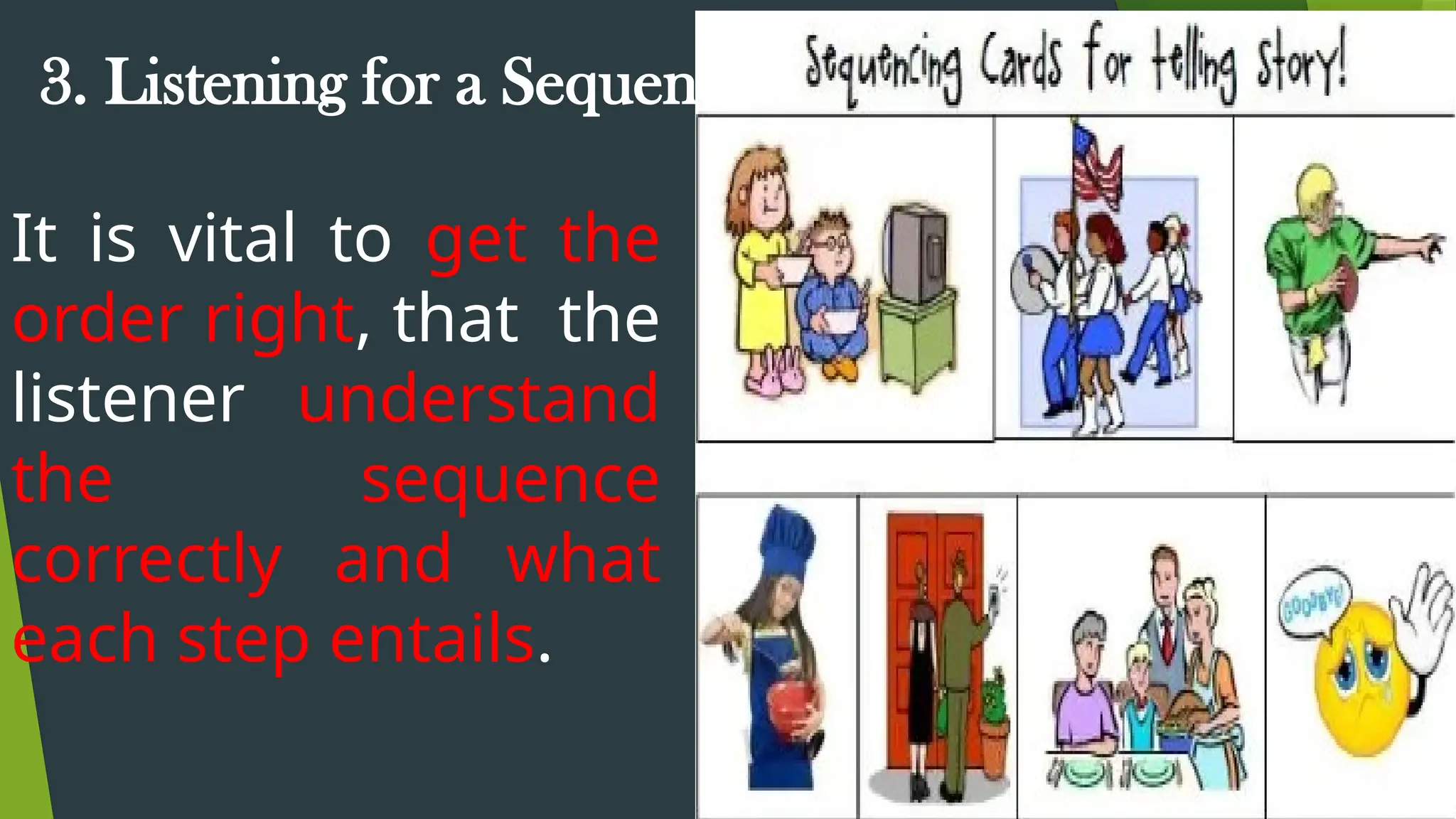
3. Listening for a Sequence
It is vital to get the
order right, that the
listener understand
the sequence
correctly and what
each step entails.
4. Listening for Specific Vocabulary
To teach new words or review vocabulary previously
taught.
The purpose is to identify and remember a series of
words, which are usually easily categorized, like types
of food, sports animals etc…
5. Listening for Cultural Interest
The purpose is to expose you to this cultural aspect
through listening actively.
6. Listening for attitude and Opinions
Attitudes, opinions and feeling can all be conveyed in varying
degrees from strong disagreement to mild criticism.
Listener should be able to
discern different attitudes
and positions, as well as
identify how the speaker
feels.
7. Listening for Functional Language
Listeners can use
functional language to
accept/ decline invitations,
gives suggestions, give
advice, etc…
The purpose is to show
how these expressions are
used in a conversation.
Suggestion for Improving
Listening Skills
Communication is an everyday activity.
Have you ever gone a day without talking?
How were you able to know what to say or
reply to the one you are talking to?
Your answer to the last question: listening.
Good!
But honestly speaking, was there a time
when you did not know how to respond?
Listening has been a skill oftentimes
ignored. Remember that hearing is not
listening. What you heard might be forgotten
but what you listened to may be kept in the
heart and shared with others.
Listening is intentional hearing. You
understand, examine and answer to what
you hear. To make you a better listener,
these seven common listening strategies
will help:
 NOTING DETAILS
This is like selective listening. You filter the ideas and
ignore anything that is not connected because you are
only looking for particular information – maybe a name
or object, a word or phrase. With this, you can shorten
the long list and get the needed information.
If you know how to distinguish the key words or
phrase (the most important idea or concept stated in
the shortest way possible), then you are good to
go.
 EXTRACTING INFORMATION
Extracting information is getting the
unstated fact from the text. It is similar
to reading between the lines (therefore
making it listening between the lines).
This is your ability to determine ideas
that are not literally or directly stated
from the text.
 RECOGNIZING MAIN IDEAS
Being able to identify the main point
discussed in the text listened to is also
an important skill. With this, you don’t
need to listen word by word but take the
text idea by idea. You could listen to one
paragraph as a whole and just think
what topic do all the sentences
conclude to.
 MAKING PREDICTIONS
You are not guessing but making a
hypothesis.
This means you based your hunch on
premises or ideas before arriving to an
educated guess.
This skill makes it easy for you to answer
the question “What happens next?”.
DETERMINING TONE AND MOOD
Determining the tone and mood is
knowing the feelings of the speaker or
character based on the dialogues
heard.
When you hear the lines, what could the
character or speaker be feeling?
 INFERRING THE PURPOSE
“What is the message of the text listened
to?” - this is the question the purpose is
going to answer.
Inferring the purpose means knowing
what the text is for. So, you may also be
asked, “Why did the author write the text?”.
 INFERRING THOUGHTS AND FEELINGS
Inferring thoughts and feelings is almost the
same with determining tone and mood. The only
difference is that the emotions are from you, the
listener.
To put into question, “What did you feel while
listening to the text?” or “What do you think
about this particular situation or concept in the
text?”.
Activity 1:
Listening Comprehension
Listening Activity
Directions:
listen attentively to the audio of poem Ballad
of a Mother’s Heart . Answer the question below
in your notebook.
1. What is the poem about?
2. What do you think the author’s purpose in
writing the poem?
Activity II:
Fill-up the lyrics
Listening Activity
Directions:
Are you familiar with the song Roar by Katy
Perry? You are going to listen to a certain part of
the song to played twice.
Sing the song while filling up the missing
words.
Choose the words inside the box.
SIX STRATEGIES TO
IMPROVE YOUR LISTENING
SKILLS
1. Be Attentive
– practice mindfulness by
consciously eliminating
distractions from your mind and
body.
2. Ask Questions
– one of the ways you can live in the
moment is by asking clear questions.
Often times, people's comments are
open to interpretation to understand
their desire to understand what they
hear. One of the ways you can stay in
the moment is to ask clarifying
questions.
3. Don’t interrupt unnecessarily
– use the acronym WAIT, Why Am I
Talking? to keep your comments relative to
the speaker’s thoughts.
4. Use body language
– being able to understand and interpret
body language can help you grasp other
people's unspoken questions, problems, or
negative feelings.
Face-to-face, you can convey that you are
listening by nodding, smiling, and
maintaining eye contact.
5. Empathize
– the ability to perceive the feelings
of others, as well as to imagine
what someone else is thinking or
feeling. To listen effectively to what
the speaker is saying, try to look at
him from his perspective.
6. Take notes
– it provides you with a
permanent record to refer back
to. Good note taking will
improve your active listening,
comprehension of material, and
retention.
WHAT I HAVE LEARNED
Instruction: read the statements
carefully. Write TRUE if the statement
is correct and write FALSE if it is
incorrect. Write you answers in your
English notebook.
WHAT I HAVE LEARNED
1.We always understand what we listen
to.
2.When we listen, we listen to every word
that the speaker is saying.
3.We can predict or guess the topic that
the speaker is sharing based on the
words that he or she uses.
4. We use our prior knowledge when we try
to understand the message to the speaker
or material we listen to.
5. It is important to listen to the whole
material to get the message of the speaker.
I. True or False. Write True if the statement
is correct, and False if it is wrong.
____ 1. Hearing and listening are
the same thing.
____ 2. If someone does not
agree, he/she is not listening.
____ 3. Asking questions
improves listening
effectiveness.
____ 4. The person speaking is
responsible for making sure
his/her message is
understood.
____ 5. People with higher IQs
are better listeners.
___ 6. Listening is poor when
A. we do not expend the effort.
B. we experience message overload.
C. we experience psychological noise.
D. All of these are correct.
____ 7. Which is true?
A. Listening and hearing are remarkably
similar.
B. It is possible to hear without listening.
C. Listening is physical; hearing is
psychological.
D. It is possible to listen without hearing.
____ 8. The stages of listening
include all BUT NOT______.
A. attending.
B. understanding.
C. responding.
D. activating.
____ 9. When listening for information, it is wise
to
A. make some quick judgments about the
speaker, so you are not misled.
B. tie the message and speaker together in your
mind.
C. be opportunistic by learning what you can
from this speaker, even if
you learn what not to do.
D. listen for details rather than the main ideas.
____ 10. Research cited in your text
shows listening to be a significant factor
in maintaining _______________.
A. marital relationships.
B. family relationships.
C. career success.
D. All of these are correct.
This Photo by Unknown Author is licensed under CC BY-SA
THANK YOU!!!

English 7 listening strategies on purpose

  • 1.
  • 2.
    OBJECTIVES After going throughthe lesson, you are expected to : 1. Identify the different purpose in listening. 2. Use listening strategies based on purpose, familiarity with the topic and level of difficulty of short text listened level.
  • 3.
    WHAT I KNOW Trueor False. Read each statement carefully and write TRUE if the statement is correct and FALSE if the statement is incorrect. 1.Listening is the one skill that you use to least in everyday life.
  • 4.
    3. Listening comprehensionis the basis for your speaking, writing and reading skill. 4. To develop your listening skill, it is important to listen actively, which means actively pay attention to what you are listening.
  • 5.
    4.As one listenshe/ he could try to think ahead: What might happen next? What might the speakers says, which words might they use? 5. Taking down notes while listening is not important.
  • 6.
  • 7.
    1. Listening comprehensionis the basis for speaking, writing and reading skills. Yes, it is TRUE!
  • 8.
    2. Listening isthe one skill that you use the least in everyday life. Yes, it is False!
  • 9.
    3. To developlistening skills, it is important to listen actively, which means actively pay attention to what you are listening to. Yes, it is TRUE!
  • 10.
    4. As one, he/ she could try to think ahead: What might happen next? What might the speaker say, which words might they use? Yes, it is TRUE!
  • 11.
    5. Taking downnotes while listening is not important. Yes, it is FALSE!
  • 12.
    What’s In? What arethe things that make listening difficult based on your experience?
  • 13.
    What is it? ListeningStrategies Based on Purpose  listening is the one skill that you use the most everyday life. Listening comprehension is the basis for your speaking , writing and reading skills.
  • 14.
    What is it? ListeningStrategies Based on Purpose  to train your listening skills, it is important to listen actively which means to actively pay attention to what you are listening to. Make it a habit to listen to audio books, podcasts, news, songs, ect. and to watch videos and films in the foreign language.
  • 15.
    Types of Activitiesfor Listening with a Purpose.
  • 16.
    1. Listening forthe Main Idea The purpose is to listen grasp the main points or general presented by the speaker or from the audio/ video you are listening to.
  • 17.
    2. Listening forDetail The purpose is to grasp information, details that are relevant, important or necessary. The goal is to obtain the detailed information like hours, dates, names,
  • 18.
    3. Listening fora Sequence It is vital to get the order right, that the listener understand the sequence correctly and what each step entails.
  • 19.
    4. Listening forSpecific Vocabulary To teach new words or review vocabulary previously taught. The purpose is to identify and remember a series of words, which are usually easily categorized, like types of food, sports animals etc…
  • 20.
    5. Listening forCultural Interest The purpose is to expose you to this cultural aspect through listening actively.
  • 21.
    6. Listening forattitude and Opinions Attitudes, opinions and feeling can all be conveyed in varying degrees from strong disagreement to mild criticism. Listener should be able to discern different attitudes and positions, as well as identify how the speaker feels.

  • 22.
    7. Listening forFunctional Language Listeners can use functional language to accept/ decline invitations, gives suggestions, give advice, etc… The purpose is to show how these expressions are used in a conversation.
  • 23.
  • 24.
    Communication is aneveryday activity. Have you ever gone a day without talking? How were you able to know what to say or reply to the one you are talking to? Your answer to the last question: listening. Good! But honestly speaking, was there a time when you did not know how to respond?
  • 25.
    Listening has beena skill oftentimes ignored. Remember that hearing is not listening. What you heard might be forgotten but what you listened to may be kept in the heart and shared with others. Listening is intentional hearing. You understand, examine and answer to what you hear. To make you a better listener, these seven common listening strategies will help:
  • 26.
     NOTING DETAILS Thisis like selective listening. You filter the ideas and ignore anything that is not connected because you are only looking for particular information – maybe a name or object, a word or phrase. With this, you can shorten the long list and get the needed information. If you know how to distinguish the key words or phrase (the most important idea or concept stated in the shortest way possible), then you are good to go.
  • 27.
     EXTRACTING INFORMATION Extractinginformation is getting the unstated fact from the text. It is similar to reading between the lines (therefore making it listening between the lines). This is your ability to determine ideas that are not literally or directly stated from the text.
  • 28.
     RECOGNIZING MAINIDEAS Being able to identify the main point discussed in the text listened to is also an important skill. With this, you don’t need to listen word by word but take the text idea by idea. You could listen to one paragraph as a whole and just think what topic do all the sentences conclude to.
  • 29.
     MAKING PREDICTIONS Youare not guessing but making a hypothesis. This means you based your hunch on premises or ideas before arriving to an educated guess. This skill makes it easy for you to answer the question “What happens next?”.
  • 30.
    DETERMINING TONE ANDMOOD Determining the tone and mood is knowing the feelings of the speaker or character based on the dialogues heard. When you hear the lines, what could the character or speaker be feeling?
  • 31.
     INFERRING THEPURPOSE “What is the message of the text listened to?” - this is the question the purpose is going to answer. Inferring the purpose means knowing what the text is for. So, you may also be asked, “Why did the author write the text?”.
  • 32.
     INFERRING THOUGHTSAND FEELINGS Inferring thoughts and feelings is almost the same with determining tone and mood. The only difference is that the emotions are from you, the listener. To put into question, “What did you feel while listening to the text?” or “What do you think about this particular situation or concept in the text?”.
  • 33.
  • 34.
    Listening Activity Directions: listen attentivelyto the audio of poem Ballad of a Mother’s Heart . Answer the question below in your notebook. 1. What is the poem about? 2. What do you think the author’s purpose in writing the poem?
  • 36.
  • 37.
    Listening Activity Directions: Are youfamiliar with the song Roar by Katy Perry? You are going to listen to a certain part of the song to played twice. Sing the song while filling up the missing words. Choose the words inside the box.
  • 40.
    SIX STRATEGIES TO IMPROVEYOUR LISTENING SKILLS
  • 41.
    1. Be Attentive –practice mindfulness by consciously eliminating distractions from your mind and body.
  • 42.
    2. Ask Questions –one of the ways you can live in the moment is by asking clear questions. Often times, people's comments are open to interpretation to understand their desire to understand what they hear. One of the ways you can stay in the moment is to ask clarifying questions.
  • 43.
    3. Don’t interruptunnecessarily – use the acronym WAIT, Why Am I Talking? to keep your comments relative to the speaker’s thoughts.
  • 44.
    4. Use bodylanguage – being able to understand and interpret body language can help you grasp other people's unspoken questions, problems, or negative feelings. Face-to-face, you can convey that you are listening by nodding, smiling, and maintaining eye contact.
  • 45.
    5. Empathize – theability to perceive the feelings of others, as well as to imagine what someone else is thinking or feeling. To listen effectively to what the speaker is saying, try to look at him from his perspective.
  • 46.
    6. Take notes –it provides you with a permanent record to refer back to. Good note taking will improve your active listening, comprehension of material, and retention.
  • 47.
    WHAT I HAVELEARNED Instruction: read the statements carefully. Write TRUE if the statement is correct and write FALSE if it is incorrect. Write you answers in your English notebook.
  • 48.
    WHAT I HAVELEARNED 1.We always understand what we listen to. 2.When we listen, we listen to every word that the speaker is saying. 3.We can predict or guess the topic that the speaker is sharing based on the words that he or she uses.
  • 49.
    4. We useour prior knowledge when we try to understand the message to the speaker or material we listen to. 5. It is important to listen to the whole material to get the message of the speaker.
  • 50.
    I. True orFalse. Write True if the statement is correct, and False if it is wrong. ____ 1. Hearing and listening are the same thing.
  • 51.
    ____ 2. Ifsomeone does not agree, he/she is not listening.
  • 52.
    ____ 3. Askingquestions improves listening effectiveness.
  • 53.
    ____ 4. Theperson speaking is responsible for making sure his/her message is understood.
  • 54.
    ____ 5. Peoplewith higher IQs are better listeners.
  • 55.
    ___ 6. Listeningis poor when A. we do not expend the effort. B. we experience message overload. C. we experience psychological noise. D. All of these are correct.
  • 56.
    ____ 7. Whichis true? A. Listening and hearing are remarkably similar. B. It is possible to hear without listening. C. Listening is physical; hearing is psychological. D. It is possible to listen without hearing.
  • 57.
    ____ 8. Thestages of listening include all BUT NOT______. A. attending. B. understanding. C. responding. D. activating.
  • 58.
    ____ 9. Whenlistening for information, it is wise to A. make some quick judgments about the speaker, so you are not misled. B. tie the message and speaker together in your mind. C. be opportunistic by learning what you can from this speaker, even if you learn what not to do. D. listen for details rather than the main ideas.
  • 59.
    ____ 10. Researchcited in your text shows listening to be a significant factor in maintaining _______________. A. marital relationships. B. family relationships. C. career success. D. All of these are correct.
  • 60.
    This Photo byUnknown Author is licensed under CC BY-SA THANK YOU!!!