
1
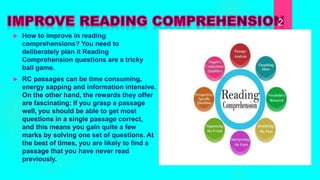
 How to improve in reading
comprehensions? You need to
deliberately plan it Reading
Comprehension questions are a tricky
ball game.
 RC passages can be time consuming,
energy sapping and information intensive.
On the other hand, the rewards they offer
are fascinating: if you grasp a passage
well, you should be able to get most
questions in a single passage correct,
and this means you gain quite a few
marks by solving one set of questions. At
the best of times, you are likely to find a
passage that you have never read
previously.
2
 One of the most significant factors for
solving reading comprehensions and
being accurate in this area actually
revolves around the approach you adopt
for this topic. How do you cope with such
a challenge actually becomes a central
aspect of how you perform in reading
comprehensions.
 It is important that you keep a number of
things in your mind and ensure you do
not fall into the common pitfalls. With
regards to the approach you should
adopt for reading comprehensions, keep
the following points in mind:
3
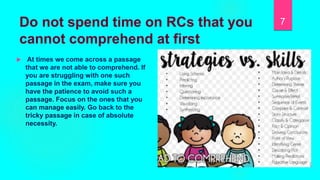
Do not spend time on RCs that you
cannot comprehend at first
 At times we come across a passage
that we are not able to comprehend.
If you are struggling with one such
passage in the exam, make sure you
have the patience to avoid such a
passage. Focus on the ones that
you can manage easily. Go back to
the tricky passage in case of
absolute necessity.
4
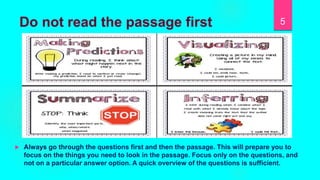
Do not read the passage first
 Always go through the questions first and then the passage. This will prepare you to
focus on the things you need to look in the passage. Focus only on the questions, and
not on a particular answer option. A quick overview of the questions is sufficient.
5
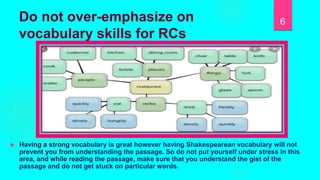
Do not over-emphasize on
vocabulary skills for RCs
 Having a strong vocabulary is great however having Shakespearean vocabulary will not
prevent you from understanding the passage. So do not put yourself under stress in this
area, and while reading the passage, make sure that you understand the gist of the
passage and do not get stuck on particular words.
6
Do not spend time on RCs that you
cannot comprehend at first
 At times we come across a passage
that we are not able to comprehend. If
you are struggling with one such
passage in the exam, make sure you
have the patience to avoid such a
passage. Focus on the ones that you
can manage easily. Go back to the
tricky passage in case of absolute
necessity.
7
Do not over-emphasize trivialities
 Details are important but don't be
obsessed with examples,
illustrations and so on. You just need
to get a hang of the main point and
not the examples. Comprehending
the overall flow and structure will
help you analyze and answer the
questions.
8
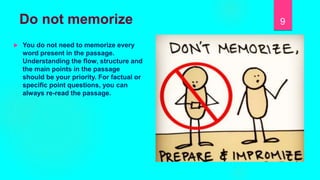
Do not memorize
 You do not need to memorize every
word present in the passage.
Understanding the flow, structure and
the main points in the passage
should be your priority. For factual or
specific point questions, you can
always re-read the passage.
9
Do not think the correct option
would come from outside the
passage
 Any of the options that is out of
scope is never the correct answer.
The right answer is always based on
the information given within the
passage. Do not focus on any of the
options that distract you from the
passage.
10
Do not rely on 'trigger words'
 You might get trapped in the web of
'trigger words' if you don’t read
attentively through the passage. A
passage may focus on one point for
quite a bit of sentences and then
change it towards the end with trigger
words like 'but' or 'however'. This will
usually confuse readers who skim
through the passage or rush through
it in haste.
11
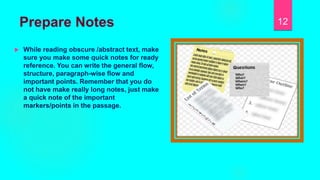
Prepare Notes
 While reading obscure /abstract text, make
sure you make some quick notes for ready
reference. You can write the general flow,
structure, paragraph-wise flow and
important points. Remember that you do
not have make really long notes, just make
a quick note of the important
markers/points in the passage.
12
Try to preempt questions
 This is a really difficult skill but if you
can master this, you will surely by the
'King of Reading Comprehensions'.
While reading the passage, try to
identify the possible questions that
could be asked, and which parts of
the passage seem the most likely
candidates for question-setting.
13
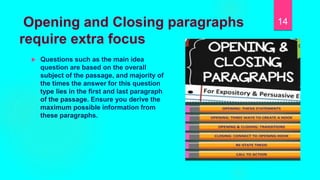
Opening and Closing paragraphs
require extra focus
 Questions such as the main idea
question are based on the overall
subject of the passage, and majority of
the times the answer for this question
type lies in the first and last paragraph
of the passage. Ensure you derive the
maximum possible information from
these paragraphs.
14
Constantly question yourself while
reading the passage
 In order to maintain your concentration while
reading, make sure that some basic questions
keep playing at the back of your mind: What is
the author's main point? Why is the author
writing this? How has the author chosen to
convey his main point? How has the author
organized his material?
15
Conclusion
 These are the basic points that should be kept in mind while approaching reading
comprehensions. These would improve your focus, increase your grasp of the
subject matter and deliver greater understanding.
16
THANK YOU
17

Reading comprehension strategies

  • 1.
  • 2.
     How toimprove in reading comprehensions? You need to deliberately plan it Reading Comprehension questions are a tricky ball game.  RC passages can be time consuming, energy sapping and information intensive. On the other hand, the rewards they offer are fascinating: if you grasp a passage well, you should be able to get most questions in a single passage correct, and this means you gain quite a few marks by solving one set of questions. At the best of times, you are likely to find a passage that you have never read previously. 2
  • 3.
     One ofthe most significant factors for solving reading comprehensions and being accurate in this area actually revolves around the approach you adopt for this topic. How do you cope with such a challenge actually becomes a central aspect of how you perform in reading comprehensions.  It is important that you keep a number of things in your mind and ensure you do not fall into the common pitfalls. With regards to the approach you should adopt for reading comprehensions, keep the following points in mind: 3
  • 4.
    Do not spendtime on RCs that you cannot comprehend at first  At times we come across a passage that we are not able to comprehend. If you are struggling with one such passage in the exam, make sure you have the patience to avoid such a passage. Focus on the ones that you can manage easily. Go back to the tricky passage in case of absolute necessity. 4
  • 5.
    Do not readthe passage first  Always go through the questions first and then the passage. This will prepare you to focus on the things you need to look in the passage. Focus only on the questions, and not on a particular answer option. A quick overview of the questions is sufficient. 5
  • 6.
    Do not over-emphasizeon vocabulary skills for RCs  Having a strong vocabulary is great however having Shakespearean vocabulary will not prevent you from understanding the passage. So do not put yourself under stress in this area, and while reading the passage, make sure that you understand the gist of the passage and do not get stuck on particular words. 6
  • 7.
    Do not spendtime on RCs that you cannot comprehend at first  At times we come across a passage that we are not able to comprehend. If you are struggling with one such passage in the exam, make sure you have the patience to avoid such a passage. Focus on the ones that you can manage easily. Go back to the tricky passage in case of absolute necessity. 7
  • 8.
    Do not over-emphasizetrivialities  Details are important but don't be obsessed with examples, illustrations and so on. You just need to get a hang of the main point and not the examples. Comprehending the overall flow and structure will help you analyze and answer the questions. 8
  • 9.
    Do not memorize You do not need to memorize every word present in the passage. Understanding the flow, structure and the main points in the passage should be your priority. For factual or specific point questions, you can always re-read the passage. 9
  • 10.
    Do not thinkthe correct option would come from outside the passage  Any of the options that is out of scope is never the correct answer. The right answer is always based on the information given within the passage. Do not focus on any of the options that distract you from the passage. 10
  • 11.
    Do not relyon 'trigger words'  You might get trapped in the web of 'trigger words' if you don’t read attentively through the passage. A passage may focus on one point for quite a bit of sentences and then change it towards the end with trigger words like 'but' or 'however'. This will usually confuse readers who skim through the passage or rush through it in haste. 11
  • 12.
    Prepare Notes  Whilereading obscure /abstract text, make sure you make some quick notes for ready reference. You can write the general flow, structure, paragraph-wise flow and important points. Remember that you do not have make really long notes, just make a quick note of the important markers/points in the passage. 12
  • 13.
    Try to preemptquestions  This is a really difficult skill but if you can master this, you will surely by the 'King of Reading Comprehensions'. While reading the passage, try to identify the possible questions that could be asked, and which parts of the passage seem the most likely candidates for question-setting. 13
  • 14.
    Opening and Closingparagraphs require extra focus  Questions such as the main idea question are based on the overall subject of the passage, and majority of the times the answer for this question type lies in the first and last paragraph of the passage. Ensure you derive the maximum possible information from these paragraphs. 14
  • 15.
    Constantly question yourselfwhile reading the passage  In order to maintain your concentration while reading, make sure that some basic questions keep playing at the back of your mind: What is the author's main point? Why is the author writing this? How has the author chosen to convey his main point? How has the author organized his material? 15
  • 16.
    Conclusion  These arethe basic points that should be kept in mind while approaching reading comprehensions. These would improve your focus, increase your grasp of the subject matter and deliver greater understanding. 16
  • 17.