I.F.D.C. LENGUAS VIVAS BARILOCHE
PRÁCTICA DOCENTE I
Alumno residente: MaríaPía Garbuglia
Institución Educativa: Jardín deInfantesMariano Moreno
Dirección: calle 1 N° 574
Cantidad dealumnos: 26 alumnos -13 nenesy 13 nenas
Edad: 5 años
Unidad Temática: Farm Animals
Clase Nº: 9
Fecha: 25/11/2019
Hora: 13: 30 hs
Duración dela clase: 30 minutos
Fecha de entrega dela planificación: 25/11/2019
Learning aims:
Duringthis lesson, learnerswill be able to:
- Develop listening and speakingskills through the activities and the
interaction with the teacher and peers.
- Develop cognitive skills and motor skills with the aid of flashcardsand a
drawingactivity.
Learning focus:
During this lesson, students will be able to learn and revise:
-Some colours: brown, yellow, grey, red, etc.
- Farm animals: hen, chicks, mouse, horse, etc.
- New: sheep, cow, rooster, duck, pig, etc.
Integration of skills:
During this lesson students will develop these skills:
- Linguistic skills: speaking words in English.
- Personal skills: being able to anchor words in English.
- Social skills: interacting with the teacher and peers.
- Physical skills: dancing, singing, drawing the farm animals.
- Cognitive skills: matching picture to the correct word in English.
Multiple intelligences:
During this lesson the following intelligences will be met:
- Visual-spatial: watching the song on the TV and watching and guessing the
animals with the flashcards.
- Linguistic-verbal: by answering the teacher´s questions and singing.
- Interpersonal: by interacting with their teacher and classmates.
- Bodily-kinesthetic: singing and dancing the song and drawing the animals.
Materials and resources:
Song, flashcards and worksheet. The flashcards are uploaded to the
campus. I created them. I looked for the pictures in google and printed
them in colour. The worksheet was taken from
www.supersimplelearning.com
The resources are detailed in their right place in the plan.
Possible contingencies:
There are some students who find it difficult to follow the instructions
during the English lessons because of their slow-working path. There are
two troublesome kids in particular who find it really difficult to follow
the lesson. They always misbehave and the teachers don´t seem to care
too much about it. They can be taken out of the classroom if it´s
necessary. The teacher should try to make them feel engaged in the
lesson. During the last lessons these two kids tried to work but their
engagement lasted for some minutes.
The teacher will start singing the silence song in order to ask for silence:
Put your finger on your lip like this, SHHH
Close your mouth with a zip,
Put your finger on your lip,
Put your finger on your lip like this, SHHH
Shhhhhhhhhhhh
Put your finger on your lip like this, SHHH
Close your mouth with a squeeze
Listen up, quiet please
Put your finger on your lip like this, SHHH
Shhhhhhhhhhh
Classroom management strategies:
Explain in L2 what the speaking activity is about and then, ask one student to
explain the activity to see whether he/she has understood. Continue
explaining other activities in L2 as well as usinggestures and body language in
order to avoid the use of L1 in the classroom.
Assessment: collecting information and reportingyour findings
The teacher will observe how much or how little they all participate when
answering questions while they have a look at the flashcards and then, while
singing, dancing and drawing.
Lesson stages:
Routine
We sing the hello song: https://www.youtube.com/watch?v=tVlcKp3bWH8 to
create the English learning atmosphere. Duration: 1:19 minutes.
Hello, hello, hello, how are you?
I’m good.
I’m great!
I’m wonderful!
I’m good.
I’m great!
I’m wonderful!
Hello, hello, hello, how are you?
I’m tired.
I’m hungry.
I’m not so good.
I’m tired.
I’m hungry.
I’m not so good.
Hello, hello, hello, how are you?
Lead-in
Students start singing the Hello! Song from their desks (following the daily
routine). They will then be invited to sit down and listen to Miss Pía to start
the speaking activity with flaschards.
Teacher: Hello children, how are you today?
Kids: Fine!!!
Teacher: Great!!!! I´m glad you are fine! Let´s start singing the Hello! Song.....
Teacher: Great job! Now, let´s see if you can guess the animals I brought
today....the teacher imitates the animal and its sound in order to make the
students guess it...once they answer with the name (they mainly use Spanish)
she shows them the animal and says its name in English. Asking them to
repeat it.
Presentation
Today we are going to play with the animals that we learnt in Little Red Hen
and Old Mc Donald. I am going to imitate them and their sounds and you will
have to guess them, alright? Are you ready? Here, we go!
Development of the sequence of activities
During the previous lessons children worked with the story “The Little Red
Hen” and they sang the song “Old Mc Donald”.
Teacher: Ok children, now, we are going to play with the animals that we
learnt with “The Little Red Hen”. Are you ready to guess them? Here, we go!
The teacher starts imitating the animals and their sounds and once the
students answer with one animal she shows them the corresponding
flashcard. The speaking activity is solved all together.
Duration: 15 minutes.
After finishing the speaking activity/game children will be invited to sing and
dance with the farm animals: https://www.youtube.com/watch?v=zXEq-
QO3xTg This song didn´t work last lesson so I downloaded it again to make
sure it works. Last lesson we sang and danced with Old Mc Donald´s song:
https://www.youtube.com/watch?v=5oYKonYBujg
Duration: 3: 23 minutes
The ducks on the farm say, “Quack, quack, quack.”
The mice on the farm say, “Squeak, squeak, squeak.”
The chickens on the farm say, “Cluck, cluck, cluck.”
“Quack. Squeak. Cluck.”
The pigs on the farm say, “Oink, oink, oink.”
The goats on the farm say “Meh, meh, meh.”
The sheep on the farm say “Baa, baa, baa.”
“Oink. Meh. Baa.”
The horses on the farm say, “Neigh, neigh, neigh.”
The cows on the farm say, “Moo, moo, moo.”
The roosters on the farm say, “Cock-a-doodle-doo.”
“Neigh. Moo. Cock-a-doodle-doo.”
Let’s try it a little faster.
The ducks on the farm say, “Quack, quack, quack.”
The mice on the farm say, “Squeak, squeak, squeak.”
The chickens on the farm say, “Cluck, cluck, cluck.”
“Quack. Squeak. Cluck.”
Okay, a little faster.
The pigs on the farm say, “Oink, oink, oink.”
The goats on the farm say “Meh, meh, meh.”
The sheep on the farm say “Baa, baa, baa.”
“Oink. Meh. Baa.”
Okay, super fast!
The horses on the farm say, “Neigh, neigh, neigh.”
The cows on the farm say, “Moo, moo, moo.”
The roosters on the farm say, “Cock-a-doodle-doo”
“Neigh. Moo. Cock-a-doodle-doo.”
Finally, students will be invited to sit down and start drawing the animals on
their farms. (See worksheet in campus). The teacher will ask students what
animals they can find on their farms in order to make sure they can anchor
their names in English.
Duration: 10 minutes.
Closure
When time is over, the teacher says: “Well kids, time´s up” Let´s sing the
goodbye song. Thank you for letting me be your teacher during these lessons.
I´ll miss you all. Good luck in first grade!!!! We sing the goodbye song:
https://www.youtube.com/watch?v=UQfvAlmr5g0 to round-up the lesson.
Duration: 0:54 minutes.
Goodbye, goodbye.
It’s time to go.
Goodbye, goodbye.
I don’t want to go.
See you later, alligator.
Bye bye bye, butterfly.
Goodbye!
Each activity must be described in terms of the following components:
 Purpose
 Timing
 Activity description and instructions as they will be said to
students (include direct speech)
 Scaffolding strategies
 Transition comment to link each stage of the lesson with the next one
Lesson plan
component
Excellent
5
Very
Good
4
Good
3
Acceptable
2
Needs
improvement
1
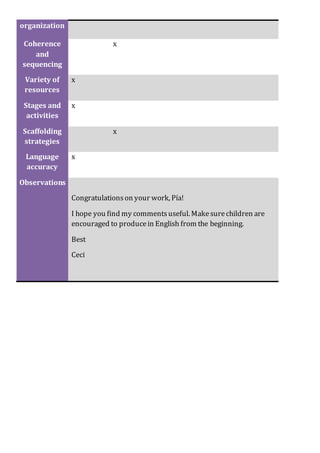
Visual x
organization
Coherence
and
sequencing
x
Variety of
resources
x
Stages and
activities
x
Scaffolding
strategies
x
Language
accuracy
x
Observations
Congratulationson your work, Pía!
I hope you find my commentsuseful. Makesurechildren are
encouraged to producein English from the beginning.
Best
Ceci

Lesson plan 7

  • 1.
    I.F.D.C. LENGUAS VIVASBARILOCHE PRÁCTICA DOCENTE I Alumno residente: MaríaPía Garbuglia Institución Educativa: Jardín deInfantesMariano Moreno Dirección: calle 1 N° 574 Cantidad dealumnos: 26 alumnos -13 nenesy 13 nenas Edad: 5 años Unidad Temática: Farm Animals Clase Nº: 9 Fecha: 25/11/2019 Hora: 13: 30 hs Duración dela clase: 30 minutos Fecha de entrega dela planificación: 25/11/2019 Learning aims: Duringthis lesson, learnerswill be able to: - Develop listening and speakingskills through the activities and the interaction with the teacher and peers. - Develop cognitive skills and motor skills with the aid of flashcardsand a drawingactivity. Learning focus: During this lesson, students will be able to learn and revise: -Some colours: brown, yellow, grey, red, etc. - Farm animals: hen, chicks, mouse, horse, etc. - New: sheep, cow, rooster, duck, pig, etc. Integration of skills: During this lesson students will develop these skills: - Linguistic skills: speaking words in English. - Personal skills: being able to anchor words in English. - Social skills: interacting with the teacher and peers. - Physical skills: dancing, singing, drawing the farm animals. - Cognitive skills: matching picture to the correct word in English.
  • 2.
    Multiple intelligences: During thislesson the following intelligences will be met: - Visual-spatial: watching the song on the TV and watching and guessing the animals with the flashcards. - Linguistic-verbal: by answering the teacher´s questions and singing. - Interpersonal: by interacting with their teacher and classmates. - Bodily-kinesthetic: singing and dancing the song and drawing the animals. Materials and resources: Song, flashcards and worksheet. The flashcards are uploaded to the campus. I created them. I looked for the pictures in google and printed them in colour. The worksheet was taken from www.supersimplelearning.com The resources are detailed in their right place in the plan. Possible contingencies: There are some students who find it difficult to follow the instructions during the English lessons because of their slow-working path. There are two troublesome kids in particular who find it really difficult to follow the lesson. They always misbehave and the teachers don´t seem to care too much about it. They can be taken out of the classroom if it´s necessary. The teacher should try to make them feel engaged in the lesson. During the last lessons these two kids tried to work but their engagement lasted for some minutes. The teacher will start singing the silence song in order to ask for silence: Put your finger on your lip like this, SHHH Put your finger on your lip like this, SHHH Close your mouth with a zip, Put your finger on your lip, Put your finger on your lip like this, SHHH Shhhhhhhhhhhh Put your finger on your lip like this, SHHH Put your finger on your lip like this, SHHH Close your mouth with a squeeze Listen up, quiet please
  • 3.
    Put your fingeron your lip like this, SHHH Shhhhhhhhhhh Classroom management strategies: Explain in L2 what the speaking activity is about and then, ask one student to explain the activity to see whether he/she has understood. Continue explaining other activities in L2 as well as usinggestures and body language in order to avoid the use of L1 in the classroom. Assessment: collecting information and reportingyour findings The teacher will observe how much or how little they all participate when answering questions while they have a look at the flashcards and then, while singing, dancing and drawing. Lesson stages: Routine We sing the hello song: https://www.youtube.com/watch?v=tVlcKp3bWH8 to create the English learning atmosphere. Duration: 1:19 minutes. Hello, hello, hello, how are you? Hello, hello, hello, how are you? I’m good. I’m great! I’m wonderful! I’m good. I’m great! I’m wonderful! Hello, hello, hello, how are you? Hello, hello, hello, how are you? I’m tired. I’m hungry. I’m not so good. I’m tired. I’m hungry. I’m not so good. Hello, hello, hello, how are you? Hello, hello, hello, how are you?
  • 4.
    Hello, hello, hello,how are you? Hello, hello, hello, how are you? Lead-in Students start singing the Hello! Song from their desks (following the daily routine). They will then be invited to sit down and listen to Miss Pía to start the speaking activity with flaschards. Teacher: Hello children, how are you today? Kids: Fine!!! Teacher: Great!!!! I´m glad you are fine! Let´s start singing the Hello! Song..... Teacher: Great job! Now, let´s see if you can guess the animals I brought today....the teacher imitates the animal and its sound in order to make the students guess it...once they answer with the name (they mainly use Spanish) she shows them the animal and says its name in English. Asking them to repeat it. Presentation Today we are going to play with the animals that we learnt in Little Red Hen and Old Mc Donald. I am going to imitate them and their sounds and you will have to guess them, alright? Are you ready? Here, we go! Development of the sequence of activities During the previous lessons children worked with the story “The Little Red Hen” and they sang the song “Old Mc Donald”. Teacher: Ok children, now, we are going to play with the animals that we learnt with “The Little Red Hen”. Are you ready to guess them? Here, we go! The teacher starts imitating the animals and their sounds and once the students answer with one animal she shows them the corresponding flashcard. The speaking activity is solved all together. Duration: 15 minutes.
  • 5.
    After finishing thespeaking activity/game children will be invited to sing and dance with the farm animals: https://www.youtube.com/watch?v=zXEq- QO3xTg This song didn´t work last lesson so I downloaded it again to make sure it works. Last lesson we sang and danced with Old Mc Donald´s song: https://www.youtube.com/watch?v=5oYKonYBujg Duration: 3: 23 minutes The ducks on the farm say, “Quack, quack, quack.” The mice on the farm say, “Squeak, squeak, squeak.” The chickens on the farm say, “Cluck, cluck, cluck.” “Quack. Squeak. Cluck.” The pigs on the farm say, “Oink, oink, oink.” The goats on the farm say “Meh, meh, meh.” The sheep on the farm say “Baa, baa, baa.” “Oink. Meh. Baa.” The horses on the farm say, “Neigh, neigh, neigh.” The cows on the farm say, “Moo, moo, moo.” The roosters on the farm say, “Cock-a-doodle-doo.” “Neigh. Moo. Cock-a-doodle-doo.” “Neigh. Moo. Cock-a-doodle-doo.” Let’s try it a little faster. The ducks on the farm say, “Quack, quack, quack.” The mice on the farm say, “Squeak, squeak, squeak.” The chickens on the farm say, “Cluck, cluck, cluck.” “Quack. Squeak. Cluck.” Okay, a little faster. The pigs on the farm say, “Oink, oink, oink.” The goats on the farm say “Meh, meh, meh.” The sheep on the farm say “Baa, baa, baa.” “Oink. Meh. Baa.” Okay, super fast! The horses on the farm say, “Neigh, neigh, neigh.” The cows on the farm say, “Moo, moo, moo.” The roosters on the farm say, “Cock-a-doodle-doo” “Neigh. Moo. Cock-a-doodle-doo.” “Neigh. Moo. Cock-a-doodle-doo.”
  • 6.
    Finally, students willbe invited to sit down and start drawing the animals on their farms. (See worksheet in campus). The teacher will ask students what animals they can find on their farms in order to make sure they can anchor their names in English. Duration: 10 minutes. Closure When time is over, the teacher says: “Well kids, time´s up” Let´s sing the goodbye song. Thank you for letting me be your teacher during these lessons. I´ll miss you all. Good luck in first grade!!!! We sing the goodbye song: https://www.youtube.com/watch?v=UQfvAlmr5g0 to round-up the lesson. Duration: 0:54 minutes. Goodbye, goodbye. It’s time to go. Goodbye, goodbye. I don’t want to go. See you later, alligator. Bye bye bye, butterfly. Goodbye! Each activity must be described in terms of the following components:  Purpose  Timing  Activity description and instructions as they will be said to students (include direct speech)  Scaffolding strategies  Transition comment to link each stage of the lesson with the next one Lesson plan component Excellent 5 Very Good 4 Good 3 Acceptable 2 Needs improvement 1 Visual x
  • 7.
    organization Coherence and sequencing x Variety of resources x Stages and activities x Scaffolding strategies x Language accuracy x Observations Congratulationsonyour work, Pía! I hope you find my commentsuseful. Makesurechildren are encouraged to producein English from the beginning. Best Ceci