I.F.D.C. LENGUAS VIVAS BARILOCHE
PRÁCTICA DOCENTE I
Alumno residente: Bárbara Edith Martínez
Institución Educativa: Escuela Primara N°315
Dirección: Almirante Brown 600. Piedra del Águila. Neuquén.
Cantidad de alumnos: 14
Edad: entre 6 y 7 años
Unidad Temática: Animales de la granja, números hasta el 10.
Clase Nº: 2
Fecha: 28/10/2019
Hora: 10:45 a 11:30 am
Duración de la clase: 45 minutos
Fecha de entrega de la planificación: 27/10/19
Learning aims:
During this lesson, learners will be able to revise the farm animals
learnt in the previous lesson and thus be aware of what animals are in a
real farm. Counting up to10: they will be introduced to numbers up to
ten since during the observation period the teacher could notice that
they have some knowledge about numbers.
They will also be able to pluralize the nouns taught by counting: ten
pigs.
They will be able to develop their listening skill by the listening of
instructions in English and of a song.
Learning focus:
Vocabulary related to farm animals.: pig, cow, horse, rooster, duck,
sheep.
Numbers up to 10.
Integration of skills:
 Speaking: students will try to communicate using the new words
and at the same time they will socialize and discuss some items
with their peers and with the teacher. They will be able to sing
and reproduce the different items of vocabulary that are
introduced.
 Listening: students will start developing their listening skill since
they will have to pay attention to the song and the video. At the
same time, they will have to pay attention to the teacher’s
instructions so as to comply with the activities offered. The
teacher will scaffold them by repeating as many times as needed.
Multiple intelligences:
 Linguistic intelligence: students will need to express their ideas
to the teacher and to their mates.
 Musical intelligence: students will be asked to sing and follow the
rhythm of the song.
 Visual- Spatial intelligence: students will be asked to find items
that have been hidden in the classroom.
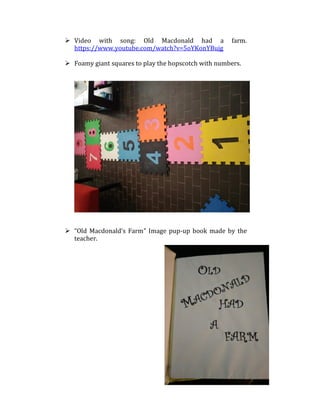
 Bodily kineasthetic: students will play hopscotch as they count
up to 10.
Materials and resources:
 Hand-made tube puzzles with animal images on them.
 Variety of materials to decorate the puzzles once they have
finished with the activity.
 Video with song: Old Macdonald had a farm.
https://www.youtube.com/watch?v=5oYKonYBujg
 Foamy giant squares to play the hopscotch with numbers.
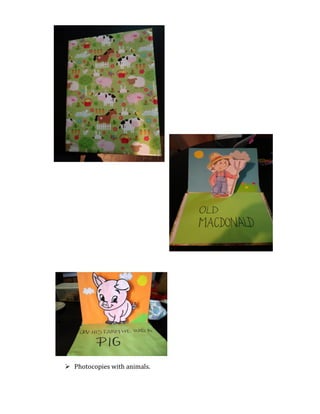
 “Old Macdonald’s Farm” Image pup-up book made by the
teacher.
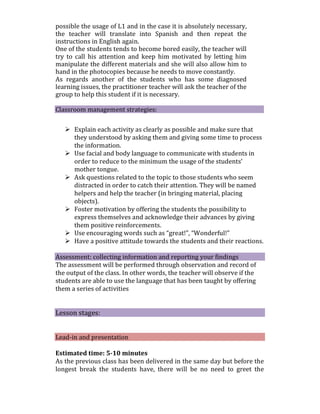
 Photocopies with animals.
Possible contingencies:
As explained in the previous lesson plan, students have never
been formally in contact with the English language, it is possible
that the teacher needs to use Spanish to explain or clarify some
concepts. However, the strategy will be to avoid as much as
possible the usage of L1 and in the case it is absolutely necessary,
the teacher will translate into Spanish and then repeat the
instructions in English again.
One of the students tends to become bored easily, the teacher will
try to call his attention and keep him motivated by letting him
manipulate the different materials and she will also allow him to
hand in the photocopies because he needs to move constantly.
As regards another of the students who has some diagnosed
learning issues, the practitioner teacher will ask the teacher of the
group to help this student if it is necessary.
Classroom management strategies:
 Explain each activity as clearly as possible and make sure that
they understood by asking them and giving some time to process
the information.
 Use facial and body language to communicate with students in
order to reduce to the minimum the usage of the students’
mother tongue.
 Ask questions related to the topic to those students who seem
distracted in order to catch their attention. They will be named
helpers and help the teacher (in bringing material, placing
objects).
 Foster motivation by offering the students the possibility to
express themselves and acknowledge their advances by giving
them positive reinforcements.
 Use encouraging words such as “great!”, “Wonderful!”
 Have a positive attitude towards the students and their reactions.
Assessment: collecting information and reporting your findings
The assessment will be performed through observation and record of
the output of the class. In other words, the teacher will observe if the
students are able to use the language that has been taught by offering
them a series of activities
Lesson stages:
Lead-in and presentation
Estimated time: 5-10 minutes
As the previous class has been delivered in the same day but before the
longest break the students have, there will be no need to greet the
students again. However, if the students are willing to say hello again,
they will be allowed to do so.
The teacher will hand in a thumb-up stick puppet, and she will ask: How
was the break? The students will answer raising their stick puppet and
say at the same time: “OK!”1.
As it was stated in the previous lesson plan, the students have no formal
instruction in the English language, that it is why the teacher will
scaffold students by repeating as many times as needed and by miming
to avoid the usage of Spanish. In the case it is needed, the teacher will
say the instructions three times: the first time in English, the second
time in Spanish and the last one in English again.
After asking how they have done during the break-time, the teacher will
ask students to sit on the floor to listen and watch the video of the song
“Old Macdonald had a farm” they have already learnt. The teacher will
sing and encourage the children to sing with her. The teacher will pause
the video for the children to repeat and sing along with the teacher. The
children are expected to sing and remember the animals.
Development of the sequence of activities
Estimated time: 25 minutes
Purpose: To revise the vocabulary learnt in the previous lesson. To
teach students the numbers up toten. To teach the word order: number
followed by animal(s). To make students feel as comfortable as possible
with the usage of a language they do not know.
The teacher will tell students: Do you know? Old Macdonald has lost
one of his animals! And he cannot discover which is this animal! Let´s
help him to find out what animal is lost by completing this puzzles.” The
teacher will give students some time to complete the task and once they
have finish, the teacher will ask: “What animals have you found?” Is it a
rooster?” the students may answer: “no” So the teacher will continue:
then, it’s a ddduuuu…” and let the students finish the phrase. After this,
the teacher will encourage students to repeat the complete phrase:
(pointing at the image of the animal: “It’s a duck”.
At this point the teacher will help the students realize that the missing
animal is the pig. She will do so by eliciting the animals from the
children as she points at each image (on the puzzles). If the students do
not remember the words, the teacher will scaffold them by repeating
1
This stick puppet will be used from this moment on to answer to the question: How are you?
the first sounds of each word.Then, the teacher will say that they have
to find all the missing pigs. Previously, the teacher will sitck ten
pictures of pigs on the classroom walls. “Let’s help Old Macdonald to
find his pigs!”. The children will look for the pictures and as they find
them, they will have to stick the image on a foamy hopscotch that will
be placed on the floor. After finding them all, the teacher will say: “Now,
let’s count how many pigs we have found. One… (encouraging the
children to continue). Once they have finished, they will play the game
for a while.
The scaffolding strategies the ones described in the lesson plan:
repetition, modeling of the activities (the teacher will make first each
activity and encourage the students to follow her), miming.
Closure
Timing: 10 minutes
Purpose: To assess if the students have understood and learnt the new
vocabulary introduced. To make students relax after having jumped and
been moving around.
To finish with the class, the teacher will explain students: “Old
Macdonald needs to go to bed, but first we need to check if all his
animals are in the farm”. Let’s listen and paint.
The teacher will then, hand in a photocopy in which there will be 10
cows, she will say students: “Mac Donald has three cows…” so the
children have to paint three of all the cows they will find. Then, the
teacher will encourage the students to count the painted cow by saying:
one cow, two… and three… cows.
This will be repeated with 5 roosters, 7 horse and 10 ducks.
The photocopies will be handed in one at a time, to give time for the
children to finish painting and not to generate confusion in them.
Before the bell rings, the teacher will greet students saying: see you!
Bye bye! The students may answer in the same way or in Spanish
Lesson plan
component
Excellent
5
Very Good
4
Good
3
Acceptable
2
Needs
improvement
1
Visual
organization
Coherence and
sequencing
Variety of
resources
Stages and
activities
Scaffolding
strategies
Language
accuracy
Observations

Lessonplan2

  • 1.
    I.F.D.C. LENGUAS VIVASBARILOCHE PRÁCTICA DOCENTE I Alumno residente: Bárbara Edith Martínez Institución Educativa: Escuela Primara N°315 Dirección: Almirante Brown 600. Piedra del Águila. Neuquén. Cantidad de alumnos: 14 Edad: entre 6 y 7 años Unidad Temática: Animales de la granja, números hasta el 10. Clase Nº: 2 Fecha: 28/10/2019 Hora: 10:45 a 11:30 am Duración de la clase: 45 minutos Fecha de entrega de la planificación: 27/10/19 Learning aims: During this lesson, learners will be able to revise the farm animals learnt in the previous lesson and thus be aware of what animals are in a real farm. Counting up to10: they will be introduced to numbers up to ten since during the observation period the teacher could notice that they have some knowledge about numbers. They will also be able to pluralize the nouns taught by counting: ten pigs. They will be able to develop their listening skill by the listening of instructions in English and of a song. Learning focus: Vocabulary related to farm animals.: pig, cow, horse, rooster, duck, sheep. Numbers up to 10. Integration of skills:  Speaking: students will try to communicate using the new words and at the same time they will socialize and discuss some items with their peers and with the teacher. They will be able to sing and reproduce the different items of vocabulary that are introduced.  Listening: students will start developing their listening skill since
  • 2.
    they will haveto pay attention to the song and the video. At the same time, they will have to pay attention to the teacher’s instructions so as to comply with the activities offered. The teacher will scaffold them by repeating as many times as needed. Multiple intelligences:  Linguistic intelligence: students will need to express their ideas to the teacher and to their mates.  Musical intelligence: students will be asked to sing and follow the rhythm of the song.  Visual- Spatial intelligence: students will be asked to find items that have been hidden in the classroom.  Bodily kineasthetic: students will play hopscotch as they count up to 10. Materials and resources:  Hand-made tube puzzles with animal images on them.  Variety of materials to decorate the puzzles once they have finished with the activity.
  • 3.
     Video withsong: Old Macdonald had a farm. https://www.youtube.com/watch?v=5oYKonYBujg  Foamy giant squares to play the hopscotch with numbers.  “Old Macdonald’s Farm” Image pup-up book made by the teacher.
  • 4.
  • 5.
    Possible contingencies: As explainedin the previous lesson plan, students have never been formally in contact with the English language, it is possible that the teacher needs to use Spanish to explain or clarify some concepts. However, the strategy will be to avoid as much as
  • 6.
    possible the usageof L1 and in the case it is absolutely necessary, the teacher will translate into Spanish and then repeat the instructions in English again. One of the students tends to become bored easily, the teacher will try to call his attention and keep him motivated by letting him manipulate the different materials and she will also allow him to hand in the photocopies because he needs to move constantly. As regards another of the students who has some diagnosed learning issues, the practitioner teacher will ask the teacher of the group to help this student if it is necessary. Classroom management strategies:  Explain each activity as clearly as possible and make sure that they understood by asking them and giving some time to process the information.  Use facial and body language to communicate with students in order to reduce to the minimum the usage of the students’ mother tongue.  Ask questions related to the topic to those students who seem distracted in order to catch their attention. They will be named helpers and help the teacher (in bringing material, placing objects).  Foster motivation by offering the students the possibility to express themselves and acknowledge their advances by giving them positive reinforcements.  Use encouraging words such as “great!”, “Wonderful!”  Have a positive attitude towards the students and their reactions. Assessment: collecting information and reporting your findings The assessment will be performed through observation and record of the output of the class. In other words, the teacher will observe if the students are able to use the language that has been taught by offering them a series of activities Lesson stages: Lead-in and presentation Estimated time: 5-10 minutes As the previous class has been delivered in the same day but before the longest break the students have, there will be no need to greet the
  • 7.
    students again. However,if the students are willing to say hello again, they will be allowed to do so. The teacher will hand in a thumb-up stick puppet, and she will ask: How was the break? The students will answer raising their stick puppet and say at the same time: “OK!”1. As it was stated in the previous lesson plan, the students have no formal instruction in the English language, that it is why the teacher will scaffold students by repeating as many times as needed and by miming to avoid the usage of Spanish. In the case it is needed, the teacher will say the instructions three times: the first time in English, the second time in Spanish and the last one in English again. After asking how they have done during the break-time, the teacher will ask students to sit on the floor to listen and watch the video of the song “Old Macdonald had a farm” they have already learnt. The teacher will sing and encourage the children to sing with her. The teacher will pause the video for the children to repeat and sing along with the teacher. The children are expected to sing and remember the animals. Development of the sequence of activities Estimated time: 25 minutes Purpose: To revise the vocabulary learnt in the previous lesson. To teach students the numbers up toten. To teach the word order: number followed by animal(s). To make students feel as comfortable as possible with the usage of a language they do not know. The teacher will tell students: Do you know? Old Macdonald has lost one of his animals! And he cannot discover which is this animal! Let´s help him to find out what animal is lost by completing this puzzles.” The teacher will give students some time to complete the task and once they have finish, the teacher will ask: “What animals have you found?” Is it a rooster?” the students may answer: “no” So the teacher will continue: then, it’s a ddduuuu…” and let the students finish the phrase. After this, the teacher will encourage students to repeat the complete phrase: (pointing at the image of the animal: “It’s a duck”. At this point the teacher will help the students realize that the missing animal is the pig. She will do so by eliciting the animals from the children as she points at each image (on the puzzles). If the students do not remember the words, the teacher will scaffold them by repeating 1 This stick puppet will be used from this moment on to answer to the question: How are you?
  • 8.
    the first soundsof each word.Then, the teacher will say that they have to find all the missing pigs. Previously, the teacher will sitck ten pictures of pigs on the classroom walls. “Let’s help Old Macdonald to find his pigs!”. The children will look for the pictures and as they find them, they will have to stick the image on a foamy hopscotch that will be placed on the floor. After finding them all, the teacher will say: “Now, let’s count how many pigs we have found. One… (encouraging the children to continue). Once they have finished, they will play the game for a while. The scaffolding strategies the ones described in the lesson plan: repetition, modeling of the activities (the teacher will make first each activity and encourage the students to follow her), miming. Closure Timing: 10 minutes Purpose: To assess if the students have understood and learnt the new vocabulary introduced. To make students relax after having jumped and been moving around. To finish with the class, the teacher will explain students: “Old Macdonald needs to go to bed, but first we need to check if all his animals are in the farm”. Let’s listen and paint. The teacher will then, hand in a photocopy in which there will be 10 cows, she will say students: “Mac Donald has three cows…” so the children have to paint three of all the cows they will find. Then, the teacher will encourage the students to count the painted cow by saying: one cow, two… and three… cows. This will be repeated with 5 roosters, 7 horse and 10 ducks. The photocopies will be handed in one at a time, to give time for the children to finish painting and not to generate confusion in them. Before the bell rings, the teacher will greet students saying: see you! Bye bye! The students may answer in the same way or in Spanish Lesson plan component Excellent 5 Very Good 4 Good 3 Acceptable 2 Needs improvement 1 Visual organization
  • 9.
    Coherence and sequencing Variety of resources Stagesand activities Scaffolding strategies Language accuracy Observations