SEMINAR ON LIPOSOMES
Presented by:
VENKATESH GOLI
M. Pharm 1st
YEAR (Pharmaceutics)
SVU COLLEGE OF PHARMACEUTICAL SCIENCES ,
TIRUPATI
SRI VENKATESWARA UNIVERSITY,
TIRUPATI
CONTENTS
• INTRODUCTION
• BASIC STRUCTURE
• DIFFERENCE BETEEN MICELLE AND
LIPOSOME
• STRUCTURAL COMPONENTS
• FORMATION OF A LIPOSOME
• TYPES OF LIPOSOMES
• METHOD OF PREPARATION
• ADVANTAGES AND DISADVANTAGES
• APPLICATIONS
LIPOSOMES
 Liposomes first described by Dr. A. D. Bangham in 1960.who
was studynig phospolipid bilayers and blood cloting.
 The Liposomes are sperical, microscopic vesicles composed of
one or more concentric phospholipids bi-layer separated by
aqueous buffer compartments known as “Liposomes”..
 Liposomes is Greek words means
‘Lipo’ mean ‘Fat’ and
‘Somes’ mean‘Body’.
 Their diameter ranges from 10nm to 10,000nm.
BASIC STRUTURE
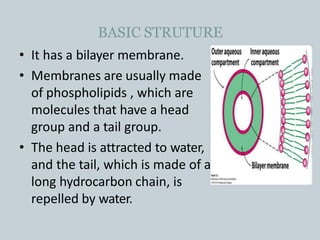
• It has a bilayer membrane.
• Membranes are usually made
of phospholipids , which are
molecules that have a head
group and a tail group.
• The head is attracted to water,
and the tail, which is made of a
long hydrocarbon chain, is
repelled by water.
DIFFERENCE BETEEN
MICELLE AND
LIPOSOME
MICELE
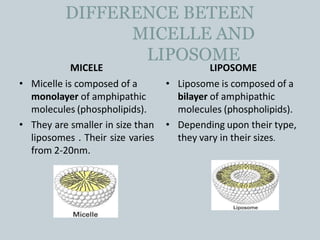
• Micelle is composed of a
monolayer of amphipathic
molecules (phospholipids).
• They are smaller in size than
liposomes . Their size varies
from 2-20nm.
LIPOSOME
• Liposome is composed of a
bilayer of amphipathic
molecules (phospholipids).
• Depending upon their type,
they vary in their sizes.
STRUCTURAL COMPONENTS
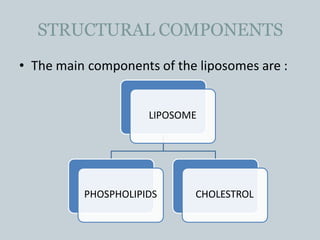
• The main components of the liposomes are :
LIPOSOME
PHOSPHOLIPIDS CHOLESTROL
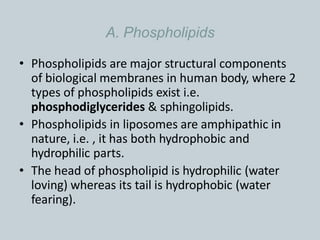
A. Phospholipids
• Phospholipids are major structural components
of biological membranes in human body, where 2
types of phospholipids exist i.e.
phosphodiglycerides & sphingolipids.
• Phospholipids in liposomes are amphipathic in
nature, i.e. , it has both hydrophobic and
hydrophilic parts.
• The head of phospholipid is hydrophilic (water
loving) whereas its tail is hydrophobic (water
fearing).
B. Cholesterol
• Cholesterol by itself does not form bilayer
structure.
• They are present within the phospholipids.
FORMATION OF A LIPOSOME
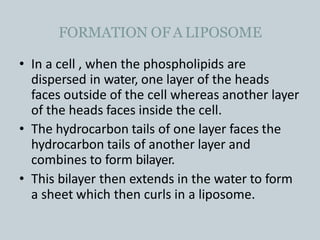
• In a cell , when the phospholipids are
dispersed in water, one layer of the heads
faces outside of the cell whereas another layer
of the heads faces inside the cell.
• The hydrocarbon tails of one layer faces the
hydrocarbon tails of another layer and
combines to form bilayer.
• This bilayer then extends in the water to form
a sheet which then curls in a liposome.
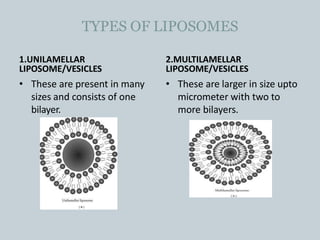
TYPES OF LIPOSOMES
1.UNILAMELLAR
LIPOSOME/VESICLES
• These are present in many
sizes and consists of one
bilayer.
2.MULTILAMELLAR
LIPOSOME/VESICLES
• These are larger in size upto
micrometer with two to
more bilayers.
TYPES OF LIPOSOMES
 TYPES OF
UNILAMELLAR
• Unilamellar are of 3 types :
1. Small unilamellar vesicles
usually range from 20-100nm
in size and consists 0ne bilayer.
2. Large unilamellar vesicles are
usually greater than 100nm in
size with one bilayer.
3. Giant unilamellar are greater
than 1000nm in size and
consists one bilayer.
OLIGOLAMELLAR
LIPOSOME/VESICLES
• These are 0.1-1nm in size
and consists of 5 bilayers
10
Method of liposome
preparation
Passive loading
techniques
Mechanical
dispersion
methods.
1. Hand shaking
2. Sonication
3.Micro-
emulsification
4. French pressure
cell
Solvent
dispersion
methods.
1.Ethanol injection
2. Ether injection
3.Double
emulsion vesicles
4.Reverse phase
evaporation
vesicles
Detergent
removal
methods.
1. Detergent
2. Dialysis
3. Column
chromatography
4. Dilution
Active loading
techniques
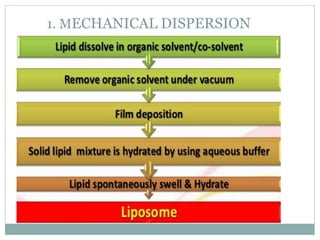
1. MECHANICAL DISPERSION
METHODS.
11
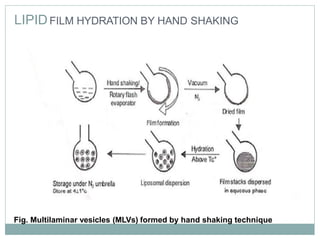
LIPIDFILM HYDRATION BY HAND SHAKING
12
Fig. Multilaminar vesicles (MLVs) formed by hand shaking technique
2. SOLVENT DISPERSIONMETHOD
19
3. DETERGENT REMOVAL
METHODS
15
 The conc. of detergent at which micelles are formed is
called as CMC.
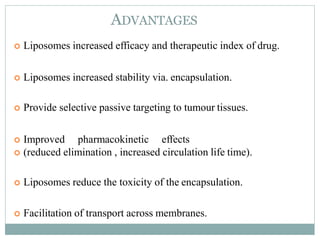
ADVANTAGES
 Liposomes increased efficacy and therapeutic index of drug.
 Liposomes increased stability via. encapsulation.
 Provide selective passive targeting to tumour tissues.
 Improved pharmacokinetic effects
 (reduced elimination , increased circulation life time).
 Liposomes reduce the toxicity of the encapsulation.
 Facilitation of transport across membranes. 5
DISADVANTAGES
2
2
 Low solubility in water.
 Sometimes phospholipid undergoes oxidation and hydrolysis
like reaction.
 Production cost is high.
APPLICATIONS
1. Liposomes are used in drug/protein delivery
or medicines.
• Controlled and sustained drug release in situ.
• Enchanced drug solubization.
2. In Cosmetology and dermatology.
3. In cancer therapy.

Thank

Liposomes

  • 1.
    SEMINAR ON LIPOSOMES Presentedby: VENKATESH GOLI M. Pharm 1st YEAR (Pharmaceutics) SVU COLLEGE OF PHARMACEUTICAL SCIENCES , TIRUPATI SRI VENKATESWARA UNIVERSITY, TIRUPATI
  • 2.
    CONTENTS • INTRODUCTION • BASICSTRUCTURE • DIFFERENCE BETEEN MICELLE AND LIPOSOME • STRUCTURAL COMPONENTS • FORMATION OF A LIPOSOME • TYPES OF LIPOSOMES • METHOD OF PREPARATION • ADVANTAGES AND DISADVANTAGES • APPLICATIONS
  • 3.
    LIPOSOMES  Liposomes firstdescribed by Dr. A. D. Bangham in 1960.who was studynig phospolipid bilayers and blood cloting.  The Liposomes are sperical, microscopic vesicles composed of one or more concentric phospholipids bi-layer separated by aqueous buffer compartments known as “Liposomes”..  Liposomes is Greek words means ‘Lipo’ mean ‘Fat’ and ‘Somes’ mean‘Body’.  Their diameter ranges from 10nm to 10,000nm.
  • 5.
    BASIC STRUTURE • Ithas a bilayer membrane. • Membranes are usually made of phospholipids , which are molecules that have a head group and a tail group. • The head is attracted to water, and the tail, which is made of a long hydrocarbon chain, is repelled by water.
  • 6.
    DIFFERENCE BETEEN MICELLE AND LIPOSOME MICELE •Micelle is composed of a monolayer of amphipathic molecules (phospholipids). • They are smaller in size than liposomes . Their size varies from 2-20nm. LIPOSOME • Liposome is composed of a bilayer of amphipathic molecules (phospholipids). • Depending upon their type, they vary in their sizes.
  • 7.
    STRUCTURAL COMPONENTS • Themain components of the liposomes are : LIPOSOME PHOSPHOLIPIDS CHOLESTROL
  • 8.
    A. Phospholipids • Phospholipidsare major structural components of biological membranes in human body, where 2 types of phospholipids exist i.e. phosphodiglycerides & sphingolipids. • Phospholipids in liposomes are amphipathic in nature, i.e. , it has both hydrophobic and hydrophilic parts. • The head of phospholipid is hydrophilic (water loving) whereas its tail is hydrophobic (water fearing).
  • 10.
    B. Cholesterol • Cholesterolby itself does not form bilayer structure. • They are present within the phospholipids.
  • 11.
    FORMATION OF ALIPOSOME • In a cell , when the phospholipids are dispersed in water, one layer of the heads faces outside of the cell whereas another layer of the heads faces inside the cell. • The hydrocarbon tails of one layer faces the hydrocarbon tails of another layer and combines to form bilayer. • This bilayer then extends in the water to form a sheet which then curls in a liposome.
  • 13.
    TYPES OF LIPOSOMES 1.UNILAMELLAR LIPOSOME/VESICLES •These are present in many sizes and consists of one bilayer. 2.MULTILAMELLAR LIPOSOME/VESICLES • These are larger in size upto micrometer with two to more bilayers.
  • 14.
    TYPES OF LIPOSOMES TYPES OF UNILAMELLAR • Unilamellar are of 3 types : 1. Small unilamellar vesicles usually range from 20-100nm in size and consists 0ne bilayer. 2. Large unilamellar vesicles are usually greater than 100nm in size with one bilayer. 3. Giant unilamellar are greater than 1000nm in size and consists one bilayer. OLIGOLAMELLAR LIPOSOME/VESICLES • These are 0.1-1nm in size and consists of 5 bilayers
  • 16.
    10 Method of liposome preparation Passiveloading techniques Mechanical dispersion methods. 1. Hand shaking 2. Sonication 3.Micro- emulsification 4. French pressure cell Solvent dispersion methods. 1.Ethanol injection 2. Ether injection 3.Double emulsion vesicles 4.Reverse phase evaporation vesicles Detergent removal methods. 1. Detergent 2. Dialysis 3. Column chromatography 4. Dilution Active loading techniques
  • 17.
  • 18.
    LIPIDFILM HYDRATION BYHAND SHAKING 12 Fig. Multilaminar vesicles (MLVs) formed by hand shaking technique
  • 19.
  • 20.
    3. DETERGENT REMOVAL METHODS 15 The conc. of detergent at which micelles are formed is called as CMC.
  • 21.
    ADVANTAGES  Liposomes increasedefficacy and therapeutic index of drug.  Liposomes increased stability via. encapsulation.  Provide selective passive targeting to tumour tissues.  Improved pharmacokinetic effects  (reduced elimination , increased circulation life time).  Liposomes reduce the toxicity of the encapsulation.  Facilitation of transport across membranes. 5
  • 22.
    DISADVANTAGES 2 2  Low solubilityin water.  Sometimes phospholipid undergoes oxidation and hydrolysis like reaction.  Production cost is high.
  • 23.
    APPLICATIONS 1. Liposomes areused in drug/protein delivery or medicines. • Controlled and sustained drug release in situ. • Enchanced drug solubization. 2. In Cosmetology and dermatology. 3. In cancer therapy.
  • 24.