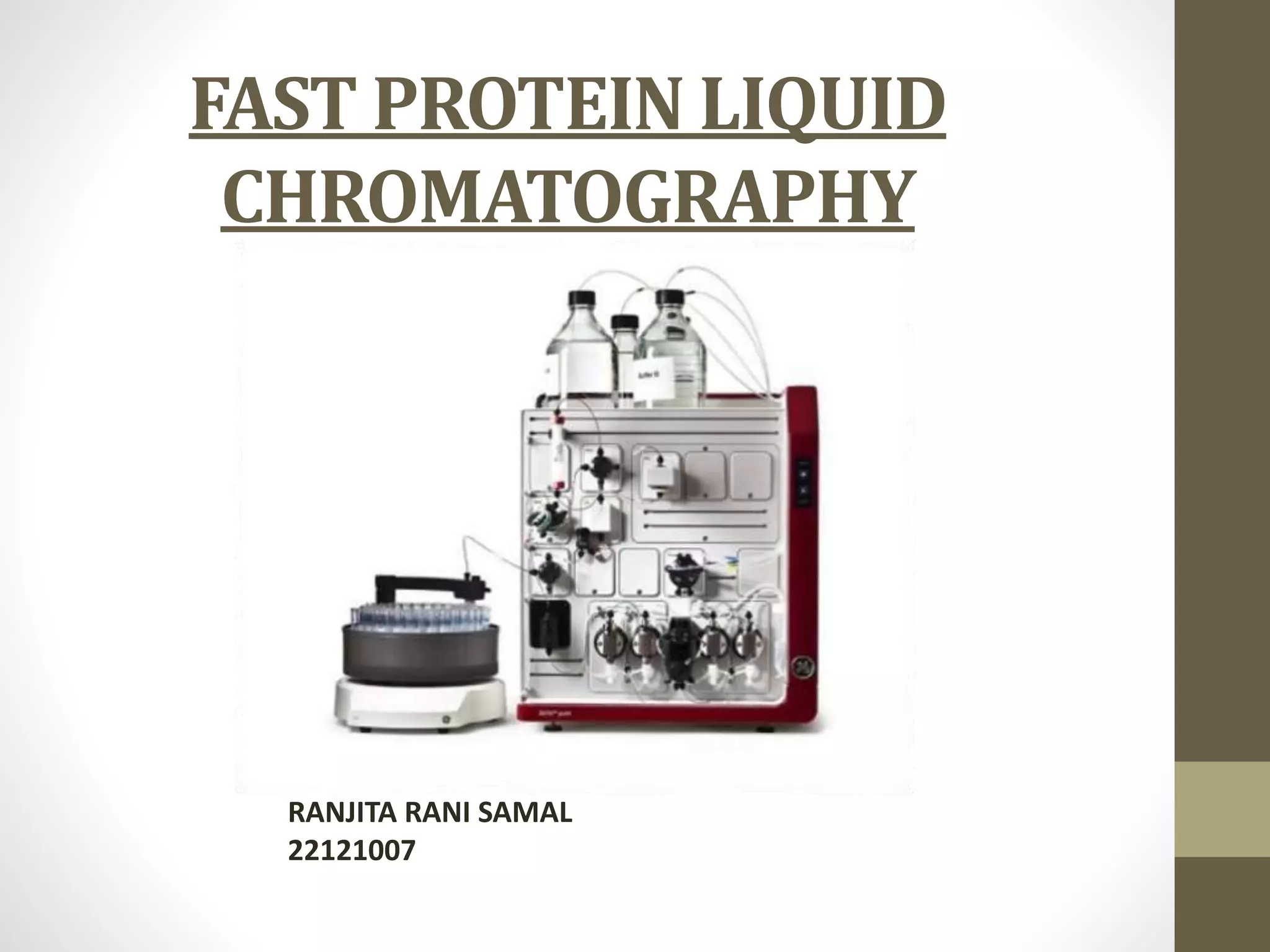
FAST PROTEIN LIQUID
CHROMATOGRAPHY
RANJITA RANI SAMAL
22121007
INTRODUCTION
• Chromatography is a method of separating mixture of
components into individual components through equilibrium
distribution between two phases.
• Each chromatographic method essentially consists of 2 phases
a stationary phase and mobile phase.
Stationary phase :- solid or liquid
Mobile phase :- liquid or gas
INTRODUCTION
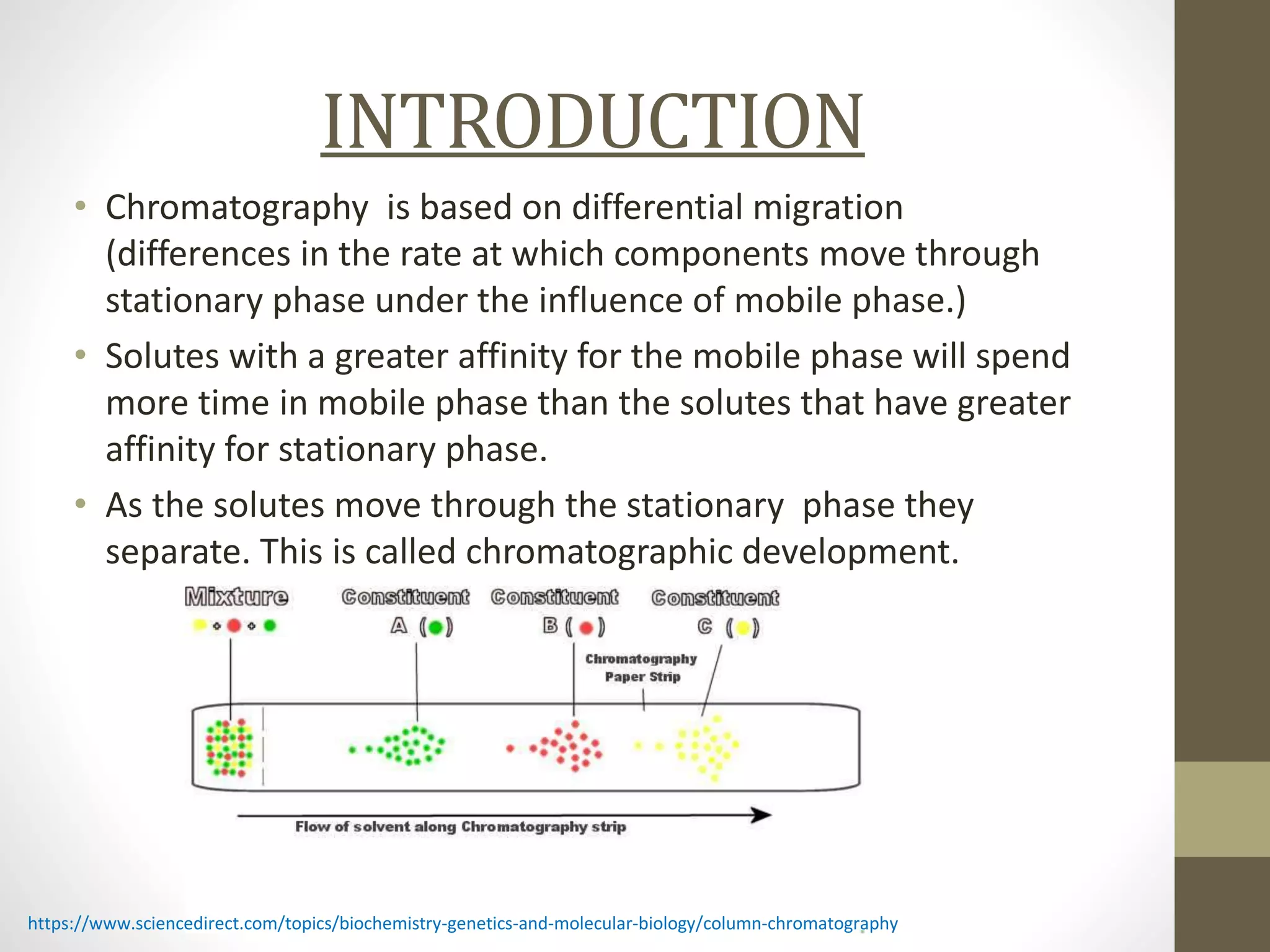
• Chromatography is based on differential migration
(differences in the rate at which components move through
stationary phase under the influence of mobile phase.)
• Solutes with a greater affinity for the mobile phase will spend
more time in mobile phase than the solutes that have greater
affinity for stationary phase.
• As the solutes move through the stationary phase they
separate. This is called chromatographic development.
https://www.sciencedirect.com/topics/biochemistry-genetics-and-molecular-biology/column-chromatography
DistributionCoefficient(Equilibrium
Distribution)
• DEFINITION :-
Concentration of component in stationary phase
Concentration of component in mobile phase
Due difference in distribution Coefficient of various component of mixture,
there mobility in two phases differ hence, separation
Measure of this mobility is called RF value i.e Relative Fraction value
RF = Distance travelled by substance
Distance travelled by solvent
Classification Of Chromatography
FPLC -
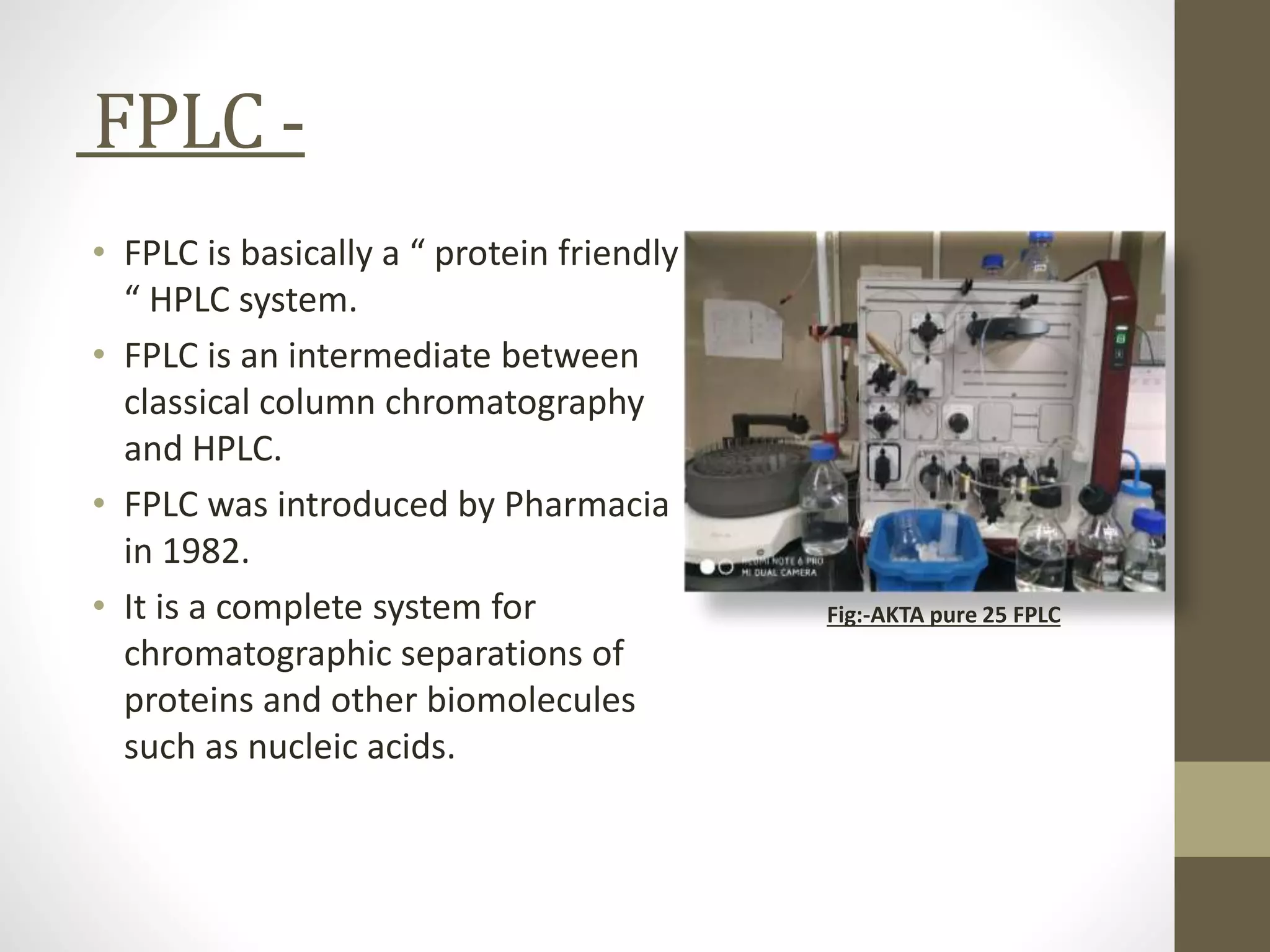
• FPLC is basically a “ protein friendly
“ HPLC system.
• FPLC is an intermediate between
classical column chromatography
and HPLC.
• FPLC was introduced by Pharmacia
in 1982.
• It is a complete system for
chromatographic separations of
proteins and other biomolecules
such as nucleic acids.
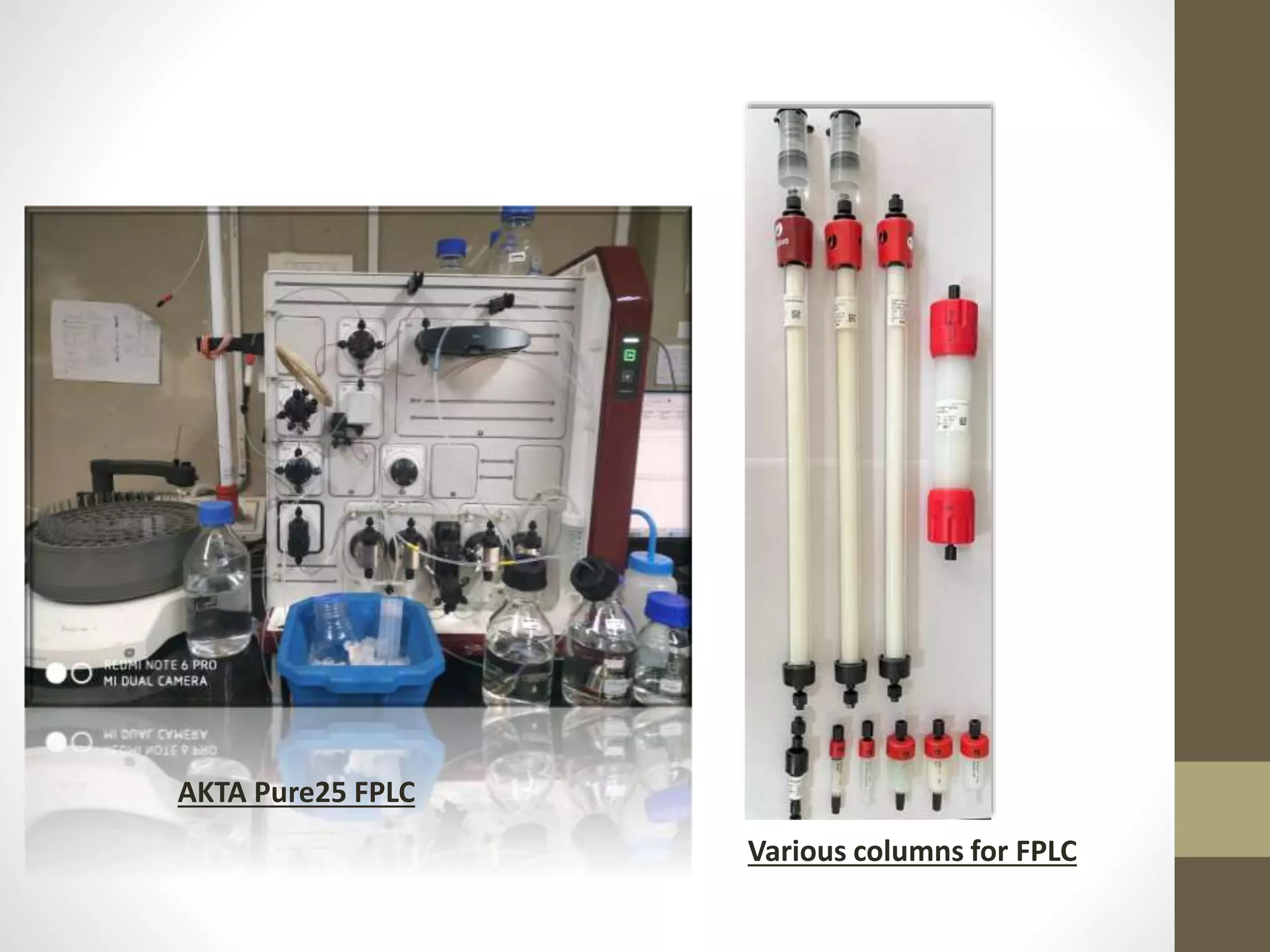
Fig:-AKTA pure 25 FPLC
FPLC -
• Fast protein liquid chromatography
(FPLC), is a form of liquid
chromatography that is often used to
analyze or purify mixtures of proteins
• In FPLC the mobile phase is an
aqueous solution, or “ Buffer".
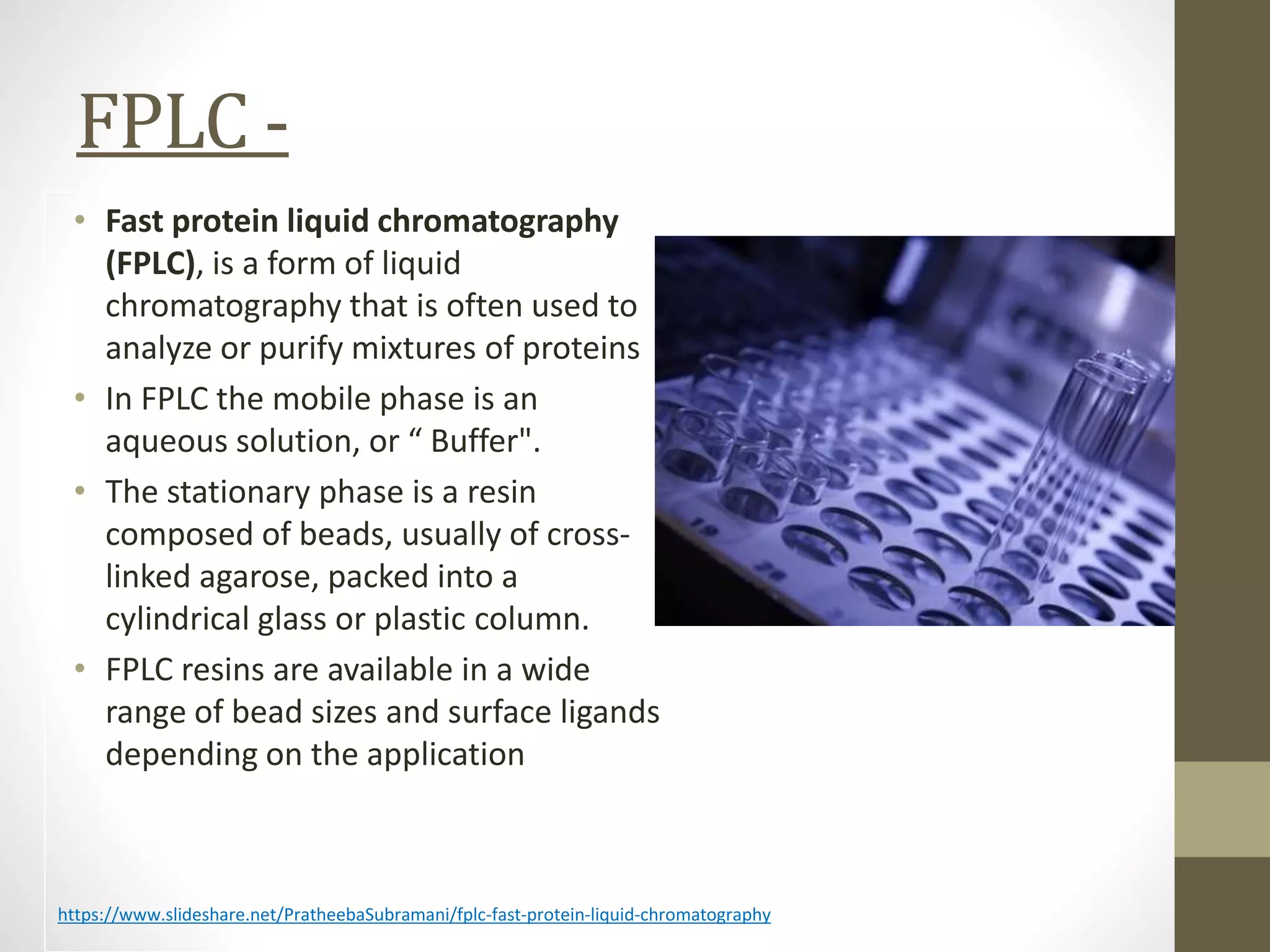
• The stationary phase is a resin
composed of beads, usually of cross-
linked agarose, packed into a
cylindrical glass or plastic column.
• FPLC resins are available in a wide
range of bead sizes and surface ligands
depending on the application
https://www.slideshare.net/PratheebaSubramani/fplc-fast-protein-liquid-chromatography
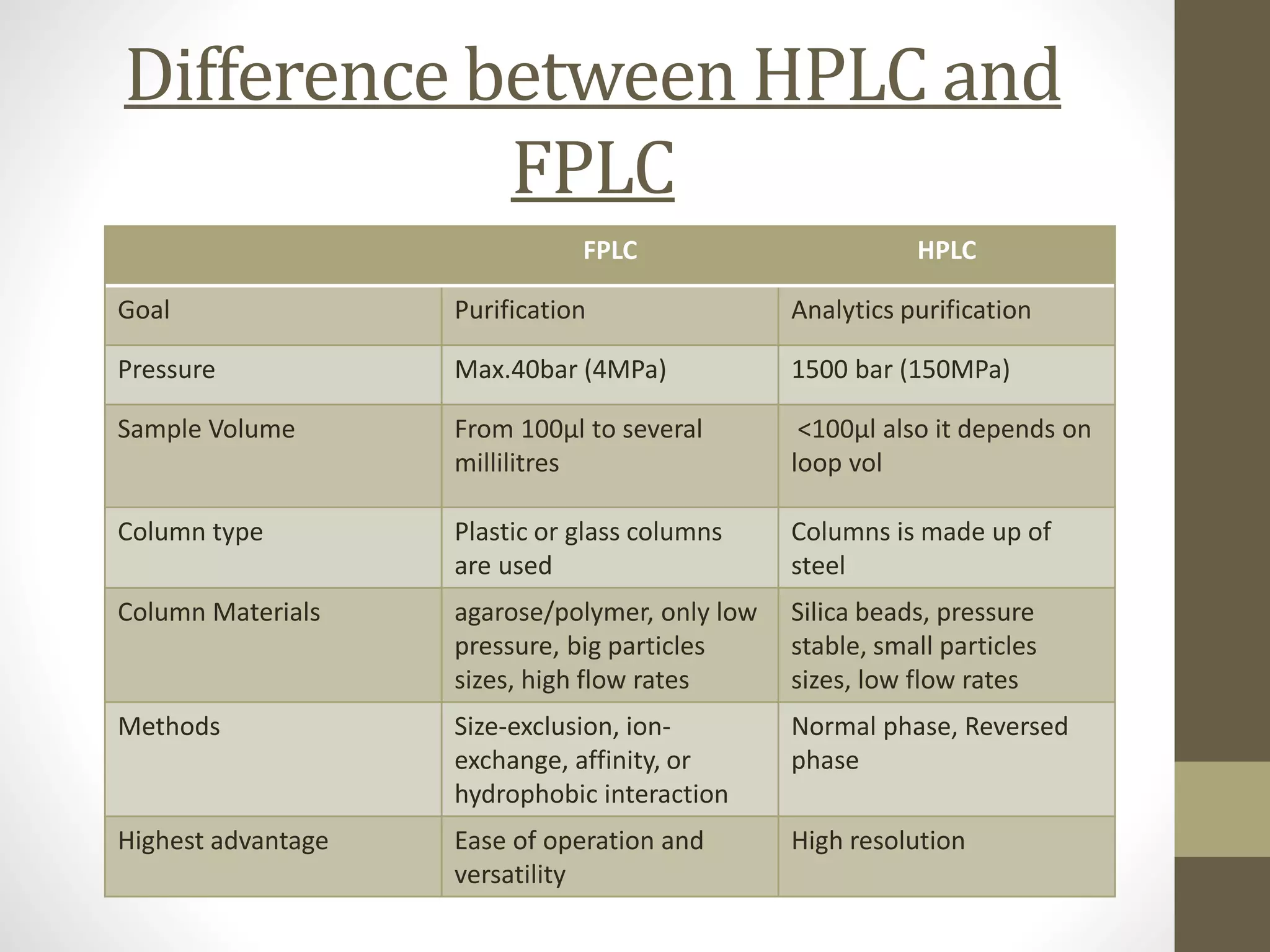
Difference between HPLC and
FPLC
FPLC HPLC
Goal Purification Analytics purification
Pressure Max.40bar (4MPa) 1500 bar (150MPa)
Sample Volume From 100µl to several
millilitres
<100µl also it depends on
loop vol
Column type Plastic or glass columns
are used
Columns is made up of
steel
Column Materials agarose/polymer, only low
pressure, big particles
sizes, high flow rates
Silica beads, pressure
stable, small particles
sizes, low flow rates
Methods Size-exclusion, ion-
exchange, affinity, or
hydrophobic interaction
Normal phase, Reversed
phase
Highest advantage Ease of operation and
versatility
High resolution
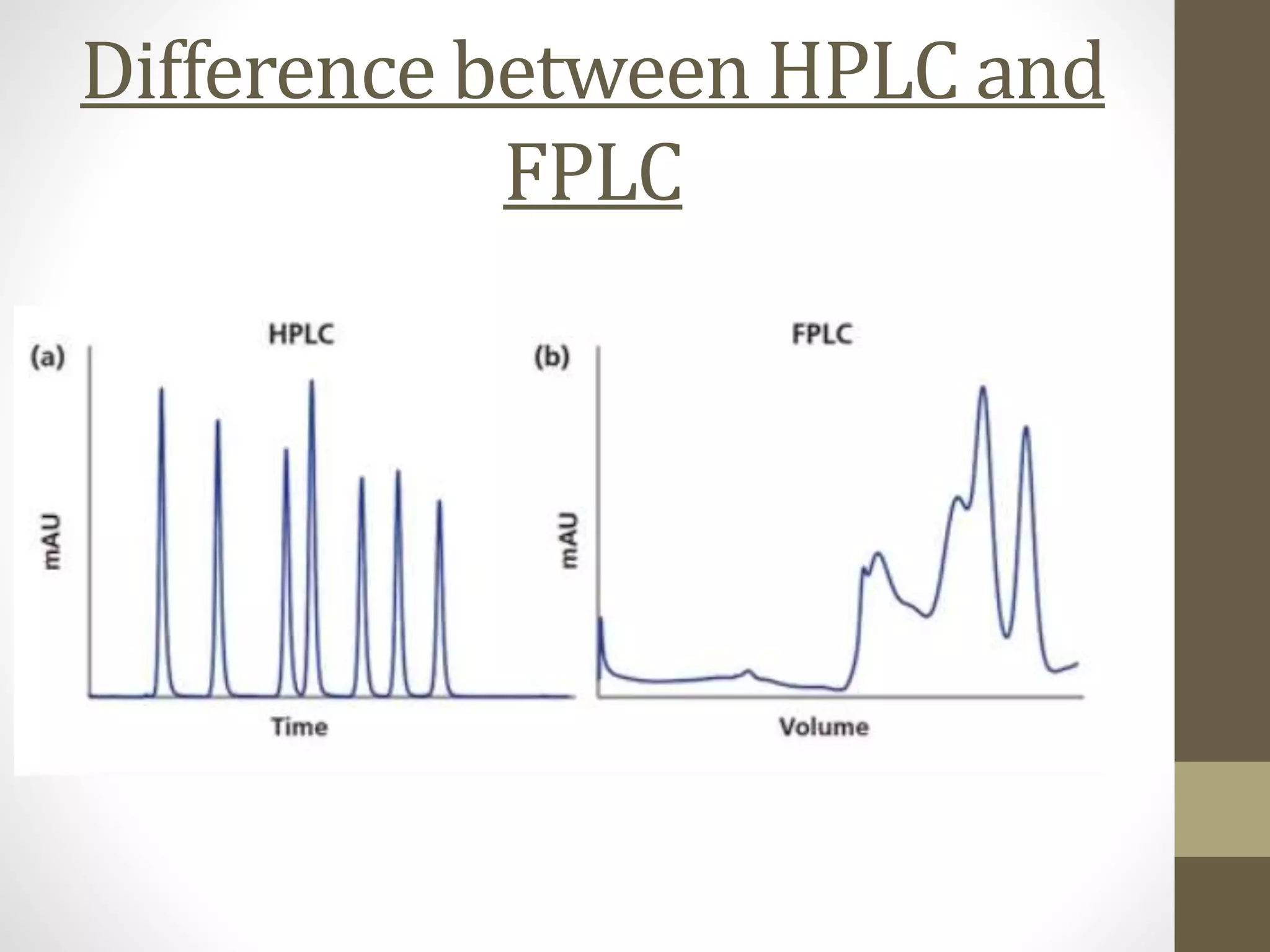
Difference between HPLC and
FPLC
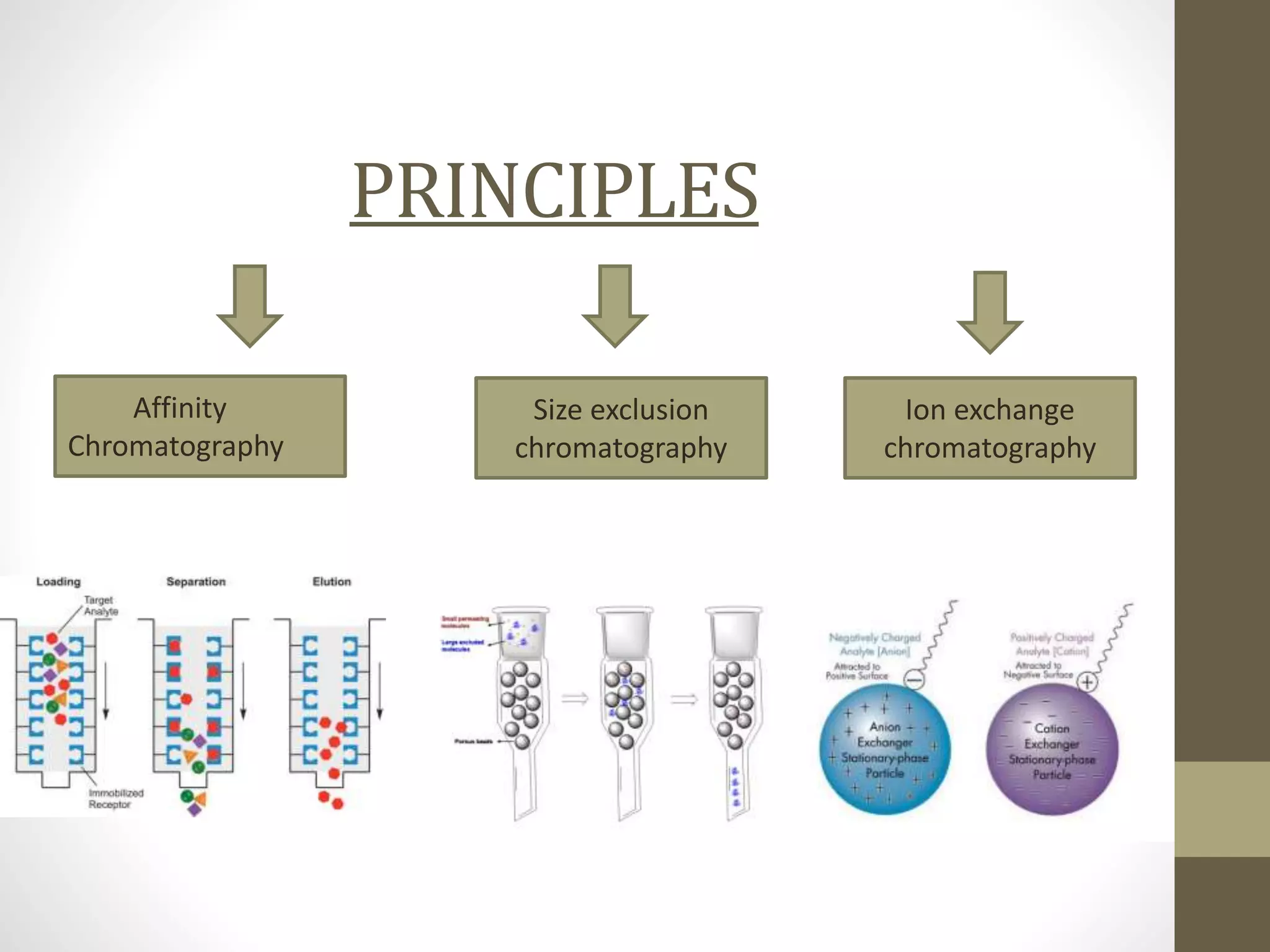
PRINCIPLES
Affinity
Chromatography
Size exclusion
chromatography
Ion exchange
chromatography
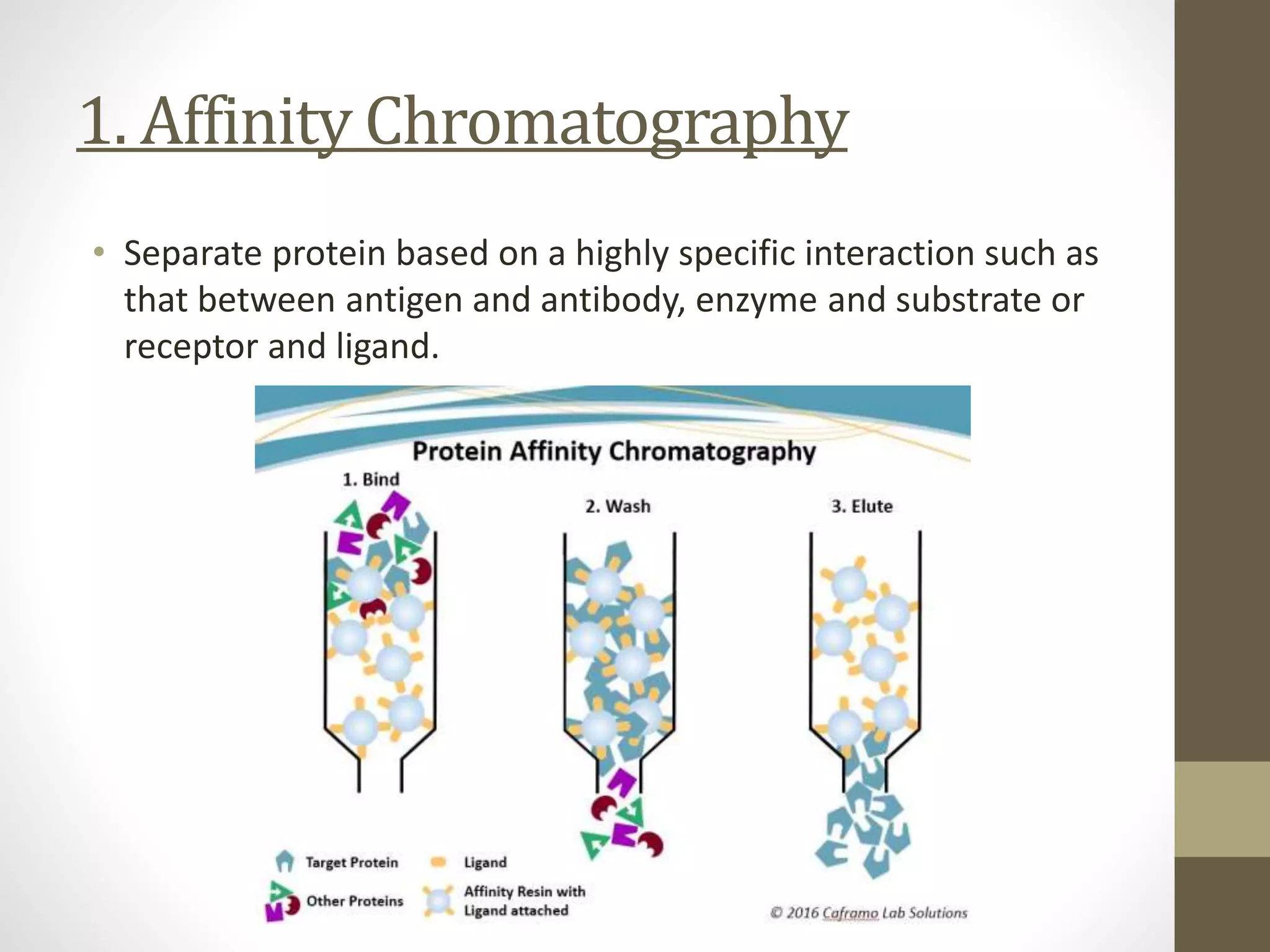
1. Affinity Chromatography
• Separate protein based on a highly specific interaction such as
that between antigen and antibody, enzyme and substrate or
receptor and ligand.
Affinity Chromatography
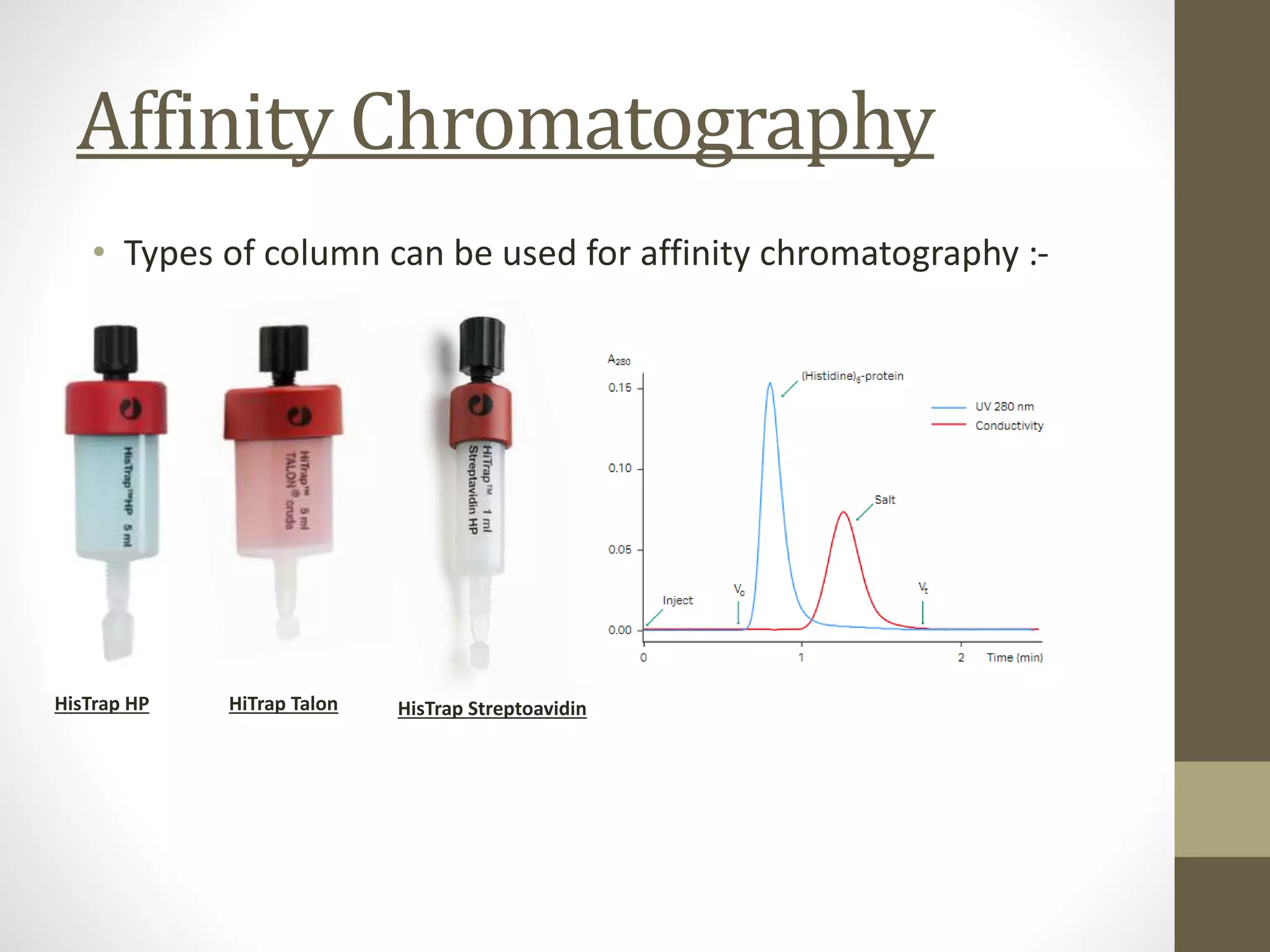
• Types of column can be used for affinity chromatography :-
HisTrap HP HisTrap Streptoavidin
HiTrap Talon
2. Size (size exclusion chromatography)
• Separate proteins according to their size. Also termed as ‘’Gel
Filtration Chromatography ‘’
Size Exclusion Chromatography
Superdex 75 Prep grade HiTrap Desalting
-100
0
100
200
300
400
500
600
700
800
900
0 20 40 60 80 100
mAU
3. Charge distribution (ion exchange
chromatography)
• Separate proteins based on surface charges.
Ion Exchange Chromatography
• column can be used for ion exchange chromatography :-
Resource Q HiTrap CM
Instrumentation :-
• Pump:- The majority of systems utilize two piston
pumps which delivers buffer or sample in
purification runs
• Mixer:- Mixes the buffers delivered from the
system pumps to a homogeneous buffer
composition.
• Injection valve:- The injection valve has a sample
loading port through which the sample can be
loaded into the injection loop.
• UV monitor:- Measures the UV absorbance at a
fixed wavelength of 280 nm.
Instrumentation :-
• UV monitor:- Measures the UV/Vis absorbance at
up to three wavelengths simultaneously in the
range 190-700 nm
• Conductivity monitor:- Measures the conductivity
of buffers and eluted proteins.
• Versatile valve:- which can be used when adding
extra features to the flow path.
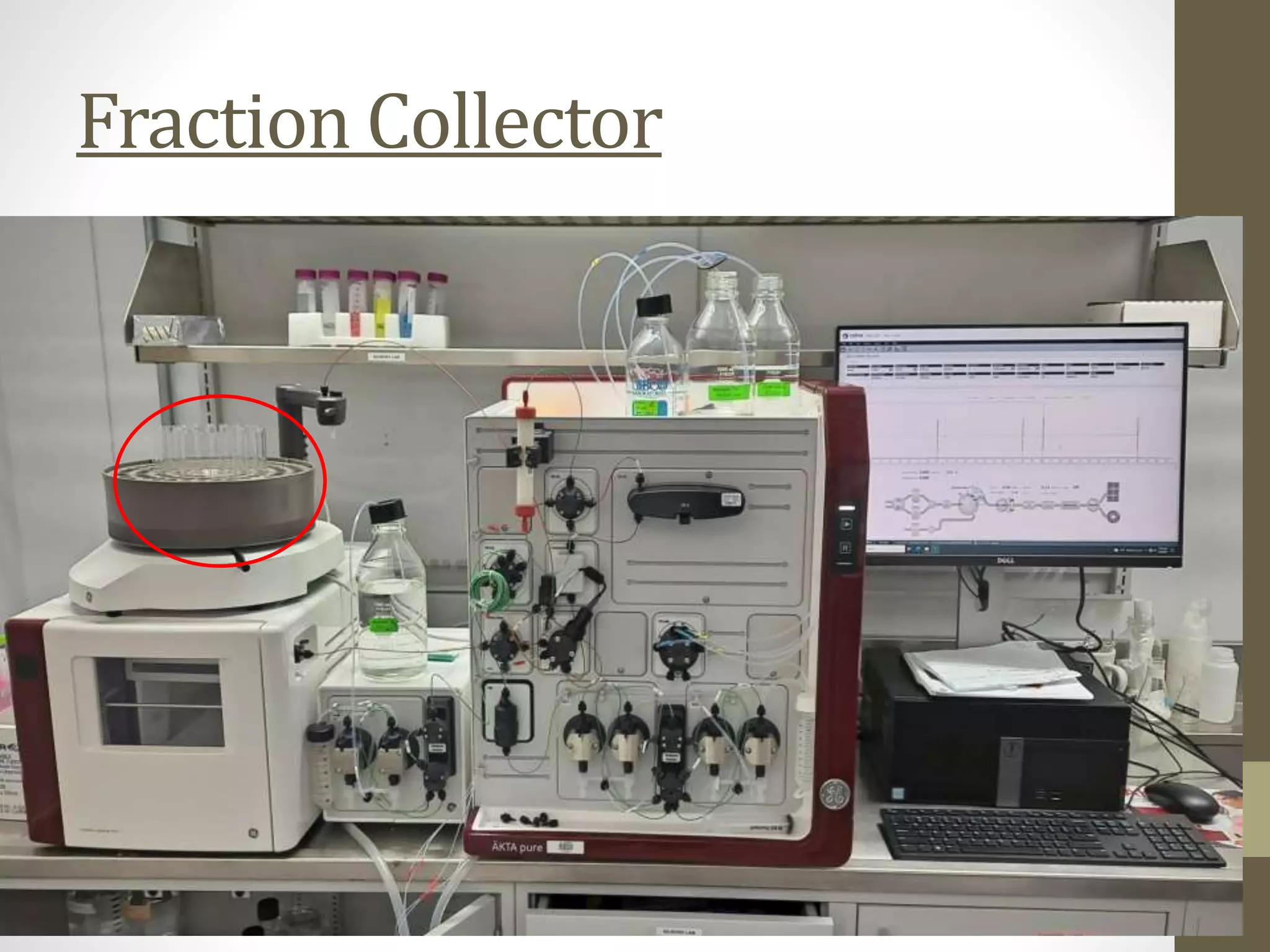
• Fraction collector:- The fraction collector is
typically a rotating rack that can be filled with test
tubes or similar containers.it allows sample to be
collected in fixed volume.
Pumps
Pressure Monitor
Mixer
Inlet Valves
Outlet Valve
Injection Valve
UV Monitor
Conductivity Monitor:-
pH Valve
Column
Fraction Collector
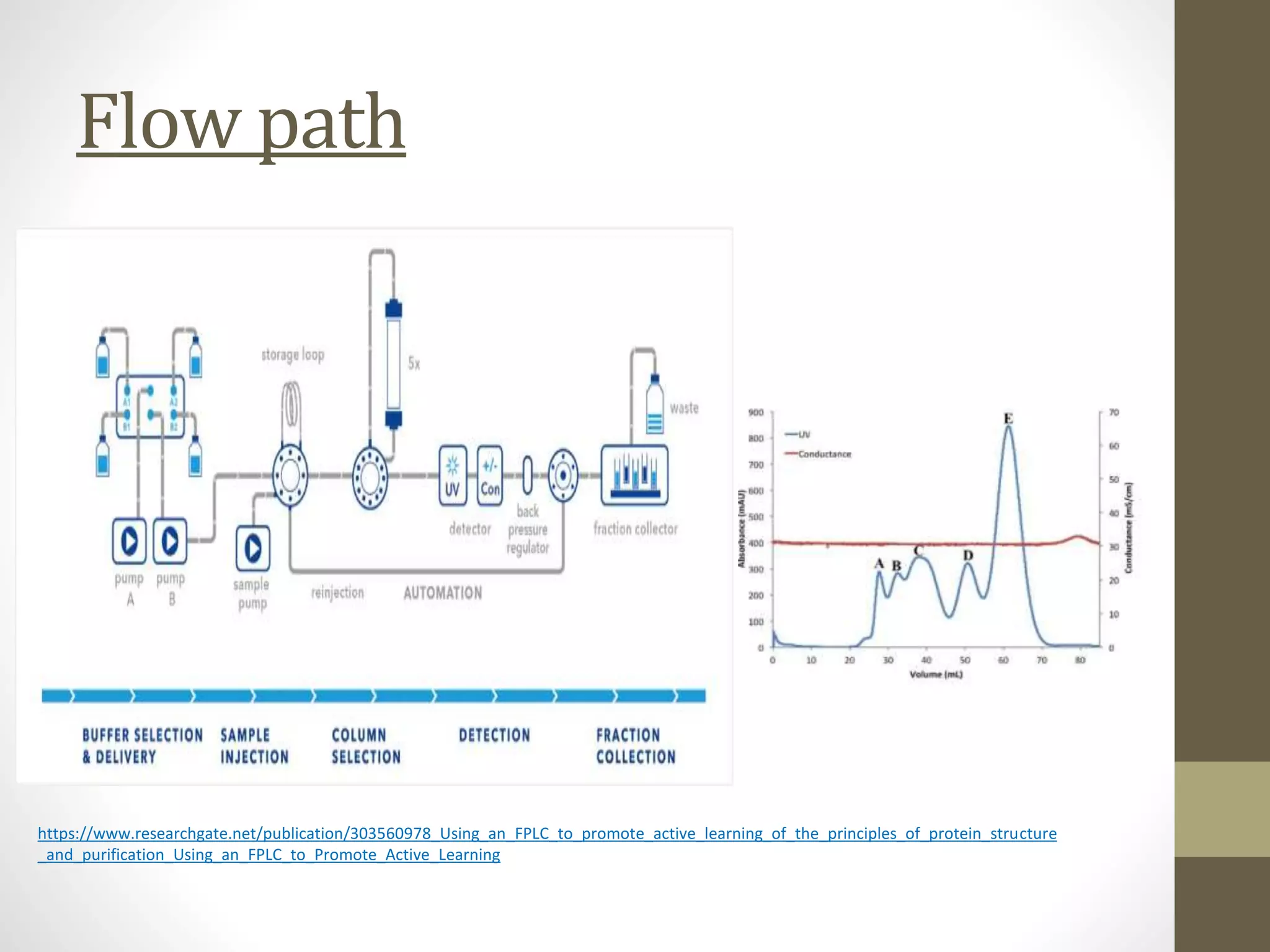
Flow path
• Based on hydrophobic interaction
• Stationary phase- resin
• Mobile phase- Buffer A ( running buffer ) & Buffer B ( elution buffer)
Flow path
https://www.researchgate.net/publication/303560978_Using_an_FPLC_to_promote_active_learning_of_the_principles_of_protein_structure
_and_purification_Using_an_FPLC_to_Promote_Active_Learning
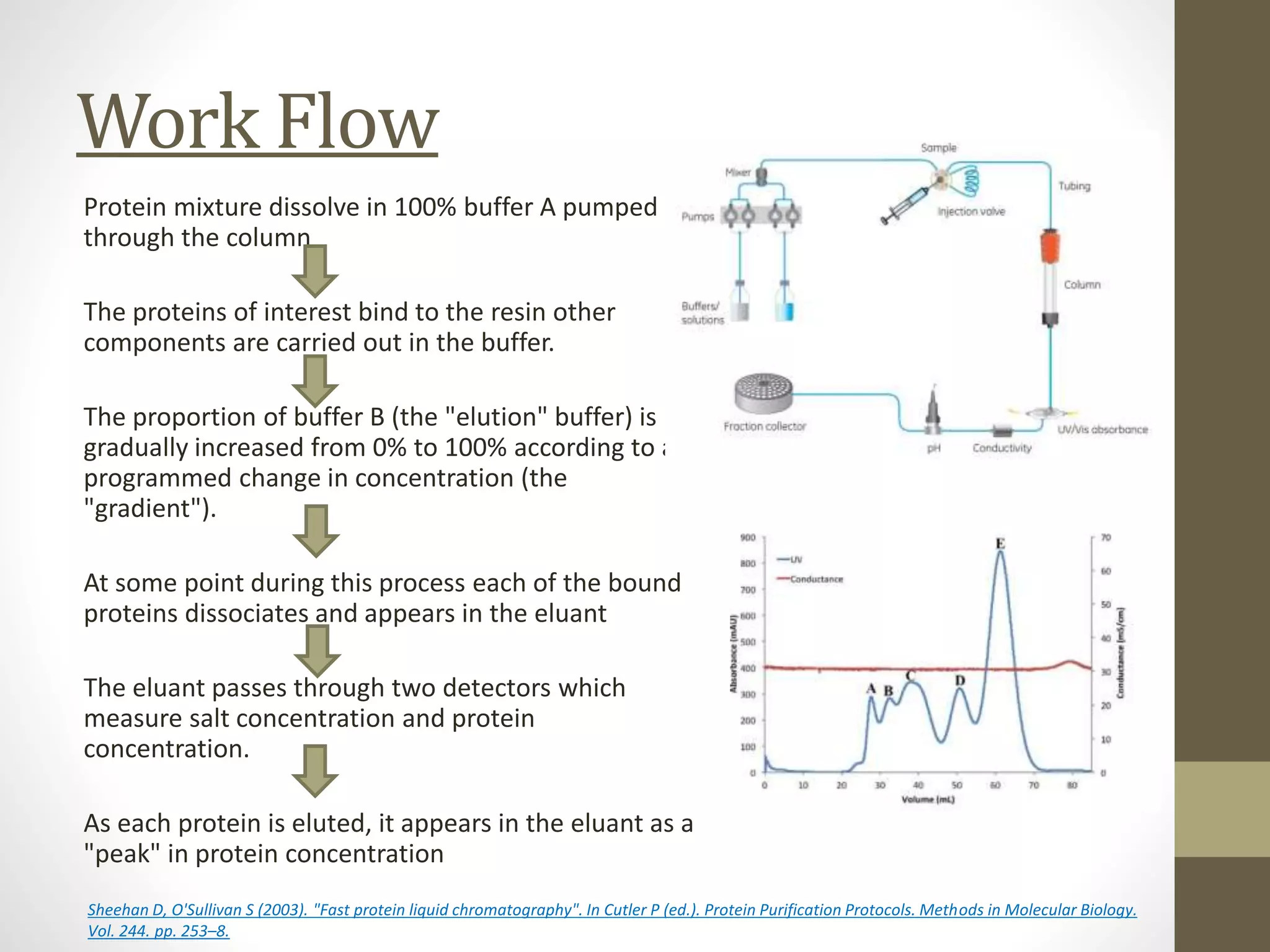
Work Flow
Protein mixture dissolve in 100% buffer A pumped
through the column
The proteins of interest bind to the resin other
components are carried out in the buffer.
The proportion of buffer B (the "elution" buffer) is
gradually increased from 0% to 100% according to a
programmed change in concentration (the
"gradient").
At some point during this process each of the bound
proteins dissociates and appears in the eluant
The eluant passes through two detectors which
measure salt concentration and protein
concentration.
As each protein is eluted, it appears in the eluant as a
"peak" in protein concentration
Sheehan D, O'Sullivan S (2003). "Fast protein liquid chromatography". In Cutler P (ed.). Protein Purification Protocols. Methods in Molecular Biology.
Vol. 244. pp. 253–8.
Analysis
-100
0
100
200
300
400
500
600
700
800
900 mAU
0.5 1.0 1.5 2.0 2.5
Unknown Protein
Analysis
-100
0
100
200
300
400
500
600
700
800
900
0 20 40 60 80 100
mAU
0
200
400
600
800
1000
1200
1400
1600
3.00
4.81
6.61
8.41
10.21
12.02
13.82
15.62
17.43
19.23
21.03
22.84
24.64
26.44
28.25
Affinity based chromatogram Size exclusion based chromatogram
Anion exchange based chromatogram
Oligomers separation chromatogram
Analysis
His Tag purification
0
500
1000
1500
2000
2500
3000
0 2 4 6 810
12
14
16
18
20
22
24
26
28
30
32
34
36
38
40
42
44
46
48
50
52
54
56
Size Exclusion Chromatography purification
-200
0
200
400
600
800
1000
0 20 40 60 80 100
mAU
Applications
Applications
AKTA Pure25 FPLC
Various columns for FPLC
References:-
• https://g.co/kgs/Z2VyFP
• https://www.slideshare.net/PratheebaSubramani/fplc-fast-protein-
liquid-chromatography
• https://www.researchgate.net/publication/303560978_Using_an_F
PLC_to_promote_active_learning_of_the_principles_of_protein_str
ucture_and_purification_Using_an_FPLC_to_Promote_Active_Learn
ing
• https://cdn.cytivalifesciences.com/api/public/content/digi-16308-
original
• https://www.cytivalifesciences.com/en/us/search#q=hitrap%20colu
ms&t=coveo5819fbca
• https://www.cytivalifesciences.com/en/us/search#q=superdex%20c
olums&t=coveo5819fbca
• https://www.cytivalifesciences.com/en/us/solutions/protein-
research/knowledge-center/protein-purification-methods/routine-
protein-purification-with-akta-go
FAST PROTEIN LIQUID CHROMATOGRAPHY.pptx

FAST PROTEIN LIQUID CHROMATOGRAPHY.pptx

  • 1.
  • 2.
    INTRODUCTION • Chromatography isa method of separating mixture of components into individual components through equilibrium distribution between two phases. • Each chromatographic method essentially consists of 2 phases a stationary phase and mobile phase. Stationary phase :- solid or liquid Mobile phase :- liquid or gas
  • 3.
    INTRODUCTION • Chromatography isbased on differential migration (differences in the rate at which components move through stationary phase under the influence of mobile phase.) • Solutes with a greater affinity for the mobile phase will spend more time in mobile phase than the solutes that have greater affinity for stationary phase. • As the solutes move through the stationary phase they separate. This is called chromatographic development. https://www.sciencedirect.com/topics/biochemistry-genetics-and-molecular-biology/column-chromatography
  • 4.
    DistributionCoefficient(Equilibrium Distribution) • DEFINITION :- Concentrationof component in stationary phase Concentration of component in mobile phase Due difference in distribution Coefficient of various component of mixture, there mobility in two phases differ hence, separation Measure of this mobility is called RF value i.e Relative Fraction value RF = Distance travelled by substance Distance travelled by solvent
  • 5.
  • 6.
    FPLC - • FPLCis basically a “ protein friendly “ HPLC system. • FPLC is an intermediate between classical column chromatography and HPLC. • FPLC was introduced by Pharmacia in 1982. • It is a complete system for chromatographic separations of proteins and other biomolecules such as nucleic acids. Fig:-AKTA pure 25 FPLC
  • 7.
    FPLC - • Fastprotein liquid chromatography (FPLC), is a form of liquid chromatography that is often used to analyze or purify mixtures of proteins • In FPLC the mobile phase is an aqueous solution, or “ Buffer". • The stationary phase is a resin composed of beads, usually of cross- linked agarose, packed into a cylindrical glass or plastic column. • FPLC resins are available in a wide range of bead sizes and surface ligands depending on the application https://www.slideshare.net/PratheebaSubramani/fplc-fast-protein-liquid-chromatography
  • 8.
    Difference between HPLCand FPLC FPLC HPLC Goal Purification Analytics purification Pressure Max.40bar (4MPa) 1500 bar (150MPa) Sample Volume From 100µl to several millilitres <100µl also it depends on loop vol Column type Plastic or glass columns are used Columns is made up of steel Column Materials agarose/polymer, only low pressure, big particles sizes, high flow rates Silica beads, pressure stable, small particles sizes, low flow rates Methods Size-exclusion, ion- exchange, affinity, or hydrophobic interaction Normal phase, Reversed phase Highest advantage Ease of operation and versatility High resolution
  • 9.
  • 10.
  • 11.
    1. Affinity Chromatography •Separate protein based on a highly specific interaction such as that between antigen and antibody, enzyme and substrate or receptor and ligand.
  • 12.
    Affinity Chromatography • Typesof column can be used for affinity chromatography :- HisTrap HP HisTrap Streptoavidin HiTrap Talon
  • 13.
    2. Size (sizeexclusion chromatography) • Separate proteins according to their size. Also termed as ‘’Gel Filtration Chromatography ‘’
  • 14.
    Size Exclusion Chromatography Superdex75 Prep grade HiTrap Desalting -100 0 100 200 300 400 500 600 700 800 900 0 20 40 60 80 100 mAU
  • 15.
    3. Charge distribution(ion exchange chromatography) • Separate proteins based on surface charges.
  • 16.
    Ion Exchange Chromatography •column can be used for ion exchange chromatography :- Resource Q HiTrap CM
  • 17.
    Instrumentation :- • Pump:-The majority of systems utilize two piston pumps which delivers buffer or sample in purification runs • Mixer:- Mixes the buffers delivered from the system pumps to a homogeneous buffer composition. • Injection valve:- The injection valve has a sample loading port through which the sample can be loaded into the injection loop. • UV monitor:- Measures the UV absorbance at a fixed wavelength of 280 nm.
  • 18.
    Instrumentation :- • UVmonitor:- Measures the UV/Vis absorbance at up to three wavelengths simultaneously in the range 190-700 nm • Conductivity monitor:- Measures the conductivity of buffers and eluted proteins. • Versatile valve:- which can be used when adding extra features to the flow path. • Fraction collector:- The fraction collector is typically a rotating rack that can be filled with test tubes or similar containers.it allows sample to be collected in fixed volume.
  • 19.
  • 20.
  • 21.
  • 22.
  • 23.
  • 24.
  • 25.
  • 26.
  • 27.
  • 28.
  • 29.
  • 30.
    Flow path • Basedon hydrophobic interaction • Stationary phase- resin • Mobile phase- Buffer A ( running buffer ) & Buffer B ( elution buffer)
  • 31.
  • 32.
    Work Flow Protein mixturedissolve in 100% buffer A pumped through the column The proteins of interest bind to the resin other components are carried out in the buffer. The proportion of buffer B (the "elution" buffer) is gradually increased from 0% to 100% according to a programmed change in concentration (the "gradient"). At some point during this process each of the bound proteins dissociates and appears in the eluant The eluant passes through two detectors which measure salt concentration and protein concentration. As each protein is eluted, it appears in the eluant as a "peak" in protein concentration Sheehan D, O'Sullivan S (2003). "Fast protein liquid chromatography". In Cutler P (ed.). Protein Purification Protocols. Methods in Molecular Biology. Vol. 244. pp. 253–8.
  • 33.
  • 34.
    Analysis -100 0 100 200 300 400 500 600 700 800 900 0 20 4060 80 100 mAU 0 200 400 600 800 1000 1200 1400 1600 3.00 4.81 6.61 8.41 10.21 12.02 13.82 15.62 17.43 19.23 21.03 22.84 24.64 26.44 28.25 Affinity based chromatogram Size exclusion based chromatogram Anion exchange based chromatogram Oligomers separation chromatogram
  • 35.
    Analysis His Tag purification 0 500 1000 1500 2000 2500 3000 02 4 6 810 12 14 16 18 20 22 24 26 28 30 32 34 36 38 40 42 44 46 48 50 52 54 56 Size Exclusion Chromatography purification -200 0 200 400 600 800 1000 0 20 40 60 80 100 mAU
  • 36.
  • 37.
  • 38.
    AKTA Pure25 FPLC Variouscolumns for FPLC
  • 39.
    References:- • https://g.co/kgs/Z2VyFP • https://www.slideshare.net/PratheebaSubramani/fplc-fast-protein- liquid-chromatography •https://www.researchgate.net/publication/303560978_Using_an_F PLC_to_promote_active_learning_of_the_principles_of_protein_str ucture_and_purification_Using_an_FPLC_to_Promote_Active_Learn ing • https://cdn.cytivalifesciences.com/api/public/content/digi-16308- original • https://www.cytivalifesciences.com/en/us/search#q=hitrap%20colu ms&t=coveo5819fbca • https://www.cytivalifesciences.com/en/us/search#q=superdex%20c olums&t=coveo5819fbca • https://www.cytivalifesciences.com/en/us/solutions/protein- research/knowledge-center/protein-purification-methods/routine- protein-purification-with-akta-go

Editor's Notes

  • #7 It was originally called fast performance liquid chromatography to contrast it with HPLC or High performance liquid chromatography FPLC is generally applied only to proteins; however, because of the wide choice of resins and buffers it has broad applications
  • #9 Flow rate is 5ml/min fplc Flow rate is 1ml/min HPLC FPLC purifies large biomolecules like proteins or DNA The chromatography of biomolecules is very demanding and sensitive because they cannot stand high temperatures, high pressures, or the solvents usually used in HPLC.
  • #11 It utilizes a combination of these principles to separate and analyze proteins based on their affinity, size, and charge.
  • #12 Affinity chromatography is a separation method based on a specific binding interaction between an immobilized ligand and its binding partner
  • #13 HisTrap HP prepacked columns preparative purification of histidine-tagged (His-tag) recombinant proteins. Columns prepacked with cobalt-based chromatography media designed for purification of histidine-tagged recombinant proteins by immobilized metal affinity chromatography HiTrap Streptavidin HP is a column prepacked with Streptavidin Sepharose High Performance for purification of biotinylated proteins and biomolecules
  • #14 SEC is a type of chromatography used to separate proteins based on their size. It is based on the principles that protein with larger molecular weights will be excluded from the pores of the stationary phases, while proteins with smaller mol wt will pass through the pores. In FPLC , SEC used to separate proteins based on their size. This help to identify and isolate proteins that share similar properties
  • #15 Superdex prep grade (pg) is produced by covalent bonding of dextran to highly cross-linked agarose.The separation properties of these media are determined by the dextran component. columns prepacked with Sephadex G-25 Superfine resin for fast and convenient desalting and buffer exchange.
  • #16 In FPLC , ion exchange chromatography used to separate proteins based on their surface charges. This help to identify and isolate proteins that share similar properties such as those having positive or negative surface charges
  • #17 Quaternary ammonium (Q) strong anion exchanger for high resolution ion exchange chromatography HiTrap CM FF is prepacked with CM Sepharose Fast Flow, and is a weak cation exchanger for small-scale protein purifications
  • #20 :- The majority of systems utilize two piston pumps which delivers buffer or sample in purification runs. The flow rate is varied based on scale of preparation i.e; analytical or preparative chromatography.
  • #21 It is Pressure monitor . It Reads the system pressure after System pump A and System pump B.
  • #22 Mixer which is Power and controlled by the pump. Especially important when forming gradients between buffer sources. The mixer ensures that the buffer used are in the correct proportion during the the FPLC run
  • #23 The inlet valves are used to select which buffers or samples to use in a run
  • #24 The outlet valve is used to direct the flow to the fraction collector, to an outlet port, or to waste.
  • #25 The injection valve is a motorized valve which links the mixer and sample loop to the column. The injection valve has a sample loading port through which the sample can be loaded into the injection loop. Inject sample into column. Loop volume can range from a few microliters to 50 ml or more.
  • #26 UV monitor:- Measures the UV/Vis absorbance at up to three wavelengths simultaneously in the range 190-700 nm
  • #27 Measures the conductivity of buffers and eluted proteins.
  • #28 Enables the pH electrode to be included in the flow path or bypassed during a run.
  • #29 The colums is a glass or plastic cylinder packed with stationary phase-beads of resin.thess are mounted vertically with the buffer flowing downward from top to bottom
  • #30 The fraction collector is typically a rotating rack that can be filled with test tubes or similar containers.it allows sample to be collected in fixed volume.
  • #32 . A mixture containing one or more proteins of interest is dissolved in 100% buffer A and pumped into the column. The proteins of interest bind to the resin while other components are carried out in the buffer.[2] The total flow rate of the buffer is kept constant; however, the proportion of buffer B (the "elution" buffer) is gradually increased from 0% to 100% according to a programmed change in concentration (the "gradient"). At some point during this process each of the bound proteins dissociates and appears in the eluant. The eluant passes through two detectors which measure salt concentration (by conductivity) and protein concentration (by absorption of ultraviolet light at a wavelength of 280nm). As each protein is eluted, it appears in the eluant as a "peak" in protein concentration, and can be collected for further use
  • #33 . A mixture containing one or more proteins of interest is dissolved in 100% buffer A and pumped into the column. The proteins of interest bind to the resin while other components are carried out in the buffer.[2] The total flow rate of the buffer is kept constant; however, the proportion of buffer B (the "elution" buffer) is gradually increased from 0% to 100% according to a programmed change in concentration (the "gradient"). Because different protein may elute at different gradient .At some point during this process each of the bound proteins dissociates and appears in the eluant. The eluant passes through two detectors which measure salt concentration (by conductivity) and protein concentration (by absorption of ultraviolet light at a wavelength of 280nm). As each protein is eluted, it appears in the eluant as a "peak" in protein concentration, and can be collected for further use
  • #34 So With every columns there come a standard chromatogram so if am using superdex 75 increase which is a size exclusion chromatography they give known protein with know mol wt. they also mention the sample volume and flow rates and buffer. Wen iam passing these sample through the column iam getting a peak bet 1ml and 2ml So any protein eluting before 1ml is considered to be unresolved as because of higher mol mass or may be due to aggregartion
  • #35 Measures the conductivity of buffers and eluted proteins. Addition of elution buffer could separate slightly negatively charges molecules that give us a small peak so addition of elution buffer with increased concentration to separate highly negatively charged molecules Equilibrate the columns with buffer that is compatible with the protein of interest, Binding of protein Columns Wash so that unbound proteins will remove Elution buffer