Lipids-definition, functions.
Fatty acids- saturated and unsaturated fatty acids-definition,
examples
Essential and non essential fatty acids, melting point of fatty
acids.
Triacylglycerol and wax, phospholipids, glycolipids,
Eicosanoids, plasma lipoproteins
Lipids
 Biological lipids are a chemically diverse group of
organic compounds which are insoluble or only poorly
soluble in water
 They are readily soluble in non polar solvents such as
ether, chloroform, benzene
 The hydrophobic nature of lipids is due to the
predominance of hydrocarbons chains (-CH2-CH2-
CH2-) in their structures
 Unlike the proteins, nucleic acids and polysaccharides,
lipids are not polymers
Functions of lipids
 They serve as a storage form of metabolic fuel
 They serve as a transport form of metabolic fuel
 They provide the structural components of membranes
 They have protective functions in bacteria, plants, insects
and vertebrates, serving as a part of the outer coating
between the body of the organism and the environment
 Apart from the general functions biological lipids serve as
pigments(carotene), hormones( vitamin D derivatives, sex
hormones ), signaling molecules(eicosanoids,
phopshotidylinositol derivatives) , cofactors (vitamin K) ,
detergents (bile salt ) and many other specialized functions
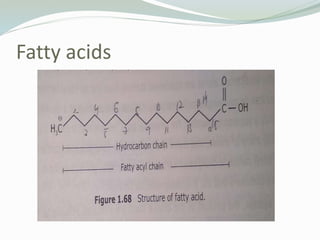
Fatty acids
 Are the simplest form of lipids and serve as constituents in a
large number of complex forms of lipids
 Fatty acids are long –chain hydrocarbons (4-36 carbon long)
with one carboxyl group
 Fatty acids in biological systems usually contain an even number
of carbon atoms
 The 16- and 18- carbon fatty acids are most common
 The alkyl chain may be saturated or unsaturated
 Unsaturated fatty acids may contain one or more double bonds
 Fatty acids are amphipathetic by nature; that is they have both
nonpolar and polar ends
 By an older system, in a fatty acid second carbon is referred to as
the α-carbon , 3rd carbon as the β-carbon and the end methyl
carbon as the ω- carbon
Fatty acids
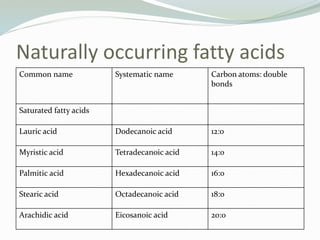
Naturally occurring fatty acids
Common name Systematic name Carbon atoms: double
bonds
Saturated fatty acids
Lauric acid Dodecanoic acid 12:0
Myristic acid Tetradecanoic acid 14:0
Palmitic acid Hexadecanoic acid 16:0
Stearic acid Octadecanoic acid 18:0
Arachidic acid Eicosanoic acid 20:0
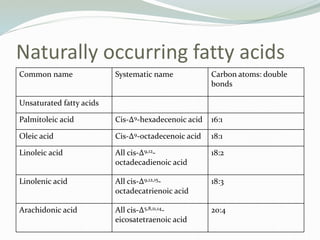
Naturally occurring fatty acids
Common name Systematic name Carbon atoms: double
bonds
Unsaturated fatty acids
Palmitoleic acid Cis-∆9-hexadecenoic acid 16:1
Oleic acid Cis-∆9-octadecenoic acid 18:1
Linoleic acid All cis-∆9,12-
octadecadienoic acid
18:2
Linolenic acid All cis-∆9,12,15-
octadecatrienoic acid
18:3
Arachidonic acid All cis-∆5,8,11,14-
eicosatetraenoic acid
20:4
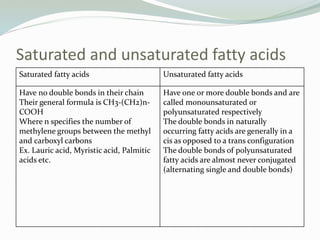
Saturated and unsaturated fatty acids
Saturated fatty acids Unsaturated fatty acids
Have no double bonds in their chain
Their general formula is CH3-(CH2)n-
COOH
Where n specifies the number of
methylene groups between the methyl
and carboxyl carbons
Ex. Lauric acid, Myristic acid, Palmitic
acids etc.
Have one or more double bonds and are
called monounsaturated or
polyunsaturated respectively
The double bonds in naturally
occurring fatty acids are generally in a
cis as opposed to a trans configuration
The double bonds of polyunsaturated
fatty acids are almost never conjugated
(alternating single and double bonds)
Fatty acids
 Essential fatty acids- are those which are not synthesized
by animals and must be obtained from diet
 Linoleate and linolenate are 2 essential fatty acids for
humans and other animals
 Humans lack enzymes to introduce double bonds at carbon
atoms beyond C-9 in the fatty acid chain
 Hence human cannot synthesize Linoleate and linolenate
 Fatty acids that can be endogenously synthesized are
termed as non essential fatty acids
 They are non essential in the sense that they do not have to
be obligatorily obtained from diet
Fatty acids
 Melting point of fatty acids – depends on chain length, presence
or absence of double bonds and number of double bonds (i.e.
degree of unsaturation)
 The longer the chain length, higher the melting point
 greater the number of double bonds, lower the melting point
 The presence of double bonds makes unsaturated chain more
rigid
 As a result, unsaturated chains cannot pack themselves in
crystals efficiently and densely as unsaturated chain
 So they have a lower melting point as compared to saturated
fatty acids
 Similarly the unsaturated fatty acids with cis configuration have
lower melting points than the unsaturated fatty acids with the
trans configuration
Triacylglycerol
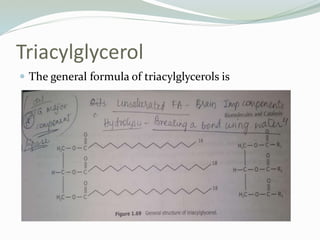
 also called triglycerides are triesters of fatty acids and
glycerol
 They are composed of 3 fatty acids and a glycerol
molecules
 Triacylglycerols are of 2 types – simple and mixed type
 Those containing a single kind of a fatty acids are
called simple Triacylglycerols and with 2 or more
different kinds of fatty acids are called mixed
triacylglycerols
Triacylglycerol
 The general formula of triacylglycerols is
Triacylglycerol
 Triacylglycerol are non polar, hydrophobic in nature and a
major form of stored lipids
 Because triacylglycerols have no charge (i.e. the carboxyl
group of each fatty acid is joined to glycerol through a
covalent bond), they are sometimes called as neutral lipid
 Triacylglycerol molecules contain fatty acids of varying
lengths, which may be unsaturated or saturated
 Triacylglycerol can be distinguished as fat and oil on the
basis of physical state at room temperature
 Fat- is solid in room temperature, contain a large
proportion of saturated fatty acids
 Oil- liquid in room temperature, because of their relatively
high unsaturated fatty acid content
Hydrolysis of Triacylglycerol
 Hydrolysis of Triacylglycerol with alkali such as NaOH
/KOH is called saponification
 Saponification yields salts of free fatty acids(termed soap)
and glycerol
 The number of milligrams of KOH required to saponify
one-gram of fat is known as saponification number
 The saponification number measures the average
molecular weight of fats
 The number of grams of iodine that can be added to 100g
sample of fat or oil is called iodine number which is used
to determine the degree of unsaturation (i.e. extent of
unsaturation)
Waxes
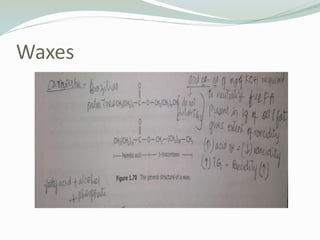
 Natural waxes are typically esters of fatty acids and
long chain alcohols
 They are formed by esterification of long chain fatty
acids( saturated and unsaturated) and high molecular
weight monohydroxy alcohols (C14-C36)
 Waxes are biosynthesized by many plants or animals
 The best known animal wax is bee wax
 Triacontanyl palmitate(an ester of palmitic acid with
the alcohol triacontanol) is the major component of
bee wax
Waxes
Phospholipids
 Is an amphipathetic molecule constructed from 4
components – fatty acids, a platform to which the fatty
acids are attached, a phosphate and an alcohol
attached to the phosphate.
 The platform on which phospholipids are built may be
glycerol or sphingosine
Phosphoglycerides
 Phospholipids derived from glycerol are called Phosphoglycerides
(glycerophospholipids)
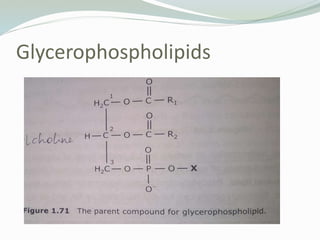
 A phosphoglyceride consist of a glycerol molecule, 2 fatty acids, a
phosphate, and an alcohol(e.g. choline)
 Phosphoglycerides are the most numerous phospholipid molecules
found in cell membranes
 In simplest Phosphoglyceride, phosphatidic acid, the hydroxyl group at
C-1 and C-2 of glycerol are esterified to the carboxyl groups of the 2
fatty acid chains
 The C-3 hydroxyl group of glycerol backbone is esterified to phosphoric
acid
 Phosphoglyceride molecule are classified according to which alcohol
becomes esterified to the phosphate group
 The common alcohol moieties of Phosphoglyceride are serine,
ethanolamine, choline, glycerol, inositol
 If alcohol is choline, then Phosphoglyceride molecule is
phosphotidylcholine (lecithin) and if serine it is called is
phosphotidylserine
Glycerophospholipids
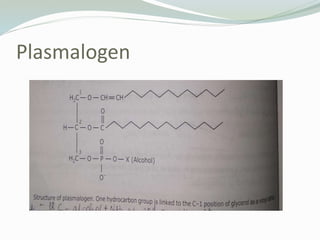
Ether glycerophospholipids
 Possess an ether linkage instead of an acyl group at C-1
position of glycerol
 Ex. Platelet activating factor or PAF found in mammals
 PAF is a potent signal molecule that causes platelet
aggregation and dilation of blood vessels
 In Ether glycerophospholipids, the ether-linked chain
may be saturated or may contain a double bond
between C-1 and C-2
 Ether glycerophospholipids in which the alkyl moiety
is cis-α,β-unsaturated is termed as plasmalogen
Plasmalogen
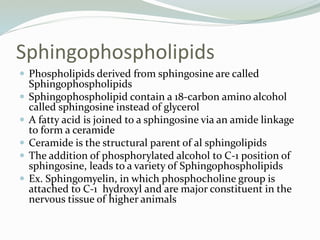
Sphingophospholipids
 Phospholipids derived from sphingosine are called
Sphingophospholipids
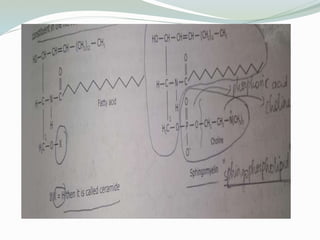
 Sphingophospholipid contain a 18-carbon amino alcohol
called sphingosine instead of glycerol
 A fatty acid is joined to a sphingosine via an amide linkage
to form a ceramide
 Ceramide is the structural parent of al sphingolipids
 The addition of phosphorylated alcohol to C-1 position of
sphingosine, leads to a variety of Sphingophospholipids
 Ex. Sphingomyelin, in which phosphocholine group is
attached to C-1 hydroxyl and are major constituent in the
nervous tissue of higher animals
Glycolipids
 Lipids containing saccharide group go under the
general name of glycolipids
 They glycosphingolipid is the most important type of
glycolipid and constitute 3rd major class of membrane
lipids
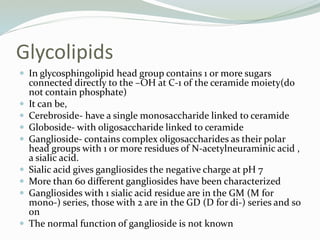
Glycolipids
 In glycosphingolipid head group contains 1 or more sugars
connected directly to the –OH at C-1 of the ceramide moiety(do
not contain phosphate)
 It can be,
 Cerebroside- have a single monosaccharide linked to ceramide
 Globoside- with oligosaccharide linked to ceramide
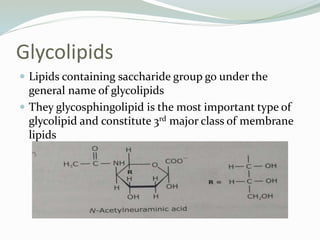
 Ganglioside- contains complex oligosaccharides as their polar
head groups with 1 or more residues of N-acetylneuraminic acid ,
a sialic acid.
 Sialic acid gives gangliosides the negative charge at pH 7
 More than 60 different gangliosides have been characterized
 Gangliosides with 1 sialic acid residue are in the GM (M for
mono-) series, those with 2 are in the GD (D for di-) series and so
on
 The normal function of ganglioside is not known
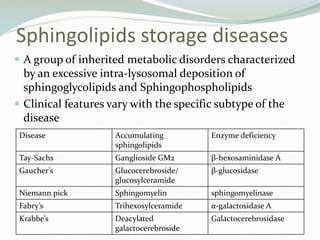
Sphingolipids storage diseases
 A group of inherited metabolic disorders characterized
by an excessive intra-lysosomal deposition of
sphingoglycolipids and Sphingophospholipids
 Clinical features vary with the specific subtype of the
disease
Disease Accumulating
sphingolipids
Enzyme deficiency
Tay-Sachs Ganglioside GM2 β-hexosaminidase A
Gaucher’s Glucocerebroside/
glucosylceramide
β-glucosidase
Niemann pick Sphingomyelin sphingomyelinase
Fabry’s Trihexosylceramide α-galactosidase A
Krabbe’s Deacylated
galactocerebroside
Galactocerebrosidase
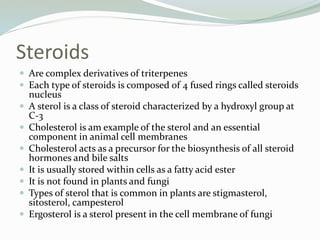
Steroids
 Are complex derivatives of triterpenes
 Each type of steroids is composed of 4 fused rings called steroids
nucleus
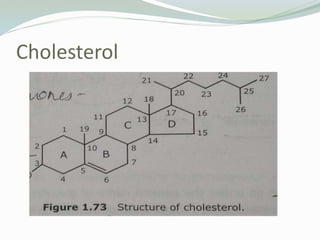
 A sterol is a class of steroid characterized by a hydroxyl group at
C-3
 Cholesterol is am example of the sterol and an essential
component in animal cell membranes
 Cholesterol acts as a precursor for the biosynthesis of all steroid
hormones and bile salts
 It is usually stored within cells as a fatty acid ester
 It is not found in plants and fungi
 Types of sterol that is common in plants are stigmasterol,
sitosterol, campesterol
 Ergosterol is a sterol present in the cell membrane of fungi
Cholesterol
Eicosanoids
 Are a family of very potent biological signaling molecules that
act as short range messengers
 It includes prostanoids and leukotrienes
 It is known as eicosanoids because of their common origin from
20 carbons polyunsaturated fatty acids, eicosanoic acids,
particularly arachidonic acid
 Eicosanoids are potent hormones and are locally instead of being
transported in the blood to act on cells of the other tissues or
organs
 Prostanoids and leukotrienes – 2 major groups of eicosanoids
formed via 2 distinct pathways, the cycloxygenase and
lipoxygenase pathways
 Prostanoids, which include the prostaglandins, prostacyclins and
thromboxanes are formed through the cycloxygenase pathway
(cyclic pathway) and leukotrienes come from the lipoxygenase
pathway (linear pathway)
Prostaglandins
 Were first identified in human semen
 Almost all mammalian cells except RBC produce prostaglandins
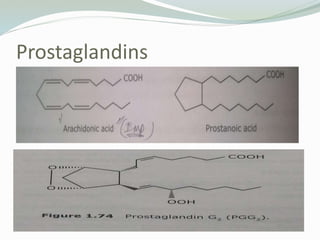
 These are all derivatives of the hypothetical C20 fatty acid
 Prostanoic acid in which carbon atoms 8 to 12 comprise a
cyclopentane ring
 These perform diverse functions
 They stimulate uterine contraction, lowering blood pressure,
vasodilation and inflammation and pain
 Aspirin used as an analgesic(pain-relieving), antipyretic(fever-
reducing) and anti inflammatory agent inhibits the synthesis of
prostaglandins . It irreversibly inhibits cycloxygenase by
acetylating a Ser residue and blocking the enzyme active site.
The inhibition of cycloxygenase blocks the synthesis of
prostaglandins which in turn reduces the inflammatory response
Prostaglandins
Prostaglandins
 Ibuprofen is also used as an analgesic and anti-
inflammatory agent.
 It is a non-steroidal anti inflammatory drug(NSAID) acts as
a reversible competitive inhibitor of cycloxygenase
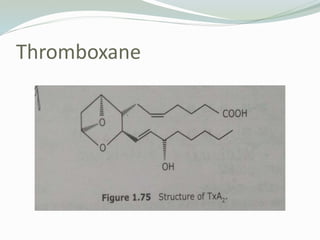
 Thromboxanes- are derived from prostaglandin in the
blood platelets( thrombocytes) by enzyme thromboxane
synthase which convertsPGH2 to thromboxane A2 (TxA2)
 They act as a vasoconstrictor and stimulator of platelet
aggregation (an initial step in blood clotting)
 Thromboxanes have heterocyclic oxane structures
 Thromboxane A (TxA) contains an unstable bicyclic
oxygenated ring structure, while thromboxaneB(TxB) has a
stable oxane ring
Thromboxane
Prostaglandins
 Prostacyclins- the endogenous antagonist of
thromboxane A2 are generated from prostaglandin H2
by a prostacyclin synthase that is particularly
abundant in endothelial cells. The biosynthesis of
prostacyclin starts with COX-1 and is inhibited by
aspirin
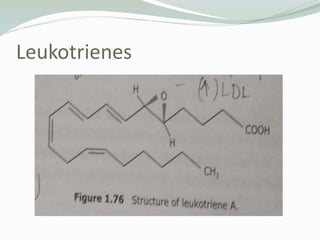
 Leukotrienes- are hydroxyl fatty acid derivatives of
arachidonic acid and do not contain ring structure.
They are distinguished by containing a conjugated
triene double-bond arrangement. They are involved in
chemotaxis, inflammation and allergic reactions
Leukotrienes
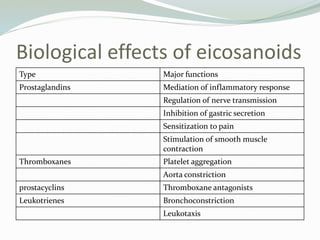
Biological effects of eicosanoids
Type Major functions
Prostaglandins Mediation of inflammatory response
Regulation of nerve transmission
Inhibition of gastric secretion
Sensitization to pain
Stimulation of smooth muscle
contraction
Thromboxanes Platelet aggregation
Aorta constriction
prostacyclins Thromboxane antagonists
Leukotrienes Bronchoconstriction
Leukotaxis
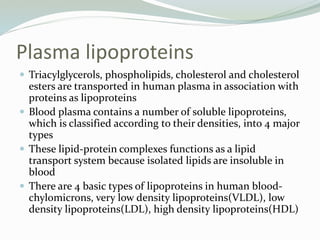
Plasma lipoproteins
 Triacylglycerols, phospholipids, cholesterol and cholesterol
esters are transported in human plasma in association with
proteins as lipoproteins
 Blood plasma contains a number of soluble lipoproteins,
which is classified according to their densities, into 4 major
types
 These lipid-protein complexes functions as a lipid
transport system because isolated lipids are insoluble in
blood
 There are 4 basic types of lipoproteins in human blood-
chylomicrons, very low density lipoproteins(VLDL), low
density lipoproteins(LDL), high density lipoproteins(HDL)
Plasma lipoproteins
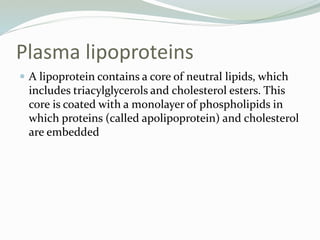
 A lipoprotein contains a core of neutral lipids, which
includes triacylglycerols and cholesterol esters. This
core is coated with a monolayer of phospholipids in
which proteins (called apolipoprotein) and cholesterol
are embedded
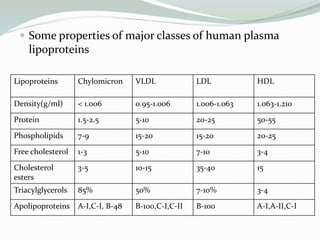
 Some properties of major classes of human plasma
lipoproteins
Lipoproteins Chylomicron VLDL LDL HDL
Density(g/ml) < 1.006 0.95-1.006 1.006-1.063 1.063-1.210
Protein 1.5-2.5 5-10 20-25 50-55
Phospholipids 7-9 15-20 15-20 20-25
Free cholesterol 1-3 5-10 7-10 3-4
Cholesterol
esters
3-5 10-15 35-40 15
Triacylglycerols 85% 50% 7-10% 3-4
Apolipoproteins A-I,C-I, B-48 B-100,C-I,C-II B-100 A-I,A-II,C-I
Lipids and fatty acids.pptx

Lipids and fatty acids.pptx

  • 1.
    Lipids-definition, functions. Fatty acids-saturated and unsaturated fatty acids-definition, examples Essential and non essential fatty acids, melting point of fatty acids. Triacylglycerol and wax, phospholipids, glycolipids, Eicosanoids, plasma lipoproteins
  • 2.
    Lipids  Biological lipidsare a chemically diverse group of organic compounds which are insoluble or only poorly soluble in water  They are readily soluble in non polar solvents such as ether, chloroform, benzene  The hydrophobic nature of lipids is due to the predominance of hydrocarbons chains (-CH2-CH2- CH2-) in their structures  Unlike the proteins, nucleic acids and polysaccharides, lipids are not polymers
  • 3.
    Functions of lipids They serve as a storage form of metabolic fuel  They serve as a transport form of metabolic fuel  They provide the structural components of membranes  They have protective functions in bacteria, plants, insects and vertebrates, serving as a part of the outer coating between the body of the organism and the environment  Apart from the general functions biological lipids serve as pigments(carotene), hormones( vitamin D derivatives, sex hormones ), signaling molecules(eicosanoids, phopshotidylinositol derivatives) , cofactors (vitamin K) , detergents (bile salt ) and many other specialized functions
  • 4.
    Fatty acids  Arethe simplest form of lipids and serve as constituents in a large number of complex forms of lipids  Fatty acids are long –chain hydrocarbons (4-36 carbon long) with one carboxyl group  Fatty acids in biological systems usually contain an even number of carbon atoms  The 16- and 18- carbon fatty acids are most common  The alkyl chain may be saturated or unsaturated  Unsaturated fatty acids may contain one or more double bonds  Fatty acids are amphipathetic by nature; that is they have both nonpolar and polar ends  By an older system, in a fatty acid second carbon is referred to as the α-carbon , 3rd carbon as the β-carbon and the end methyl carbon as the ω- carbon
  • 5.
  • 6.
    Naturally occurring fattyacids Common name Systematic name Carbon atoms: double bonds Saturated fatty acids Lauric acid Dodecanoic acid 12:0 Myristic acid Tetradecanoic acid 14:0 Palmitic acid Hexadecanoic acid 16:0 Stearic acid Octadecanoic acid 18:0 Arachidic acid Eicosanoic acid 20:0
  • 7.
    Naturally occurring fattyacids Common name Systematic name Carbon atoms: double bonds Unsaturated fatty acids Palmitoleic acid Cis-∆9-hexadecenoic acid 16:1 Oleic acid Cis-∆9-octadecenoic acid 18:1 Linoleic acid All cis-∆9,12- octadecadienoic acid 18:2 Linolenic acid All cis-∆9,12,15- octadecatrienoic acid 18:3 Arachidonic acid All cis-∆5,8,11,14- eicosatetraenoic acid 20:4
  • 8.
    Saturated and unsaturatedfatty acids Saturated fatty acids Unsaturated fatty acids Have no double bonds in their chain Their general formula is CH3-(CH2)n- COOH Where n specifies the number of methylene groups between the methyl and carboxyl carbons Ex. Lauric acid, Myristic acid, Palmitic acids etc. Have one or more double bonds and are called monounsaturated or polyunsaturated respectively The double bonds in naturally occurring fatty acids are generally in a cis as opposed to a trans configuration The double bonds of polyunsaturated fatty acids are almost never conjugated (alternating single and double bonds)
  • 9.
    Fatty acids  Essentialfatty acids- are those which are not synthesized by animals and must be obtained from diet  Linoleate and linolenate are 2 essential fatty acids for humans and other animals  Humans lack enzymes to introduce double bonds at carbon atoms beyond C-9 in the fatty acid chain  Hence human cannot synthesize Linoleate and linolenate  Fatty acids that can be endogenously synthesized are termed as non essential fatty acids  They are non essential in the sense that they do not have to be obligatorily obtained from diet
  • 10.
    Fatty acids  Meltingpoint of fatty acids – depends on chain length, presence or absence of double bonds and number of double bonds (i.e. degree of unsaturation)  The longer the chain length, higher the melting point  greater the number of double bonds, lower the melting point  The presence of double bonds makes unsaturated chain more rigid  As a result, unsaturated chains cannot pack themselves in crystals efficiently and densely as unsaturated chain  So they have a lower melting point as compared to saturated fatty acids  Similarly the unsaturated fatty acids with cis configuration have lower melting points than the unsaturated fatty acids with the trans configuration
  • 11.
    Triacylglycerol  also calledtriglycerides are triesters of fatty acids and glycerol  They are composed of 3 fatty acids and a glycerol molecules  Triacylglycerols are of 2 types – simple and mixed type  Those containing a single kind of a fatty acids are called simple Triacylglycerols and with 2 or more different kinds of fatty acids are called mixed triacylglycerols
  • 12.
    Triacylglycerol  The generalformula of triacylglycerols is
  • 13.
    Triacylglycerol  Triacylglycerol arenon polar, hydrophobic in nature and a major form of stored lipids  Because triacylglycerols have no charge (i.e. the carboxyl group of each fatty acid is joined to glycerol through a covalent bond), they are sometimes called as neutral lipid  Triacylglycerol molecules contain fatty acids of varying lengths, which may be unsaturated or saturated  Triacylglycerol can be distinguished as fat and oil on the basis of physical state at room temperature  Fat- is solid in room temperature, contain a large proportion of saturated fatty acids  Oil- liquid in room temperature, because of their relatively high unsaturated fatty acid content
  • 14.
    Hydrolysis of Triacylglycerol Hydrolysis of Triacylglycerol with alkali such as NaOH /KOH is called saponification  Saponification yields salts of free fatty acids(termed soap) and glycerol  The number of milligrams of KOH required to saponify one-gram of fat is known as saponification number  The saponification number measures the average molecular weight of fats  The number of grams of iodine that can be added to 100g sample of fat or oil is called iodine number which is used to determine the degree of unsaturation (i.e. extent of unsaturation)
  • 15.
    Waxes  Natural waxesare typically esters of fatty acids and long chain alcohols  They are formed by esterification of long chain fatty acids( saturated and unsaturated) and high molecular weight monohydroxy alcohols (C14-C36)  Waxes are biosynthesized by many plants or animals  The best known animal wax is bee wax  Triacontanyl palmitate(an ester of palmitic acid with the alcohol triacontanol) is the major component of bee wax
  • 16.
  • 17.
    Phospholipids  Is anamphipathetic molecule constructed from 4 components – fatty acids, a platform to which the fatty acids are attached, a phosphate and an alcohol attached to the phosphate.  The platform on which phospholipids are built may be glycerol or sphingosine
  • 18.
    Phosphoglycerides  Phospholipids derivedfrom glycerol are called Phosphoglycerides (glycerophospholipids)  A phosphoglyceride consist of a glycerol molecule, 2 fatty acids, a phosphate, and an alcohol(e.g. choline)  Phosphoglycerides are the most numerous phospholipid molecules found in cell membranes  In simplest Phosphoglyceride, phosphatidic acid, the hydroxyl group at C-1 and C-2 of glycerol are esterified to the carboxyl groups of the 2 fatty acid chains  The C-3 hydroxyl group of glycerol backbone is esterified to phosphoric acid  Phosphoglyceride molecule are classified according to which alcohol becomes esterified to the phosphate group  The common alcohol moieties of Phosphoglyceride are serine, ethanolamine, choline, glycerol, inositol  If alcohol is choline, then Phosphoglyceride molecule is phosphotidylcholine (lecithin) and if serine it is called is phosphotidylserine
  • 19.
  • 20.
    Ether glycerophospholipids  Possessan ether linkage instead of an acyl group at C-1 position of glycerol  Ex. Platelet activating factor or PAF found in mammals  PAF is a potent signal molecule that causes platelet aggregation and dilation of blood vessels  In Ether glycerophospholipids, the ether-linked chain may be saturated or may contain a double bond between C-1 and C-2  Ether glycerophospholipids in which the alkyl moiety is cis-α,β-unsaturated is termed as plasmalogen
  • 21.
  • 22.
    Sphingophospholipids  Phospholipids derivedfrom sphingosine are called Sphingophospholipids  Sphingophospholipid contain a 18-carbon amino alcohol called sphingosine instead of glycerol  A fatty acid is joined to a sphingosine via an amide linkage to form a ceramide  Ceramide is the structural parent of al sphingolipids  The addition of phosphorylated alcohol to C-1 position of sphingosine, leads to a variety of Sphingophospholipids  Ex. Sphingomyelin, in which phosphocholine group is attached to C-1 hydroxyl and are major constituent in the nervous tissue of higher animals
  • 24.
    Glycolipids  Lipids containingsaccharide group go under the general name of glycolipids  They glycosphingolipid is the most important type of glycolipid and constitute 3rd major class of membrane lipids
  • 25.
    Glycolipids  In glycosphingolipidhead group contains 1 or more sugars connected directly to the –OH at C-1 of the ceramide moiety(do not contain phosphate)  It can be,  Cerebroside- have a single monosaccharide linked to ceramide  Globoside- with oligosaccharide linked to ceramide  Ganglioside- contains complex oligosaccharides as their polar head groups with 1 or more residues of N-acetylneuraminic acid , a sialic acid.  Sialic acid gives gangliosides the negative charge at pH 7  More than 60 different gangliosides have been characterized  Gangliosides with 1 sialic acid residue are in the GM (M for mono-) series, those with 2 are in the GD (D for di-) series and so on  The normal function of ganglioside is not known
  • 26.
    Sphingolipids storage diseases A group of inherited metabolic disorders characterized by an excessive intra-lysosomal deposition of sphingoglycolipids and Sphingophospholipids  Clinical features vary with the specific subtype of the disease Disease Accumulating sphingolipids Enzyme deficiency Tay-Sachs Ganglioside GM2 β-hexosaminidase A Gaucher’s Glucocerebroside/ glucosylceramide β-glucosidase Niemann pick Sphingomyelin sphingomyelinase Fabry’s Trihexosylceramide α-galactosidase A Krabbe’s Deacylated galactocerebroside Galactocerebrosidase
  • 27.
    Steroids  Are complexderivatives of triterpenes  Each type of steroids is composed of 4 fused rings called steroids nucleus  A sterol is a class of steroid characterized by a hydroxyl group at C-3  Cholesterol is am example of the sterol and an essential component in animal cell membranes  Cholesterol acts as a precursor for the biosynthesis of all steroid hormones and bile salts  It is usually stored within cells as a fatty acid ester  It is not found in plants and fungi  Types of sterol that is common in plants are stigmasterol, sitosterol, campesterol  Ergosterol is a sterol present in the cell membrane of fungi
  • 28.
  • 29.
    Eicosanoids  Are afamily of very potent biological signaling molecules that act as short range messengers  It includes prostanoids and leukotrienes  It is known as eicosanoids because of their common origin from 20 carbons polyunsaturated fatty acids, eicosanoic acids, particularly arachidonic acid  Eicosanoids are potent hormones and are locally instead of being transported in the blood to act on cells of the other tissues or organs  Prostanoids and leukotrienes – 2 major groups of eicosanoids formed via 2 distinct pathways, the cycloxygenase and lipoxygenase pathways  Prostanoids, which include the prostaglandins, prostacyclins and thromboxanes are formed through the cycloxygenase pathway (cyclic pathway) and leukotrienes come from the lipoxygenase pathway (linear pathway)
  • 30.
    Prostaglandins  Were firstidentified in human semen  Almost all mammalian cells except RBC produce prostaglandins  These are all derivatives of the hypothetical C20 fatty acid  Prostanoic acid in which carbon atoms 8 to 12 comprise a cyclopentane ring  These perform diverse functions  They stimulate uterine contraction, lowering blood pressure, vasodilation and inflammation and pain  Aspirin used as an analgesic(pain-relieving), antipyretic(fever- reducing) and anti inflammatory agent inhibits the synthesis of prostaglandins . It irreversibly inhibits cycloxygenase by acetylating a Ser residue and blocking the enzyme active site. The inhibition of cycloxygenase blocks the synthesis of prostaglandins which in turn reduces the inflammatory response
  • 31.
  • 32.
    Prostaglandins  Ibuprofen isalso used as an analgesic and anti- inflammatory agent.  It is a non-steroidal anti inflammatory drug(NSAID) acts as a reversible competitive inhibitor of cycloxygenase  Thromboxanes- are derived from prostaglandin in the blood platelets( thrombocytes) by enzyme thromboxane synthase which convertsPGH2 to thromboxane A2 (TxA2)  They act as a vasoconstrictor and stimulator of platelet aggregation (an initial step in blood clotting)  Thromboxanes have heterocyclic oxane structures  Thromboxane A (TxA) contains an unstable bicyclic oxygenated ring structure, while thromboxaneB(TxB) has a stable oxane ring
  • 33.
  • 34.
    Prostaglandins  Prostacyclins- theendogenous antagonist of thromboxane A2 are generated from prostaglandin H2 by a prostacyclin synthase that is particularly abundant in endothelial cells. The biosynthesis of prostacyclin starts with COX-1 and is inhibited by aspirin  Leukotrienes- are hydroxyl fatty acid derivatives of arachidonic acid and do not contain ring structure. They are distinguished by containing a conjugated triene double-bond arrangement. They are involved in chemotaxis, inflammation and allergic reactions
  • 35.
  • 36.
    Biological effects ofeicosanoids Type Major functions Prostaglandins Mediation of inflammatory response Regulation of nerve transmission Inhibition of gastric secretion Sensitization to pain Stimulation of smooth muscle contraction Thromboxanes Platelet aggregation Aorta constriction prostacyclins Thromboxane antagonists Leukotrienes Bronchoconstriction Leukotaxis
  • 37.
    Plasma lipoproteins  Triacylglycerols,phospholipids, cholesterol and cholesterol esters are transported in human plasma in association with proteins as lipoproteins  Blood plasma contains a number of soluble lipoproteins, which is classified according to their densities, into 4 major types  These lipid-protein complexes functions as a lipid transport system because isolated lipids are insoluble in blood  There are 4 basic types of lipoproteins in human blood- chylomicrons, very low density lipoproteins(VLDL), low density lipoproteins(LDL), high density lipoproteins(HDL)
  • 38.
    Plasma lipoproteins  Alipoprotein contains a core of neutral lipids, which includes triacylglycerols and cholesterol esters. This core is coated with a monolayer of phospholipids in which proteins (called apolipoprotein) and cholesterol are embedded
  • 39.
     Some propertiesof major classes of human plasma lipoproteins Lipoproteins Chylomicron VLDL LDL HDL Density(g/ml) < 1.006 0.95-1.006 1.006-1.063 1.063-1.210 Protein 1.5-2.5 5-10 20-25 50-55 Phospholipids 7-9 15-20 15-20 20-25 Free cholesterol 1-3 5-10 7-10 3-4 Cholesterol esters 3-5 10-15 35-40 15 Triacylglycerols 85% 50% 7-10% 3-4 Apolipoproteins A-I,C-I, B-48 B-100,C-I,C-II B-100 A-I,A-II,C-I