Linux Operating
System
Fundamentals
ANSHUL PATEL
1
Agenda  Linux Bootup Process
 Linux Services and its supervision with systemctl
 Linux Process and Memory Management
 Linux FileSystems
 Linux Package Management
 Linux Kernel Parameters
 Linux Shell
2
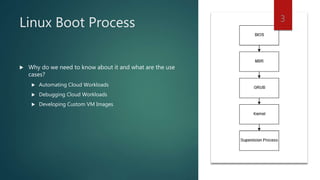
Linux Boot Process
 Why do we need to know about it and what are the use
cases?
 Automating Cloud Workloads
 Debugging Cloud Workloads
 Developing Custom VM Images
3
Why
Systemctl
 Governs the startup sequence of services
 Provides declarative way to define dependency
between the services
 Starts the services in parallel to boost up the
startup process
 New services can be added via simple
configuration files
 Provides facility to control resources like CPU,
Memory, IO
 Provides facility to control restart/failure
behaviours of the services
4
Linux Types
of Processes
Parent process
Child process
Zombie process
Orphan process
Daemon process
Process niceness
5
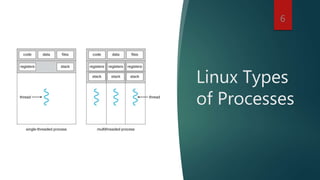
Linux Types
of Processes
6
Linux Types of
Memory
Resident/Main Memory
Virtual/Swap Memory
Buffers/Cache
7
Linux Filesystem
Mounting Filesystem
Unmounting Filesystem
Formatting Filesystem
Filesystem inodes
8
Linux FileSystem
etc
Standardized directory for storing
configuration files
opt
Standardized directory for installing
applications
home
Directory which contain home directory for
linux users
lib
Directory containing 32 bit shared object
files
lib64
Directory containing 64 bit shared object
files
var Directory which contains variable files
dev
Special directory which contains devices
files
tmp Directory which is accessible by all users
proc
Special directory which contains process
tables
9
Linux Package
Management
 Adding Package repositories
 Installing Packages
 Removing Packages
 Updating Packages
 Listing installed packages
10
Linux Kernel
Parameters
 Operating performance can be enhanced by tuning
corresponding kernel parameters.
 For example:
 Increase tcp buffers size
 Enable Network traffic forwarding
 Control Memory swapiness
11
Linux Shell
 What and why Linux Shell?
 What is shell profile?
 What are environment variables? (Especially Path
environment variable)
 Popular Shells
 Bash
 Tcsh
 C shell
 KornShell
 Zsh
12
Thank You!!
13

Linux Operating System Fundamentals

  • 1.
  • 2.
    Agenda  LinuxBootup Process  Linux Services and its supervision with systemctl  Linux Process and Memory Management  Linux FileSystems  Linux Package Management  Linux Kernel Parameters  Linux Shell 2
  • 3.
    Linux Boot Process Why do we need to know about it and what are the use cases?  Automating Cloud Workloads  Debugging Cloud Workloads  Developing Custom VM Images 3
  • 4.
    Why Systemctl  Governs thestartup sequence of services  Provides declarative way to define dependency between the services  Starts the services in parallel to boost up the startup process  New services can be added via simple configuration files  Provides facility to control resources like CPU, Memory, IO  Provides facility to control restart/failure behaviours of the services 4
  • 5.
    Linux Types of Processes Parentprocess Child process Zombie process Orphan process Daemon process Process niceness 5
  • 6.
  • 7.
    Linux Types of Memory Resident/MainMemory Virtual/Swap Memory Buffers/Cache 7
  • 8.
    Linux Filesystem Mounting Filesystem UnmountingFilesystem Formatting Filesystem Filesystem inodes 8
  • 9.
    Linux FileSystem etc Standardized directoryfor storing configuration files opt Standardized directory for installing applications home Directory which contain home directory for linux users lib Directory containing 32 bit shared object files lib64 Directory containing 64 bit shared object files var Directory which contains variable files dev Special directory which contains devices files tmp Directory which is accessible by all users proc Special directory which contains process tables 9
  • 10.
    Linux Package Management  AddingPackage repositories  Installing Packages  Removing Packages  Updating Packages  Listing installed packages 10
  • 11.
    Linux Kernel Parameters  Operatingperformance can be enhanced by tuning corresponding kernel parameters.  For example:  Increase tcp buffers size  Enable Network traffic forwarding  Control Memory swapiness 11
  • 12.
    Linux Shell  Whatand why Linux Shell?  What is shell profile?  What are environment variables? (Especially Path environment variable)  Popular Shells  Bash  Tcsh  C shell  KornShell  Zsh 12
  • 13.