Chaos Engineering
Anshul Patel
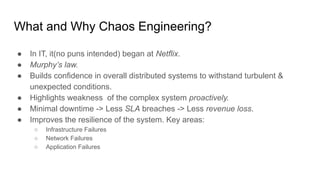
What and Why Chaos Engineering?
● In IT, it(no puns intended) began at Netflix.
● Murphy’s law.
● Builds confidence in overall distributed systems to withstand turbulent &
unexpected conditions.
● Highlights weakness of the complex system proactively.
● Minimal downtime -> Less SLA breaches -> Less revenue loss.
● Improves the resilience of the system. Key areas:
○ Infrastructure Failures
○ Network Failures
○ Application Failures
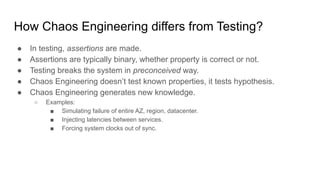
How Chaos Engineering differs from Testing?
● In testing, assertions are made.
● Assertions are typically binary, whether property is correct or not.
● Testing breaks the system in preconceived way.
● Chaos Engineering doesn’t test known properties, it tests hypothesis.
● Chaos Engineering generates new knowledge.
○ Examples:
■ Simulating failure of entire AZ, region, datacenter.
■ Injecting latencies between services.
■ Forcing system clocks out of sync.
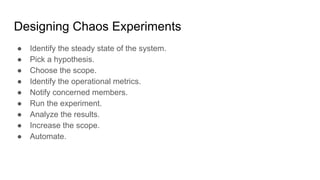
Designing Chaos Experiments
● Identify the steady state of the system.
● Pick a hypothesis.
● Choose the scope.
● Identify the operational metrics.
● Notify concerned members.
● Run the experiment.
● Analyze the results.
● Increase the scope.
● Automate.
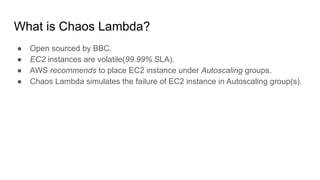
What is Chaos Lambda?
● Open sourced by BBC.
● EC2 instances are volatile(99.99% SLA).
● AWS recommends to place EC2 instance under Autoscaling groups.
● Chaos Lambda simulates the failure of EC2 instance in Autoscaling group(s).
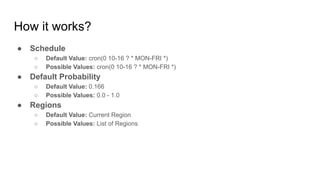
How it works?
● Schedule
○ Default Value: cron(0 10-16 ? * MON-FRI *)
○ Possible Values: cron(0 10-16 ? * MON-FRI *)
● Default Probability
○ Default Value: 0.166
○ Possible Values: 0.0 - 1.0
● Regions
○ Default Value: Current Region
○ Possible Values: List of Regions
Demo
Thank You & QA
Reference: https://github.com/dastergon/awesome-chaos-engineering

Chaos Engineering

  • 1.
  • 2.
    What and WhyChaos Engineering? ● In IT, it(no puns intended) began at Netflix. ● Murphy’s law. ● Builds confidence in overall distributed systems to withstand turbulent & unexpected conditions. ● Highlights weakness of the complex system proactively. ● Minimal downtime -> Less SLA breaches -> Less revenue loss. ● Improves the resilience of the system. Key areas: ○ Infrastructure Failures ○ Network Failures ○ Application Failures
  • 3.
    How Chaos Engineeringdiffers from Testing? ● In testing, assertions are made. ● Assertions are typically binary, whether property is correct or not. ● Testing breaks the system in preconceived way. ● Chaos Engineering doesn’t test known properties, it tests hypothesis. ● Chaos Engineering generates new knowledge. ○ Examples: ■ Simulating failure of entire AZ, region, datacenter. ■ Injecting latencies between services. ■ Forcing system clocks out of sync.
  • 4.
    Designing Chaos Experiments ●Identify the steady state of the system. ● Pick a hypothesis. ● Choose the scope. ● Identify the operational metrics. ● Notify concerned members. ● Run the experiment. ● Analyze the results. ● Increase the scope. ● Automate.
  • 5.
    What is ChaosLambda? ● Open sourced by BBC. ● EC2 instances are volatile(99.99% SLA). ● AWS recommends to place EC2 instance under Autoscaling groups. ● Chaos Lambda simulates the failure of EC2 instance in Autoscaling group(s).
  • 6.
    How it works? ●Schedule ○ Default Value: cron(0 10-16 ? * MON-FRI *) ○ Possible Values: cron(0 10-16 ? * MON-FRI *) ● Default Probability ○ Default Value: 0.166 ○ Possible Values: 0.0 - 1.0 ● Regions ○ Default Value: Current Region ○ Possible Values: List of Regions
  • 7.
  • 8.
    Thank You &QA Reference: https://github.com/dastergon/awesome-chaos-engineering