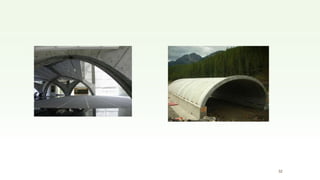
ARCHES
PRESENTED BY
GAYATHRY SATHEESAN
1
ARCHES
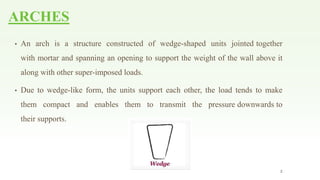
• An arch is a structure constructed of wedge-shaped units jointed together
with mortar and spanning an opening to support the weight of the wall above it
along with other super-imposed loads.
• Due to wedge-like form, the units support each other, the load tends to make
them compact and enables them to transmit the pressure downwards to
their supports.
2
Technical terms
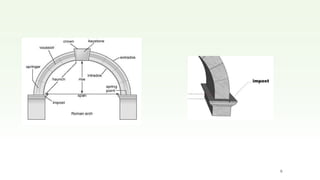
• Intrados: This is the inner curve of the arch
• Soffit: This is the inner surface of the arch. Sometimes the terms intrados and soffit are
treated as synonymous.
• Extrados or back: This is the external curve of an arch.
• Voussoirs: These are the wedge-shaped units forming the courses of an arch.
• Skewback: This is the inclined surface on the abutment. It is prepared to receive the arch
and from it springs the arch.
3
3
• Springer: This is the first voussoir at springing level on either side of an arch and it is
immediately adjacent to the skewback.
• Crown: This is the highest point of the extrados.
• Key: This is the wedge-shaped unit at the crown of an arch. It is sometimes made
prominent by making it of a larger section and projecting it below and above the outlines of
an arch.
• Springing points: These are the points from which the curve of an arch springs.
• Springing line: This is the imaginary horizontal line joining the two springing points.
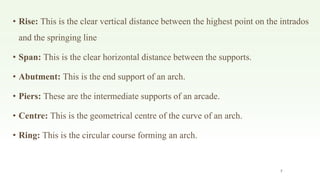
• Impost: The projecting course at the upper part of a pier or an abutment to stress the
springing line is called the impost.
5
6
• Rise: This is the clear vertical distance between the highest point on the intrados
and the springing line
• Span: This is the clear horizontal distance between the supports.
• Abutment: This is the end support of an arch.
• Piers: These are the intermediate supports of an arcade.
• Centre: This is the geometrical centre of the curve of an arch.
• Ring: This is the circular course forming an arch.
7
8
• Depth or height: This is the perpendicular distance between the intrados and extrados.
• Spandril: This is the irregular triangular space formed between the extrados and the
horizontal line drawn tangent to the crown.
• Haunch: This is the lower half portion of the arch between the crown and
the skewback.
• Arcade: This is a row of arches supporting a wall above and being supported by
the piers.
• Thickness or breadth of soffit: The horizontal distance measured perpendicular to
the front and back faces of an arch is known as the thickness or breadth of soffit.
9
10
TYPES OF ARCHES
• The various types of arches can be classified as follows for convenience:
(1) Classification of arches according to shape
(2) Classification of arches according to number of centres
(3) Classification of arches according to materials
11
•(1) Classification of arches according to shape
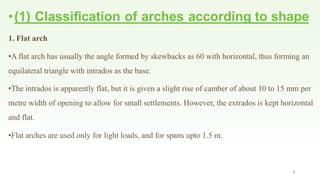
1. Flat arch
•A flat arch has usually the angle formed by skewbacks as 60 with horizontal, thus forming an
equilateral triangle with intrados as the base.
•The intrados is apparently flat, but it is given a slight rise of camber of about 10 to 15 mm per
metre width of opening to allow for small settlements. However, the extrados is kept horizontal
and flat.
•Flat arches are used only for light loads, and for spans upto 1.5 m.
8
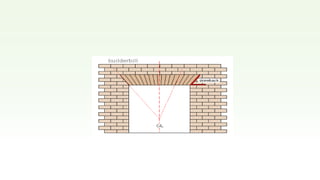
2. Segmental arch
• This is the common type of arch used for buildings..
• The centre of arch lies below the springing line.
• The thrust transferred to the abutment is in an inclined direction
14
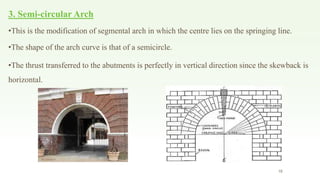
3. Semi-circular Arch
•This is the modification of segmental arch in which the centre lies on the springing line.
•The shape of the arch curve is that of a semicircle.
•The thrust transferred to the abutments is perfectly in vertical direction since the skewback is
horizontal.
15
4. Horse Shoe Arch
•The arch has the shape of a horse shoe, incorporating more than a
semi-circle.
•provided mainly from architectural considerations.
16
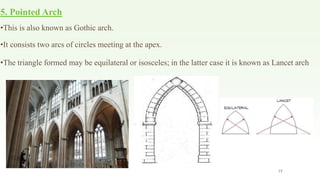
5. Pointed Arch
•This is also known as Gothic arch.
•It consists two arcs of circles meeting at the apex.
•The triangle formed may be equilateral or isosceles; in the latter case it is known as Lancet arch
17
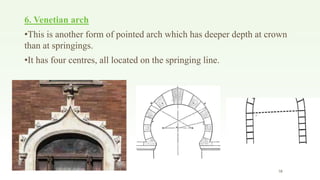
6. Venetian arch
•This is another form of pointed arch which has deeper depth at crown
than at springings.
•It has four centres, all located on the springing line.
18
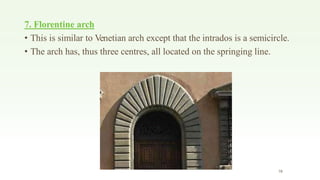
7. Florentine arch
• This is similar to Venetian arch except that the intrados is a semicircle.
• The arch has, thus three centres, all located on the springing line.
19
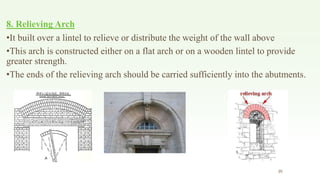
8. Relieving Arch
•It built over a lintel to relieve or distribute the weight of the wall above
•This arch is constructed either on a flat arch or on a wooden lintel to provide
greater strength.
•The ends of the relieving arch should be carried sufficiently into the abutments.
20
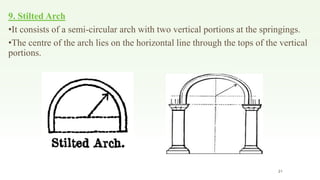
9. Stilted Arch
•It consists of a semi-circular arch with two vertical portions at the springings.
•The centre of the arch lies on the horizontal line through the tops of the vertical
portions.
21
10. Semi-elliptical arch
•This type of arch has the shape of a semi-ellipse and may have either
three centres or five centres.
22
23
(2) Classification of arches according to number of centres
1.One-centred arch: Segmental arches, semi circular arches, fiat arches, horse-shoe arch and
stilted arches come under this category. Sometimes, a perfectly circular arch, known as
bull's eye arch is provided for circular windows.
2.Two-centred arch: Pointed arches come under this category. Semi elliptical arch and
florentine arch come under this category.
3.Three-centred arch: Elliptical arches come under this category
4.Four-centred arch:It has four centres. Venetian arch is a typical example of this type.
Another example is the Tudor arch.
24
25
(3) Classification of arches according to materials of construction
(1) Stone arches:
• Can be constructed :
i. Rubble masonry
ii. Ashlar masonry.
i) Rubble masonry
•.
•.
•.
Comparatively weak and hence it is used for inferior type of work
Hammer dressed, roughly shaped
The span of arch is limited to about 1 m
ii) Ashlar masonry
•. Stones cut to proper shape and are fully dressed, set in lime or cement mortar
joint
Can also be used to make flat arch•.
26
(2) Brick arches:
•These arches can be constructed
i)Rough bricks arches
ii)Axed brick arch
iii)Gauged bricks arch
iv)Purpose made brick
27
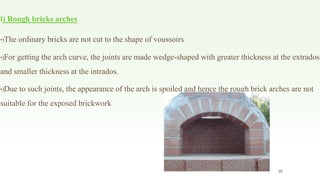
i) Rough bricks arches
•)The ordinary bricks are not cut to the shape of voussoirs
•)For getting the arch curve, the joints are made wedge-shaped with greater thickness at the extrados
and smaller thickness at the intrados.
•)Due to such joints, the appearance of the arch is spoiled and hence the rough brick arches are not
suitable for the exposed brickwork
28
ii) Axed brick arch
•Bricks are cut wedge shaped with the help of brick axe
•Joints are uniform thickness along the radius
•Appearance is not very pleasant because wedge shaped bricks are not finely dressed
iii) Gauged brick arch
•Bricks are cut to exact shape of wedge by means of wire saw
•Surface of bricks are fie dressed with the help of file
•Soft bricks are used
•For jointing Lime putty is used
iv)Purpose made bricks
•Bricks are manufactured by matching exact shape and size of voussoirs
29
30
(3) Concrete arches:
i) pre-cast concrete block arch
• Prepared by casting cement concrete in specially prepared moulds.
• Because of exact shape and size good appearance is achieved.1:2:4 cement concrete is usually
used
ii) Monolithic concrete arch
• Constructed from cast-in-situ concrete and are suitable for big spans.
• Form work is removed only when concrete has sufficiently hardened
• Hence they are employed in the construction of culverts and bridges.
31
32
Thank You!!

Arches

  • 1.
  • 2.
    ARCHES • An archis a structure constructed of wedge-shaped units jointed together with mortar and spanning an opening to support the weight of the wall above it along with other super-imposed loads. • Due to wedge-like form, the units support each other, the load tends to make them compact and enables them to transmit the pressure downwards to their supports. 2
  • 3.
    Technical terms • Intrados:This is the inner curve of the arch • Soffit: This is the inner surface of the arch. Sometimes the terms intrados and soffit are treated as synonymous. • Extrados or back: This is the external curve of an arch. • Voussoirs: These are the wedge-shaped units forming the courses of an arch. • Skewback: This is the inclined surface on the abutment. It is prepared to receive the arch and from it springs the arch. 3
  • 4.
  • 5.
    • Springer: Thisis the first voussoir at springing level on either side of an arch and it is immediately adjacent to the skewback. • Crown: This is the highest point of the extrados. • Key: This is the wedge-shaped unit at the crown of an arch. It is sometimes made prominent by making it of a larger section and projecting it below and above the outlines of an arch. • Springing points: These are the points from which the curve of an arch springs. • Springing line: This is the imaginary horizontal line joining the two springing points. • Impost: The projecting course at the upper part of a pier or an abutment to stress the springing line is called the impost. 5
  • 6.
  • 7.
    • Rise: Thisis the clear vertical distance between the highest point on the intrados and the springing line • Span: This is the clear horizontal distance between the supports. • Abutment: This is the end support of an arch. • Piers: These are the intermediate supports of an arcade. • Centre: This is the geometrical centre of the curve of an arch. • Ring: This is the circular course forming an arch. 7
  • 8.
  • 9.
    • Depth orheight: This is the perpendicular distance between the intrados and extrados. • Spandril: This is the irregular triangular space formed between the extrados and the horizontal line drawn tangent to the crown. • Haunch: This is the lower half portion of the arch between the crown and the skewback. • Arcade: This is a row of arches supporting a wall above and being supported by the piers. • Thickness or breadth of soffit: The horizontal distance measured perpendicular to the front and back faces of an arch is known as the thickness or breadth of soffit. 9
  • 10.
  • 11.
    TYPES OF ARCHES •The various types of arches can be classified as follows for convenience: (1) Classification of arches according to shape (2) Classification of arches according to number of centres (3) Classification of arches according to materials 11
  • 12.
    •(1) Classification ofarches according to shape 1. Flat arch •A flat arch has usually the angle formed by skewbacks as 60 with horizontal, thus forming an equilateral triangle with intrados as the base. •The intrados is apparently flat, but it is given a slight rise of camber of about 10 to 15 mm per metre width of opening to allow for small settlements. However, the extrados is kept horizontal and flat. •Flat arches are used only for light loads, and for spans upto 1.5 m. 8
  • 14.
    2. Segmental arch •This is the common type of arch used for buildings.. • The centre of arch lies below the springing line. • The thrust transferred to the abutment is in an inclined direction 14
  • 15.
    3. Semi-circular Arch •Thisis the modification of segmental arch in which the centre lies on the springing line. •The shape of the arch curve is that of a semicircle. •The thrust transferred to the abutments is perfectly in vertical direction since the skewback is horizontal. 15
  • 16.
    4. Horse ShoeArch •The arch has the shape of a horse shoe, incorporating more than a semi-circle. •provided mainly from architectural considerations. 16
  • 17.
    5. Pointed Arch •Thisis also known as Gothic arch. •It consists two arcs of circles meeting at the apex. •The triangle formed may be equilateral or isosceles; in the latter case it is known as Lancet arch 17
  • 18.
    6. Venetian arch •Thisis another form of pointed arch which has deeper depth at crown than at springings. •It has four centres, all located on the springing line. 18
  • 19.
    7. Florentine arch •This is similar to Venetian arch except that the intrados is a semicircle. • The arch has, thus three centres, all located on the springing line. 19
  • 20.
    8. Relieving Arch •Itbuilt over a lintel to relieve or distribute the weight of the wall above •This arch is constructed either on a flat arch or on a wooden lintel to provide greater strength. •The ends of the relieving arch should be carried sufficiently into the abutments. 20
  • 21.
    9. Stilted Arch •Itconsists of a semi-circular arch with two vertical portions at the springings. •The centre of the arch lies on the horizontal line through the tops of the vertical portions. 21
  • 22.
    10. Semi-elliptical arch •Thistype of arch has the shape of a semi-ellipse and may have either three centres or five centres. 22
  • 23.
    23 (2) Classification ofarches according to number of centres 1.One-centred arch: Segmental arches, semi circular arches, fiat arches, horse-shoe arch and stilted arches come under this category. Sometimes, a perfectly circular arch, known as bull's eye arch is provided for circular windows. 2.Two-centred arch: Pointed arches come under this category. Semi elliptical arch and florentine arch come under this category. 3.Three-centred arch: Elliptical arches come under this category 4.Four-centred arch:It has four centres. Venetian arch is a typical example of this type. Another example is the Tudor arch.
  • 24.
  • 25.
    25 (3) Classification ofarches according to materials of construction (1) Stone arches: • Can be constructed : i. Rubble masonry ii. Ashlar masonry. i) Rubble masonry •. •. •. Comparatively weak and hence it is used for inferior type of work Hammer dressed, roughly shaped The span of arch is limited to about 1 m ii) Ashlar masonry •. Stones cut to proper shape and are fully dressed, set in lime or cement mortar joint Can also be used to make flat arch•.
  • 26.
  • 27.
    (2) Brick arches: •Thesearches can be constructed i)Rough bricks arches ii)Axed brick arch iii)Gauged bricks arch iv)Purpose made brick 27
  • 28.
    i) Rough bricksarches •)The ordinary bricks are not cut to the shape of voussoirs •)For getting the arch curve, the joints are made wedge-shaped with greater thickness at the extrados and smaller thickness at the intrados. •)Due to such joints, the appearance of the arch is spoiled and hence the rough brick arches are not suitable for the exposed brickwork 28
  • 29.
    ii) Axed brickarch •Bricks are cut wedge shaped with the help of brick axe •Joints are uniform thickness along the radius •Appearance is not very pleasant because wedge shaped bricks are not finely dressed iii) Gauged brick arch •Bricks are cut to exact shape of wedge by means of wire saw •Surface of bricks are fie dressed with the help of file •Soft bricks are used •For jointing Lime putty is used iv)Purpose made bricks •Bricks are manufactured by matching exact shape and size of voussoirs 29
  • 30.
  • 31.
    (3) Concrete arches: i)pre-cast concrete block arch • Prepared by casting cement concrete in specially prepared moulds. • Because of exact shape and size good appearance is achieved.1:2:4 cement concrete is usually used ii) Monolithic concrete arch • Constructed from cast-in-situ concrete and are suitable for big spans. • Form work is removed only when concrete has sufficiently hardened • Hence they are employed in the construction of culverts and bridges. 31
  • 32.
  • 33.