Introduction, properties, and applications
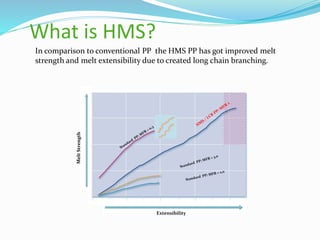
In comparison to conventional PP the HMS PP has got improved melt
strength and melt extensibility due to created long chain branching.
Extensibility
MeltStrength
What is HMS?
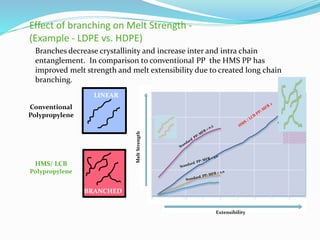
Branches decrease crystallinity and increase inter and intra chain
entanglement. In comparison to conventional PP the HMS PP has
improved melt strength and melt extensibility due to created long chain
branching.
LINEAR
BRANCHED
Conventional
Polypropylene
HMS/ LCB
Polypropylene
Extensibility
MeltStrength
Effect of branching on Melt Strength -
(Example - LDPE vs. HDPE)
How does branches affect properties?
 Increases “free volume” – will reduce viscosity, inter
chain attraction – dipole – reduced crystallinity.
 Increase MWD
 Shear Sensitivity. Higher viscosity at low shear and
lower viscosity at high shear.
 The effect will vary depending on length of chains,
inter chain entanglements. The entangled LCB will
increase low shear viscosity, Tg, Tm, stiffness, creep
resistance, HDT, strain hardening, stress
whitening, melt strength, and met elasticity.
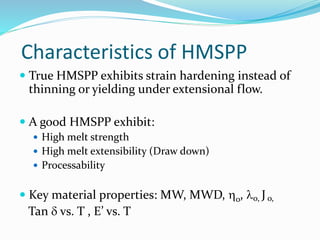
Characteristics of HMSPP
 True HMSPP exhibits strain hardening instead of
thinning or yielding under extensional flow.
 A good HMSPP exhibit:
 High melt strength
 High melt extensibility (Draw down)
 Processability
 Key material properties: MW, MWD, o, o, J o,
Tan  vs. T , E’ vs. T
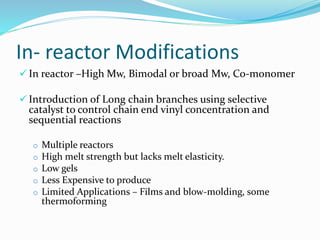
In- reactor Modifications
 In reactor –High Mw, Bimodal or broad Mw, Co-monomer
 Introduction of Long chain branches using selective
catalyst to control chain end vinyl concentration and
sequential reactions
o Multiple reactors
o High melt strength but lacks melt elasticity.
o Low gels
o Less Expensive to produce
o Limited Applications – Films and blow-molding, some
thermoforming
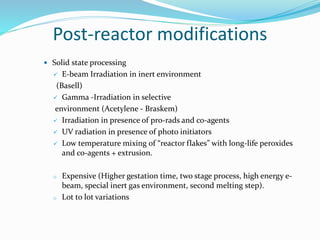
Post-reactor modifications
 Solid state processing
 E-beam Irradiation in inert environment
(Basell)
 Gamma -Irradiation in selective
environment (Acetylene - Braskem)
 Irradiation in presence of pro-rads and co-agents
 UV radiation in presence of photo initiators
 Low temperature mixing of “reactor flakes” with long-life peroxides
and co-agents + extrusion.
o Expensive (Higher gestation time, two stage process, high energy e-
beam, special inert gas environment, second melting step).
o Lot to lot variations
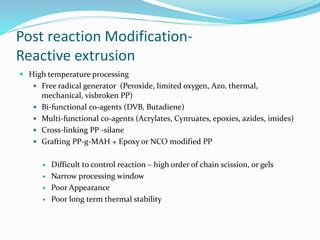
Post reaction Modification-
Reactive extrusion
 High temperature processing
 Free radical generator (Peroxide, limited oxygen, Azo, thermal,
mechanical, visbroken PP)
 Bi-functional co-agents (DVB, Butadiene)
 Multi-functional co-agents (Acrylates, Cynruates, epoxies, azides, imides)
 Cross-linking PP -silane
 Grafting PP-g-MAH + Epoxy or NCO modified PP
 Difficult to control reaction – high order of chain scission, or gels
 Narrow processing window
 Poor Appearance
 Poor long term thermal stability
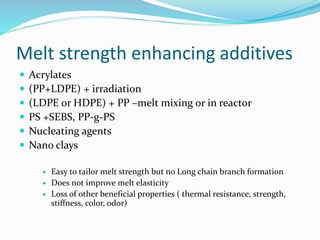
Melt strength enhancing additives
 Acrylates
 (PP+LDPE) + irradiation
 (LDPE or HDPE) + PP –melt mixing or in reactor
 PS +SEBS, PP-g-PS
 Nucleating agents
 Nano clays
 Easy to tailor melt strength but no Long chain branch formation
 Does not improve melt elasticity
 Loss of other beneficial properties ( thermal resistance, strength,
stiffness, color, odor)
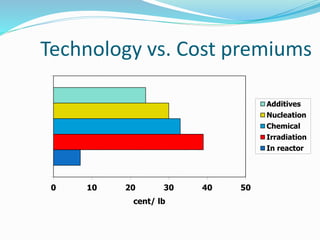
Technology vs. Cost premiums
0 10 20 30 40 50
cent/ lb
Additives
Nucleation
Chemical
Irradiation
In reactor
HMSPP -Players
 Work in Progress
 Braskem
 Honan Petro Chemical
 Total Petrochemical
 Current
 Borealis (Daploy) – The only commercially proven LCB-HMSPP
on market
 Chisso/JPP (Newform and New stretch – In reactor + post reaction
 Past
 Basell – Post reactor irradiation – quenching (has some reactor made HMSPP)
 Solvay – Post reactor Chemical modification (peroxide + coagent)
 Rohm & Haas – EPR-9 Additive
 Amoco – In reactor modification, HCPP
 Exxon – in reactor modifications
 Fina – Bi Modal/ Nucleated in reactor
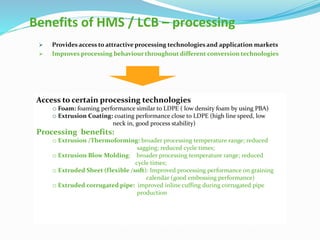
Benefits of HMS / LCB – processing
 Provides access to attractive processing technologies and application markets
 Improves processing behaviour throughout different conversion technologies
Access to certain processing technologies
o Foam: foaming performance similar to LDPE ( low density foam by using PBA)
o Extrusion Coating: coating performance close to LDPE (high line speed, low
neck in, good process stability)
Processing benefits:
o Extrusion /Thermoforming: broader processing temperature range; reduced
sagging; reduced cycle times;
o Extrusion Blow Molding: broader processing temperature range; reduced
cycle times;
o Extruded Sheet (flexible /soft): Improved processing performance on graining
calendar (good embossing performance)
o Extruded corrugated pipe: improved inline cuffing during corrugated pipe
production
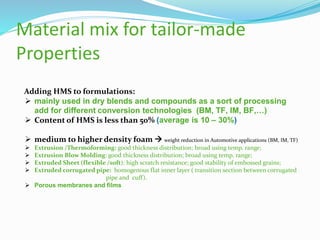
Adding HMS to formulations:
 mainly used in dry blends and compounds as a sort of processing
add for different conversion technologies (BM, TF, IM, BF,…)
 Content of HMS is less than 50% (average is 10 – 30%)
 medium to higher density foam  weight reduction in Automotive applications (BM, IM, TF)
 Extrusion /Thermoforming: good thickness distribution; broad using temp. range;
 Extrusion Blow Molding: good thickness distribution; broad using temp. range;
 Extruded Sheet (flexible /soft): high scratch resistance; good stability of embossed grains;
 Extruded corrugated pipe: homogenous flat inner layer ( transition section between corrugated
pipe and cuff).
 Porous membranes and films
Material mix for tailor-made
Properties
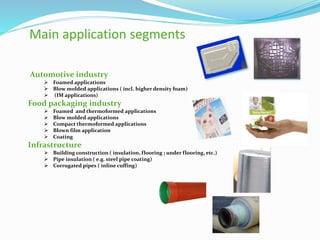
Automotive industry
 Foamed applications
 Blow molded applications ( incl. higher density foam)
 (IM applications)
Food packaging industry
 Foamed and thermoformed applications
 Blow molded applications
 Compact thermoformed applications
 Blown film application
 Coating
Infrastructure
 Building construction ( insulation, flooring ; under flooring, etc.)
 Pipe insulation ( e.g. steel pipe coating)
 Corrugated pipes ( inline cuffing)
Main application segments
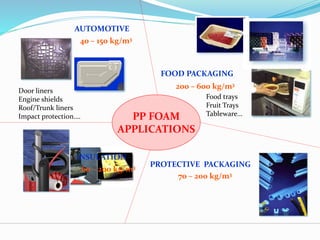
PP FOAM
APPLICATIONS
AUTOMOTIVE
FOOD PACKAGING
INSULATION
PROTECTIVE PACKAGING
Door liners
Engine shields
Roof/Trunk liners
Impact protection….
Food trays
Fruit Trays
Tableware…
60 – 200 kg/m3
40 – 150 kg/m3
70 – 200 kg/m3
200 – 600 kg/m3
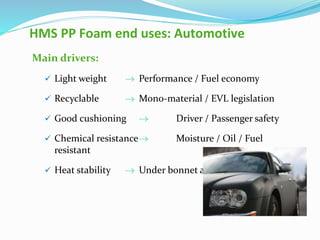
Main drivers:
 Light weight  Performance / Fuel economy
 Recyclable  Mono-material / EVL legislation
 Good cushioning  Driver / Passenger safety
 Chemical resistance Moisture / Oil / Fuel
resistant
 Heat stability  Under bonnet applications
HMS PP Foam end uses: Automotive
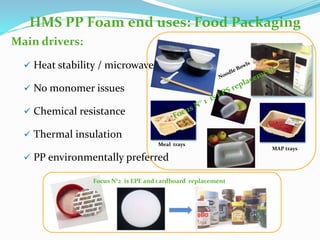
Main drivers:
 Heat stability / microwaveable
 No monomer issues
 Chemical resistance
 Thermal insulation
 PP environmentally preferred
MAP trays
Meal trays
Focus N°2 is EPE and cardboard replacement
HMS PP Foam end uses: Food Packaging
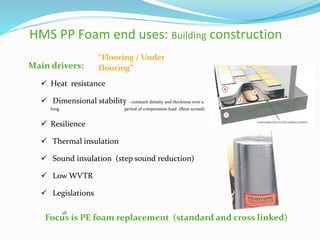
HMS PP Foam end uses: Building construction
18
Main drivers:
 Heat resistance
 Dimensional stability - constant density and thickness over a
long period of compression load (floor screed)
 Resilience
 Thermal insulation
 Sound insulation (step sound reduction)
 Low WVTR
 Legislations
Focus is PE foam replacement (standard and cross linked)
“Flooring / Under
flooring”
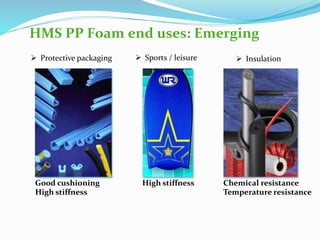
 Protective packaging  Insulation Sports / leisure
Good cushioning
High stiffness
Chemical resistance
Temperature resistance
High stiffness
HMS PP Foam end uses: Emerging
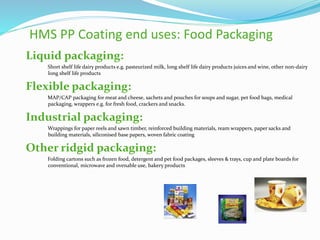
HMS PP Coating end uses: Food Packaging
Liquid packaging:
Short shelf life dairy products e.g. pasteurized milk, long shelf life dairy products juices and wine, other non-dairy
long shelf life products
Flexible packaging:
MAP/CAP packaging for meat and cheese, sachets and pouches for soups and sugar, pet food bags, medical
packaging, wrappers e.g. for fresh food, crackers and snacks.
Industrial packaging:
Wrappings for paper reels and sawn timber, reinforced building materials, ream wrappers, paper sacks and
building materials, siliconised base papers, woven fabric coating
Other ridgid packaging:
Folding cartons such as frozen food, detergent and pet food packages, sleeves & trays, cup and plate boards for
conventional, microwave and ovenable use, bakery products
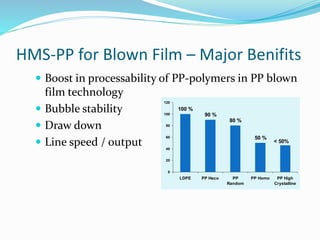
HMS-PP for Blown Film – Major Benifits
 Boost in processability of PP-polymers in PP blown
film technology
 Bubble stability
 Draw down
 Line speed / output
100 %
90 %
80 %
50 %
0
20
40
60
80
100
120
LDPE PP Heco PP
Random
PP Homo PP High
Crystalline
< 50%
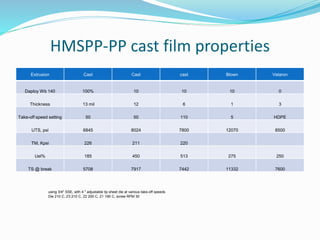
HMSPP-PP cast film properties
Extrusion Cast Cast cast Blown Velaron
Daploy Wb 140 100% 10 10 10 0
Thickness 13 mil 12 6 1 3
Take-off speed setting 50 50 110 5 HDPE
UTS, psi 6845 8024 7800 12070 8500
TM, Kpsi 226 211 220
Uel% 185 450 513 275 250
TS @ break 5708 7917 7442 11332 7600
using 3/4" SSE, with 4 " adjustable lip sheet die at various take-off speeds
Die 210 C, Z3 210 C, Z2 200 C, Z1 190 C, screw RPM 30
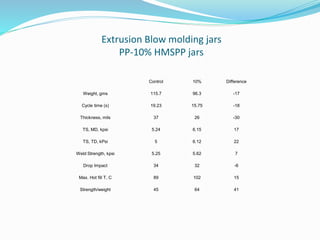
Extrusion Blow molding jars
PP-10% HMSPP jars
Control 10% Difference
Weight, gms 115.7 96.3 -17
Cycle time (s) 19.23 15.75 -18
Thickness, mils 37 26 -30
TS, MD, kpsi 5.24 6.15 17
TS, TD, kPsi 5 6.12 22
Weld Strength, kpsi 5.25 5.62 7
Drop Impact 34 32 -6
Max. Hot fill T, C 89 102 15
Strength/weight 45 64 41
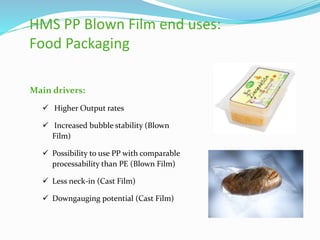
Main drivers:
 Higher Output rates
 Increased bubble stability (Blown
Film)
 Possibility to use PP with comparable
processability than PE (Blown Film)
 Less neck-in (Cast Film)
 Downgauging potential (Cast Film)
HMS PP Blown Film end uses:
Food Packaging
HMS as modifier
0
5
10
15
20
25
0 100 200 300
Meltstrength[cN]
Extensibility [mm/s]
Standard iPP
MFR 0.3 g/10'
HMS
MFR 3 g/10'
LDPE
MFR 3 g/10'
85
120
0
20
40
60
80
100
120
140
PP-Homo; MFR 3 Daploy™ HMS-Homo * addition
Output[kg/h]
Processing aid  increased output, less neck in
Nucleating agent  mechanics  downgaging potential
Extensibility  downgaging potential
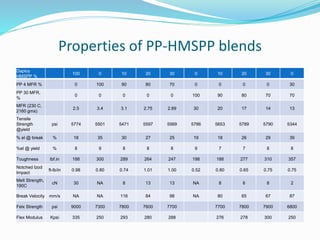
Properties of PP-HMSPP blends
Daploy
HMSPP %
100 0 10 20 30 0 10 20 30 0
PP 4 MFR % 0 100 90 80 70 0 0 0 0 30
PP 30 MFR,
%
0 0 0 0 0 100 90 80 70 70
MFR (230 C,
2160 gms)
2.5 3.4 3.1 2.75 2.69 30 20 17 14 13
Tensile
Strength
@yield
psi 5774 5501 5471 5597 5569 5786 5653 5789 5790 5344
% el @ break % 18 35 30 27 25 19 18 26 29 39
%el @ yield % 8 9 8 8 8 9 7 7 8 8
Toughness lbf.in 188 300 289 264 247 198 188 277 310 357
Notched Izod
Impact
ft-lb/in 0.98 0.80 0.74 1.01 1.00 0.52 0.80 0.65 0.75 0.75
Melt Strength,
190C
cN 30 NA 8 13 13 NA 8 6 8 2
Break Velocity mm/s NA NA 116 84 98 NA 80 65 67 87
Felx Strength psi 9000 7300 7800 7600 7700 7700 7800 7900 6800
Flex Modulus Kpsi 335 250 293 280 288 276 278 300 250
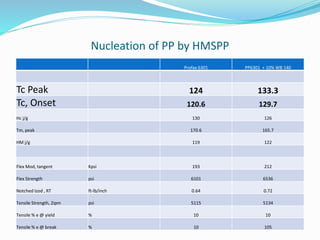
Nucleation of PP by HMSPP
Profax 6301 PP6301 + 10% WB 140
Tc Peak 124 133.3
Tc, Onset 120.6 129.7
Hc j/g 130 126
Tm, peak 170.6 165.7
HM j/g 119 122
Flex Mod, tangent Kpsi 193 212
Flex Strength psi 6101 6536
Notched Izod , RT ft-lb/inch 0.64 0.72
Tensile Strength, 2ipm psi 5115 5134
Tensile % e @ yield % 10 10
Tensile % e @ break % 10 105

LINKEDINHMSPP

  • 1.
  • 2.
    In comparison toconventional PP the HMS PP has got improved melt strength and melt extensibility due to created long chain branching. Extensibility MeltStrength What is HMS?
  • 3.
    Branches decrease crystallinityand increase inter and intra chain entanglement. In comparison to conventional PP the HMS PP has improved melt strength and melt extensibility due to created long chain branching. LINEAR BRANCHED Conventional Polypropylene HMS/ LCB Polypropylene Extensibility MeltStrength Effect of branching on Melt Strength - (Example - LDPE vs. HDPE)
  • 4.
    How does branchesaffect properties?  Increases “free volume” – will reduce viscosity, inter chain attraction – dipole – reduced crystallinity.  Increase MWD  Shear Sensitivity. Higher viscosity at low shear and lower viscosity at high shear.  The effect will vary depending on length of chains, inter chain entanglements. The entangled LCB will increase low shear viscosity, Tg, Tm, stiffness, creep resistance, HDT, strain hardening, stress whitening, melt strength, and met elasticity.
  • 5.
    Characteristics of HMSPP True HMSPP exhibits strain hardening instead of thinning or yielding under extensional flow.  A good HMSPP exhibit:  High melt strength  High melt extensibility (Draw down)  Processability  Key material properties: MW, MWD, o, o, J o, Tan  vs. T , E’ vs. T
  • 6.
    In- reactor Modifications In reactor –High Mw, Bimodal or broad Mw, Co-monomer  Introduction of Long chain branches using selective catalyst to control chain end vinyl concentration and sequential reactions o Multiple reactors o High melt strength but lacks melt elasticity. o Low gels o Less Expensive to produce o Limited Applications – Films and blow-molding, some thermoforming
  • 7.
    Post-reactor modifications  Solidstate processing  E-beam Irradiation in inert environment (Basell)  Gamma -Irradiation in selective environment (Acetylene - Braskem)  Irradiation in presence of pro-rads and co-agents  UV radiation in presence of photo initiators  Low temperature mixing of “reactor flakes” with long-life peroxides and co-agents + extrusion. o Expensive (Higher gestation time, two stage process, high energy e- beam, special inert gas environment, second melting step). o Lot to lot variations
  • 8.
    Post reaction Modification- Reactiveextrusion  High temperature processing  Free radical generator (Peroxide, limited oxygen, Azo, thermal, mechanical, visbroken PP)  Bi-functional co-agents (DVB, Butadiene)  Multi-functional co-agents (Acrylates, Cynruates, epoxies, azides, imides)  Cross-linking PP -silane  Grafting PP-g-MAH + Epoxy or NCO modified PP  Difficult to control reaction – high order of chain scission, or gels  Narrow processing window  Poor Appearance  Poor long term thermal stability
  • 9.
    Melt strength enhancingadditives  Acrylates  (PP+LDPE) + irradiation  (LDPE or HDPE) + PP –melt mixing or in reactor  PS +SEBS, PP-g-PS  Nucleating agents  Nano clays  Easy to tailor melt strength but no Long chain branch formation  Does not improve melt elasticity  Loss of other beneficial properties ( thermal resistance, strength, stiffness, color, odor)
  • 10.
    Technology vs. Costpremiums 0 10 20 30 40 50 cent/ lb Additives Nucleation Chemical Irradiation In reactor
  • 11.
    HMSPP -Players  Workin Progress  Braskem  Honan Petro Chemical  Total Petrochemical  Current  Borealis (Daploy) – The only commercially proven LCB-HMSPP on market  Chisso/JPP (Newform and New stretch – In reactor + post reaction  Past  Basell – Post reactor irradiation – quenching (has some reactor made HMSPP)  Solvay – Post reactor Chemical modification (peroxide + coagent)  Rohm & Haas – EPR-9 Additive  Amoco – In reactor modification, HCPP  Exxon – in reactor modifications  Fina – Bi Modal/ Nucleated in reactor
  • 12.
    Benefits of HMS/ LCB – processing  Provides access to attractive processing technologies and application markets  Improves processing behaviour throughout different conversion technologies Access to certain processing technologies o Foam: foaming performance similar to LDPE ( low density foam by using PBA) o Extrusion Coating: coating performance close to LDPE (high line speed, low neck in, good process stability) Processing benefits: o Extrusion /Thermoforming: broader processing temperature range; reduced sagging; reduced cycle times; o Extrusion Blow Molding: broader processing temperature range; reduced cycle times; o Extruded Sheet (flexible /soft): Improved processing performance on graining calendar (good embossing performance) o Extruded corrugated pipe: improved inline cuffing during corrugated pipe production
  • 13.
    Adding HMS toformulations:  mainly used in dry blends and compounds as a sort of processing add for different conversion technologies (BM, TF, IM, BF,…)  Content of HMS is less than 50% (average is 10 – 30%)  medium to higher density foam  weight reduction in Automotive applications (BM, IM, TF)  Extrusion /Thermoforming: good thickness distribution; broad using temp. range;  Extrusion Blow Molding: good thickness distribution; broad using temp. range;  Extruded Sheet (flexible /soft): high scratch resistance; good stability of embossed grains;  Extruded corrugated pipe: homogenous flat inner layer ( transition section between corrugated pipe and cuff).  Porous membranes and films Material mix for tailor-made Properties
  • 14.
    Automotive industry  Foamedapplications  Blow molded applications ( incl. higher density foam)  (IM applications) Food packaging industry  Foamed and thermoformed applications  Blow molded applications  Compact thermoformed applications  Blown film application  Coating Infrastructure  Building construction ( insulation, flooring ; under flooring, etc.)  Pipe insulation ( e.g. steel pipe coating)  Corrugated pipes ( inline cuffing) Main application segments
  • 15.
    PP FOAM APPLICATIONS AUTOMOTIVE FOOD PACKAGING INSULATION PROTECTIVEPACKAGING Door liners Engine shields Roof/Trunk liners Impact protection…. Food trays Fruit Trays Tableware… 60 – 200 kg/m3 40 – 150 kg/m3 70 – 200 kg/m3 200 – 600 kg/m3
  • 16.
    Main drivers:  Lightweight  Performance / Fuel economy  Recyclable  Mono-material / EVL legislation  Good cushioning  Driver / Passenger safety  Chemical resistance Moisture / Oil / Fuel resistant  Heat stability  Under bonnet applications HMS PP Foam end uses: Automotive
  • 17.
    Main drivers:  Heatstability / microwaveable  No monomer issues  Chemical resistance  Thermal insulation  PP environmentally preferred MAP trays Meal trays Focus N°2 is EPE and cardboard replacement HMS PP Foam end uses: Food Packaging
  • 18.
    HMS PP Foamend uses: Building construction 18 Main drivers:  Heat resistance  Dimensional stability - constant density and thickness over a long period of compression load (floor screed)  Resilience  Thermal insulation  Sound insulation (step sound reduction)  Low WVTR  Legislations Focus is PE foam replacement (standard and cross linked) “Flooring / Under flooring”
  • 19.
     Protective packaging Insulation Sports / leisure Good cushioning High stiffness Chemical resistance Temperature resistance High stiffness HMS PP Foam end uses: Emerging
  • 20.
    HMS PP Coatingend uses: Food Packaging Liquid packaging: Short shelf life dairy products e.g. pasteurized milk, long shelf life dairy products juices and wine, other non-dairy long shelf life products Flexible packaging: MAP/CAP packaging for meat and cheese, sachets and pouches for soups and sugar, pet food bags, medical packaging, wrappers e.g. for fresh food, crackers and snacks. Industrial packaging: Wrappings for paper reels and sawn timber, reinforced building materials, ream wrappers, paper sacks and building materials, siliconised base papers, woven fabric coating Other ridgid packaging: Folding cartons such as frozen food, detergent and pet food packages, sleeves & trays, cup and plate boards for conventional, microwave and ovenable use, bakery products
  • 21.
    HMS-PP for BlownFilm – Major Benifits  Boost in processability of PP-polymers in PP blown film technology  Bubble stability  Draw down  Line speed / output 100 % 90 % 80 % 50 % 0 20 40 60 80 100 120 LDPE PP Heco PP Random PP Homo PP High Crystalline < 50%
  • 22.
    HMSPP-PP cast filmproperties Extrusion Cast Cast cast Blown Velaron Daploy Wb 140 100% 10 10 10 0 Thickness 13 mil 12 6 1 3 Take-off speed setting 50 50 110 5 HDPE UTS, psi 6845 8024 7800 12070 8500 TM, Kpsi 226 211 220 Uel% 185 450 513 275 250 TS @ break 5708 7917 7442 11332 7600 using 3/4" SSE, with 4 " adjustable lip sheet die at various take-off speeds Die 210 C, Z3 210 C, Z2 200 C, Z1 190 C, screw RPM 30
  • 23.
    Extrusion Blow moldingjars PP-10% HMSPP jars Control 10% Difference Weight, gms 115.7 96.3 -17 Cycle time (s) 19.23 15.75 -18 Thickness, mils 37 26 -30 TS, MD, kpsi 5.24 6.15 17 TS, TD, kPsi 5 6.12 22 Weld Strength, kpsi 5.25 5.62 7 Drop Impact 34 32 -6 Max. Hot fill T, C 89 102 15 Strength/weight 45 64 41
  • 24.
    Main drivers:  HigherOutput rates  Increased bubble stability (Blown Film)  Possibility to use PP with comparable processability than PE (Blown Film)  Less neck-in (Cast Film)  Downgauging potential (Cast Film) HMS PP Blown Film end uses: Food Packaging
  • 25.
    HMS as modifier 0 5 10 15 20 25 0100 200 300 Meltstrength[cN] Extensibility [mm/s] Standard iPP MFR 0.3 g/10' HMS MFR 3 g/10' LDPE MFR 3 g/10' 85 120 0 20 40 60 80 100 120 140 PP-Homo; MFR 3 Daploy™ HMS-Homo * addition Output[kg/h] Processing aid  increased output, less neck in Nucleating agent  mechanics  downgaging potential Extensibility  downgaging potential
  • 26.
    Properties of PP-HMSPPblends Daploy HMSPP % 100 0 10 20 30 0 10 20 30 0 PP 4 MFR % 0 100 90 80 70 0 0 0 0 30 PP 30 MFR, % 0 0 0 0 0 100 90 80 70 70 MFR (230 C, 2160 gms) 2.5 3.4 3.1 2.75 2.69 30 20 17 14 13 Tensile Strength @yield psi 5774 5501 5471 5597 5569 5786 5653 5789 5790 5344 % el @ break % 18 35 30 27 25 19 18 26 29 39 %el @ yield % 8 9 8 8 8 9 7 7 8 8 Toughness lbf.in 188 300 289 264 247 198 188 277 310 357 Notched Izod Impact ft-lb/in 0.98 0.80 0.74 1.01 1.00 0.52 0.80 0.65 0.75 0.75 Melt Strength, 190C cN 30 NA 8 13 13 NA 8 6 8 2 Break Velocity mm/s NA NA 116 84 98 NA 80 65 67 87 Felx Strength psi 9000 7300 7800 7600 7700 7700 7800 7900 6800 Flex Modulus Kpsi 335 250 293 280 288 276 278 300 250
  • 27.
    Nucleation of PPby HMSPP Profax 6301 PP6301 + 10% WB 140 Tc Peak 124 133.3 Tc, Onset 120.6 129.7 Hc j/g 130 126 Tm, peak 170.6 165.7 HM j/g 119 122 Flex Mod, tangent Kpsi 193 212 Flex Strength psi 6101 6536 Notched Izod , RT ft-lb/inch 0.64 0.72 Tensile Strength, 2ipm psi 5115 5134 Tensile % e @ yield % 10 10 Tensile % e @ break % 10 105