May 8, 2006 Transmit Technology Group, LLC
Applications of
Thermoformability Analyzer
Amit Dharia
Transmit Technology Group, LLC
Irving, Texas
May 8, 2006 Transmit Technology Group, LLC
Objectives
• To demonstrate the need for an industry wide
standard Quantitative test method for
“Measuring” and “Reporting”
Thermoformability of plastic materials (2005)
• To illustrate applications of test equipment and
test method in understanding and resolving
issues related to Thermoformability.
May 8, 2006 Transmit Technology Group, LLC
Outline
• Structure-Property- Process relationship
• Current test methods
• Description of Technoform
• Application and data interpretation
• Products – Basic, Standard, Advanced
• Conclusion
May 8, 2006 Transmit Technology Group, LLC
Thermoforming Process
• Extruding sheet stock
• Heating sheet above Tg
• Stretching heated sheet in rubbery state
• Cooling
• Trimming
• Finishing
• Regrinding and recycling scrape
May 8, 2006 Transmit Technology Group, LLC
Structure - Properties -
Thermoformability
• Rate of change of strength with the change in
strain rate at forming temperature
• % Crystallinity – Breadth of rubbery Plateau
• Molecular weight, Molecular weight
distribution, molecular architecture
(branching, crosslinking) – MFR, Melt
Elasticity, Rheology
May 8, 2006 Transmit Technology Group, LLC
Other parameters
• Density - % filler, type of fillers, degassing
• Geometry – Thickness, area, multi-layered
structures, adhesion between layers
• Residual stresses between and within in
extruded layer sheet stock
• Thermal diffusivity (Cp, K. Rho)
• Extrusion quality ( gels, unmelts, thickness
variation, grain patterns)
• Color (IR absorption)
May 8, 2006 Transmit Technology Group, LLC
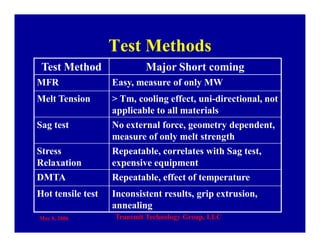
Test Methods
Test Method Major Short coming
MFR Easy, measure of only MW
Melt Tension > Tm, cooling effect, uni-directional, not
applicable to all materials
Sag test No external force, geometry dependent,
measure of only melt strength
Stress
Relaxation
Repeatable, correlates with Sag test,
expensive equipment
DMTA Repeatable, effect of temperature
Hot tensile test Inconsistent results, grip extrusion,
annealing
May 8, 2006 Transmit Technology Group, LLC
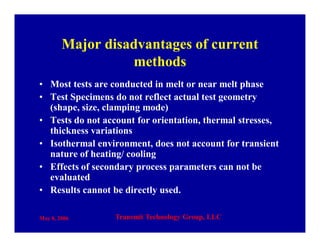
Major disadvantages of current
methods
• Most tests are conducted in melt or near melt phase
• Test Specimens do not reflect actual test geometry
(shape, size, clamping mode)
• Tests do not account for orientation, thermal stresses,
thickness variations
• Isothermal environment, does not account for transient
nature of heating/ cooling
• Effects of secondary process parameters can not be
evaluated
• Results cannot be directly used.
May 8, 2006 Transmit Technology Group, LLC
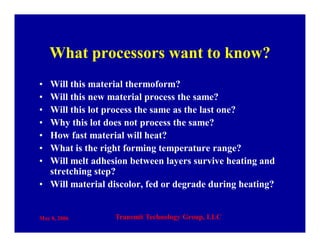
What processors want to know?
• Will this material thermoform?
• Will this new material process the same?
• Will this lot process the same as the last one?
• Why this lot does not process the same?
• How fast material will heat?
• What is the right forming temperature range?
• Will melt adhesion between layers survive heating and
stretching step?
• Will material discolor, fed or degrade during heating?
May 8, 2006 Transmit Technology Group, LLC
What processors want to
know? -II
• What is the maximum draw down?
• How fast part can be made?
• What is the MD and TD shrinkage?
• Will material tear at the corners and ribs?
• How much regrind can I use?
• Will grains retain shape and depth?
• Does extruded sheet have gels or unmelts?
May 8, 2006 Transmit Technology Group, LLC
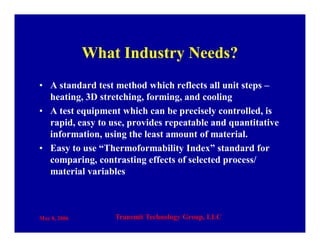
What Industry Needs?
• A standard test method which reflects all unit steps –
heating, 3D stretching, forming, and cooling
• A test equipment which can be precisely controlled, is
rapid, easy to use, provides repeatable and quantitative
information, using the least amount of material.
• Easy to use “Thermoformability Index” standard for
comparing, contrasting effects of selected process/
material variables
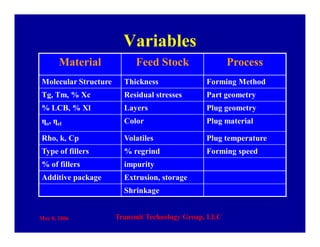
May 8, 2006 Transmit Technology Group, LLC
Variables
Material Feed Stock Process
Molecular Structure Thickness Forming Method
Tg, Tm, % Xc Residual stresses Part geometry
% LCB, % Xl Layers Plug geometry
ηo, ηel Color Plug material
Rho, k, Cp Volatiles Plug temperature
Type of fillers % regrind Forming speed
% of fillers impurity
Additive package Extrusion, storage
Shrinkage
May 8, 2006 Transmit Technology Group, LLC
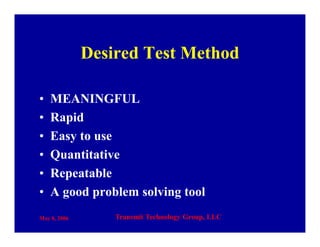
Desired Test Method
• MEANINGFUL
• Rapid
• Easy to use
• Quantitative
• Repeatable
• A good problem solving tool
May 8, 2006 Transmit Technology Group, LLC
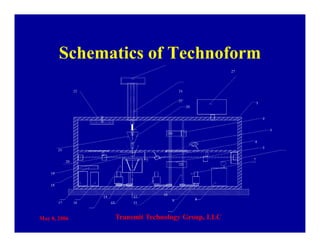
Schematics of Technoform
May 8, 2006 Transmit Technology Group, LLC
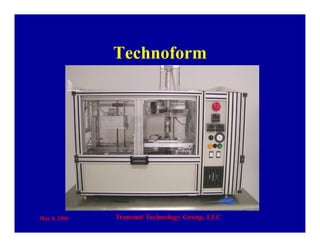
Technoform
May 8, 2006 Transmit Technology Group, LLC
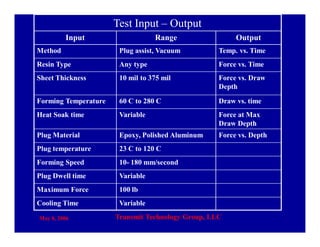
Test Input – Output
Input Range Output
Method Plug assist, Vacuum Temp. vs. Time
Resin Type Any type Force vs. Time
Sheet Thickness 10 mil to 375 mil Force vs. Draw
Depth
Forming Temperature 60 C to 280 C Draw vs. time
Heat Soak time Variable Force at Max
Draw Depth
Plug Material Epoxy, Polished Aluminum Force vs. Depth
Plug temperature 23 C to 120 C
Forming Speed 10- 180 mm/second
Plug Dwell time Variable
Maximum Force 100 lb
Cooling Time Variable
May 8, 2006 Transmit Technology Group, LLC
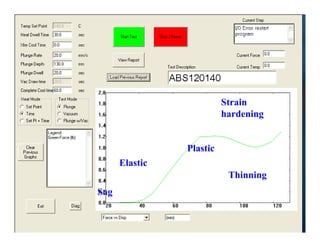
Typical GUI Screen
Sag
Elastic
Plastic
Strain
hardening
Thinning
May 8, 2006 Transmit Technology Group, LLC
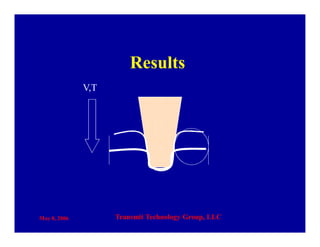
Results
V,T
May 8, 2006 Transmit Technology Group, LLC
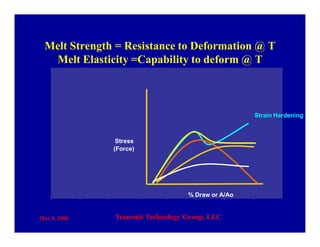
Melt Strength = Resistance to Deformation @ T
Melt Elasticity =Capability to deform @ T
Stress
(Force)
% Draw or A/Ao
Strain Hardening
May 8, 2006 Transmit Technology Group, LLC
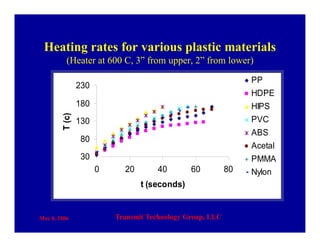
Heating rates for various plastic materials
(Heater at 600 C, 3” from upper, 2” from lower)
30
80
130
180
230
0 20 40 60 80
t (seconds)
T(c)
PP
HDPE
HIPS
PVC
ABS
Acetal
PMMA
Nylon
May 8, 2006 Transmit Technology Group, LLC
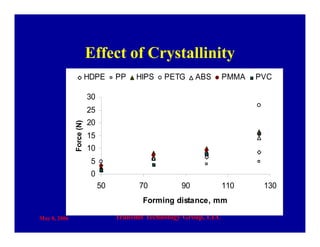
Effect of Crystallinity
0
5
10
15
20
25
30
50 70 90 110 130
Forming distance, mm
Force(N)HDPE PP HIPS PETG ABS PMMA PVC
May 8, 2006 Transmit Technology Group, LLC
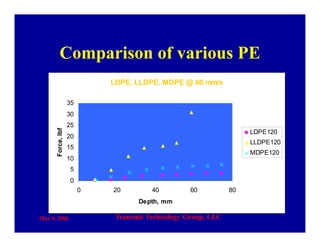
Comparison of various PE
LDPE, LLDPE, MDPE @ 60 mm/s
0
5
10
15
20
25
30
35
0 20 40 60 80
Depth, mm
Force,lbf
LDPE120
LLDPE120
MDPE120
May 8, 2006 Transmit Technology Group, LLC
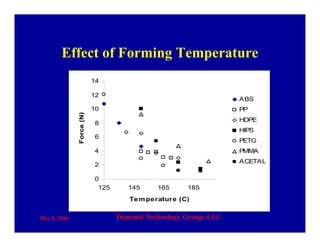
Effect of Forming Temperature
0
2
4
6
8
10
12
14
125 145 165 185
Temperature (C)
Force(N)
ABS
PP
HDPE
HIPS
PETG
PMMA
ACETAL
May 8, 2006 Transmit Technology Group, LLC
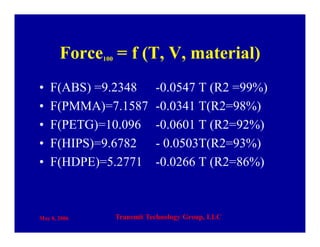
Force100 = f (T, V, material)
• F(ABS) =9.2348 -0.0547 T (R2 =99%)
• F(PMMA)=7.1587 -0.0341 T(R2=98%)
• F(PETG)=10.096 -0.0601 T (R2=92%)
• F(HIPS)=9.6782 - 0.0503T(R2=93%)
• F(HDPE)=5.2771 -0.0266 T (R2=86%)
May 8, 2006 Transmit Technology Group, LLC
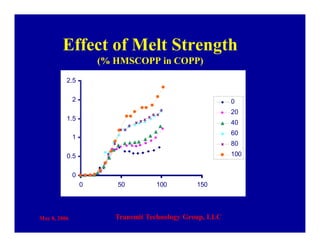
Effect of Melt Strength
(% HMSCOPP in COPP)
0
0.5
1
1.5
2
2.5
0 50 100 150
0
20
40
60
80
100
May 8, 2006 Transmit Technology Group, LLC
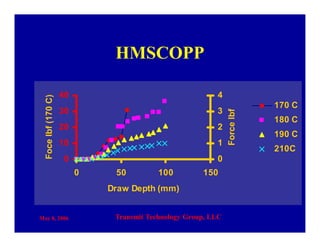
HMSCOPP
0
10
20
30
40
0 50 100 150
Draw Depth (mm)
Focelbf(170C)
0
1
2
3
4
Forcelbf
170 C
180 C
190 C
210C
May 8, 2006 Transmit Technology Group, LLC
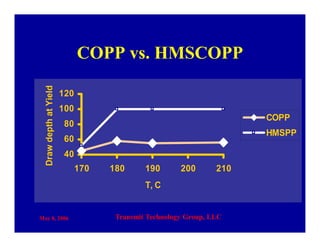
COPP vs. HMSCOPP
40
60
80
100
120
170 180 190 200 210
T, C
DrawdepthatYield
COPP
HMSPP
May 8, 2006 Transmit Technology Group, LLC
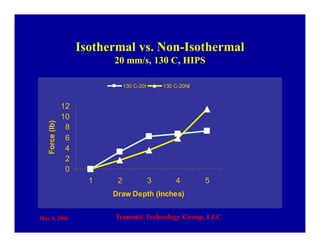
Isothermal vs. Non-Isothermal
20 mm/s, 130 C, HIPS
0
2
4
6
8
10
12
1 2 3 4 5
Draw Depth (Inches)
Force(lb)
130 C-20I 130 C-20NI
May 8, 2006 Transmit Technology Group, LLC
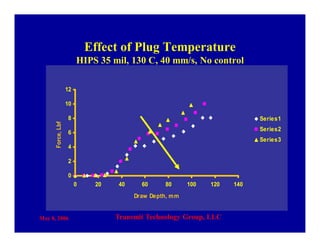
Effect of Plug Temperature
HIPS 35 mil, 130 C, 40 mm/s, No control
0
2
4
6
8
10
12
0 20 40 60 80 100 120 140
Draw Depth, mm
Force,Lbf
Series1
Series2
Series3
May 8, 2006 Transmit Technology Group, LLC
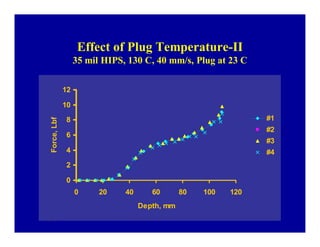
Effect of Plug Temperature-II
35 mil HIPS, 130 C, 40 mm/s, Plug at 23 C
0
2
4
6
8
10
12
0 20 40 60 80 100 120
Depth, mm
Force,Lbf
#1
#2
#3
#4
May 8, 2006 Transmit Technology Group, LLC
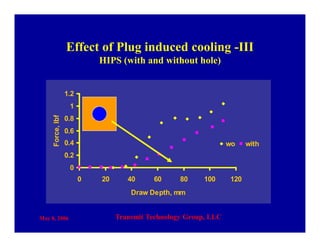
Effect of Plug induced cooling -III
HIPS (with and without hole)
0
0.2
0.4
0.6
0.8
1
1.2
0 20 40 60 80 100 120
Draw Depth, mm
Force,lbf
wo with
May 8, 2006 Transmit Technology Group, LLC
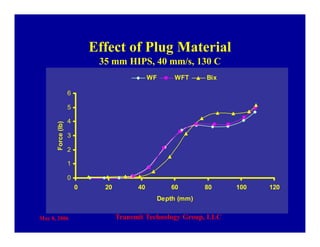
Effect of Plug Material
35 mm HIPS, 40 mm/s, 130 C
0
1
2
3
4
5
6
0 20 40 60 80 100 120
Depth (mm)
Force(lb)
WF WFT Bix
May 8, 2006 Transmit Technology Group, LLC
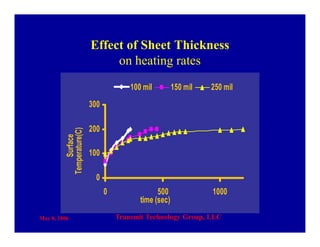
Effect of Sheet Thickness
on heating rates
0
100
200
300
0 500 1000
time (sec)
Surface
Temperature(C)
100 mil 150 mil 250 mil
May 8, 2006 Transmit Technology Group, LLC
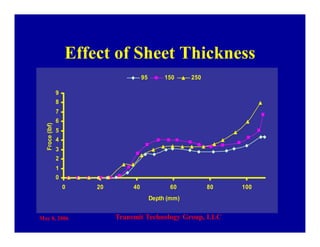
Effect of Sheet Thickness
0
1
2
3
4
5
6
7
8
9
0 20 40 60 80 100
Depth (mm)
Froce(lbf)
95 150 250
May 8, 2006 Transmit Technology Group, LLC
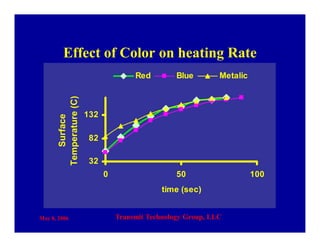
Effect of Color on heating Rate
32
82
132
0 50 100
time (sec)
Surface
Temperature(C) Red Blue Metalic
May 8, 2006 Transmit Technology Group, LLC
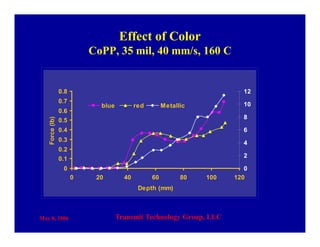
Effect of Color
CoPP, 35 mil, 40 mm/s, 160 C
0
0.1
0.2
0.3
0.4
0.5
0.6
0.7
0.8
0 20 40 60 80 100 120
Depth (mm)
Force(lb)
0
2
4
6
8
10
12
blue red Metallic
May 8, 2006 Transmit Technology Group, LLC
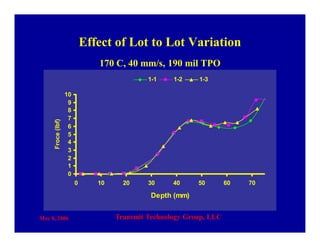
Effect of Lot to Lot Variation
170 C, 40 mm/s, 190 mil TPO
0
1
2
3
4
5
6
7
8
9
10
0 10 20 30 40 50 60 70
Depth (mm)
Froce(lbf)
1-1 1-2 1-3
May 8, 2006 Transmit Technology Group, LLC
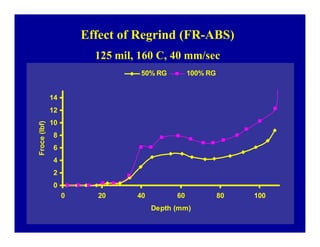
Effect of Regrind (FR-ABS)
125 mil, 160 C, 40 mm/sec
0
2
4
6
8
10
12
14
0 20 40 60 80 100
Depth (mm)
Froce(lbf)
50% RG 100% RG
May 8, 2006 Transmit Technology Group, LLC
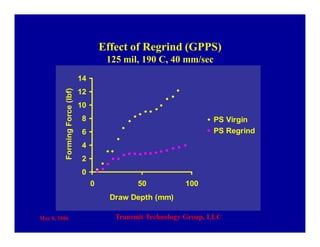
Effect of Regrind (GPPS)
125 mil, 190 C, 40 mm/sec
0
2
4
6
8
10
12
14
0 50 100
Draw Depth (mm)
FormingForce(lbf)
PS Virgin
PS Regrind
May 8, 2006 Transmit Technology Group, LLC
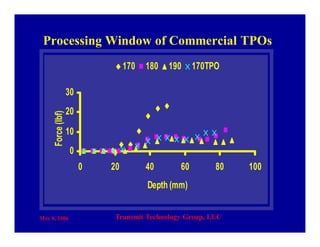
Processing Window of Commercial TPOs
0
10
20
30
0 20 40 60 80 100
Depth (mm)
Force(lbf)
170 180 190 170TPO
May 8, 2006 Transmit Technology Group, LLC
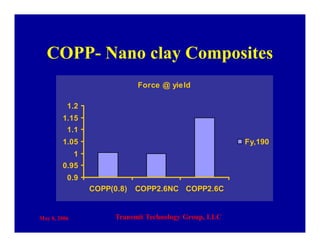
COPP- Nano clay Composites
Force @ yield
0.9
0.95
1
1.05
1.1
1.15
1.2
COPP(0.8) COPP2.6NC COPP2.6C
Fy,190
May 8, 2006 Transmit Technology Group, LLC
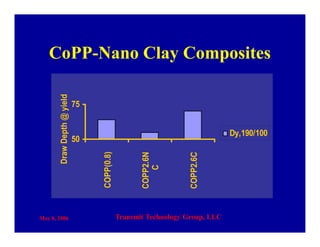
CoPP-Nano Clay Composites
50
75 COPP(0.8)
COPP2.6N
C
COPP2.6C
DrawDepth@yield
Dy,190/100
May 8, 2006 Transmit Technology Group, LLC
How to Standardize?
• Thermoforming Index (TFI)
– Force required to draw a sheet of thickness X at
speed Y mm/second using a Plug of specified
geometry G at Temperature Tf to area ratio A
(or volume ratio V), with plug temperature Tp.
• TFI = [Force (M, Tm)/ Force (GPPS, Ts)]
May 8, 2006 Transmit Technology Group, LLC
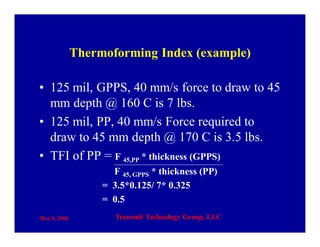
Thermoforming Index (example)
• 125 mil, GPPS, 40 mm/s force to draw to 45
mm depth @ 160 C is 7 lbs.
• 125 mil, PP, 40 mm/s Force required to
draw to 45 mm depth @ 170 C is 3.5 lbs.
• TFI of PP = F 45,PP * thickness (GPPS)
F 45, GPPS * thickness (PP)
= 3.5*0.125/ 7* 0.325
= 0.5
May 8, 2006 Transmit Technology Group, LLC
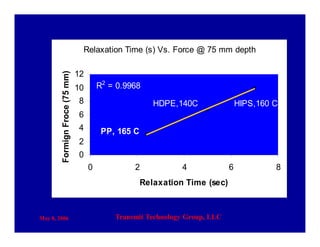
Relaxation Time (s) Vs. Force @ 75 mm depth
R2
= 0.9968
0
2
4
6
8
10
12
0 2 4 6 8
Relaxation Time (sec)
FormignFroce(75mm)
PP, 165 C
HDPE,140C HIPS,160 C
May 8, 2006 Transmit Technology Group, LLC
Conclusions
• Easy and rapid test method with overall operation
similar to actual Thermoforming process
• Economical vs. Field trials
• Test equipment and method can be applied to wide
range of Industrial applications
• TFI offers one simple number (like MFI)
representing material’s Thermoformability
• Test equipment and method can be applied to wide
range of Industrial applications

SPE Aug15

  • 1.
    May 8, 2006Transmit Technology Group, LLC Applications of Thermoformability Analyzer Amit Dharia Transmit Technology Group, LLC Irving, Texas
  • 2.
    May 8, 2006Transmit Technology Group, LLC Objectives • To demonstrate the need for an industry wide standard Quantitative test method for “Measuring” and “Reporting” Thermoformability of plastic materials (2005) • To illustrate applications of test equipment and test method in understanding and resolving issues related to Thermoformability.
  • 3.
    May 8, 2006Transmit Technology Group, LLC Outline • Structure-Property- Process relationship • Current test methods • Description of Technoform • Application and data interpretation • Products – Basic, Standard, Advanced • Conclusion
  • 4.
    May 8, 2006Transmit Technology Group, LLC Thermoforming Process • Extruding sheet stock • Heating sheet above Tg • Stretching heated sheet in rubbery state • Cooling • Trimming • Finishing • Regrinding and recycling scrape
  • 5.
    May 8, 2006Transmit Technology Group, LLC Structure - Properties - Thermoformability • Rate of change of strength with the change in strain rate at forming temperature • % Crystallinity – Breadth of rubbery Plateau • Molecular weight, Molecular weight distribution, molecular architecture (branching, crosslinking) – MFR, Melt Elasticity, Rheology
  • 6.
    May 8, 2006Transmit Technology Group, LLC Other parameters • Density - % filler, type of fillers, degassing • Geometry – Thickness, area, multi-layered structures, adhesion between layers • Residual stresses between and within in extruded layer sheet stock • Thermal diffusivity (Cp, K. Rho) • Extrusion quality ( gels, unmelts, thickness variation, grain patterns) • Color (IR absorption)
  • 7.
    May 8, 2006Transmit Technology Group, LLC Test Methods Test Method Major Short coming MFR Easy, measure of only MW Melt Tension > Tm, cooling effect, uni-directional, not applicable to all materials Sag test No external force, geometry dependent, measure of only melt strength Stress Relaxation Repeatable, correlates with Sag test, expensive equipment DMTA Repeatable, effect of temperature Hot tensile test Inconsistent results, grip extrusion, annealing
  • 8.
    May 8, 2006Transmit Technology Group, LLC Major disadvantages of current methods • Most tests are conducted in melt or near melt phase • Test Specimens do not reflect actual test geometry (shape, size, clamping mode) • Tests do not account for orientation, thermal stresses, thickness variations • Isothermal environment, does not account for transient nature of heating/ cooling • Effects of secondary process parameters can not be evaluated • Results cannot be directly used.
  • 9.
    May 8, 2006Transmit Technology Group, LLC What processors want to know? • Will this material thermoform? • Will this new material process the same? • Will this lot process the same as the last one? • Why this lot does not process the same? • How fast material will heat? • What is the right forming temperature range? • Will melt adhesion between layers survive heating and stretching step? • Will material discolor, fed or degrade during heating?
  • 10.
    May 8, 2006Transmit Technology Group, LLC What processors want to know? -II • What is the maximum draw down? • How fast part can be made? • What is the MD and TD shrinkage? • Will material tear at the corners and ribs? • How much regrind can I use? • Will grains retain shape and depth? • Does extruded sheet have gels or unmelts?
  • 11.
    May 8, 2006Transmit Technology Group, LLC What Industry Needs? • A standard test method which reflects all unit steps – heating, 3D stretching, forming, and cooling • A test equipment which can be precisely controlled, is rapid, easy to use, provides repeatable and quantitative information, using the least amount of material. • Easy to use “Thermoformability Index” standard for comparing, contrasting effects of selected process/ material variables
  • 12.
    May 8, 2006Transmit Technology Group, LLC Variables Material Feed Stock Process Molecular Structure Thickness Forming Method Tg, Tm, % Xc Residual stresses Part geometry % LCB, % Xl Layers Plug geometry ηo, ηel Color Plug material Rho, k, Cp Volatiles Plug temperature Type of fillers % regrind Forming speed % of fillers impurity Additive package Extrusion, storage Shrinkage
  • 13.
    May 8, 2006Transmit Technology Group, LLC Desired Test Method • MEANINGFUL • Rapid • Easy to use • Quantitative • Repeatable • A good problem solving tool
  • 14.
    May 8, 2006Transmit Technology Group, LLC Schematics of Technoform
  • 15.
    May 8, 2006Transmit Technology Group, LLC Technoform
  • 16.
    May 8, 2006Transmit Technology Group, LLC Test Input – Output Input Range Output Method Plug assist, Vacuum Temp. vs. Time Resin Type Any type Force vs. Time Sheet Thickness 10 mil to 375 mil Force vs. Draw Depth Forming Temperature 60 C to 280 C Draw vs. time Heat Soak time Variable Force at Max Draw Depth Plug Material Epoxy, Polished Aluminum Force vs. Depth Plug temperature 23 C to 120 C Forming Speed 10- 180 mm/second Plug Dwell time Variable Maximum Force 100 lb Cooling Time Variable
  • 17.
    May 8, 2006Transmit Technology Group, LLC Typical GUI Screen Sag Elastic Plastic Strain hardening Thinning
  • 18.
    May 8, 2006Transmit Technology Group, LLC Results V,T
  • 19.
    May 8, 2006Transmit Technology Group, LLC Melt Strength = Resistance to Deformation @ T Melt Elasticity =Capability to deform @ T Stress (Force) % Draw or A/Ao Strain Hardening
  • 20.
    May 8, 2006Transmit Technology Group, LLC Heating rates for various plastic materials (Heater at 600 C, 3” from upper, 2” from lower) 30 80 130 180 230 0 20 40 60 80 t (seconds) T(c) PP HDPE HIPS PVC ABS Acetal PMMA Nylon
  • 21.
    May 8, 2006Transmit Technology Group, LLC Effect of Crystallinity 0 5 10 15 20 25 30 50 70 90 110 130 Forming distance, mm Force(N)HDPE PP HIPS PETG ABS PMMA PVC
  • 22.
    May 8, 2006Transmit Technology Group, LLC Comparison of various PE LDPE, LLDPE, MDPE @ 60 mm/s 0 5 10 15 20 25 30 35 0 20 40 60 80 Depth, mm Force,lbf LDPE120 LLDPE120 MDPE120
  • 23.
    May 8, 2006Transmit Technology Group, LLC Effect of Forming Temperature 0 2 4 6 8 10 12 14 125 145 165 185 Temperature (C) Force(N) ABS PP HDPE HIPS PETG PMMA ACETAL
  • 24.
    May 8, 2006Transmit Technology Group, LLC Force100 = f (T, V, material) • F(ABS) =9.2348 -0.0547 T (R2 =99%) • F(PMMA)=7.1587 -0.0341 T(R2=98%) • F(PETG)=10.096 -0.0601 T (R2=92%) • F(HIPS)=9.6782 - 0.0503T(R2=93%) • F(HDPE)=5.2771 -0.0266 T (R2=86%)
  • 25.
    May 8, 2006Transmit Technology Group, LLC Effect of Melt Strength (% HMSCOPP in COPP) 0 0.5 1 1.5 2 2.5 0 50 100 150 0 20 40 60 80 100
  • 26.
    May 8, 2006Transmit Technology Group, LLC HMSCOPP 0 10 20 30 40 0 50 100 150 Draw Depth (mm) Focelbf(170C) 0 1 2 3 4 Forcelbf 170 C 180 C 190 C 210C
  • 27.
    May 8, 2006Transmit Technology Group, LLC COPP vs. HMSCOPP 40 60 80 100 120 170 180 190 200 210 T, C DrawdepthatYield COPP HMSPP
  • 28.
    May 8, 2006Transmit Technology Group, LLC Isothermal vs. Non-Isothermal 20 mm/s, 130 C, HIPS 0 2 4 6 8 10 12 1 2 3 4 5 Draw Depth (Inches) Force(lb) 130 C-20I 130 C-20NI
  • 29.
    May 8, 2006Transmit Technology Group, LLC Effect of Plug Temperature HIPS 35 mil, 130 C, 40 mm/s, No control 0 2 4 6 8 10 12 0 20 40 60 80 100 120 140 Draw Depth, mm Force,Lbf Series1 Series2 Series3
  • 30.
    May 8, 2006Transmit Technology Group, LLC Effect of Plug Temperature-II 35 mil HIPS, 130 C, 40 mm/s, Plug at 23 C 0 2 4 6 8 10 12 0 20 40 60 80 100 120 Depth, mm Force,Lbf #1 #2 #3 #4
  • 31.
    May 8, 2006Transmit Technology Group, LLC Effect of Plug induced cooling -III HIPS (with and without hole) 0 0.2 0.4 0.6 0.8 1 1.2 0 20 40 60 80 100 120 Draw Depth, mm Force,lbf wo with
  • 32.
    May 8, 2006Transmit Technology Group, LLC Effect of Plug Material 35 mm HIPS, 40 mm/s, 130 C 0 1 2 3 4 5 6 0 20 40 60 80 100 120 Depth (mm) Force(lb) WF WFT Bix
  • 33.
    May 8, 2006Transmit Technology Group, LLC Effect of Sheet Thickness on heating rates 0 100 200 300 0 500 1000 time (sec) Surface Temperature(C) 100 mil 150 mil 250 mil
  • 34.
    May 8, 2006Transmit Technology Group, LLC Effect of Sheet Thickness 0 1 2 3 4 5 6 7 8 9 0 20 40 60 80 100 Depth (mm) Froce(lbf) 95 150 250
  • 35.
    May 8, 2006Transmit Technology Group, LLC Effect of Color on heating Rate 32 82 132 0 50 100 time (sec) Surface Temperature(C) Red Blue Metalic
  • 36.
    May 8, 2006Transmit Technology Group, LLC Effect of Color CoPP, 35 mil, 40 mm/s, 160 C 0 0.1 0.2 0.3 0.4 0.5 0.6 0.7 0.8 0 20 40 60 80 100 120 Depth (mm) Force(lb) 0 2 4 6 8 10 12 blue red Metallic
  • 37.
    May 8, 2006Transmit Technology Group, LLC Effect of Lot to Lot Variation 170 C, 40 mm/s, 190 mil TPO 0 1 2 3 4 5 6 7 8 9 10 0 10 20 30 40 50 60 70 Depth (mm) Froce(lbf) 1-1 1-2 1-3
  • 38.
    May 8, 2006Transmit Technology Group, LLC Effect of Regrind (FR-ABS) 125 mil, 160 C, 40 mm/sec 0 2 4 6 8 10 12 14 0 20 40 60 80 100 Depth (mm) Froce(lbf) 50% RG 100% RG
  • 39.
    May 8, 2006Transmit Technology Group, LLC Effect of Regrind (GPPS) 125 mil, 190 C, 40 mm/sec 0 2 4 6 8 10 12 14 0 50 100 Draw Depth (mm) FormingForce(lbf) PS Virgin PS Regrind
  • 40.
    May 8, 2006Transmit Technology Group, LLC Processing Window of Commercial TPOs 0 10 20 30 0 20 40 60 80 100 Depth (mm) Force(lbf) 170 180 190 170TPO
  • 41.
    May 8, 2006Transmit Technology Group, LLC COPP- Nano clay Composites Force @ yield 0.9 0.95 1 1.05 1.1 1.15 1.2 COPP(0.8) COPP2.6NC COPP2.6C Fy,190
  • 42.
    May 8, 2006Transmit Technology Group, LLC CoPP-Nano Clay Composites 50 75 COPP(0.8) COPP2.6N C COPP2.6C DrawDepth@yield Dy,190/100
  • 43.
    May 8, 2006Transmit Technology Group, LLC How to Standardize? • Thermoforming Index (TFI) – Force required to draw a sheet of thickness X at speed Y mm/second using a Plug of specified geometry G at Temperature Tf to area ratio A (or volume ratio V), with plug temperature Tp. • TFI = [Force (M, Tm)/ Force (GPPS, Ts)]
  • 44.
    May 8, 2006Transmit Technology Group, LLC Thermoforming Index (example) • 125 mil, GPPS, 40 mm/s force to draw to 45 mm depth @ 160 C is 7 lbs. • 125 mil, PP, 40 mm/s Force required to draw to 45 mm depth @ 170 C is 3.5 lbs. • TFI of PP = F 45,PP * thickness (GPPS) F 45, GPPS * thickness (PP) = 3.5*0.125/ 7* 0.325 = 0.5
  • 45.
    May 8, 2006Transmit Technology Group, LLC Relaxation Time (s) Vs. Force @ 75 mm depth R2 = 0.9968 0 2 4 6 8 10 12 0 2 4 6 8 Relaxation Time (sec) FormignFroce(75mm) PP, 165 C HDPE,140C HIPS,160 C
  • 46.
    May 8, 2006Transmit Technology Group, LLC Conclusions • Easy and rapid test method with overall operation similar to actual Thermoforming process • Economical vs. Field trials • Test equipment and method can be applied to wide range of Industrial applications • TFI offers one simple number (like MFI) representing material’s Thermoformability • Test equipment and method can be applied to wide range of Industrial applications