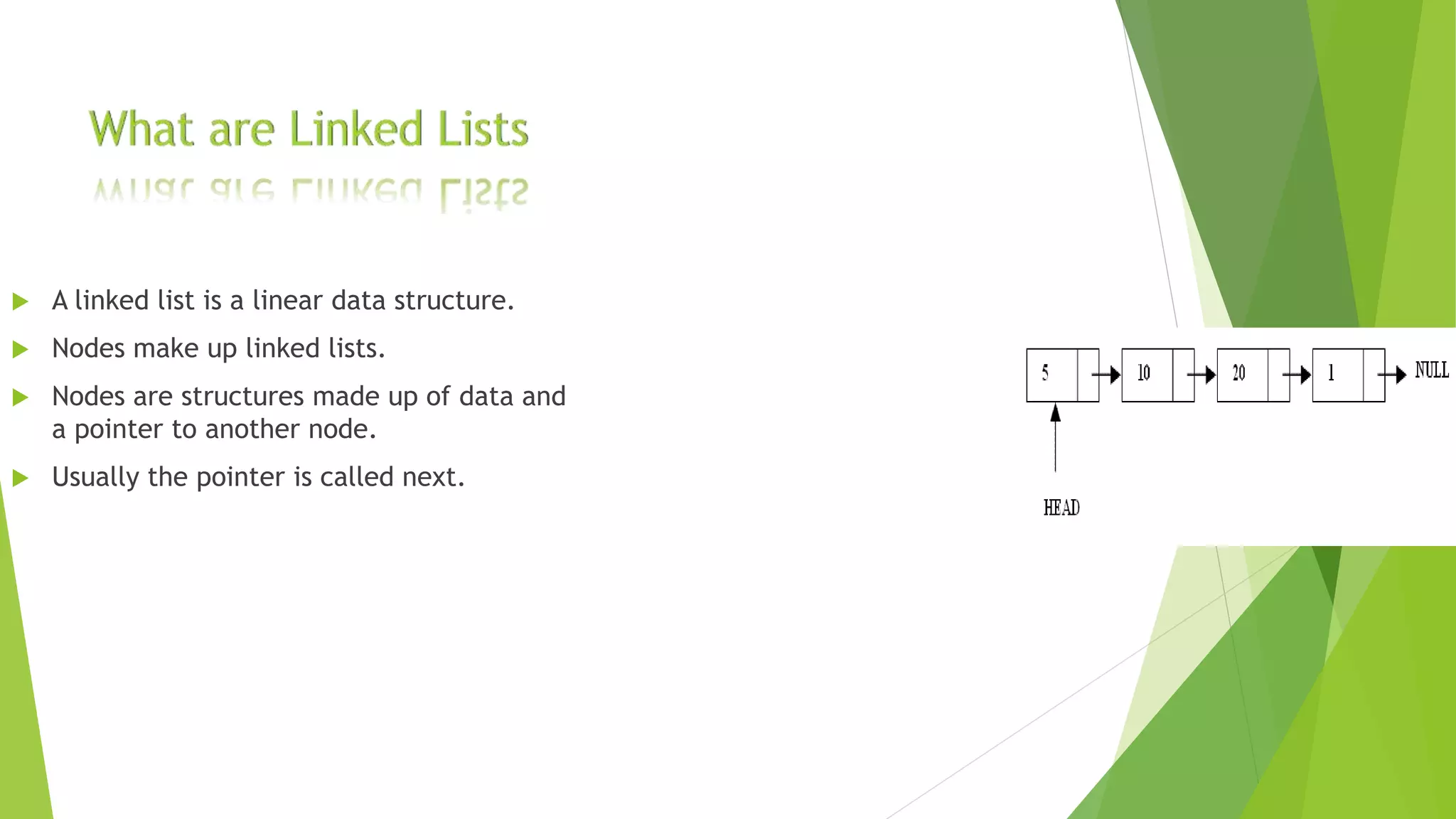
 A linked list is a linear data structure.
 Nodes make up linked lists.
 Nodes are structures made up of data and
a pointer to another node.
 Usually the pointer is called next.
Arrays Vs Linked Lists
Arrays Linked list
Fixed size: Resizing is expensive Dynamic size
Insertions and Deletions are inefficient:
Elements are usually shifted
Insertions and Deletions are efficient: No
shifting
Random access i.e., efficient indexing No random access
 Not suitable for operations requiring
accessing elements by index such as sorting
No memory waste if the array is full or almost
full; otherwise may result in much memory
waste.
Since memory is allocated dynamically(acc. to
our need) there is no waste of memory.
Sequential access is faster [Reason: Elements in
contiguous memory locations]
Sequential access is slow [Reason: Elements not
in contiguous memory locations]
Singly Linked List
 Each node has only one link part
 Each link part contains the address of the next node in the list
 Link part of the last node contains NULL value which signifies the end of
the node
Schematic representation
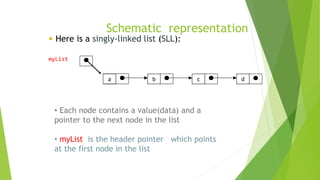
 Here is a singly-linked list (SLL):
a b c d
myList
• Each node contains a value(data) and a
pointer to the next node in the list
• myList is the header pointer which points
at the first node in the list
Basic Operations on a list
• Creating a List
• Inserting an element in a list
• Deleting an element from a list
• Searching a list
• Reversing a list
Inserting the node in a SLL
There are 3 cases here:-
Insertion at the beginning
Insertion at the end
Insertion after a particular node
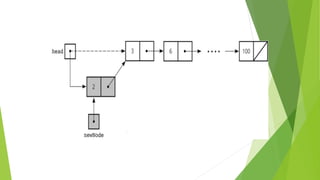
Insertion at the beginning
There are two steps to be followed:-
a) Make the next pointer of the node point towards the first node of the
list
b) Make the start pointer point towards this new node
 If the list is empty simply make the start pointer point towards the new
node;
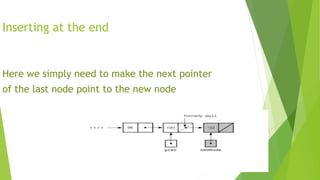
Inserting at the end
Here we simply need to make the next pointer
of the last node point to the new node
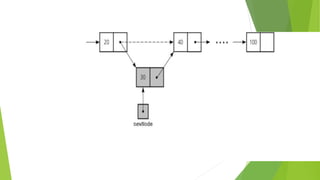
Inserting after an element
Here we again need to do 2 steps :-
 Make the next pointer of the node to be
inserted point to the next node of the node
after which you want to insert the node
 Make the next pointer of the node after which
the node is to be inserted, point to the node to
be inserted
Inserting after an element at end
algorithm :-
 STEP-1: new=getnode
 STEP-2: temp=first
 STEP-3: while(temp->next)!=NULL
 STEP-4: temp=temp->next
 STEP-5: end while
 STEP-6: temp->next=new
 STEP-7: temp=new
 STEP-8: stop
Deleting a node in SLL
Here also we have three cases:-
 Deleting the first node
 Deleting the last node
 Deleting the intermediate node
Deleting the first node
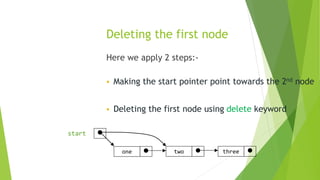
Here we apply 2 steps:-
 Making the start pointer point towards the 2nd node
 Deleting the first node using delete keyword
threetwoone
start
Deleting the last node
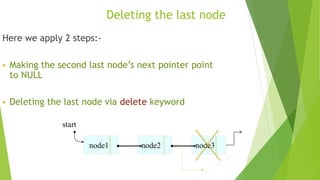
Here we apply 2 steps:-
 Making the second last node’s next pointer point
to NULL
 Deleting the last node via delete keyword
node3node2node1
start
Deleting a particular node
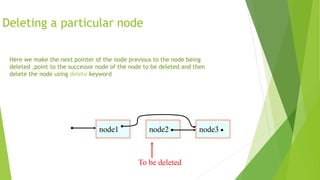
Here we make the next pointer of the node previous to the node being
deleted ,point to the successor node of the node to be deleted and then
delete the node using delete keyword
node1 node2 node3
To be deleted
Searching a SLL
 Searching involves finding the required element in the list
 We can use various techniques of searching like linear search or binary
search where binary search is more efficient in case of Arrays
 But in case of linked list since random access is not available it would
become complex to do binary search in it
 We can perform simple linear search traversal
Reversing a linked list
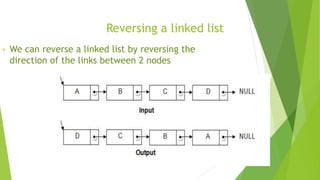
• We can reverse a linked list by reversing the
direction of the links between 2 nodes
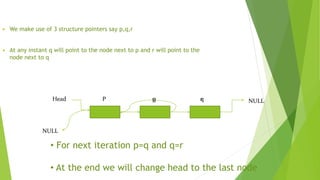
 We make use of 3 structure pointers say p,q,r
 At any instant q will point to the node next to p and r will point to the
node next to q
NULLHead P q r
NULL
• For next iteration p=q and q=r
• At the end we will change head to the last node
p q

linked list using c

  • 1.
     A linkedlist is a linear data structure.  Nodes make up linked lists.  Nodes are structures made up of data and a pointer to another node.  Usually the pointer is called next.
  • 2.
    Arrays Vs LinkedLists Arrays Linked list Fixed size: Resizing is expensive Dynamic size Insertions and Deletions are inefficient: Elements are usually shifted Insertions and Deletions are efficient: No shifting Random access i.e., efficient indexing No random access  Not suitable for operations requiring accessing elements by index such as sorting No memory waste if the array is full or almost full; otherwise may result in much memory waste. Since memory is allocated dynamically(acc. to our need) there is no waste of memory. Sequential access is faster [Reason: Elements in contiguous memory locations] Sequential access is slow [Reason: Elements not in contiguous memory locations]
  • 3.
    Singly Linked List Each node has only one link part  Each link part contains the address of the next node in the list  Link part of the last node contains NULL value which signifies the end of the node
  • 4.
    Schematic representation  Hereis a singly-linked list (SLL): a b c d myList • Each node contains a value(data) and a pointer to the next node in the list • myList is the header pointer which points at the first node in the list
  • 5.
    Basic Operations ona list • Creating a List • Inserting an element in a list • Deleting an element from a list • Searching a list • Reversing a list
  • 6.
    Inserting the nodein a SLL There are 3 cases here:- Insertion at the beginning Insertion at the end Insertion after a particular node
  • 7.
    Insertion at thebeginning There are two steps to be followed:- a) Make the next pointer of the node point towards the first node of the list b) Make the start pointer point towards this new node  If the list is empty simply make the start pointer point towards the new node;
  • 10.
    Inserting at theend Here we simply need to make the next pointer of the last node point to the new node
  • 11.
    Inserting after anelement Here we again need to do 2 steps :-  Make the next pointer of the node to be inserted point to the next node of the node after which you want to insert the node  Make the next pointer of the node after which the node is to be inserted, point to the node to be inserted
  • 12.
    Inserting after anelement at end algorithm :-  STEP-1: new=getnode  STEP-2: temp=first  STEP-3: while(temp->next)!=NULL  STEP-4: temp=temp->next  STEP-5: end while  STEP-6: temp->next=new  STEP-7: temp=new  STEP-8: stop
  • 14.
    Deleting a nodein SLL Here also we have three cases:-  Deleting the first node  Deleting the last node  Deleting the intermediate node
  • 15.
    Deleting the firstnode Here we apply 2 steps:-  Making the start pointer point towards the 2nd node  Deleting the first node using delete keyword threetwoone start
  • 16.
    Deleting the lastnode Here we apply 2 steps:-  Making the second last node’s next pointer point to NULL  Deleting the last node via delete keyword node3node2node1 start
  • 17.
    Deleting a particularnode Here we make the next pointer of the node previous to the node being deleted ,point to the successor node of the node to be deleted and then delete the node using delete keyword node1 node2 node3 To be deleted
  • 18.
    Searching a SLL Searching involves finding the required element in the list  We can use various techniques of searching like linear search or binary search where binary search is more efficient in case of Arrays  But in case of linked list since random access is not available it would become complex to do binary search in it  We can perform simple linear search traversal
  • 19.
    Reversing a linkedlist • We can reverse a linked list by reversing the direction of the links between 2 nodes
  • 20.
     We makeuse of 3 structure pointers say p,q,r  At any instant q will point to the node next to p and r will point to the node next to q NULLHead P q r NULL • For next iteration p=q and q=r • At the end we will change head to the last node p q