DATA STRUCTURE
Linked list
p
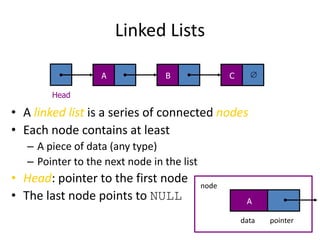
Linked Lists
• A linked list is a series of connected nodes
• Each node contains at least
– A piece of data (any type)
– Pointer to the next node in the list
• Head: pointer to the first node
• The last node points to NULL
A 
Head
B C
A
data pointer
node
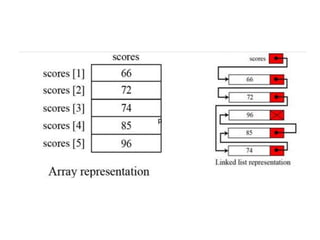
Arrays Vs Linked Lists
Arrays Linked list
Fixed size: Resizing is expensive Dynamic size
Insertions and Deletions are inefficient:
Elements are usually shifted
Insertions and Deletions are efficient: No
shifting
Random access i.e., efficient indexing No random access
 Not suitable for operations requiring
accessing elements by index such as sorting
No memory waste if the array is full or almost
full; otherwise may result in much memory
waste.
Since memory is allocated dynamically(acc. to
our need) there is no waste of memory.
Sequential access is faster [Reason: Elements in
contiguous memory locations]
Sequential access is slow [Reason: Elements not
in contiguous memory locations]
List Overview
• Linked lists
– Abstract data type (ADT)
• Basic operations of linked lists
– Insert, find, delete, print, etc.
• Variations of linked lists
– Circular linked lists
– Doubly linked lists
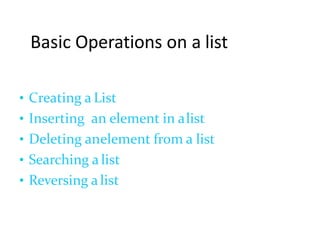
Basic Operations on a list
• Creating a List
• Inserting an element in alist
• Deleting anelement from a list
• Searching a list
• Reversing alist
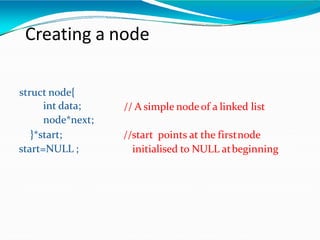
Creating a node
// A simple nodeof a linked list
struct node{
int data;
node*next;
}*start;
start=NULL ;
//start points at the firstnode
initialised to NULL atbeginning
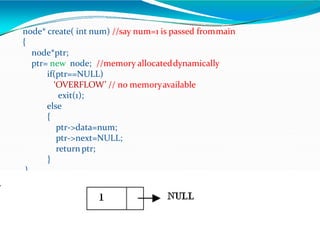
node* create( int num) //say num=1 is passed frommain
{
node*ptr;
ptr= new node; //memory allocateddynamically
if(ptr==NULL)
‘OVERFLOW’ // no memoryavailable
exit(1);
else
{
ptr->data=num;
ptr->next=NULL;
return ptr;
}
}
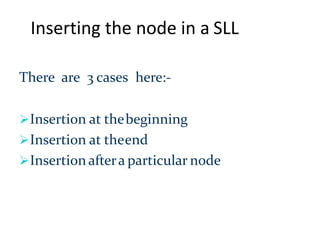
Inserting the node in a SLL
There are 3 cases here:-
Insertion at thebeginning
Insertion at theend
Insertion aftera particular node
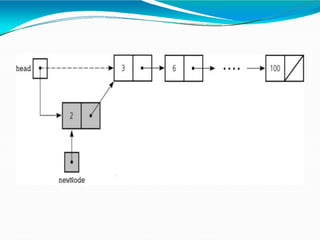
//if the list isempty
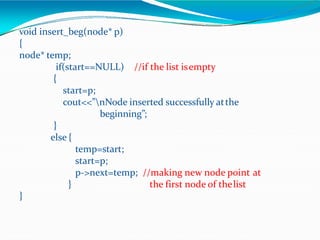
void insert_beg(node* p)
{
node* temp;
if(start==NULL)
{
start=p;
cout<<”nNode inserted successfully atthe
beginning”;
}
else {
}
temp=start;
start=p;
p->next=temp; //making new node point at
the first node of thelist
}
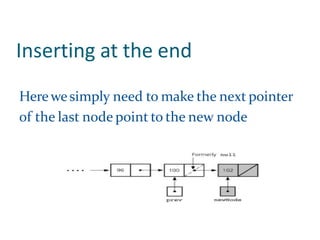
Inserting at the end
Herewesimply need to make the next pointer
of the last node point to the new node
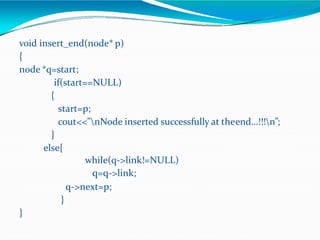
void insert_end(node* p)
{
node *q=start;
if(start==NULL)
{
start=p;
cout<<”nNode inserted successfully at theend…!!!n”;
}
else{
while(q->link!=NULL)
q=q->link;
q->next=p;
}
}
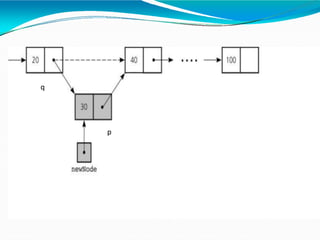
p
q
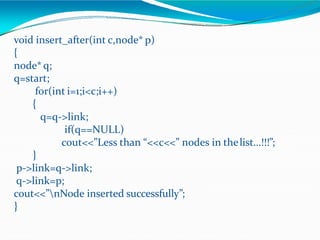
void insert_after(int c,node* p)
{
node* q;
q=start;
for(int i=1;i<c;i++)
{
q=q->link;
if(q==NULL)
cout<<”Less than “<<c<<” nodes in thelist…!!!”;
}
p->link=q->link;
q->link=p;
cout<<”nNode inserted successfully”;
}
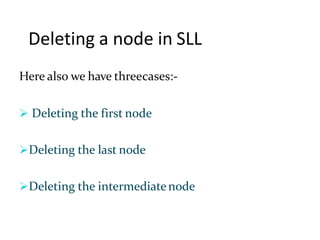
Deleting a node in SLL
Here also we have threecases:-
 Deleting the first node
Deleting the last node
Deleting the intermediatenode
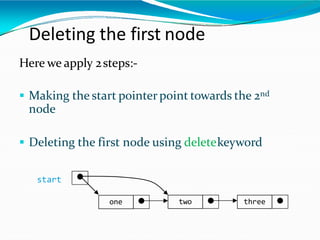
Deleting the first node
threetwoone
Here we apply 2steps:-
 Making the start pointerpoint towards the 2nd
node
 Deleting the first node using deletekeyword
start
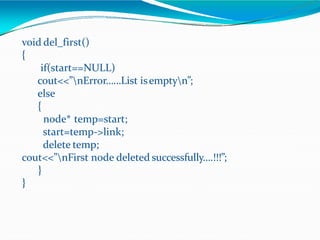
void del_first()
{
if(start==NULL)
cout<<”nError……List isemptyn”;
else
{
node* temp=start;
start=temp->link;
delete temp;
cout<<”nFirst node deleted successfully….!!!”;
}
}
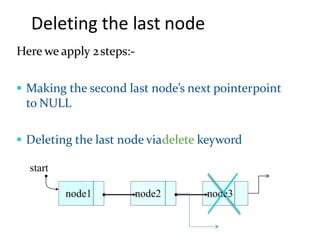
Deleting the last node
node3node2node1
Here we apply 2steps:-
 Making the second last node’s next pointerpoint
to NULL
 Deleting the last node viadelete keyword
start
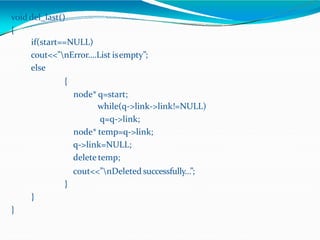
void del_last()
{
if(start==NULL)
cout<<”nError….List isempty”;
else
{
node* q=start;
while(q->link->link!=NULL)
q=q->link;
node* temp=q->link;
q->link=NULL;
delete temp;
cout<<”nDeleted successfully…”;
}
}
}
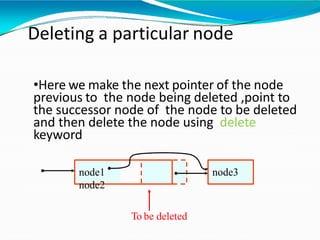
Deleting a particular node
•Here we make the next pointer of the node
previous to the node being deleted ,point to
the successor node of the node to be deleted
and then delete the node using delete
keyword
node1
node2
node3
To be deleted
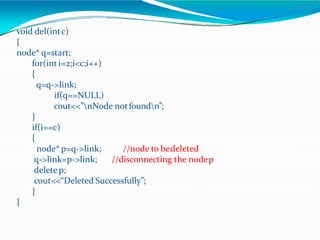
void del(intc)
{
node* q=start;
for(int i=2;i<c;i++)
{
q=q->link;
if(q==NULL)
cout<<”nNode notfoundn”;
}
if(i==c)
{
//node to bedeleted
//disconnecting the nodep
node* p=q->link;
q->link=p->link;
deletep;
cout<<“Deleted Successfully”;
}
}
Searching a SLL
 Searching involves finding the required element inthe
list
 Wecan usevarious techniquesof searching like linear
search or binary search where binary search is more
efficient in case ofArrays
 But in case of linked list since random access is not
available itwould becomecomplex todo binary search
in it
 Wecan perform simple linearsearch traversal
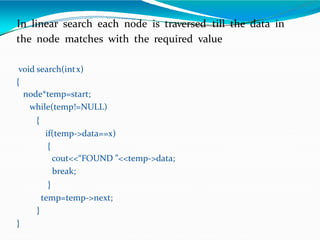
In linear search each node is traversed till the data in
the node matches with the required value
void search(intx)
{
node*temp=start;
while(temp!=NULL)
{
if(temp->data==x)
{
cout<<“FOUND ”<<temp->data;
break;
}
temp=temp->next;
}
}
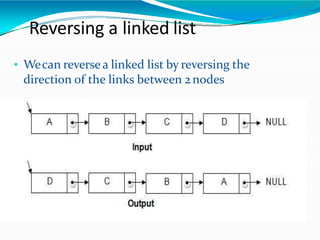
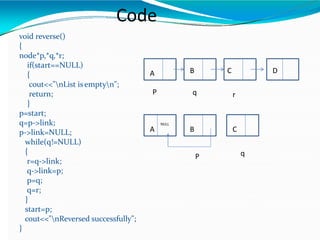
Reversing a linked list
• Wecan reverse a linked list by reversing the
direction of the links between 2nodes
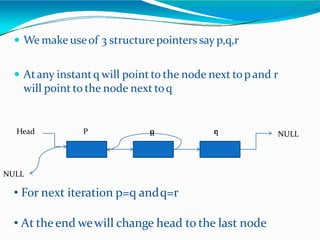
 We make useof 3 structurepointers say p,q,r
 Atany instantq will point to the node next topand r
will point to the node next toq
NULLHead P
NULL
• For next iteration p=q andq=r
• At the end wewill change head to the last node
qp rq
AAA Code
void reverse()
{
node*p,*q,*r;
if(start==NULL)
{
cout<<"nList isemptyn";
return;
}
p=start;
q=p->link;
p->link=NULL;
while(q!=NULL)
{
r=q->link;
q->link=p;
p=q;
q=r;
}
start=p;
cout<<"nReversed successfully";
}
A B C D
P q r
A B C
NULL
P q
Doubly Linked List
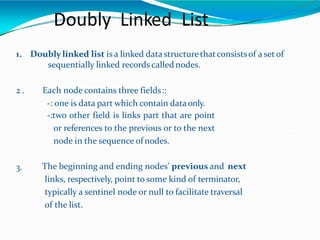
1. Doubly linked list is a linked data structurethatconsistsof a set of
sequentially linked records callednodes.
2 . Each node contains three fields::
-: one is data part which contain dataonly.
-:two other field is links part that are point
or references to the previous or to the next
node in the sequence of nodes.
3. The beginning and ending nodes' previous and next
links, respectively, point to some kind of terminator,
typically a sentinel node or null to facilitate traversal
of the list.
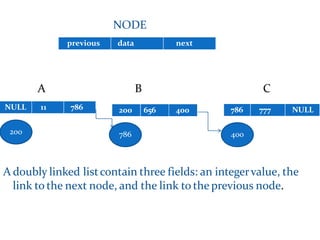
NODE
A B C
A doubly linked listcontain three fields: an integervalue, the
link to the next node, and the link to the previous node.
previous data next
NULL 11 786
786200 400
200 656 400 786 777 NULL
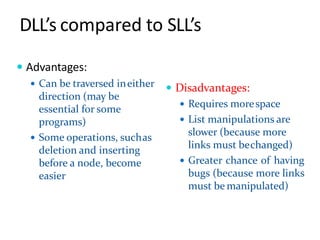
DLL’s compared to SLL’s
 Advantages:
 Can be traversed ineither
direction (may be
essential for some
programs)
 Some operations, suchas
deletion and inserting
before a node, become
easier
 Disadvantages:
 Requires morespace
 List manipulations are
slower (because more
links must bechanged)
 Greater chance of having
bugs (because more links
must be manipulated)
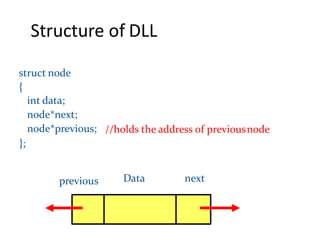
Structure of DLL
//holds the address of previousnode
struct node
{
int data;
node*next;
node*previous;
};
.Data .nextprevious.
inf
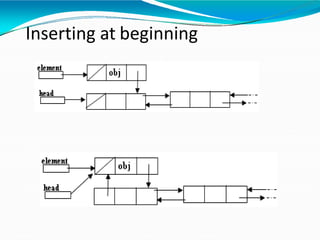
Inserting at beginning
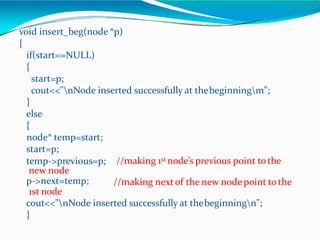
void insert_beg(node *p)
{
if(start==NULL)
{
start=p;
cout<<"nNode inserted successfully at thebeginningm";
}
else
{
node* temp=start;
start=p;
//making 1st node’s previous point tothe
//making nextof the new node point to the
temp->previous=p;
new node
p->next=temp;
1st node
cout<<"nNode inserted successfully at thebeginningn";
}
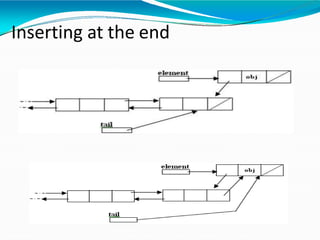
Inserting at the end
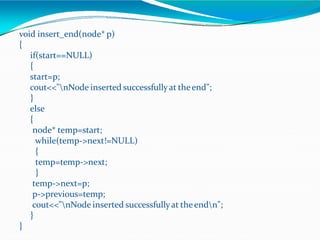
void insert_end(node* p)
{
if(start==NULL)
{
start=p;
cout<<"nNode inserted successfullyat theend";
}
else
{
node* temp=start;
while(temp->next!=NULL)
{
temp=temp->next;
}
temp->next=p;
p->previous=temp;
cout<<"nNode inserted successfullyat theendn";
}
}
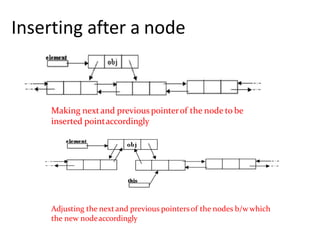
Making nextand previous pointerof the node to be
inserted pointaccordingly
Adjusting the nextand previous pointersof the nodes b/wwhich
the new nodeaccordingly
Inserting after a node
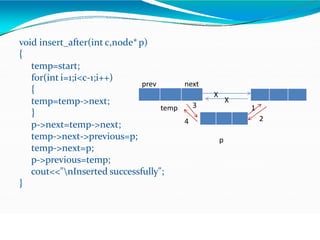
void insert_after(int c,node*p)
{
temp=start;
for(int i=1;i<c-1;i++)
{
temp=temp->next;
}
p->next=temp->next;
temp->next->previous=p;
temp->next=p;
p->previous=temp;
cout<<"nInserted successfully";
}
temp
p
prev next
X
X
1
2
3
4
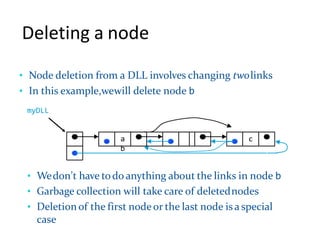
Deleting a node
• Node deletion from a DLL involves changing twolinks
• In this example,wewill delete node b
myDLL
a
b
c
• Wedon’t have todo anything about the links in node b
• Garbage collection will take care of deletednodes
• Deletion of the first nodeor the last node isa special
case
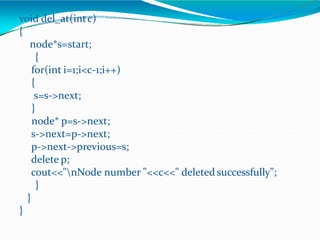
void del_at(intc)
{
node*s=start;
{
for(int i=1;i<c-1;i++)
{
s=s->next;
}
node* p=s->next;
s->next=p->next;
p->next->previous=s;
delete p;
cout<<"nNode number "<<c<<" deleted successfully";
}
}
}

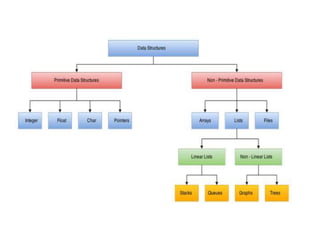
Linear data structure concepts

  • 1.
  • 3.
  • 4.
    Linked Lists • Alinked list is a series of connected nodes • Each node contains at least – A piece of data (any type) – Pointer to the next node in the list • Head: pointer to the first node • The last node points to NULL A  Head B C A data pointer node
  • 5.
    Arrays Vs LinkedLists Arrays Linked list Fixed size: Resizing is expensive Dynamic size Insertions and Deletions are inefficient: Elements are usually shifted Insertions and Deletions are efficient: No shifting Random access i.e., efficient indexing No random access  Not suitable for operations requiring accessing elements by index such as sorting No memory waste if the array is full or almost full; otherwise may result in much memory waste. Since memory is allocated dynamically(acc. to our need) there is no waste of memory. Sequential access is faster [Reason: Elements in contiguous memory locations] Sequential access is slow [Reason: Elements not in contiguous memory locations]
  • 6.
    List Overview • Linkedlists – Abstract data type (ADT) • Basic operations of linked lists – Insert, find, delete, print, etc. • Variations of linked lists – Circular linked lists – Doubly linked lists
  • 7.
    Basic Operations ona list • Creating a List • Inserting an element in alist • Deleting anelement from a list • Searching a list • Reversing alist
  • 8.
    Creating a node //A simple nodeof a linked list struct node{ int data; node*next; }*start; start=NULL ; //start points at the firstnode initialised to NULL atbeginning
  • 9.
    node* create( intnum) //say num=1 is passed frommain { node*ptr; ptr= new node; //memory allocateddynamically if(ptr==NULL) ‘OVERFLOW’ // no memoryavailable exit(1); else { ptr->data=num; ptr->next=NULL; return ptr; } }
  • 10.
    Inserting the nodein a SLL There are 3 cases here:- Insertion at thebeginning Insertion at theend Insertion aftera particular node
  • 12.
    //if the listisempty void insert_beg(node* p) { node* temp; if(start==NULL) { start=p; cout<<”nNode inserted successfully atthe beginning”; } else { } temp=start; start=p; p->next=temp; //making new node point at the first node of thelist }
  • 13.
    Inserting at theend Herewesimply need to make the next pointer of the last node point to the new node
  • 14.
    void insert_end(node* p) { node*q=start; if(start==NULL) { start=p; cout<<”nNode inserted successfully at theend…!!!n”; } else{ while(q->link!=NULL) q=q->link; q->next=p; } }
  • 15.
  • 16.
    void insert_after(int c,node*p) { node* q; q=start; for(int i=1;i<c;i++) { q=q->link; if(q==NULL) cout<<”Less than “<<c<<” nodes in thelist…!!!”; } p->link=q->link; q->link=p; cout<<”nNode inserted successfully”; }
  • 17.
    Deleting a nodein SLL Here also we have threecases:-  Deleting the first node Deleting the last node Deleting the intermediatenode
  • 18.
    Deleting the firstnode threetwoone Here we apply 2steps:-  Making the start pointerpoint towards the 2nd node  Deleting the first node using deletekeyword start
  • 19.
    void del_first() { if(start==NULL) cout<<”nError……List isemptyn”; else { node*temp=start; start=temp->link; delete temp; cout<<”nFirst node deleted successfully….!!!”; } }
  • 20.
    Deleting the lastnode node3node2node1 Here we apply 2steps:-  Making the second last node’s next pointerpoint to NULL  Deleting the last node viadelete keyword start
  • 21.
    void del_last() { if(start==NULL) cout<<”nError….List isempty”; else { node*q=start; while(q->link->link!=NULL) q=q->link; node* temp=q->link; q->link=NULL; delete temp; cout<<”nDeleted successfully…”; } } }
  • 22.
    Deleting a particularnode •Here we make the next pointer of the node previous to the node being deleted ,point to the successor node of the node to be deleted and then delete the node using delete keyword node1 node2 node3 To be deleted
  • 23.
    void del(intc) { node* q=start; for(inti=2;i<c;i++) { q=q->link; if(q==NULL) cout<<”nNode notfoundn”; } if(i==c) { //node to bedeleted //disconnecting the nodep node* p=q->link; q->link=p->link; deletep; cout<<“Deleted Successfully”; } }
  • 24.
    Searching a SLL Searching involves finding the required element inthe list  Wecan usevarious techniquesof searching like linear search or binary search where binary search is more efficient in case ofArrays  But in case of linked list since random access is not available itwould becomecomplex todo binary search in it  Wecan perform simple linearsearch traversal
  • 25.
    In linear searcheach node is traversed till the data in the node matches with the required value void search(intx) { node*temp=start; while(temp!=NULL) { if(temp->data==x) { cout<<“FOUND ”<<temp->data; break; } temp=temp->next; } }
  • 26.
    Reversing a linkedlist • Wecan reverse a linked list by reversing the direction of the links between 2nodes
  • 27.
     We makeuseof 3 structurepointers say p,q,r  Atany instantq will point to the node next topand r will point to the node next toq NULLHead P NULL • For next iteration p=q andq=r • At the end wewill change head to the last node qp rq
  • 28.
    AAA Code void reverse() { node*p,*q,*r; if(start==NULL) { cout<<"nListisemptyn"; return; } p=start; q=p->link; p->link=NULL; while(q!=NULL) { r=q->link; q->link=p; p=q; q=r; } start=p; cout<<"nReversed successfully"; } A B C D P q r A B C NULL P q
  • 29.
    Doubly Linked List 1.Doubly linked list is a linked data structurethatconsistsof a set of sequentially linked records callednodes. 2 . Each node contains three fields:: -: one is data part which contain dataonly. -:two other field is links part that are point or references to the previous or to the next node in the sequence of nodes. 3. The beginning and ending nodes' previous and next links, respectively, point to some kind of terminator, typically a sentinel node or null to facilitate traversal of the list.
  • 30.
    NODE A B C Adoubly linked listcontain three fields: an integervalue, the link to the next node, and the link to the previous node. previous data next NULL 11 786 786200 400 200 656 400 786 777 NULL
  • 31.
    DLL’s compared toSLL’s  Advantages:  Can be traversed ineither direction (may be essential for some programs)  Some operations, suchas deletion and inserting before a node, become easier  Disadvantages:  Requires morespace  List manipulations are slower (because more links must bechanged)  Greater chance of having bugs (because more links must be manipulated)
  • 32.
    Structure of DLL //holdsthe address of previousnode struct node { int data; node*next; node*previous; }; .Data .nextprevious. inf
  • 33.
  • 34.
    void insert_beg(node *p) { if(start==NULL) { start=p; cout<<"nNodeinserted successfully at thebeginningm"; } else { node* temp=start; start=p; //making 1st node’s previous point tothe //making nextof the new node point to the temp->previous=p; new node p->next=temp; 1st node cout<<"nNode inserted successfully at thebeginningn"; }
  • 35.
  • 36.
    void insert_end(node* p) { if(start==NULL) { start=p; cout<<"nNodeinserted successfullyat theend"; } else { node* temp=start; while(temp->next!=NULL) { temp=temp->next; } temp->next=p; p->previous=temp; cout<<"nNode inserted successfullyat theendn"; } }
  • 37.
    Making nextand previouspointerof the node to be inserted pointaccordingly Adjusting the nextand previous pointersof the nodes b/wwhich the new nodeaccordingly Inserting after a node
  • 38.
    void insert_after(int c,node*p) { temp=start; for(inti=1;i<c-1;i++) { temp=temp->next; } p->next=temp->next; temp->next->previous=p; temp->next=p; p->previous=temp; cout<<"nInserted successfully"; } temp p prev next X X 1 2 3 4
  • 39.
    Deleting a node •Node deletion from a DLL involves changing twolinks • In this example,wewill delete node b myDLL a b c • Wedon’t have todo anything about the links in node b • Garbage collection will take care of deletednodes • Deletion of the first nodeor the last node isa special case
  • 40.
    void del_at(intc) { node*s=start; { for(int i=1;i<c-1;i++) { s=s->next; } node*p=s->next; s->next=p->next; p->next->previous=s; delete p; cout<<"nNode number "<<c<<" deleted successfully"; } } }