Link list presentation slide(Daffodil international university)
The document summarizes information about linked lists, including:
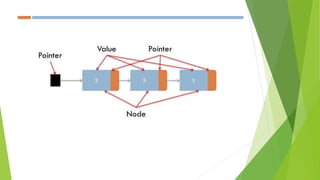
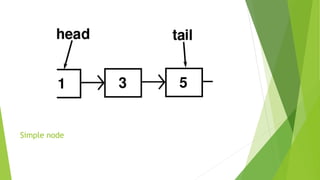
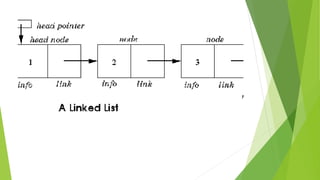
- Linked lists are linear collections of data elements called nodes connected by pointers.
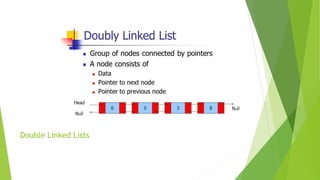
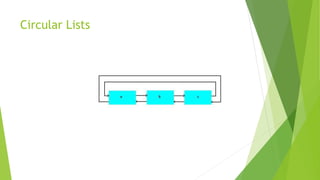
- There are single linked lists, double linked lists, and circular linked lists.
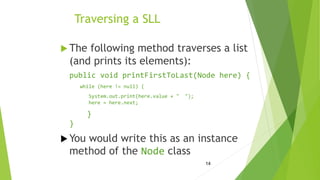
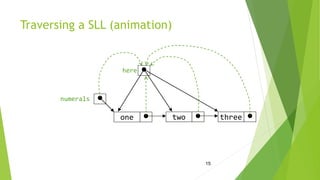
- Traversing a single linked list involves iterating through each node using the next pointer.
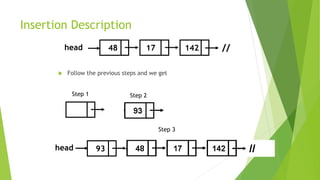
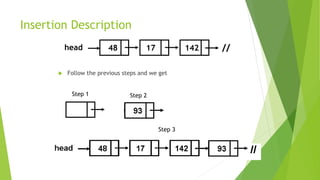
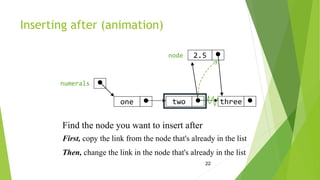
- Insertion can occur at the beginning, end, or middle of a list by creating a new node and adjusting pointers.
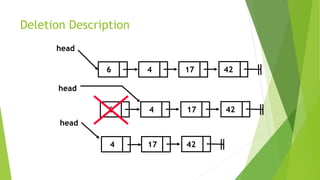
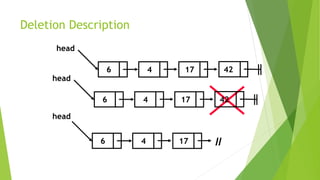
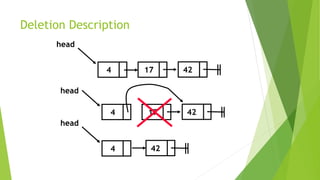
- Deletion involves removing a node by adjusting pointers of the previous and next nodes.
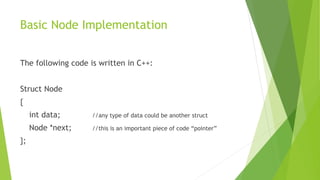
- A basic node implementation uses a struct with a data field and next pointer.

Introduction to the presentation and main topic which is Linked Lists. Outline includes traversing, searching, insertion, deletion, and basic node implementation.
Definition of linked lists: a linear collection of data elements called nodes, organized by pointers.
Overview of types of linked lists: Single linked lists, Double linked lists, and Circular linked lists.
Method for traversing a single linked list using a code example. Demonstration of traversing elements.
Description of insertion methods: at the top, end, and middle of the list with steps and animations.
Description of deletion methods: from the top, end, and middle of the list with steps and illustrations.
Basic code implementation of a node in C++ showing the structure and pointer relationship.
Conclusion of the presentation with acknowledgment.
14
Traversing a SLL
The following method traverses a list
(and prints its elements):
public void printFirstToLast(Node here) {
while (here != null) {
System.out.print(here.value + " ");
here = here.next;
}
}
You would write this as an instance
method of the Node class
Basic Node Implementation
Thefollowing code is written in C++:
Struct Node
{
int data; //any type of data could be another struct
Node *next; //this is an important piece of code “pointer”
};