Circular Linked List
CIRCULAR LINKED LISTS
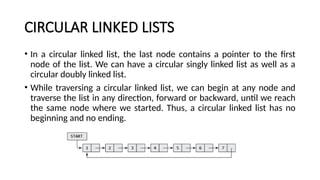
• In a circular linked list, the last node contains a pointer to the first
node of the list. We can have a circular singly linked list as well as a
circular doubly linked list.
• While traversing a circular linked list, we can begin at any node and
traverse the list in any direction, forward or backward, until we reach
the same node where we started. Thus, a circular linked list has no
beginning and no ending.
Types of Circular Linked Lists
1. Circular Singly Linked List
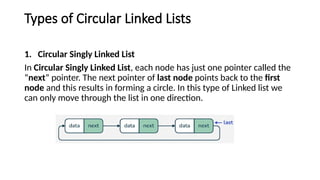
In Circular Singly Linked List, each node has just one pointer called the
“next” pointer. The next pointer of last node points back to the first
node and this results in forming a circle. In this type of Linked list we
can only move through the list in one direction.
Types of Circular Linked Lists
2. Circular Doubly Linked List:
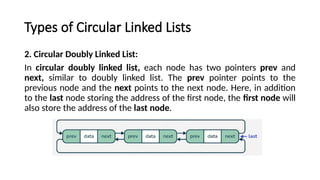
In circular doubly linked list, each node has two pointers prev and
next, similar to doubly linked list. The prev pointer points to the
previous node and the next points to the next node. Here, in addition
to the last node storing the address of the first node, the first node will
also store the address of the last node.
OPERATIONS ON CIRCULAR LINKED LIST
• INSERTION(ON BEGINNING,END AND AT SPECIFIC LOCATION)
• DELETION(FROM BEGINNING,END AND SPECIFIC LOCATION)
• TRAVERSAL
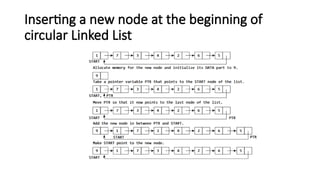
Inserting a Node at the Beginning of a Circular
Linked List
Algorithm
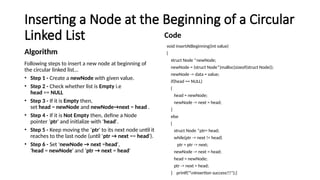
Following steps to insert a new node at beginning of
the circular linked list...
• Step 1 - Create a newNode with given value.
• Step 2 - Check whether list is Empty i.e
head == NULL
• Step 3 - If it is Empty then,
set head = newNode and newNode→next = head .
• Step 4 - If it is Not Empty then, define a Node
pointer ‘ptr' and initialize with 'head'.
• Step 5 - Keep moving the ‘ptr' to its next node until it
reaches to the last node (until ‘ptr → next == head').
• Step 6 - Set 'newNode → next =head',
'head = newNode' and ‘ptr → next = head'
Code
void insertAtBeginning(int value)
{
struct Node *newNode;
newNode = (struct Node*)malloc(sizeof(struct Node));
newNode -> data = value;
if(head == NULL)
{
head = newNode;
newNode -> next = head;
}
else
{
struct Node *ptr= head;
while(ptr -> next != head)
ptr = ptr -> next;
newNode -> next = head;
head = newNode;
ptr -> next = head;
} printf("nInsertion success!!!");}
Inserting a new node at the beginning of
circular Linked List
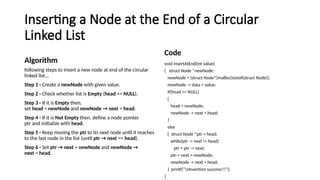
Inserting a Node at the End of a Circular
Linked List
Algorithm
following steps to insert a new node at end of the circular
linked list...
Step 1 - Create a newNode with given value.
Step 2 - Check whether list is Empty (head == NULL).
Step 3 - If it is Empty then,
set head = newNode and newNode → next = head.
Step 4 - If it is Not Empty then, define a node pointer
ptr and initialize with head.
Step 5 - Keep moving the ptr to its next node until it reaches
to the last node in the list (until ptr → next == head).
Step 6 - Set ptr → next = newNode and newNode →
next = head.
Code
void insertAtEnd(int value)
{ struct Node *newNode;
newNode = (struct Node*)malloc(sizeof(struct Node));
newNode -> data = value;
if(head == NULL)
{
head = newNode;
newNode -> next = head;
}
else
{ struct Node *ptr = head;
while(ptr -> next != head)
ptr = ptr -> next;
ptr-> next = newNode;
newNode -> next = head;
} printf("nInsertion success!!!");
}
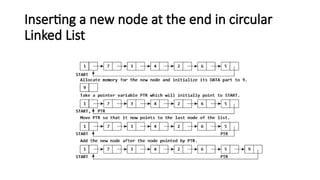
Inserting a new node at the end in circular
Linked List
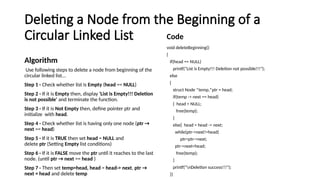
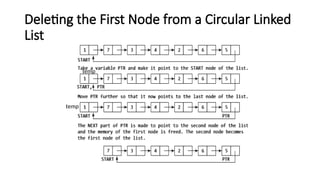
Deleting a Node from the Beginning of a
Circular Linked List
Algorithm
Use following steps to delete a node from beginning of the
circular linked list...
Step 1 - Check whether list is Empty (head == NULL)
Step 2 - If it is Empty then, display 'List is Empty!!! Deletion
is not possible' and terminate the function.
Step 3 - If it is Not Empty then, define pointer ptr and
initialize with head.
Step 4 - Check whether list is having only one node (ptr →
next == head)
Step 5 - If it is TRUE then set head = NULL and
delete ptr (Setting Empty list conditions)
Step 6 - If it is FALSE move the ptr until it reaches to the last
node. (until ptr → next == head )
Step 7 - Then set temp=head, head = head-> next, ptr →
next = head and delete temp
Code
void deleteBeginning()
{
if(head == NULL)
printf("List is Empty!!! Deletion not possible!!!");
else
{
struct Node *temp,*ptr = head;
if(temp -> next == head)
{ head = NULL;
free(temp);
}
else{ head = head -> next;
while(ptr->next!=head)
ptr=ptr->next;
ptr->next=head;
free(temp);
}
printf("nDeletion success!!!");
}}
Deleting the First Node from a Circular Linked
List
temp
temp
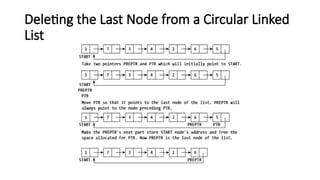
Deleting a Node from the end of a Circular
Linked List
Algorithm
Use the following steps to delete a node from end of the
circular linked list...
Step 1 - Check whether list is Empty (head == NULL)
Step 2 - If it is Empty then, display 'List is Empty!!! Deletion is
not possible' and terminate the function.
Step 3 - If it is Not Empty then, define two Node
pointers ‘preptr' and ‘ptr' and initialize ‘ptr' with head.
Step 4 - Check whether list has only one Node (ptr →
next == head)
Step 5 - If it is TRUE. Then, set head = NULL and delete ptr. And
terminate from the function. (Setting Empty list condition)
Step 6 - If it is FALSE. Then, set ‘preptr= ptr ' and move ptr to its
next node. Repeat the same until ptr reaches to the last node in
the list. (until ptr → next == head)
Step 7 - Set preptr → next = head and delete ptr.
Code
void deleteEnd()
{ if(head == NULL)
printf("List is Empty!!! Deletion not possible!!!");
else
{ struct Node *ptr = head, preptr;
if(ptr -> next == head)
{ head = NULL;
free(temp1);
}
else{
while(ptr -> next != head){
preptr= ptr;
ptr = ptr -> next;
}
preptr-> next = head;
free(ptr);
} printf("nDeletion success!!!");
}}
Deleting the Last Node from a Circular Linked
List
Applications of linked lists
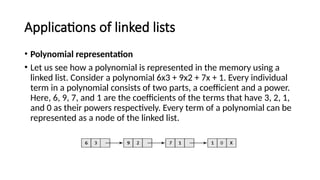
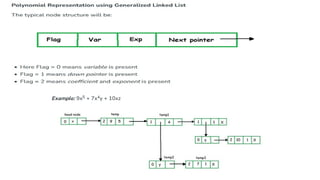
• Polynomial representation
• Let us see how a polynomial is represented in the memory using a
linked list. Consider a polynomial 6x3 + 9x2 + 7x + 1. Every individual
term in a polynomial consists of two parts, a coefficient and a power.
Here, 6, 9, 7, and 1 are the coefficients of the terms that have 3, 2, 1,
and 0 as their powers respectively. Every term of a polynomial can be
represented as a node of the linked list.
Generalized Linked List
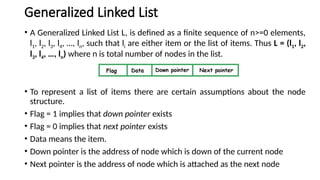
• A Generalized Linked List L, is defined as a finite sequence of n>=0 elements,
l1, l2, l3, l4, …, ln, such that li are either item or the list of items. Thus L = (l1, l2,
l3, l4, …, ln) where n is total number of nodes in the list.
• To represent a list of items there are certain assumptions about the node
structure.
• Flag = 1 implies that down pointer exists
• Flag = 0 implies that next pointer exists
• Data means the item.
• Down pointer is the address of node which is down of the current node
• Next pointer is the address of node which is attached as the next node
• Why Generalized Linked List?
Generalized linked lists are used because although the efficiency of
polynomial operations using linked list is good but still, the
disadvantage is that the linked list is unable to use multiple variable
polynomial equation efficiently. It helps us to represent multi-variable
polynomial along with the list of elements.
typedef struct node {
char c; //Data
int index; //Flag
struct node *next, *down; //Next & Down pointer
}GLL;
Thanks

CIRCULAR LINKED LIST _

  • 1.
  • 2.
    CIRCULAR LINKED LISTS •In a circular linked list, the last node contains a pointer to the first node of the list. We can have a circular singly linked list as well as a circular doubly linked list. • While traversing a circular linked list, we can begin at any node and traverse the list in any direction, forward or backward, until we reach the same node where we started. Thus, a circular linked list has no beginning and no ending.
  • 3.
    Types of CircularLinked Lists 1. Circular Singly Linked List In Circular Singly Linked List, each node has just one pointer called the “next” pointer. The next pointer of last node points back to the first node and this results in forming a circle. In this type of Linked list we can only move through the list in one direction.
  • 4.
    Types of CircularLinked Lists 2. Circular Doubly Linked List: In circular doubly linked list, each node has two pointers prev and next, similar to doubly linked list. The prev pointer points to the previous node and the next points to the next node. Here, in addition to the last node storing the address of the first node, the first node will also store the address of the last node.
  • 5.
    OPERATIONS ON CIRCULARLINKED LIST • INSERTION(ON BEGINNING,END AND AT SPECIFIC LOCATION) • DELETION(FROM BEGINNING,END AND SPECIFIC LOCATION) • TRAVERSAL
  • 6.
    Inserting a Nodeat the Beginning of a Circular Linked List Algorithm Following steps to insert a new node at beginning of the circular linked list... • Step 1 - Create a newNode with given value. • Step 2 - Check whether list is Empty i.e head == NULL • Step 3 - If it is Empty then, set head = newNode and newNode→next = head . • Step 4 - If it is Not Empty then, define a Node pointer ‘ptr' and initialize with 'head'. • Step 5 - Keep moving the ‘ptr' to its next node until it reaches to the last node (until ‘ptr → next == head'). • Step 6 - Set 'newNode → next =head', 'head = newNode' and ‘ptr → next = head' Code void insertAtBeginning(int value) { struct Node *newNode; newNode = (struct Node*)malloc(sizeof(struct Node)); newNode -> data = value; if(head == NULL) { head = newNode; newNode -> next = head; } else { struct Node *ptr= head; while(ptr -> next != head) ptr = ptr -> next; newNode -> next = head; head = newNode; ptr -> next = head; } printf("nInsertion success!!!");}
  • 7.
    Inserting a newnode at the beginning of circular Linked List
  • 8.
    Inserting a Nodeat the End of a Circular Linked List Algorithm following steps to insert a new node at end of the circular linked list... Step 1 - Create a newNode with given value. Step 2 - Check whether list is Empty (head == NULL). Step 3 - If it is Empty then, set head = newNode and newNode → next = head. Step 4 - If it is Not Empty then, define a node pointer ptr and initialize with head. Step 5 - Keep moving the ptr to its next node until it reaches to the last node in the list (until ptr → next == head). Step 6 - Set ptr → next = newNode and newNode → next = head. Code void insertAtEnd(int value) { struct Node *newNode; newNode = (struct Node*)malloc(sizeof(struct Node)); newNode -> data = value; if(head == NULL) { head = newNode; newNode -> next = head; } else { struct Node *ptr = head; while(ptr -> next != head) ptr = ptr -> next; ptr-> next = newNode; newNode -> next = head; } printf("nInsertion success!!!"); }
  • 9.
    Inserting a newnode at the end in circular Linked List
  • 10.
    Deleting a Nodefrom the Beginning of a Circular Linked List Algorithm Use following steps to delete a node from beginning of the circular linked list... Step 1 - Check whether list is Empty (head == NULL) Step 2 - If it is Empty then, display 'List is Empty!!! Deletion is not possible' and terminate the function. Step 3 - If it is Not Empty then, define pointer ptr and initialize with head. Step 4 - Check whether list is having only one node (ptr → next == head) Step 5 - If it is TRUE then set head = NULL and delete ptr (Setting Empty list conditions) Step 6 - If it is FALSE move the ptr until it reaches to the last node. (until ptr → next == head ) Step 7 - Then set temp=head, head = head-> next, ptr → next = head and delete temp Code void deleteBeginning() { if(head == NULL) printf("List is Empty!!! Deletion not possible!!!"); else { struct Node *temp,*ptr = head; if(temp -> next == head) { head = NULL; free(temp); } else{ head = head -> next; while(ptr->next!=head) ptr=ptr->next; ptr->next=head; free(temp); } printf("nDeletion success!!!"); }}
  • 11.
    Deleting the FirstNode from a Circular Linked List temp temp
  • 12.
    Deleting a Nodefrom the end of a Circular Linked List Algorithm Use the following steps to delete a node from end of the circular linked list... Step 1 - Check whether list is Empty (head == NULL) Step 2 - If it is Empty then, display 'List is Empty!!! Deletion is not possible' and terminate the function. Step 3 - If it is Not Empty then, define two Node pointers ‘preptr' and ‘ptr' and initialize ‘ptr' with head. Step 4 - Check whether list has only one Node (ptr → next == head) Step 5 - If it is TRUE. Then, set head = NULL and delete ptr. And terminate from the function. (Setting Empty list condition) Step 6 - If it is FALSE. Then, set ‘preptr= ptr ' and move ptr to its next node. Repeat the same until ptr reaches to the last node in the list. (until ptr → next == head) Step 7 - Set preptr → next = head and delete ptr. Code void deleteEnd() { if(head == NULL) printf("List is Empty!!! Deletion not possible!!!"); else { struct Node *ptr = head, preptr; if(ptr -> next == head) { head = NULL; free(temp1); } else{ while(ptr -> next != head){ preptr= ptr; ptr = ptr -> next; } preptr-> next = head; free(ptr); } printf("nDeletion success!!!"); }}
  • 13.
    Deleting the LastNode from a Circular Linked List
  • 14.
    Applications of linkedlists • Polynomial representation • Let us see how a polynomial is represented in the memory using a linked list. Consider a polynomial 6x3 + 9x2 + 7x + 1. Every individual term in a polynomial consists of two parts, a coefficient and a power. Here, 6, 9, 7, and 1 are the coefficients of the terms that have 3, 2, 1, and 0 as their powers respectively. Every term of a polynomial can be represented as a node of the linked list.
  • 15.
    Generalized Linked List •A Generalized Linked List L, is defined as a finite sequence of n>=0 elements, l1, l2, l3, l4, …, ln, such that li are either item or the list of items. Thus L = (l1, l2, l3, l4, …, ln) where n is total number of nodes in the list. • To represent a list of items there are certain assumptions about the node structure. • Flag = 1 implies that down pointer exists • Flag = 0 implies that next pointer exists • Data means the item. • Down pointer is the address of node which is down of the current node • Next pointer is the address of node which is attached as the next node
  • 16.
    • Why GeneralizedLinked List? Generalized linked lists are used because although the efficiency of polynomial operations using linked list is good but still, the disadvantage is that the linked list is unable to use multiple variable polynomial equation efficiently. It helps us to represent multi-variable polynomial along with the list of elements. typedef struct node { char c; //Data int index; //Flag struct node *next, *down; //Next & Down pointer }GLL;
  • 19.