MODERN HUMAN DIVERSITY
RACE AND RACISM
HUMAN CLASSIFICATION
 Initially began in an attempt to classify Homo
sapiens into subspecies
 Race – a subspecies/population that differs
geographically, morphologically, or genetically
from other populations of the same species
 Carolus Linnaeus’ famous classification based on
color
 Studies formed hierarchy based on
ethnocentrism
 There is NO GENETIC VARIANT for “race”
 Race is a social construct
 Cultures dictate “race” based on ethnic, religious,
and linguistic groups
HUMAN
CLASSIFICATION
 “Race” is a culturally
constructed idea
 Phenotypical characteristics
are based on environment,
diet, and culture
 Behavior can be explained in
terms of culture rather than
biology or “race”
 Intelligence
 Heath
 Crime
HUMAN
CLASSIFICATION
 “Racial” inclusion is based on
self-identification
 Can change over a lifetime
 History shows that “racial”
types exclude whole groups
 Feelings of superiority or
inferiority lead to conflict
 Racism used to mobilize
political support by
dehumanizing rivals
 Concept has been exploited
to further political and social
agendas set forth by the self-
proclaimed “superior” group
BIOLOGICAL ADAPTATIONS
 Human (biological) variation
is based on adaptation to
natural environmental
stressors:
 Sunlight
 Temperature
 Altitude
BIOLOGICAL
ADAPTATIONS
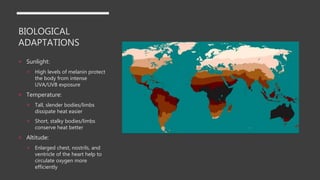
 Sunlight:
 High levels of melanin protect
the body from intense
UVA/UVB exposure
 Temperature:
 Tall, slender bodies/limbs
dissipate heat easier
 Short, stalky bodies/limbs
conserve heat better
 Altitude:
 Enlarged chest, nostrils, and
ventricle of the heart help to
circulate oxygen more
efficiently
BIOLOGICAL ADAPTATIONS
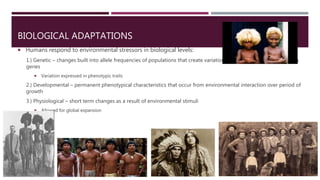
 Humans respond to environmental stressors in biological levels:
1.) Genetic – changes built into allele frequencies of populations that create variation because of multiple interacting
genes
 Variation expressed in phenotypic traits
2.) Developmental – permanent phenotypical characteristics that occur from environmental interaction over period of
growth
3.) Physiological – short term changes as a result of environmental stimuli
 Allowed for global expansion
CULTURAL ADAPTATIONS
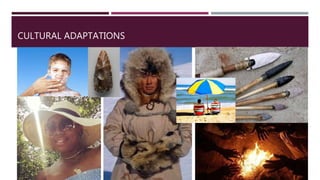
 A complex of ideas, activities, and technologies that
enable survival
 Cultural adaptations are limited by habitat and its
resources
 Change with environmental fluctuations
 Ultimately change the environment in which people live
 Creates the need for new adaptations
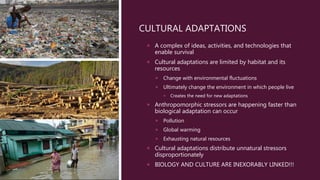
 Anthropomorphic stressors are happening faster than
biological adaptation can occur
 Pollution
 Global warming
 Exhausting natural resources
 Cultural adaptations distribute unnatural stressors
disproportionately
 BIOLOGY AND CULTURE ARE INEXORABLY LINKED!!!
LIVING IN A GLOBALIZED WORLD
 Disease is both a social and biological
process
 Interconnectedness among political and
economic systems impacts the distribution
of poverty
 Poverty is one if the major determinants
of sickness and disease
 Black people are disproportionately
affected by poverty and thus poor health
in the United States
STRUCTURAL
VIOLENCE
 Harm caused by exploitative
and unjust social, political, and
economic systems
 Unequal access to treatments
 Highly polluted (poor) areas
increase the likelihood of
contracting disease
 State of poverty leads to
malnutrition
 Poor people bare the burden
of exposure to harmful
chemicals and bad working
conditions
 Globalization has exasperated
this situation
 Globalization has unfairly
influenced the dreams and
expectations of developing
nations
FINDING
SOLUTIONS
TO
GLOBAL
PROBLEMS
• Seeks to understand the cultural aspects of medical systems
• How it is connected to economic and political forces
• How medical terminology and categorization stems from unique
cultural systems of belief
• Which cultural practices are harmful and helpful to people
• How population size, pollution, and disease are interlinked
MEDICAL
ANTHROPOLOGY
• Seeks to understand the political and economic systems, on
global and local levels, that influence human disease
• Means of acquiring and coping with disease
• Looks at available resources for prevention and treatment
• Asses the management of natural resources and access to them
POLITICAL
ECOLOGY

Modern Human Diversity & Adaptation to a Changing World

  • 1.
  • 2.
    HUMAN CLASSIFICATION  Initiallybegan in an attempt to classify Homo sapiens into subspecies  Race – a subspecies/population that differs geographically, morphologically, or genetically from other populations of the same species  Carolus Linnaeus’ famous classification based on color  Studies formed hierarchy based on ethnocentrism  There is NO GENETIC VARIANT for “race”  Race is a social construct  Cultures dictate “race” based on ethnic, religious, and linguistic groups
  • 3.
    HUMAN CLASSIFICATION  “Race” isa culturally constructed idea  Phenotypical characteristics are based on environment, diet, and culture  Behavior can be explained in terms of culture rather than biology or “race”  Intelligence  Heath  Crime
  • 4.
    HUMAN CLASSIFICATION  “Racial” inclusionis based on self-identification  Can change over a lifetime  History shows that “racial” types exclude whole groups  Feelings of superiority or inferiority lead to conflict  Racism used to mobilize political support by dehumanizing rivals  Concept has been exploited to further political and social agendas set forth by the self- proclaimed “superior” group
  • 5.
    BIOLOGICAL ADAPTATIONS  Human(biological) variation is based on adaptation to natural environmental stressors:  Sunlight  Temperature  Altitude
  • 6.
    BIOLOGICAL ADAPTATIONS  Sunlight:  Highlevels of melanin protect the body from intense UVA/UVB exposure  Temperature:  Tall, slender bodies/limbs dissipate heat easier  Short, stalky bodies/limbs conserve heat better  Altitude:  Enlarged chest, nostrils, and ventricle of the heart help to circulate oxygen more efficiently
  • 7.
    BIOLOGICAL ADAPTATIONS  Humansrespond to environmental stressors in biological levels: 1.) Genetic – changes built into allele frequencies of populations that create variation because of multiple interacting genes  Variation expressed in phenotypic traits 2.) Developmental – permanent phenotypical characteristics that occur from environmental interaction over period of growth 3.) Physiological – short term changes as a result of environmental stimuli  Allowed for global expansion
  • 8.
  • 9.
    CULTURAL ADAPTATIONS  Acomplex of ideas, activities, and technologies that enable survival  Cultural adaptations are limited by habitat and its resources  Change with environmental fluctuations  Ultimately change the environment in which people live  Creates the need for new adaptations  Anthropomorphic stressors are happening faster than biological adaptation can occur  Pollution  Global warming  Exhausting natural resources  Cultural adaptations distribute unnatural stressors disproportionately  BIOLOGY AND CULTURE ARE INEXORABLY LINKED!!!
  • 10.
    LIVING IN AGLOBALIZED WORLD  Disease is both a social and biological process  Interconnectedness among political and economic systems impacts the distribution of poverty  Poverty is one if the major determinants of sickness and disease  Black people are disproportionately affected by poverty and thus poor health in the United States
  • 11.
    STRUCTURAL VIOLENCE  Harm causedby exploitative and unjust social, political, and economic systems  Unequal access to treatments  Highly polluted (poor) areas increase the likelihood of contracting disease  State of poverty leads to malnutrition  Poor people bare the burden of exposure to harmful chemicals and bad working conditions  Globalization has exasperated this situation  Globalization has unfairly influenced the dreams and expectations of developing nations
  • 12.
    FINDING SOLUTIONS TO GLOBAL PROBLEMS • Seeks tounderstand the cultural aspects of medical systems • How it is connected to economic and political forces • How medical terminology and categorization stems from unique cultural systems of belief • Which cultural practices are harmful and helpful to people • How population size, pollution, and disease are interlinked MEDICAL ANTHROPOLOGY • Seeks to understand the political and economic systems, on global and local levels, that influence human disease • Means of acquiring and coping with disease • Looks at available resources for prevention and treatment • Asses the management of natural resources and access to them POLITICAL ECOLOGY