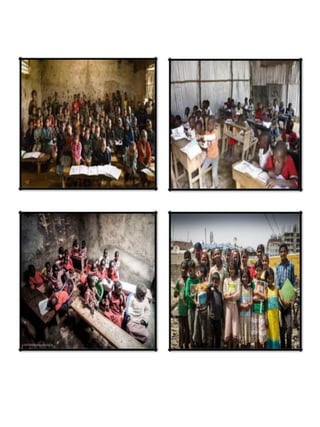
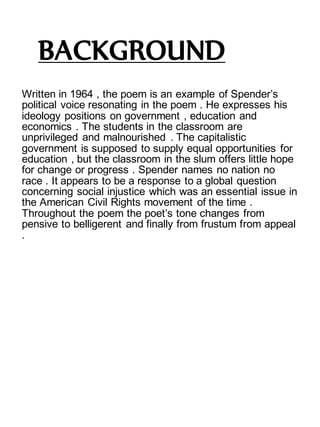
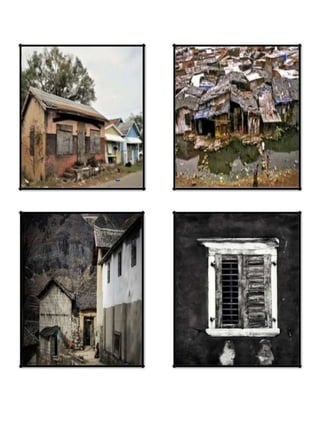
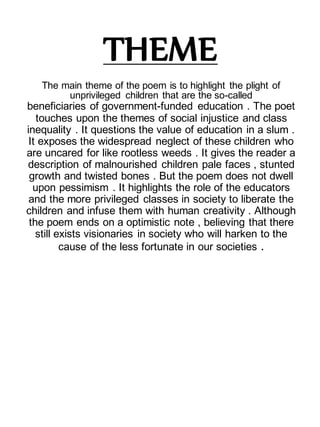
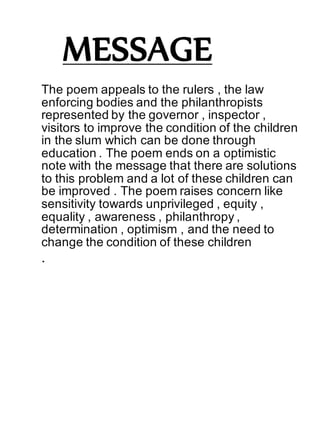
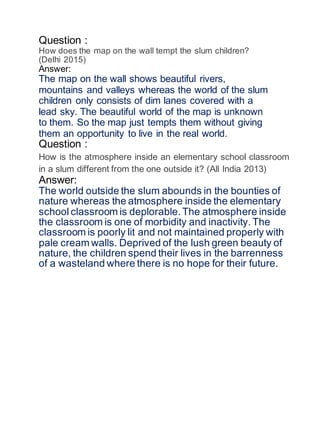
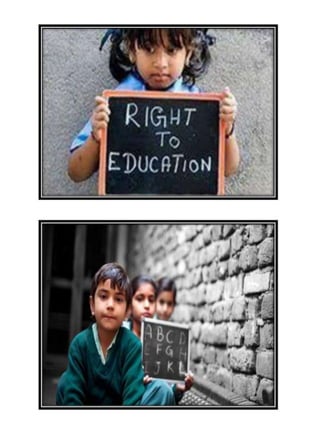
This document certifies that Anjali Kumari of class 12 'A' has successfully completed her English project, guided by her teacher and supported by her parents. The poem discussed, written by Stephen Spender, reflects on the plight of malnourished children in a slum classroom, emphasizing themes of social injustice and the need for educational reform. Spender's work ultimately calls for action from society to address the conditions of these children and foster hope for a better future.

The slides introduce a project completion certificate for Miss. Anjali Kumari, thanking teachers and parents for their support in the project.
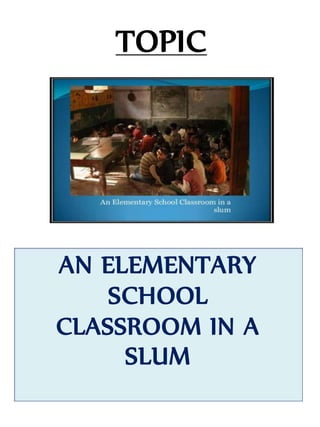
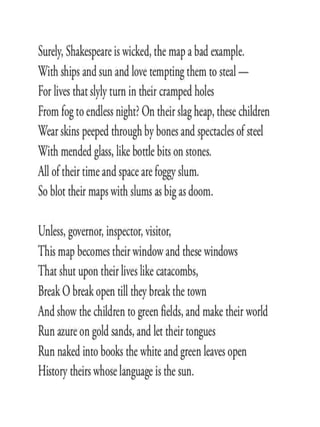
Introduces the poem topic 'An Elementary School Classroom in a Slum' by Stephen Spender, focusing on social injustice.
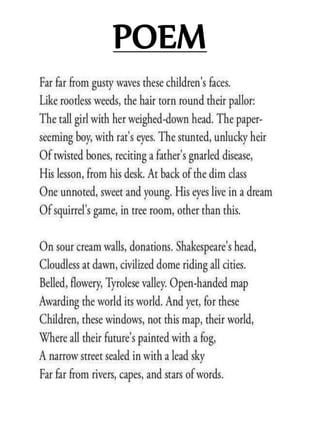
The slides summarize the poem's description of impoverished children, their experiences, social injustice themes, and a hopeful message for societal change.
Discussion on poetic devices used in the poem, important questions addressing themes of hopelessness vs. hope, and the desire for a better future.
Examines questions on the impact of Shakespeare's work on slum children and contrasting classroom atmosphere with the outside world.
This is tocertify that Miss. Anjali Kumari of
Class 12
th
‘A’ of Kendriya Vidyalaya No.2 Roll
No. 07 has successfully completed her English
project file. She has taken proper care and
utmost sincerity in completion of her project.
All the work related to the project was done by
the candidate herself. The approach towards
the subject has been sincere and scientific.
I certify that this project is upto my
expectations and as per the guidelines
issued by the CBSE.
Student
(PGT.English) Principal Mam
4.
In the accomplishmentof this project
successfully , many people have best owned
upon me their blessings and their heart
pledged support . This time I am utilizing to
thank all the people who have been concerned
with this project .
Primarily I would like to thank God for being
able to complete this project with success.
Then I would like to thank my English teacher
Mrs.Chandrima Gaur , whose valuable
guidance has been the ones that helped me
patch this project and make it full proof
success . Her suggestions and instructions
have served as the major contributor towards
the completion of the project .
Then I would like to thank my parents who
have helped me with their valuable
suggestions and guidance has been very
helpful in various phases of the completion
of the project .
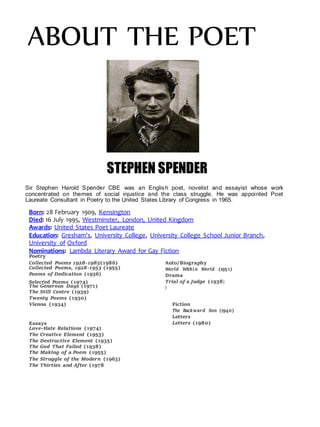
ABOUT THE POET
STEPHENSPENDER
Sir Stephen Harold Spender CBE was an English poet, novelist and essayist whose work
concentrated on themes of social injustice and the class struggle. He was appointed Poet
Laureate Consultant in Poetry to the United States Library of Congress in 1965.
Born: 28 February 1909, Kensington
Died: 16 July 1995, Westminster, London, United Kingdom
Awards: United States Poet Laureate
Education: Gresham's, University College, University College School Junior Branch,
University of Oxford
Nominations: Lambda Literary Award for Gay Fiction
Poetry
Collected Poems 1928-1985(1986) Auto/Biography
Collected Poems, 1928-1953 (1955) World Within World (1951)
Poems of Dedication (1936) Drama
Selected Poems (1974) Trial of a Judge (1938)
The Generous Days (1971) )
The Still Centre (1939)
Twenty Poems (1930)
Vienna (1934) Fiction
The Backward Son (1940)
Letters
Essays Letters (1980)
Love-Hate Relations (1974)
The Creative Element (1953)
The Destructive Element (1935)
The God That Failed (1938)
The Making of a Poem (1955)
The Struggle of the Modern (1963)
The Thirties and After (1978
SUMMARY
This poem byStephen Spender gives a vivid description of a
school classroom in a slum and the children in the class . The
faces of the children are dull. Their appearance shows that
they are unwanted. The children have gloomy faces. Their
heads hanging low in sadness due to being poor. They have
diseased bodies inherited from their parents and are victims of
poverty. At the dim end of the room, sits one child who has
bright eyes which seem to dream - of playing outside with
squirrels. He is different from the others in the dim, dark room.
11.
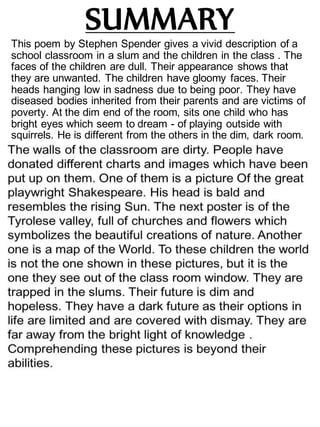
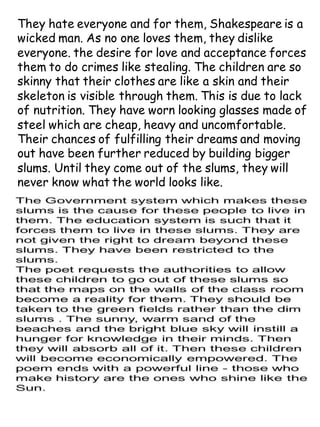
They hate everyoneand for them, Shakespeare is a
wicked man. As no one loves them, they dislike
everyone. the desire for love and acceptance forces
them to do crimes like stealing. The children are so
skinny that their clothes are like a skin and their
skeleton is visible through them. This is due to lack
of nutrition. They have worn looking glasses made of
steel which are cheap, heavy and uncomfortable.
Their chances of fulfilling their dreams and moving
out have been further reduced by building bigger
slums. Until they come out of the slums, they will
never know what the world looks like.
12.
BACKGROUND
Written in 1964, the poem is an example of Spender’s
political voice resonating in the poem . He expresses his
ideology positions on government , education and
economics . The students in the classroom are
unprivileged and malnourished . The capitalistic
government is supposed to supply equal opportunities for
education , but the classroom in the slum offers little hope
for change or progress . Spender names no nation no
race . It appears to be a response to a global question
concerning social injustice which was an essential issue in
the American Civil Rights movement of the time .
Throughout the poem the poet’s tone changes from
pensive to belligerent and finally from frustum from appeal
.
14.
THEME
The main themeof the poem is to highlight the plight of
unprivileged children that are the so-called
beneficiaries of government-funded education . The poet
touches upon the themes of social injustice and class
inequality . It questions the value of education in a slum .
It exposes the widespread neglect of these children who
are uncared for like rootless weeds . It gives the reader a
description of malnourished children pale faces , stunted
growth and twisted bones . But the poem does not dwell
upon pessimism . It highlights the role of the educators
and the more privileged classes in society to liberate the
children and infuse them with human creativity . Although
the poem ends on a optimistic note , believing that there
still exists visionaries in society who will harken to the
cause of the less fortunate in our societies .
15.
MESSAGE
The poem appealsto the rulers , the law
enforcing bodies and the philanthropists
represented by the governor , inspector ,
visitors to improve the condition of the children
in the slum which can be done through
education . The poem ends on a optimistic
note with the message that there are solutions
to this problem and a lot of these children can
be improved . The poem raises concern like
sensitivity towards unprivileged , equity ,
equality , awareness , philanthropy ,
determination , optimism , and the need to
change the condition of these children
.
16.
CENTRAL IDEA
Stephen Spenderhas presented a true picture of the life of
the school children living in the slum of Tyrolese Valley of
Austrian Alpine Province. The
• children are in a very miserable condition due to their
poverty and illiteracy. They are depressed. Their pale
faces express sadness. They look lean, skinny and
bonny. They are like rootless weeds which can’t resist
anything for their existence. They are physically very
weak and under nourished. Spender voices his concern
for these children who live all their life in slums and have
no opportunity to enjoy the real blessings of life. He
makes a frantic appeal to the educated and affluent
sections of the society to better the lot of the slum
children through education. It will remove social injustice
and class inequality.
17.
POETIC DEVICES
❑ Metaphor
•Sealed in with a lead sky
• Fathers gnarled disease
• Future’s painted with fog
• Spectacles of steel
❑ Alliteration
• From fog
❑Symbol
• Open-handed map
• White and green leaves
• Green fields , gold sand
18.
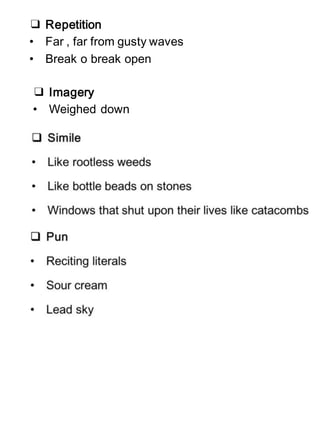
❑ Repetition
• Far, far from gusty waves
• Break o break open
❑ Imagery
• Weighed down
19.
SOME IMPORTANT
QUESTIONS
Question :
Whyis Shakespeare wicked for the slum children?
( All India 2017)
Answer:
Shakespeare is described as wicked because there
is no correlation between Shakespeare’s works and
the life of the slum children. Shakespeare’s works
are no good to the children in slum schools as they
cannot identify themselves with the characters. He
talks about a world far removed from reality. The
slum children can never reach the level of education
to understand the works of Shakespeare.
20.
Question :
In spiteof despair and disease pervading the lives of the slum children,
they are not devoid of hope. How far do you agree? (Delhi 2013)
Answer:
Though despairand disease do make these slum children look at
the world with hollow eyes yetthey are not devoid of hope. They
fight the battle of life courageously,like heroes whose victories
are never celebrated,but they still make desperate attemptsto
live life against all odds.Their hope comes from the governor,the
inspector,the visitor and the sympathetic attitude of the people.
Question :
What does Stephen Spender want to be done for the
children of the school in a slum? (Delhi 2016) Answer:
The poet Stephen Spender wants that the children of the slums
should be able to experience the beauty and joy of the outside
world. He wants that these children should be removed from
their dirty surroundings. They should get the opportunity of being
educated and be a part of the outside world. Their lives should
not be confined to the cemeteries of the slums. They should
come out in the green fields and breathe in open air so that they
can grow unrestricted and liberated.
21.
Question :
How doesthe map on the wall tempt the slum children?
(Delhi 2015)
Answer:
The map on the wall shows beautiful rivers,
mountains and valleys whereas the world of the slum
children only consists of dim lanes covered with a
lead sky. The beautiful world of the map is unknown
to them. So the map just tempts them without giving
them an opportunity to live in the real world.
Question :
How is the atmosphere inside an elementary school classroom
in a slum different from the one outside it? (All India 2013)
Answer:
The world outside the slum abounds in the bounties of
nature whereas the atmosphere inside the elementary
school classroom is deplorable. The atmosphere inside
the classroom is one of morbidity and inactivity. The
classroom is poorly lit and not maintained properly with
pale cream walls. Deprived of the lush green beauty of
nature, the children spend their lives in the barrenness
of a wasteland where there is no hope for their future.