Linear
In-equations
1
CU- 12
Pitampura
Delhi
Concept Building
2
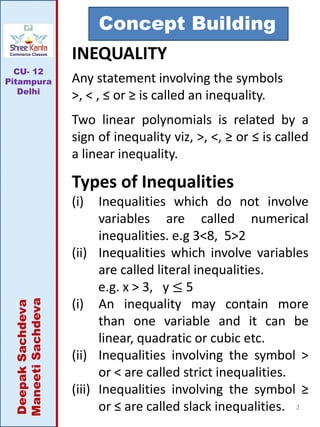
INEQUALITY
Any statement involving the symbols
>, < , ≤ or ≥ is called an inequality.
Two linear polynomials is related by a
sign of inequality viz, >, <, ≥ or ≤ is called
a linear inequality.
Types of Inequalities
(i) Inequalities which do not involve
variables are called numerical
inequalities. e.g 3<8, 5>2
(ii) Inequalities which involve variables
are called literal inequalities.
e.g. x > 3, y ≤ 5
(i) An inequality may contain more
than one variable and it can be
linear, quadratic or cubic etc.
(ii) Inequalities involving the symbol >
or < are called strict inequalities.
(iii) Inequalities involving the symbol ≥
or ≤ are called slack inequalities.
CU- 12
Pitampura
Delhi
3
Representation of Solution of Linear Inequality
in One Variable on a Number Line
(i) If the inequality involves ≥ or ≤ , we
draw filled circle (•) on the number line
to indicate that the number
corresponding to the filled circle is
included in the solution set.
e.g. x ≤ 5 𝒊. 𝒆. 𝒙 𝝐 (−∞, 𝟓]
5 ∞
−∞
x ≥ 5 𝒊. 𝒆. 𝒙 𝝐 [𝟓, ∞)
5 ∞
−∞
4
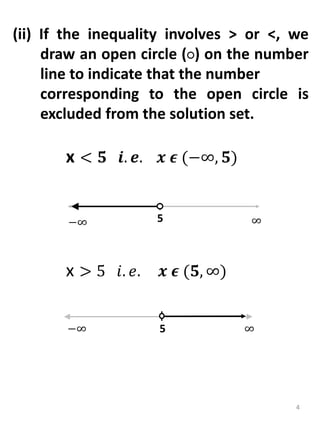
(ii) If the inequality involves > or <, we
draw an open circle (○) on the number
line to indicate that the number
corresponding to the open circle is
excluded from the solution set.
5 ∞
−∞
x > 5 𝑖. 𝑒. 𝒙 𝝐 (𝟓, ∞)
5 ∞
−∞
x < 𝟓 𝒊. 𝒆. 𝒙 𝝐 (−∞, 𝟓)
5
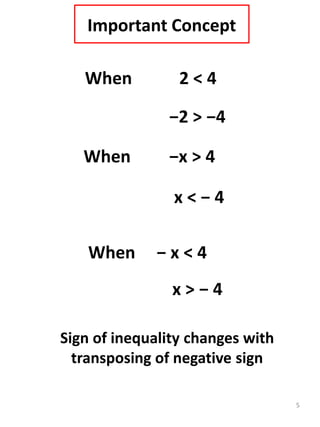
Important Concept
When 2 < 4
−2 > −4
When −x > 4
x < − 4
When − x < 4
x > − 4
Sign of inequality changes with
transposing of negative sign
6
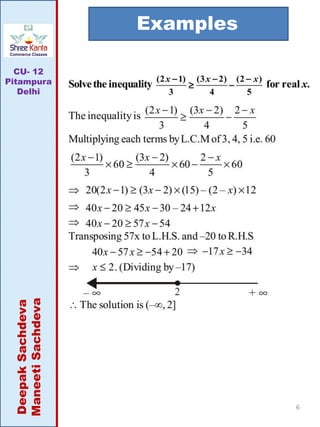
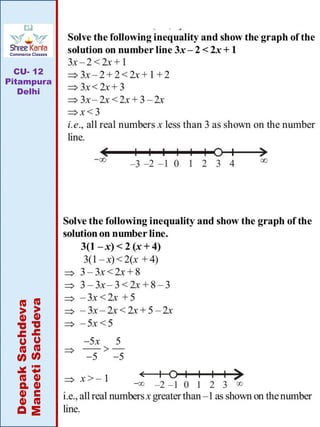
Examples
CU- 12
Pitampura
Delhi
7
CU- 12
Pitampura
Delhi
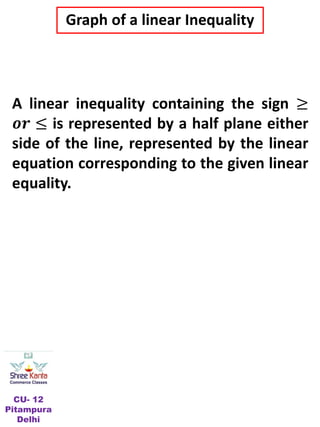
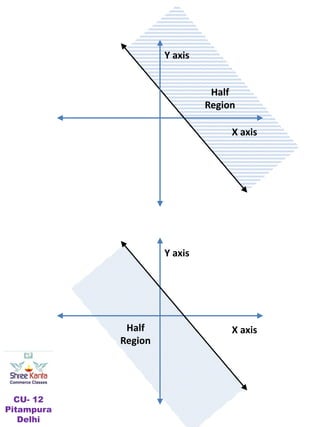
Graph of a linear Inequality
A linear inequality containing the sign ≥
𝒐𝒓 ≤ is represented by a half plane either
side of the line, represented by the linear
equation corresponding to the given linear
equality.
CU- 12
Pitampura
Delhi
X axis
Y axis
Half
Region
X axis
Y axis
Half
Region
CU- 12
Pitampura
Delhi
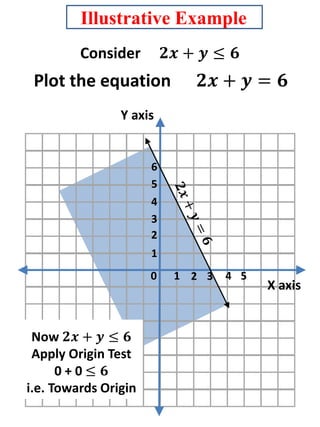
Illustrative Example
Consider 𝟐𝒙 + 𝒚 ≤ 𝟔
Plot the equation 𝟐𝒙 + 𝒚 = 𝟔
Y axis
X axis
0 1 2 3 4 5
1
2
3
4
5
6
Now 𝟐𝒙 + 𝒚 ≤ 𝟔
Apply Origin Test
0 + 0 ≤ 𝟔
i.e. Towards Origin
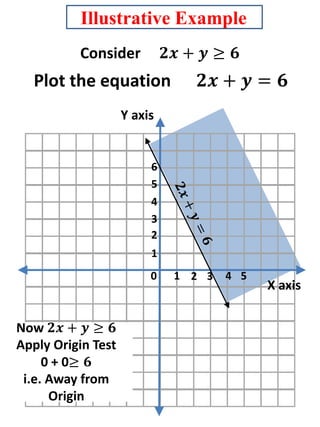
Illustrative Example
Consider 𝟐𝒙 + 𝒚 ≥ 𝟔
Plot the equation 𝟐𝒙 + 𝒚 = 𝟔
Y axis
X axis
0 1 2 3 4 5
1
2
3
4
5
6
Now 𝟐𝒙 + 𝒚 ≥ 𝟔
Apply Origin Test
0 + 0≥ 𝟔
i.e. Away from
Origin
12
CU- 12
Pitampura
Delhi
13
CU- 12
Pitampura
Delhi
14
CU- 12
Pitampura
Delhi
15
CU- 12
Pitampura
Delhi
16
CU- 12
Pitampura
Delhi
17
CU- 12
Pitampura
Delhi

Linear inequations

  • 1.
  • 2.
    Concept Building 2 INEQUALITY Any statementinvolving the symbols >, < , ≤ or ≥ is called an inequality. Two linear polynomials is related by a sign of inequality viz, >, <, ≥ or ≤ is called a linear inequality. Types of Inequalities (i) Inequalities which do not involve variables are called numerical inequalities. e.g 3<8, 5>2 (ii) Inequalities which involve variables are called literal inequalities. e.g. x > 3, y ≤ 5 (i) An inequality may contain more than one variable and it can be linear, quadratic or cubic etc. (ii) Inequalities involving the symbol > or < are called strict inequalities. (iii) Inequalities involving the symbol ≥ or ≤ are called slack inequalities. CU- 12 Pitampura Delhi
  • 3.
    3 Representation of Solutionof Linear Inequality in One Variable on a Number Line (i) If the inequality involves ≥ or ≤ , we draw filled circle (•) on the number line to indicate that the number corresponding to the filled circle is included in the solution set. e.g. x ≤ 5 𝒊. 𝒆. 𝒙 𝝐 (−∞, 𝟓] 5 ∞ −∞ x ≥ 5 𝒊. 𝒆. 𝒙 𝝐 [𝟓, ∞) 5 ∞ −∞
  • 4.
    4 (ii) If theinequality involves > or <, we draw an open circle (○) on the number line to indicate that the number corresponding to the open circle is excluded from the solution set. 5 ∞ −∞ x > 5 𝑖. 𝑒. 𝒙 𝝐 (𝟓, ∞) 5 ∞ −∞ x < 𝟓 𝒊. 𝒆. 𝒙 𝝐 (−∞, 𝟓)
  • 5.
    5 Important Concept When 2< 4 −2 > −4 When −x > 4 x < − 4 When − x < 4 x > − 4 Sign of inequality changes with transposing of negative sign
  • 6.
  • 7.
  • 8.
    Graph of alinear Inequality A linear inequality containing the sign ≥ 𝒐𝒓 ≤ is represented by a half plane either side of the line, represented by the linear equation corresponding to the given linear equality. CU- 12 Pitampura Delhi
  • 9.
    X axis Y axis Half Region Xaxis Y axis Half Region CU- 12 Pitampura Delhi
  • 10.
    Illustrative Example Consider 𝟐𝒙+ 𝒚 ≤ 𝟔 Plot the equation 𝟐𝒙 + 𝒚 = 𝟔 Y axis X axis 0 1 2 3 4 5 1 2 3 4 5 6 Now 𝟐𝒙 + 𝒚 ≤ 𝟔 Apply Origin Test 0 + 0 ≤ 𝟔 i.e. Towards Origin
  • 11.
    Illustrative Example Consider 𝟐𝒙+ 𝒚 ≥ 𝟔 Plot the equation 𝟐𝒙 + 𝒚 = 𝟔 Y axis X axis 0 1 2 3 4 5 1 2 3 4 5 6 Now 𝟐𝒙 + 𝒚 ≥ 𝟔 Apply Origin Test 0 + 0≥ 𝟔 i.e. Away from Origin
  • 12.
  • 13.
  • 14.
  • 15.
  • 16.
  • 17.