LINEAR
INEQUALITY IN
ONE VARIABLE
ax + b < c
SITUATION
SITUATION
A student should spend no
more than 2 hours a day on
social media. Let t represent
the time (in hours) spent
online.
SITUATION
A student should spend no
more than 2 hours a day on
social media. Let t represent
the time (in hours) spent
online.
How can we represent this as a
mathematical sentence?
SITUATION
A student should spend no
more than 2 hours a day on
social media. Let t represent
the time (in hours) spent
online.
How can we represent this as a
mathematical sentence?
t 2
≤
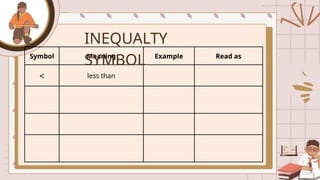
Symbol Meaning Example Read as
INEQUALTY
SYMBOL
Symbol Meaning Example Read as
<
INEQUALTY
SYMBOL
Symbol Meaning Example Read as
< less than
INEQUALTY
SYMBOL
Symbol Meaning Example Read as
< less than x < 4
INEQUALTY
SYMBOL
Symbol Meaning Example Read as
< less than x < 4 x is less than 4
INEQUALTY
SYMBOL
Symbol Meaning Example Read as
< less than x < 4 x is less than 4
>
INEQUALTY
SYMBOL
Symbol Meaning Example Read as
< less than x < 4 x is less than 4
> greater than
INEQUALTY
SYMBOL
Symbol Meaning Example Read as
< less than x < 4 x is less than 4
> greater than y > 2
INEQUALTY
SYMBOL
Symbol Meaning Example Read as
< less than x < 4 x is less than 4
> greater than y > 2 y is greater than 2
INEQUALTY
SYMBOL
Symbol Meaning Example Read as
< less than x < 4 x is less than 4
> greater than y > 2 y is greater than 2
≤
INEQUALTY
SYMBOL
Symbol Meaning Example Read as
< less than x < 4 x is less than 4
> greater than y > 2 y is greater than 2
≤ less than or equal to
INEQUALTY
SYMBOL
Symbol Meaning Example Read as
< less than x < 4 x is less than 4
> greater than y > 2 y is greater than 2
≤ less than or equal to a 10
≤
INEQUALTY
SYMBOL
Symbol Meaning Example Read as
< less than x < 4 x is less than 4
> greater than y > 2 y is greater than 2
≤ less than or equal to a 10
≤ a is at most 10
INEQUALTY
SYMBOL
Symbol Meaning Example Read as
< less than x < 4 x is less than 4
> greater than y > 2 y is greater than 2
≤ less than or equal to a 10
≤ a is at most 10
≥
INEQUALTY
SYMBOL
Symbol Meaning Example Read as
< less than x < 4 x is less than 4
> greater than y > 2 y is greater than 2
≤ less than or equal to a 10
≤ a is at most 10
≥
greater than or equal to
INEQUALTY
SYMBOL
Symbol Meaning Example Read as
< less than x < 4 x is less than 4
> greater than y > 2 y is greater than 2
≤ less than or equal to a 10
≤ a is at most 10
≥
greater than or equal to
b -3
≥
INEQUALTY
SYMBOL
Symbol Meaning Example Read as
< less than x < 4 x is less than 4
> greater than y > 2 y is greater than 2
≤ less than or equal to a 10
≤ a is at most 10
≥
greater than or equal to
b -3
≥ b is at least -3
INEQUALTY
SYMBOL
LINEAR
INEQUALITY IN
ONE VARIABLE
ax + b < c
LINEAR INEQUALITY
LINEAR INEQUALITY
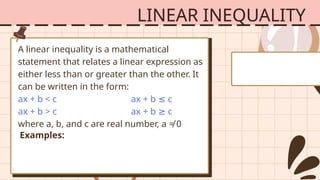
A linear inequality is a mathematical
statement that relates a linear expression as
either less than or greater than the other. It
can be written in the form:
LINEAR INEQUALITY
A linear inequality is a mathematical
statement that relates a linear expression as
either less than or greater than the other. It
can be written in the form:
ax + b < c
LINEAR INEQUALITY
A linear inequality is a mathematical
statement that relates a linear expression as
either less than or greater than the other. It
can be written in the form:
ax + b < c
ax + b > c
LINEAR INEQUALITY
A linear inequality is a mathematical
statement that relates a linear expression as
either less than or greater than the other. It
can be written in the form:
ax + b < c ax + b c
≤
ax + b > c
LINEAR INEQUALITY
A linear inequality is a mathematical
statement that relates a linear expression as
either less than or greater than the other. It
can be written in the form:
ax + b < c ax + b c
≤
ax + b > c ax + b c
≥
LINEAR INEQUALITY
A linear inequality is a mathematical
statement that relates a linear expression as
either less than or greater than the other. It
can be written in the form:
ax + b < c ax + b c
≤
ax + b > c ax + b c
≥
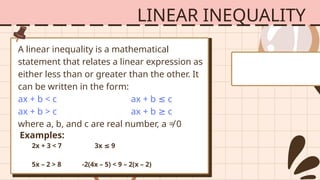
where a, b, and c are real number, a ≠ 0
LINEAR INEQUALITY
A linear inequality is a mathematical
statement that relates a linear expression as
either less than or greater than the other. It
can be written in the form:
ax + b < c ax + b c
≤
ax + b > c ax + b c
≥
where a, b, and c are real number, a ≠ 0
Examples:
LINEAR INEQUALITY
A linear inequality is a mathematical
statement that relates a linear expression as
either less than or greater than the other. It
can be written in the form:
ax + b < c ax + b c
≤
ax + b > c ax + b c
≥
where a, b, and c are real number, a ≠ 0
Examples:
2x + 3 < 7
LINEAR INEQUALITY
A linear inequality is a mathematical
statement that relates a linear expression as
either less than or greater than the other. It
can be written in the form:
ax + b < c ax + b c
≤
ax + b > c ax + b c
≥
where a, b, and c are real number, a ≠ 0
Examples:
2x + 3 < 7
5x – 2 > 8
LINEAR INEQUALITY
A linear inequality is a mathematical
statement that relates a linear expression as
either less than or greater than the other. It
can be written in the form:
ax + b < c ax + b c
≤
ax + b > c ax + b c
≥
where a, b, and c are real number, a ≠ 0
Examples:
2x + 3 < 7 3x 9
≤
5x – 2 > 8
LINEAR INEQUALITY
A linear inequality is a mathematical
statement that relates a linear expression as
either less than or greater than the other. It
can be written in the form:
ax + b < c ax + b c
≤
ax + b > c ax + b c
≥
where a, b, and c are real number, a ≠ 0
Examples:
2x + 3 < 7 3x 9
≤
5x – 2 > 8 -2(4x – 5) < 9 – 2(x – 2)
SOLVING LINEAR INEQUALITY IN ONE VARIABLE
A solution to a linear inequality is a number
that makes the inequality a true statement
when substituted for the variable. Linear
inequalities can have infinitely many
solutions or no solution at all.
SOLVING LINEAR INEQUALITY IN ONE VARIABLE
A solution to a linear inequality is a number
that makes the inequality a true statement
when substituted for the variable. Linear
inequalities can have infinitely many
solutions or no solution at all.
Steps:
SOLVING LINEAR INEQUALITY IN ONE VARIABLE
A solution to a linear inequality is a number
that makes the inequality a true statement
when substituted for the variable. Linear
inequalities can have infinitely many
solutions or no solution at all.
Steps:
1.Simplify both sides
SOLVING LINEAR INEQUALITY IN ONE VARIABLE
A solution to a linear inequality is a number
that makes the inequality a true statement
when substituted for the variable. Linear
inequalities can have infinitely many
solutions or no solution at all.
Steps:
1.Simplify both sides
2.Isolate the variable
SOLVING LINEAR INEQUALITY IN ONE VARIABLE
A solution to a linear inequality is a number
that makes the inequality a true statement
when substituted for the variable. Linear
inequalities can have infinitely many
solutions or no solution at all.
Steps:
1.Simplify both sides
2.Isolate the variable
3.When you multiply or divide both side by a negative number,
reverse the inequality sign
SOLVING LINEAR INEQUALITY IN ONE VARIABLE
A solution to a linear inequality is a number
that makes the inequality a true statement
when substituted for the variable. Linear
inequalities can have infinitely many
solutions or no solution at all.
Steps:
1.Simplify both sides
2.Isolate the variable
3.When you multiply or divide both side by a negative number,
reverse the inequality sign
4.Write the solution set
SOLVING LINEAR INEQUALITY IN ONE VARIABLE
A solution to a linear inequality is a number
that makes the inequality a true statement
when substituted for the variable. Linear
inequalities can have infinitely many
solutions or no solution at all.
Steps:
1.Simplify both sides
2.Isolate the variable
3.When you multiply or divide both side by a negative number,
reverse the inequality sign
4.Write the solution set
5.Graph the solution on a number line
SOLVING LINEAR INEQUALITY IN ONE VARIABLE
GRAPHING LINEAR INEQUALITY IN ONE
VARIABLE
GRAPHING LINEAR INEQUALITY IN ONE
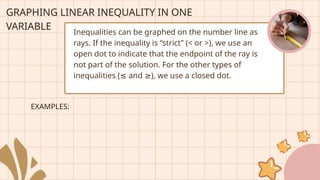
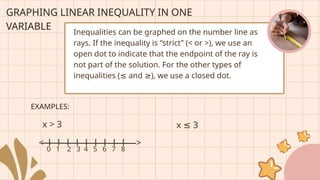
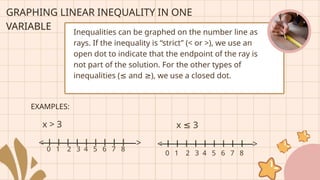
VARIABLE Inequalities can be graphed on the number line as
rays. If the inequality is “strict” (< or >), we use an
open dot to indicate that the endpoint of the ray is
not part of the solution. For the other types of
inequalities ( and ), we use a closed dot.
≤ ≥
GRAPHING LINEAR INEQUALITY IN ONE
VARIABLE Inequalities can be graphed on the number line as
rays. If the inequality is “strict” (< or >), we use an
open dot to indicate that the endpoint of the ray is
not part of the solution. For the other types of
inequalities ( and ), we use a closed dot.
≤ ≥
EXAMPLES:
GRAPHING LINEAR INEQUALITY IN ONE
VARIABLE Inequalities can be graphed on the number line as
rays. If the inequality is “strict” (< or >), we use an
open dot to indicate that the endpoint of the ray is
not part of the solution. For the other types of
inequalities ( and ), we use a closed dot.
≤ ≥
x > 3
EXAMPLES:
GRAPHING LINEAR INEQUALITY IN ONE
VARIABLE Inequalities can be graphed on the number line as
rays. If the inequality is “strict” (< or >), we use an
open dot to indicate that the endpoint of the ray is
not part of the solution. For the other types of
inequalities ( and ), we use a closed dot.
≤ ≥
x > 3
EXAMPLES:
< l l l l l l l l l >
0 1 2 3 4 5 6 7 8
GRAPHING LINEAR INEQUALITY IN ONE
VARIABLE Inequalities can be graphed on the number line as
rays. If the inequality is “strict” (< or >), we use an
open dot to indicate that the endpoint of the ray is
not part of the solution. For the other types of
inequalities ( and ), we use a closed dot.
≤ ≥
x > 3
EXAMPLES:
< l l l l l l l l l >
0 1 2 3 4 5 6 7 8
x 3
≤
GRAPHING LINEAR INEQUALITY IN ONE
VARIABLE Inequalities can be graphed on the number line as
rays. If the inequality is “strict” (< or >), we use an
open dot to indicate that the endpoint of the ray is
not part of the solution. For the other types of
inequalities ( and ), we use a closed dot.
≤ ≥
x > 3
EXAMPLES:
< l l l l l l l l l >
0 1 2 3 4 5 6 7 8
x 3
≤
< l l l l l l l l l >
0 1 2 3 4 5 6 7 8
SOLVING AND GRAPHING LINEAR INEQUALITY IN ONE
VARIABLE
SOLVING AND GRAPHING LINEAR INEQUALITY IN ONE
VARIABLE
Examples:
SOLVING AND GRAPHING LINEAR INEQUALITY IN ONE
VARIABLE
Examples:
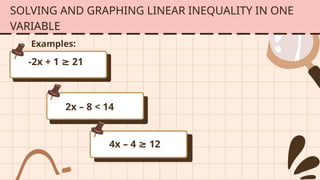
-2x + 1 21
≥
SOLVING AND GRAPHING LINEAR INEQUALITY IN ONE
VARIABLE
Examples:
-2x + 1 21
≥
2x – 8 < 14
SOLVING AND GRAPHING LINEAR INEQUALITY IN ONE
VARIABLE
Examples:
-2x + 1 21
≥
2x – 8 < 14
4x – 4 12
≥
PRACTICE
Try this!
-5x + 3 < 28
PRACTICE
Try this!
-5x + 3 < 28
1/2x – 7 < 13

Linear inequality in one variable (1).pptx

  • 1.
  • 2.
  • 3.
    SITUATION A student shouldspend no more than 2 hours a day on social media. Let t represent the time (in hours) spent online.
  • 4.
    SITUATION A student shouldspend no more than 2 hours a day on social media. Let t represent the time (in hours) spent online. How can we represent this as a mathematical sentence?
  • 5.
    SITUATION A student shouldspend no more than 2 hours a day on social media. Let t represent the time (in hours) spent online. How can we represent this as a mathematical sentence? t 2 ≤
  • 6.
    Symbol Meaning ExampleRead as INEQUALTY SYMBOL
  • 7.
    Symbol Meaning ExampleRead as < INEQUALTY SYMBOL
  • 8.
    Symbol Meaning ExampleRead as < less than INEQUALTY SYMBOL
  • 9.
    Symbol Meaning ExampleRead as < less than x < 4 INEQUALTY SYMBOL
  • 10.
    Symbol Meaning ExampleRead as < less than x < 4 x is less than 4 INEQUALTY SYMBOL
  • 11.
    Symbol Meaning ExampleRead as < less than x < 4 x is less than 4 > INEQUALTY SYMBOL
  • 12.
    Symbol Meaning ExampleRead as < less than x < 4 x is less than 4 > greater than INEQUALTY SYMBOL
  • 13.
    Symbol Meaning ExampleRead as < less than x < 4 x is less than 4 > greater than y > 2 INEQUALTY SYMBOL
  • 14.
    Symbol Meaning ExampleRead as < less than x < 4 x is less than 4 > greater than y > 2 y is greater than 2 INEQUALTY SYMBOL
  • 15.
    Symbol Meaning ExampleRead as < less than x < 4 x is less than 4 > greater than y > 2 y is greater than 2 ≤ INEQUALTY SYMBOL
  • 16.
    Symbol Meaning ExampleRead as < less than x < 4 x is less than 4 > greater than y > 2 y is greater than 2 ≤ less than or equal to INEQUALTY SYMBOL
  • 17.
    Symbol Meaning ExampleRead as < less than x < 4 x is less than 4 > greater than y > 2 y is greater than 2 ≤ less than or equal to a 10 ≤ INEQUALTY SYMBOL
  • 18.
    Symbol Meaning ExampleRead as < less than x < 4 x is less than 4 > greater than y > 2 y is greater than 2 ≤ less than or equal to a 10 ≤ a is at most 10 INEQUALTY SYMBOL
  • 19.
    Symbol Meaning ExampleRead as < less than x < 4 x is less than 4 > greater than y > 2 y is greater than 2 ≤ less than or equal to a 10 ≤ a is at most 10 ≥ INEQUALTY SYMBOL
  • 20.
    Symbol Meaning ExampleRead as < less than x < 4 x is less than 4 > greater than y > 2 y is greater than 2 ≤ less than or equal to a 10 ≤ a is at most 10 ≥ greater than or equal to INEQUALTY SYMBOL
  • 21.
    Symbol Meaning ExampleRead as < less than x < 4 x is less than 4 > greater than y > 2 y is greater than 2 ≤ less than or equal to a 10 ≤ a is at most 10 ≥ greater than or equal to b -3 ≥ INEQUALTY SYMBOL
  • 22.
    Symbol Meaning ExampleRead as < less than x < 4 x is less than 4 > greater than y > 2 y is greater than 2 ≤ less than or equal to a 10 ≤ a is at most 10 ≥ greater than or equal to b -3 ≥ b is at least -3 INEQUALTY SYMBOL
  • 23.
  • 24.
  • 25.
    LINEAR INEQUALITY A linearinequality is a mathematical statement that relates a linear expression as either less than or greater than the other. It can be written in the form:
  • 26.
    LINEAR INEQUALITY A linearinequality is a mathematical statement that relates a linear expression as either less than or greater than the other. It can be written in the form: ax + b < c
  • 27.
    LINEAR INEQUALITY A linearinequality is a mathematical statement that relates a linear expression as either less than or greater than the other. It can be written in the form: ax + b < c ax + b > c
  • 28.
    LINEAR INEQUALITY A linearinequality is a mathematical statement that relates a linear expression as either less than or greater than the other. It can be written in the form: ax + b < c ax + b c ≤ ax + b > c
  • 29.
    LINEAR INEQUALITY A linearinequality is a mathematical statement that relates a linear expression as either less than or greater than the other. It can be written in the form: ax + b < c ax + b c ≤ ax + b > c ax + b c ≥
  • 30.
    LINEAR INEQUALITY A linearinequality is a mathematical statement that relates a linear expression as either less than or greater than the other. It can be written in the form: ax + b < c ax + b c ≤ ax + b > c ax + b c ≥ where a, b, and c are real number, a ≠ 0
  • 31.
    LINEAR INEQUALITY A linearinequality is a mathematical statement that relates a linear expression as either less than or greater than the other. It can be written in the form: ax + b < c ax + b c ≤ ax + b > c ax + b c ≥ where a, b, and c are real number, a ≠ 0 Examples:
  • 32.
    LINEAR INEQUALITY A linearinequality is a mathematical statement that relates a linear expression as either less than or greater than the other. It can be written in the form: ax + b < c ax + b c ≤ ax + b > c ax + b c ≥ where a, b, and c are real number, a ≠ 0 Examples: 2x + 3 < 7
  • 33.
    LINEAR INEQUALITY A linearinequality is a mathematical statement that relates a linear expression as either less than or greater than the other. It can be written in the form: ax + b < c ax + b c ≤ ax + b > c ax + b c ≥ where a, b, and c are real number, a ≠ 0 Examples: 2x + 3 < 7 5x – 2 > 8
  • 34.
    LINEAR INEQUALITY A linearinequality is a mathematical statement that relates a linear expression as either less than or greater than the other. It can be written in the form: ax + b < c ax + b c ≤ ax + b > c ax + b c ≥ where a, b, and c are real number, a ≠ 0 Examples: 2x + 3 < 7 3x 9 ≤ 5x – 2 > 8
  • 35.
    LINEAR INEQUALITY A linearinequality is a mathematical statement that relates a linear expression as either less than or greater than the other. It can be written in the form: ax + b < c ax + b c ≤ ax + b > c ax + b c ≥ where a, b, and c are real number, a ≠ 0 Examples: 2x + 3 < 7 3x 9 ≤ 5x – 2 > 8 -2(4x – 5) < 9 – 2(x – 2)
  • 36.
  • 37.
    A solution toa linear inequality is a number that makes the inequality a true statement when substituted for the variable. Linear inequalities can have infinitely many solutions or no solution at all. SOLVING LINEAR INEQUALITY IN ONE VARIABLE
  • 38.
    A solution toa linear inequality is a number that makes the inequality a true statement when substituted for the variable. Linear inequalities can have infinitely many solutions or no solution at all. Steps: SOLVING LINEAR INEQUALITY IN ONE VARIABLE
  • 39.
    A solution toa linear inequality is a number that makes the inequality a true statement when substituted for the variable. Linear inequalities can have infinitely many solutions or no solution at all. Steps: 1.Simplify both sides SOLVING LINEAR INEQUALITY IN ONE VARIABLE
  • 40.
    A solution toa linear inequality is a number that makes the inequality a true statement when substituted for the variable. Linear inequalities can have infinitely many solutions or no solution at all. Steps: 1.Simplify both sides 2.Isolate the variable SOLVING LINEAR INEQUALITY IN ONE VARIABLE
  • 41.
    A solution toa linear inequality is a number that makes the inequality a true statement when substituted for the variable. Linear inequalities can have infinitely many solutions or no solution at all. Steps: 1.Simplify both sides 2.Isolate the variable 3.When you multiply or divide both side by a negative number, reverse the inequality sign SOLVING LINEAR INEQUALITY IN ONE VARIABLE
  • 42.
    A solution toa linear inequality is a number that makes the inequality a true statement when substituted for the variable. Linear inequalities can have infinitely many solutions or no solution at all. Steps: 1.Simplify both sides 2.Isolate the variable 3.When you multiply or divide both side by a negative number, reverse the inequality sign 4.Write the solution set SOLVING LINEAR INEQUALITY IN ONE VARIABLE
  • 43.
    A solution toa linear inequality is a number that makes the inequality a true statement when substituted for the variable. Linear inequalities can have infinitely many solutions or no solution at all. Steps: 1.Simplify both sides 2.Isolate the variable 3.When you multiply or divide both side by a negative number, reverse the inequality sign 4.Write the solution set 5.Graph the solution on a number line SOLVING LINEAR INEQUALITY IN ONE VARIABLE
  • 44.
  • 45.
    GRAPHING LINEAR INEQUALITYIN ONE VARIABLE Inequalities can be graphed on the number line as rays. If the inequality is “strict” (< or >), we use an open dot to indicate that the endpoint of the ray is not part of the solution. For the other types of inequalities ( and ), we use a closed dot. ≤ ≥
  • 46.
    GRAPHING LINEAR INEQUALITYIN ONE VARIABLE Inequalities can be graphed on the number line as rays. If the inequality is “strict” (< or >), we use an open dot to indicate that the endpoint of the ray is not part of the solution. For the other types of inequalities ( and ), we use a closed dot. ≤ ≥ EXAMPLES:
  • 47.
    GRAPHING LINEAR INEQUALITYIN ONE VARIABLE Inequalities can be graphed on the number line as rays. If the inequality is “strict” (< or >), we use an open dot to indicate that the endpoint of the ray is not part of the solution. For the other types of inequalities ( and ), we use a closed dot. ≤ ≥ x > 3 EXAMPLES:
  • 48.
    GRAPHING LINEAR INEQUALITYIN ONE VARIABLE Inequalities can be graphed on the number line as rays. If the inequality is “strict” (< or >), we use an open dot to indicate that the endpoint of the ray is not part of the solution. For the other types of inequalities ( and ), we use a closed dot. ≤ ≥ x > 3 EXAMPLES: < l l l l l l l l l > 0 1 2 3 4 5 6 7 8
  • 49.
    GRAPHING LINEAR INEQUALITYIN ONE VARIABLE Inequalities can be graphed on the number line as rays. If the inequality is “strict” (< or >), we use an open dot to indicate that the endpoint of the ray is not part of the solution. For the other types of inequalities ( and ), we use a closed dot. ≤ ≥ x > 3 EXAMPLES: < l l l l l l l l l > 0 1 2 3 4 5 6 7 8 x 3 ≤
  • 50.
    GRAPHING LINEAR INEQUALITYIN ONE VARIABLE Inequalities can be graphed on the number line as rays. If the inequality is “strict” (< or >), we use an open dot to indicate that the endpoint of the ray is not part of the solution. For the other types of inequalities ( and ), we use a closed dot. ≤ ≥ x > 3 EXAMPLES: < l l l l l l l l l > 0 1 2 3 4 5 6 7 8 x 3 ≤ < l l l l l l l l l > 0 1 2 3 4 5 6 7 8
  • 51.
    SOLVING AND GRAPHINGLINEAR INEQUALITY IN ONE VARIABLE
  • 52.
    SOLVING AND GRAPHINGLINEAR INEQUALITY IN ONE VARIABLE Examples:
  • 53.
    SOLVING AND GRAPHINGLINEAR INEQUALITY IN ONE VARIABLE Examples: -2x + 1 21 ≥
  • 54.
    SOLVING AND GRAPHINGLINEAR INEQUALITY IN ONE VARIABLE Examples: -2x + 1 21 ≥ 2x – 8 < 14
  • 55.
    SOLVING AND GRAPHINGLINEAR INEQUALITY IN ONE VARIABLE Examples: -2x + 1 21 ≥ 2x – 8 < 14 4x – 4 12 ≥
  • 56.
  • 57.
    PRACTICE Try this! -5x +3 < 28 1/2x – 7 < 13