Lesson Exemplar forMathematics Grade 8
Quarter 3: Lesson 3 (Week 3)
SY 2025-2026
This material is intended exclusively for the use of teachers participating in the pilot implementation of the MATATAG K to 10 Curriculum during the
School Year 2024-2025. It aims to assist in delivering the curriculum content, standards, and lesson competencies. Any unauthorized reproduction, distribution,
modification, or utilization of this material beyond the designated scope is strictly prohibited and may result in appropriate legal actions and disciplinary measures.
Borrowed content included in this material are owned by their respective copyright holders. Every effort has been made to locate and obtain permission
to use these materials from their respective copyright owners. The publisher and development team do not represent nor claim ownership over them.
Every care has been taken to ensure the accuracy of the information provided in this material. For inquiries or feedback, please write or call the Office
of the Director of the Bureau of Learning Resources via telephone numbers (02) 8634-1072 and 8631-6922 or by email at blr.od@deped.gov.ph.
Development Team
Writer:
• Maria-Josephine T. Arguilles (Tinajeros National High School)
Validator:
• Ysmael V. Caballas (Philippine Normal University – South Luzon)
Management Team
Philippine Normal University
Research Institute for Teacher Quality
SiMERR National Research Centre
3.
1
MATHEMATICS / QUARTER3 / GRADE 8
I. CURRICULUM CONTENT, STANDARDS, AND LESSON COMPETENCIES
A. Content
Standards
The learners should have knowledge and understanding of linear inequalities in one variable and their graphs.
B. Performance
Standards
By the end of the quarter, the learners are able to:
• Solve linear equations and linear inequalities in one variable. (NA)
• Graph linear inequalities in one variable. (NA)Graph linear equations in two variables. (NA)
C. Learning
Competencies
and Objectives
Learning Competency
1. solve linear inequalities in one variable.
2. graph on a number line the solution of linear inequalities in one variable.
3. solve problems involving linear inequalities in one variable.
D. Content Linear Inequalities in One Variable and their Graphs
Word Problems Involving Linear Inequalities in One Variables
E. Integration Real Life Situations
II. LEARNING RESOURCES
Varsity Tutors. (2024). Graphing Inequalities in One Variable. https://www.varsitytutors.com/hotmath/hotmath_help/topics/graphing-
inequalities-in-one-variable
Math planet. (2011, March 2). Solving linear inequalities. [Video]. https://www.mathplanet.com/education/algebra-1/linear-
inequalities/solving-linear-
inequalities#:~:text=The%20graph%20of%20a%20linear,circle%20for%20%E2%89%A4%20and%20%E2%89%A5.&text=Inequalities%20t
hat%20have%20the%20same,there%20were%20properties%20of%20equality
4.
2
III. TEACHING ANDLEARNING PROCEDURE NOTES TO TEACHERS
A. Activating Prior
Knowledge
DAY 1
1. Short Review
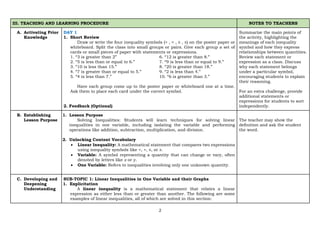
Draw or write the four inequality symbols (> , < , ≥ , ≤) on the poster paper or
whiteboard. Split the class into small groups or pairs. Give each group a set of
cards or small pieces of paper with statements or expressions.
1. “3 is greater than 2” 6. “12 is greater than 8.”
2. “5 is less than or equal to 6.” 7. “9 is less than or equal to 9.”
3. “10 is less than 15.” 8. “20 is greater than 18.”
4. “7 is greater than or equal to 5.” 9. “2 is less than 4.”
5. “4 is less than 7.” 10. “6 is greater than 3.”
Have each group come up to the poster paper or whiteboard one at a time.
Ask them to place each card under the correct symbol.
2. Feedback (Optional)
Summarize the main points of
the activity, highlighting the
meanings of each inequality
symbol and how they express
relationships between quantities.
Review each statement or
expression as a class. Discuss
why each statement belongs
under a particular symbol,
encouraging students to explain
their reasoning.
For an extra challenge, provide
additional statements or
expressions for students to sort
independently.
B. Establishing
Lesson Purpose
1. Lesson Purpose
Solving Inequalities: Students will learn techniques for solving linear
inequalities in one variable, including isolating the variable and performing
operations like addition, subtraction, multiplication, and division.
2. Unlocking Content Vocabulary
• Linear Inequality: A mathematical statement that compares two expressions
using inequality symbols like <, >, ≤, or ≥.
• Variable: A symbol representing a quantity that can change or vary, often
denoted by letters like x or 𝑦.
• One Variable: Refers to inequalities involving only one unknown quantity.
The teacher may show the
definition and ask the student
the word.
C. Developing and
Deepening
Understanding
SUB-TOPIC 1: Linear Inequalities in One Variable and their Graphs
1. Explicitation
A linear inequality is a mathematical statement that relates a linear
expression as either less than or greater than another. The following are some
examples of linear inequalities, all of which are solved in this section:
5.
3
5x +7 <22
−2(x+ 8) +6 ≥ 20
−2(4x −5) < 9 − 2(x − 2)
A solution to a linear inequality is a number that makes the inequality a true
statement when substituted for the variable. Linear inequalities can have
infinitely many solutions or no solution at all. If infinitely many solutions exist,
the solution set can be graphed on a number line and/or expressed using interval
notation.
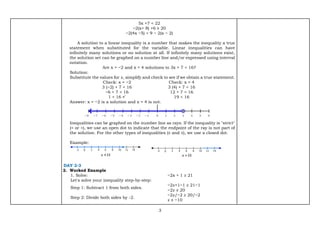
Are x = −2 and x = 4 solutions to 3x + 7 < 16?
Solution:
Substitute the values for 𝑥, simplify and check to see if we obtain a true statement.
Check: x = −2
3 (−2) + 7 < 16
−6 + 7 < 16
1 < 16 ✓
Check: x = 4
3 (4) + 7 < 16
12 + 7 < 16
19 < 16
Answer: x = −2 is a solution and x = 4 is not.
Inequalities can be graphed on the number line as rays. If the inequality is "strict"
(< or >), we use an open dot to indicate that the endpoint of the ray is not part of
the solution. For the other types of inequalities (≤ and ≥), we use a closed dot.
Example:
DAY 2-3
2. Worked Example
1. Solve: −2x + 1 ≥ 21
Let's solve your inequality step-by-step:
Step 1: Subtract 1 from both sides.
−2𝑥+1−1 ≥ 21−1
−2𝑥 ≥ 20
Step 2: Divide both sides by -2.
−2𝑥/−2 ≥ 20/−2
𝑥 ≤ −10
6.
4
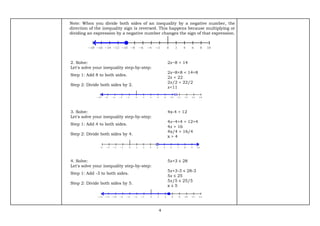
Note: When youdivide both sides of an inequality by a negative number, the
direction of the inequality sign is reversed. This happens because multiplying or
dividing an expression by a negative number changes the sign of that expression.
2. Solve: 2𝑥−8 < 14
Let's solve your inequality step-by-step:
Step 1: Add 8 to both sides.
2𝑥−8+8 < 14+8
2𝑥 < 22
Step 2: Divide both sides by 2.
2𝑥/2 < 22/2
𝑥<11
3. Solve: 4x-4 > 12
Let's solve your inequality step-by-step:
Step 1: Add 4 to both sides.
4𝑥−4+4 > 12+4
4𝑥 > 16
Step 2: Divide both sides by 4.
4x/4 > 16/4
x > 4
4. Solve: 5𝑥+3 ≤ 28
Let's solve your inequality step-by-step:
Step 1: Add -3 to both sides.
5𝑥+3-3 ≤ 28-3
5𝑥 ≤ 25
Step 2: Divide both sides by 5.
5𝑥/5 ≤ 25/5
x ≤ 5
7.
5
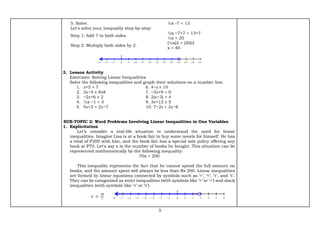
5. Solve: ½x-7 < 13
Let's solve your inequality step-by-step:
Step 1: Add 7 to both sides.
½x −7+7 < 13+7
½x < 20
Step 2: Multiply both sides by 2.
(½x)2 < (20)2
x < 40
3. Lesson Activity
Exercises: Solving Linear Inequalities
Solve the following inequalities and graph their solutions on a number line.
1. x+5 > 7 6. 4−𝑥 ≤ 10
2. 3𝑥−4 ≤ 8≤8 7. −3𝑥+9 < 0
3. −2𝑥+6 ≥ 2 8. 2(𝑥−3) > 4
4. ½x −1 < 3 9. 3𝑥+12 ≥ 5
5. 5𝑥+3 > 2𝑥−7 10. 7−2𝑥 < 3𝑥−8
SUB-TOPIC 2: Word Problems Involving Linear Inequalities in One Variables
1. Explicitation
Let’s consider a real-life situation to understand the need for linear
inequalities. Imagine Lisa is at a book fair to buy some novels for himself. He has
a total of P200 with him, and the book fair has a special sale policy offering any
book at P70. Let's say x is the number of books he bought. This situation can be
represented mathematically by the following inequality:
70x < 200
This inequality represents the fact that he cannot spend the full amount on
books, and the amount spent will always be less than Rs 200. Linear inequalities
are formed by linear equations connected by symbols such as ‘>’, ‘<‘, ‘≥’, and ’≤’.
They can be categorized as strict inequalities (with symbols like ‘>’ or ‘<‘) and slack
inequalities (with symbols like ‘≥’ or ‘≤’).
𝑥 <
20
7
8.
6
When solving linearinequalities, remember the following rules:
1. Adding or subtracting equal numbers from both sides of the inequality does
not change the sign of the inequality.
2. Multiplying or dividing both sides by a positive number does not change the
sign of the inequality.
3. However, if both sides are multiplied or divided by a negative number, the
sign of the inequality is reversed.
DAY 2-3
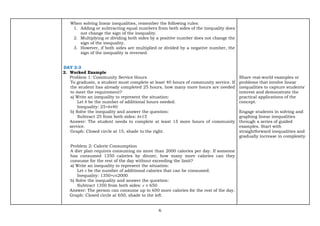
2. Worked Example
Problem 1: Community Service Hours
To graduate, a student must complete at least 40 hours of community service. If
the student has already completed 25 hours, how many more hours are needed
to meet the requirement?
a) Write an inequality to represent the situation:
Let ℎ be the number of additional hours needed.
Inequality: 25+ℎ≥40
b) Solve the inequality and answer the question:
Subtract 25 from both sides: ℎ≥15
Answer: The student needs to complete at least 15 more hours of community
service.
Graph: Closed circle at 15, shade to the right.
Problem 2: Calorie Consumption
A diet plan requires consuming no more than 2000 calories per day. If someone
has consumed 1350 calories by dinner, how many more calories can they
consume for the rest of the day without exceeding the limit?
a) Write an inequality to represent the situation:
Let 𝑐 be the number of additional calories that can be consumed.
Inequality: 1350+𝑐≤2000
b) Solve the inequality and answer the question:
Subtract 1350 from both sides: 𝑐 ≤ 650
Answer: The person can consume up to 650 more calories for the rest of the day.
Graph: Closed circle at 650, shade to the left.
Share real-world examples or
problems that involve linear
inequalities to capture students'
interest and demonstrate the
practical applications of the
concept.
Engage students in solving and
graphing linear inequalities
through a series of guided
examples. Start with
straightforward inequalities and
gradually increase in complexity.
9.
7
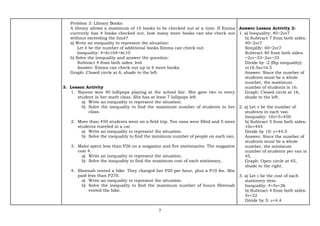
Problem 3: LibraryBooks
A library allows a maximum of 10 books to be checked out at a time. If Emma
currently has 4 books checked out, how many more books can she check out
without exceeding the limit?
a) Write an inequality to represent the situation:
Let 𝑏 be the number of additional books Emma can check out.
Inequality: 4+𝑏≤104+b≤10
b) Solve the inequality and answer the question:
Subtract 4 from both sides: 𝑏≤6
Answer: Emma can check out up to 6 more books.
Graph: Closed circle at 6, shade to the left.
3. Lesson Activity
1. Nayeon won 40 lollipops playing at the school fair. She gave two to every
student in her math class. She has at least 7 lollipops left.
a) Write an inequality to represent the situation.
b) Solve the inequality to find the maximum number of students in her
class.
2. More than 450 students went on a field trip. Ten vans were filled and 5 more
students traveled in a car.
a) Write an inequality to represent the situation.
b) Solve the inequality to find the minimum number of people on each van.
3. Maloi spent less than P26 on a magazine and five stationaries. The magazine
cost 4.
a) Write an inequality to represent the situation.
b) Solve the inequality to find the maximum cost of each stationary,
4. Sheenah rented a bike. They charged her P20 per hour, plus a P10 fee. She
paid less than P270.
a) Write an inequality to represent the situation.
b) Solve the inequality to find the maximum number of hours Sheenah
rented the bike.
Answer Lesson Activity 2:
1. a) Inequality: 40−2𝑠≥7
b) Subtract 7 from both sides:
40−2𝑠≥7
Simplify: 40−2𝑠≥7
Subtract 40 from both sides:
−2𝑠≥−33−2s≥−33
Divide by -2 (flip inequality):
𝑠≤16.5s≤16.5
Answer: Since the number of
students must be a whole
number, the maximum
number of students is 16.
Graph: Closed circle at 16,
shade to the left.
2. a) Let 𝑣 be the number of
students in each van.
Inequality: 10𝑣+5>450
b) Subtract 5 from both sides:
10𝑣>445
Divide by 10: 𝑣>44.5
Answer: Since the number of
students must be a whole
number, the minimum
number of students per van is
45.
Graph: Open circle at 45,
shade to the right.
3. a) Let 𝑠 be the cost of each
stationery item.
Inequality: 4+5𝑠<26
b) Subtract 4 from both sides:
5𝑠<22
Divide by 5: 𝑠<4.4
10.
8
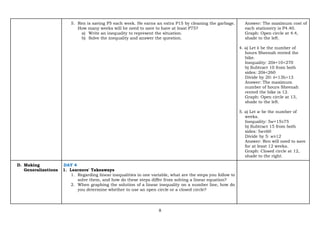
5. Ren issaving P5 each week. He earns an extra P15 by cleaning the garbage.
How many weeks will he need to save to have at least P75?
a) Write an inequality to represent the situation.
b) Solve the inequality and answer the question.
Answer: The maximum cost of
each stationery is P4.40.
Graph: Open circle at 4.4,
shade to the left.
4. a) Let ℎ be the number of
hours Sheenah rented the
bike.
Inequality: 20ℎ+10<270
b) Subtract 10 from both
sides: 20ℎ<260
Divide by 20: ℎ<13h<13
Answer: The maximum
number of hours Sheenah
rented the bike is 12.
Graph: Open circle at 13,
shade to the left.
5. a) Let 𝑤 be the number of
weeks.
Inequality: 5𝑤+15≥75
b) Subtract 15 from both
sides: 5𝑤≥60
Divide by 5: 𝑤≥12
Answer: Ren will need to save
for at least 12 weeks.
Graph: Closed circle at 12,
shade to the right.
D. Making
Generalizations
DAY 4
1. Learners' Takeaways
1. Regarding linear inequalities in one variable, what are the steps you follow to
solve them, and how do these steps differ from solving a linear equation?
2. When graphing the solution of a linear inequality on a number line, how do
you determine whether to use an open circle or a closed circle?
11.
9
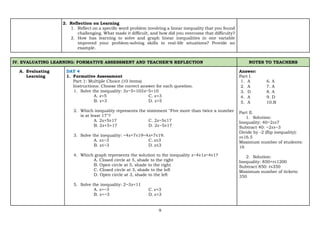
2. Reflection onLearning
1. Reflect on a specific word problem involving a linear inequality that you found
challenging. What made it difficult, and how did you overcome that difficulty?
2. How has learning to solve and graph linear inequalities in one variable
improved your problem-solving skills in real-life situations? Provide an
example.
IV. EVALUATING LEARNING: FORMATIVE ASSESSMENT AND TEACHER’S REFLECTION NOTES TO TEACHERS
A. Evaluating
Learning
DAY 4
1. Formative Assessment
Part 1: Multiple Choice (10 items)
Instructions: Choose the correct answer for each question.
1. Solve the inequality: 3𝑥−5<103x−5<10
A. 𝑥<5 C. 𝑥>3
B. 𝑥<3 D. 𝑥>5
2. Which inequality represents the statement "Five more than twice a number
is at least 17"?
A. 2𝑥+5≥17 C. 2𝑥−5≤17
B. 2𝑥+5>17 D. 2𝑥−5≥17
3. Solve the inequality: −4𝑥+7≤19−4x+7≤19.
A. 𝑥≥−3 C. 𝑥≥3
B. 𝑥≤−3 D. 𝑥≤3
4. Which graph represents the solution to the inequality 𝑥−4≥1x−4≥1?
A. Closed circle at 5, shade to the right
B. Open circle at 5, shade to the right
C. Closed circle at 3, shade to the left
D. Open circle at 3, shade to the left
5. Solve the inequality: 2−3𝑥<11
A. 𝑥>−3 C. 𝑥<3
B. 𝑥<−3 D. 𝑥>3
Answer:
Part I.
1. A 6. A
2. A 7. A
3. D 8. A
4. A 9. D
5. A 10.B
Part II.
1. Solution:
Inequality: 40−2𝑠≥7
Subtract 40: −2𝑠≥−3
Divide by -2 (flip inequality):
𝑠≤16.5
Maximum number of students:
16
2. Solution:
Inequality: 850+𝑡≤1200
Subtract 850: 𝑡≤350
Maximum number of tickets:
350
12.
10
6. If 5𝑥+2>17,what is the solution for 𝑥x?
A. 𝑥>3 C. 𝑥<3
B. 𝑥>2 D. 𝑥<2
7. Solve the inequality: 4x−3≤2
A. 𝑥≤20x≤20 C. 𝑥≤1x≤1
B. 𝑥≥20x≥20 D. 𝑥≥1x≥1
8. Which inequality represents "The sum of a number and 8 is less than 15"?
A. 𝑥+8<15 C. 𝑥−8<15
B. 𝑥+8≤15 D. 𝑥−8≤15
9. Solve the inequality: −2𝑥+3>−5.
A. 𝑥<4 C. 𝑥<−1
B. 𝑥>4 D. 𝑥>−1
10.Which graph represents the solution to the inequality 3𝑥+4≤10?
A. Open circle at 2, shade to the left
B. Closed circle at 2, shade to the left
C. Open circle at -2, shade to the right
D. Closed circle at -2, shade to the right
Part 2: Problem Solving (10 items)
Instructions: Solve each problem. Show all your work and provide a clear
explanation of your solution.
1. Nayeon won 40 lollipops playing at the school fair. She gave two to every
student in her math class. She has at least 7 lollipops left. Write and solve
an inequality to find the maximum number of students in her class.
2. A concert hall can hold a maximum of 1200 people. If 850 tickets have
already been sold, how many more tickets can be sold without exceeding
the maximum capacity?
3. Michael wants to buy a smartphone that costs PHP 30,000. He has saved
PHP 12,000 and plans to save PHP 2,000 each week. Write and solve an
inequality to find the minimum number of weeks Michael needs to save to
afford the smartphone.
3. Solution:
Inequality:
12,000+2,000𝑤≥30,000
Subtract 12,000: 2,000𝑤≥18,
Divide by 2,000: 𝑤≥9
Minimum number of weeks: 9
4. Solution:
Inequality: 850+𝑤≥1500
Subtract 850: 𝑤≥650
Minimum number of widgets:
650
5. Solution:
Inequality: 8,000+𝑥<15,000
Subtract 8,000: 𝑥<7,000
Maximum spending for rest of
month: PHP 7,000
6. Solution:
Inequality: 4+𝑏≤10
Subtract 4: 𝑏≤6
Maximum additional books: 6
7. Solution:
Inequality: 3,500+𝑥>5,000
Subtract 3,500: 𝑥>1,500
Minimum additional spending:
PHP 1,500
8. Solution:
Inequality: 3200+𝑔≤5000
Subtract 3200: 𝑔≤1800
Maximum additional gallons:
1800
13.
11
4. A factoryproduces at least 1500 widgets per day to meet demand. If it has
already produced 850 widgets by noon, how many more widgets does it
need to produce in the afternoon to meet the daily demand?
5. Jane wants to keep her monthly expenses under PHP 15,000. She has
already spent PHP 8,000 this month. How much can she spend for the rest
of the month without exceeding her budget?
6. A library allows a maximum of 10 books to be checked out at a time. If
Emma currently has 4 books checked out, how many more books can she
check out without exceeding the limit?
7. To qualify for a discount, a customer must spend more than PHP 5,000 at
a store. If the customer has already spent PHP 3,500, how much more does
the customer need to spend to get the discount?
8. A swimming pool can hold a maximum of 5000 gallons of water. If the pool
currently contains 3200 gallons, how many more gallons can be added
without exceeding the capacity?
9. A student needs to complete at least 40 hours of community service to
graduate. If the student has already completed 25 hours, how many more
hours are needed to meet the requirement?
10.Sheenah rented a bike. They charged her P20 per hour, plus a P10 fee. She
paid less than P270. Write and solve an inequality to find the maximum
number of hours Sheenah rented the bike.
2. Homework (Optional)
9. Solution:
Inequality: 25+ℎ≥40
Subtract 25: ℎ≥15
Minimum additional hours: 15
10.Solution:
Inequality: 20ℎ+10<270
Subtract 10: 20h<260
Minimum rent hours: 12
B. Teacher’s
Remarks
Note observations on any
of the following areas:
Effective Practices Problems Encountered
The teacher may take note of
some observations related to the
effective practices and problems
encountered after utilizing the
different strategies, materials
used, learner engagement, and
other related stuff.
Teachers may also suggest ways
to improve the different activities
explored/lesson exemplar.
strategies explored
materials used
learner engagement/
interaction
others
14.
12
C. Teacher’s
Reflection
Reflection guideor prompt can be on:
• principles behind the teaching
What principles and beliefs informed my lesson?
Why did I teach the lesson the way I did?
• students
What roles did my students play in my lesson?
What did my students learn? How did they learn?
• ways forward
What could I have done differently?
What can I explore in the next lesson?
Teacher’s reflection in every
lesson conducted/facilitated is
essential and necessary to
improve practice. You may also
consider this as an input for the
LAC/Collab sessions.

![1
MATHEMATICS / QUARTER 3 / GRADE 8
I. CURRICULUM CONTENT, STANDARDS, AND LESSON COMPETENCIES
A. Content
Standards
The learners should have knowledge and understanding of linear inequalities in one variable and their graphs.
B. Performance
Standards
By the end of the quarter, the learners are able to:
• Solve linear equations and linear inequalities in one variable. (NA)
• Graph linear inequalities in one variable. (NA)Graph linear equations in two variables. (NA)
C. Learning
Competencies
and Objectives
Learning Competency
1. solve linear inequalities in one variable.
2. graph on a number line the solution of linear inequalities in one variable.
3. solve problems involving linear inequalities in one variable.
D. Content Linear Inequalities in One Variable and their Graphs
Word Problems Involving Linear Inequalities in One Variables
E. Integration Real Life Situations
II. LEARNING RESOURCES
Varsity Tutors. (2024). Graphing Inequalities in One Variable. https://www.varsitytutors.com/hotmath/hotmath_help/topics/graphing-
inequalities-in-one-variable
Math planet. (2011, March 2). Solving linear inequalities. [Video]. https://www.mathplanet.com/education/algebra-1/linear-
inequalities/solving-linear-
inequalities#:~:text=The%20graph%20of%20a%20linear,circle%20for%20%E2%89%A4%20and%20%E2%89%A5.&text=Inequalities%20t
hat%20have%20the%20same,there%20were%20properties%20of%20equality](https://image.slidesharecdn.com/q3lemathematics8lesson3week3-251212043548-bcffb03d/85/Q3-_LE_Mathematics-8_Lesson-3_Week-3-pdf-3-320.jpg)