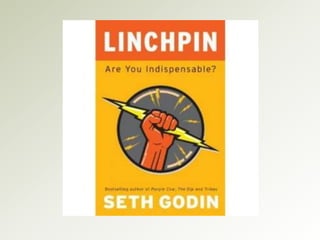
‘Reading Discoveries’Madison Book Club
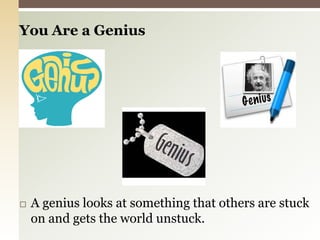
You Are a GeniusA genius looks at something that others are stuck on and gets the world unstuck.
So the question isHave you ever done that?Have you ever found a shortcut that others couldn't find?Solved a problem that confounded your family?Seen a way to make something work that wasn't working before?Made a personal connection with someone who was out of reach to everyone else?Even once?
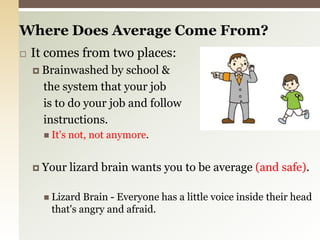
Where Does Average Come From? It comes from two places:Brainwashed by school &     the system that your job     is to do your job and follow     instructions.It's not, not anymore.Your lizard brain wants you to be average (and safe).Lizard Brain - Everyone has a little voice inside their head that's angry and afraid.
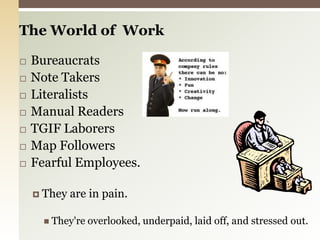
The World of  Work BureaucratsNote TakersLiteralistsManual ReadersTGIF LaborersMap FollowersFearful Employees.They are in pain.They're overlooked, underpaid, laid off, and stressed out.
World Has ChangedThere was a time whenPeople did what they were toldFollowed instructionsFound a jobMade a living& that was that. But nowAnyone who is merely good, merely obedient, and merely reliable is PUNISHED.
But…..Organizations desire to turn employees into replaceable cogs in a vast machine.The easier people are to replace, the less they need to be paid.Essence of problemWages are stagnantJob security is a fading memoryStress is skyrocketingNowhere to run, and apparently, nowhere to hide.
Here Comes the OpportunityThe indispensable employeeBrings humanity, connection and art to the organization.Is the key player, the one who's difficult to live withoutThe person you can build something around.
The PERL(Percentage of Easily Replaced Laborers) In the factory era, the goal was to have the highest PERL .If you can easily replace most of your workers, you can pay them less.The less you pay them, the more money you make.
How Companies (Used to) Make Money The difference between what an employee is paid and how much value she produces leads to profit. If the worker captures all the value in her salary, there's no profit. So, the goal is to hire as many obedient, competent workers, as cheaply as you possibly can.
How Companies (Used to) Make Money The problem?Someone else is getting better than you at hiring cheap and competent workers.They can ship the work overseas, or buy more machines, or cut corners faster than you can.Consumers are not loyal to cheap commodities.
How Companies (Used to) Make Money Two choicesWin by being more ordinary, more standard, and cheaper.Win by being faster, more remarkable, and more human.
The Final Straw:The Law of the Mechanical TurkAny project, if broken down into sufficiently small, predictable parts, can be accomplished for awfully close to free.Examples
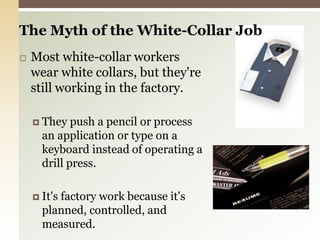
The Myth of the White-Collar Job Most white-collar workers wear white collars, but they're still working in the factory.They push a pencil or process an application or type on a keyboard instead of operating a drill press.It's factory work because it's planned, controlled, and measured.
The Myth of the White-Collar Job Competitive pressures (and greed) have encouraged most organizations to turn their workers into machines.If we can measure it, we can do it faster.If we can put it in a manual, we can outsource it.If we can outsource it, we can get it cheaper.The end resultsLegions of frustrated workers.Wasted geniuses working like automations.
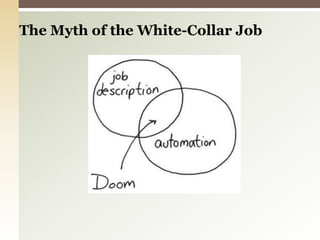
The Myth of the White-Collar Job
FurtherAverage Is OverOur world no longer fairly compensates people who are cogs in a giant machineLinchpins are the essential building blocks of tomorrow's high-value organizationsWhen the New System Replaces the OldRevolutions are rare.Electricity – Electrical Outlets - EquipmentsWho Wins?
The End of ABC and the Search for the Difference Maker ABC - Attendance-Based CompensationOwning the Means of ProductionMediocrity and the Web Mediocrity isn't going to go away.Yesterday's remarkable is today's really good and tomorrow's mediocre. Mediocre is merely a failed attempt to be really good.
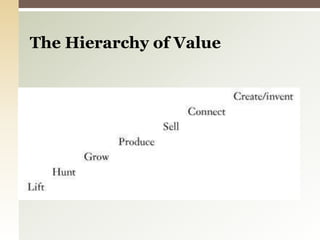
The Hierarchy of Value
Thinking About Your Choice Can You Become Indispensable? Great teachers are wonderful. They change lives. We need them.The problem is that most schools don't like great teachers.They're organized to stamp them out, bore them, bureaucratize them, and make them average.
Limited or Unlimited? You can see your marketplace as being limitedA zero-sum game, a place where in order for one person to win, another must lose. Or you can see it as unlimited.A place where talent creates growth and the market increases in size.
You Can't? At the age of four, you were an artist.At seven, you were a poet. By the time you were twelve, if you had a lemonade stand, you were an entrepreneur.If I ask you to do something truly exceptional now….. Answers may beYou don't have what it takes; you're not smart enough or trained enough or gifted enough to pull this off.A simple clarification.You can't--or you don't want to?
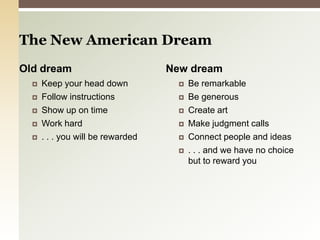
The New American DreamOld dreamKeep your head downFollow instructionsShow up on timeWork hard. . . you will be rewardedNew dreamBe remarkableBe generousCreate artMake judgment callsConnect people and ideas . . . and we have no choice but to reward you
The 3 Dangerous Words“Not My Job”In a factory, doing a job that's not yours is dangerous.Now, if you're a linchpin, doing a job that's not getting done is essential.
The Boss's Lie "What I want is someone who will do exactly what I tell them to.“"What I want is someone who works cheap.“"What I want is someone who shows up on time and doesn't give me a hard time."
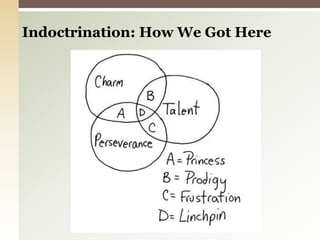
Indoctrination: How We Got Here
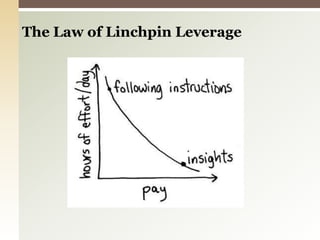
The Law of Linchpin Leverage
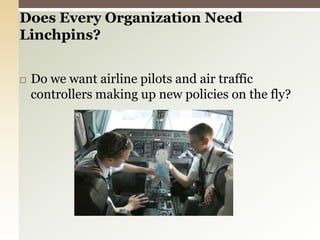
Does Every Organization Need Linchpins? Do we want airline pilots and air traffic controllers making up new policies on the fly?
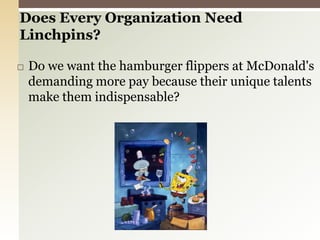
Does Every Organization Need Linchpins? Do we want the hamburger flippers at McDonald's demanding more pay because their unique talents make them indispensable?
Organizations that are centralized, monopolistic, static, safe, cost-sensitive, and far-flung should hire drones, as cheaply as possible.Does Every Organization Need Linchpins?
Depth of Knowledge Alone Is Not Enough Depth of knowledge combined with good judgment is worth a lot.
Depth of Knowledge Alone Is Not Enough A few years before Detroit's meltdown, Bill Ford knew his company was in jeopardy, so he went outside to hire a new CEO.His biggest concern?"Ford is a place where they wait for the leader to tell them what to do.“Bill Ford hired someone who knew how to train people to live without a map - Alan Mulally from Boeing
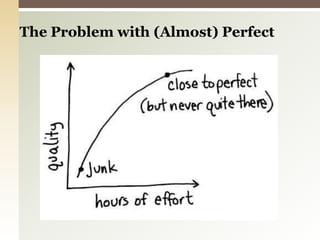
The Problem with (Almost) Perfect
Saying No There are two ways the linchpin can use "no.“The first is to never use it.Always manages to find a way to make things happen, and does it.This person says "no" all the time .Has the strength to disappoint you now in order to delight you later.
Unsolicited AdviceA – DissatisfiedWon't make eye contact.Takes a lot of breaks.Grumbles a lot. He's not being paid enough to bring his entire self to work, and he's teaching his boss a lesson.B - Engaged, Connected & EnthusiasticDecided that he has a platform & he uses it to make a tiny difference in everyone’s day.
Unsolicited AdviceThe organization has to accept part of the blame for A's situation.They don't do anything at all to reward people who are generous.A is teaching himself that this is the way to do his job.He's fully expecting that his next job will be the time when he'll become the linchpin.
If he waits for a job to be good enough to deserve his best shot, it's unlikely that he'll ever have that job.Unsolicited Advice
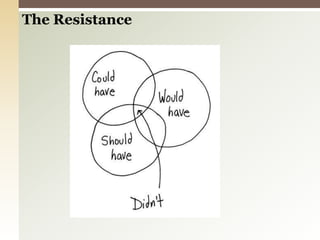
The Resistance
The ResistanceArtists don't think outside the box, because outside the box there's a vacuum.Outside of the box there are no rules, there is no reality.You have nothing to interact with, nothing to work against.Artists think along the edges of the box, because that's where things get done.
The ResistanceThe Resistance: Your Lizard BrainThe lizard brain is hungry, scared, angry, and horny.The lizard brain only wants to eat and be safe.The lizard brain will fight (to the death) if it has to, but would rather run away.The lizard brain is the reason you're afraid & the reason you don't do all the art you can.
MindDaemonSource of great ideasGround-breaking insightsGenerosityLoveConnectionKindness ResistanceSpends all its time insulating the world from our daemon
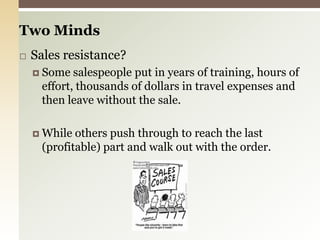
Two MindsSales resistance?Some salespeople put in years of training, hours of effort, thousands of dollars in travel expenses and then leave without the sale.While others push through to reach the last (profitable) part and walk out with the order.
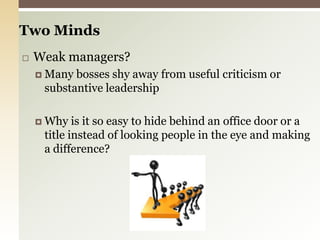
Two MindsWeak managers?Many bosses shy away from useful criticism or substantive leadershipWhy is it so easy to hide behind an office door or a title instead of looking people in the eye and making a difference?
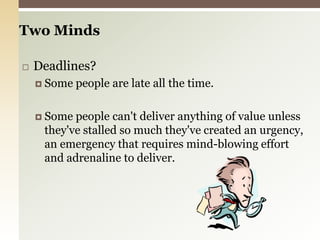
Deadlines?Some people are late all the time.Some people can't deliver anything of value unless they've stalled so much they've created an urgency, an emergency that requires mind-blowing effort and adrenaline to deliver.Two Minds
Success & FailureSuccessful people are successful for one simple reason:They think about failure differently. Successful people learn from failure, but the lesson they learn is a different one.They learn that the tactics they used didn't work or that the person they used them on didn't respond.
SuggestionYou become a winner because you're good at losing.The hard part about losing is thatyou might permit it to give strength to the resistance.you might believe that you don't deserve to win.you might, in some dark corner of your soul, give up.Don't
Seeking Out DiscomfortGoing out of your way to find uncomfortable situations isn't natural, but it's essential.The resistance seeks comfort. The resistance wants to hide.At work, we spend hours (and millions of dollars) seeking a place we can defend, a market position and sinecure we can feel safe in.Corporations watch their stocks soar when they can describe a comfortable market niche that will generate profits for years to come.
Seeking Out DiscomfortCollege professors often pick the profession because of the comfort that tenure brings.Salespeople embrace the script because using one is more comfortable than engaging with the prospect.Bosses resist giving direct and useful feedback to employees because it's momentarily uncomfortable.
Seeking Out DiscomfortThe road to comfort is crowded and it rarely gets you there.Ironically, it's those who seek out discomfort that are able to make a difference and find their footing.Inevitably, we exaggerate just how uncomfortable we are.
Seeking Out DiscomfortAn uncomfortable seat on a long airplane flight begins to feel like a open wound.This exaggeration makes it even more likely that embracing the discomfort that others fear is likely to deliver real rewards.Discomfort brings engagement and change.Discomfort means you're doing something that others were unlikely to do, because they're busy hiding out in the comfortable zone .
Symptoms of the Lizard Brain “I don't have any good ideas”“I don't know what to do”“I didn't graduate from ABC premier school”“My boss won't let me”“Well, that's fine for you, but my gender, race, health, religion, nationality, shoe size, handicap, or DNA don't make it easy”
The Work Your real work, then, what you might be paid for, and what is certainly your passion, is simple:The work.Your work is to create art that changes things, to expose your insight and humanity in such a way that you are truly indispensable.Your work is to do the work, not to do your job.Your job is about following instructions; the work is about making a difference.
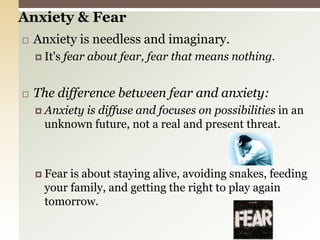
Anxiety & FearAnxiety is needless and imaginary.It's fear about fear, fear that means nothing.The difference between fear and anxiety:Anxiety is diffuse and focuses on possibilities in an unknown future, not a real and present threat.Fear is about staying alive, avoiding snakes, feeding your family, and getting the right to play again tomorrow.
The Grateful Dread:Two Ways to Deal with Anxiety Seek ReassuranceCheck in constantly, measure and repeat. "Is everything okay?”Reward the anxiety with reassurance and positive feedback. Sit with the anxiety, don't run from it.Acknowledge it, explore it, befriend it.
The Powerful Culture of GiftsGifts as a Signal of SurplusIt's difficult to be generous when you're hungry.Yet being generous keeps you from going hungry.Hence the conflict.Gifts Make the TribeThree Ways People Think About Gifts1. Give me a gift.2. Here's a gift; now you owe me, big-time.3. Here's a gift, I love you.
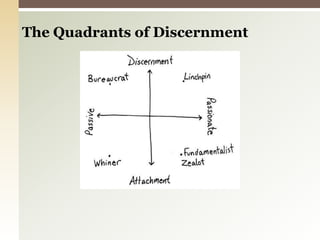
The Quadrants of Discernment
Making a ChoiceYou can either fit in or stand out. Not both.You are either defending the status quo or challenging it.Playing defense and trying to keep everything "all right," or leading and provoking and striving to make everything better.Either you are embracing the drama of your everyday life or you are seeing the world as it is.
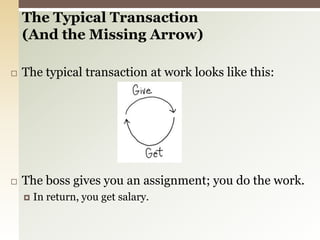
The Typical Transaction(And the Missing Arrow) The typical transaction at work looks like this: The boss gives you an assignment; you do the work.In return, you get salary.
The Typical Transaction(And the Missing Arrow) So, what's missing? The gift.If you give your boss the gift of art, insight, initiative or connection, she's less likely to shop around every day looking to replace the commodity work you do, because the work you do isn't a commodity.
The Culture of Connection The Linchpin Can't Succeed in Isolation If you can't sell your ideas, your ideas go nowhere. The new media (Internet) rewards ideas that resonate.It helps them spread.If your work persuades, you prosper.And the new media punishes those who seek to mislead.
The Five Elements of PersonalityOpennessConscientiousnessExtra-versionAgreeablenessEmotional Stability.
Creating a Culture of ConnectionThink about business-to-business sales.The key point of distinction is rarely price.It's the perceived connection between the prospect and the organization. Consider job satisfaction.The key point of distinction is rarely the work you'll be asking the employee to do.It's the perceived connection between the employee and the people he/she works with.
Creating a Culture of ConnectionThus, the individual in the organization who collects, connects, and nurtures relationships is indispensable.
The Seven Abilities Of The Linchpin 1. Providing a unique interface betweenmembers of the organizationIf the link which holds your organization   together is just the salary and each   person's fear of losing his job, you've already lost. The organization also includes its customers and prospects.
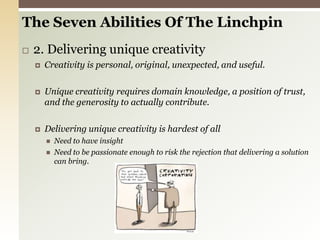
The Seven Abilities Of The Linchpin 2. Delivering unique creativityCreativity is personal, original, unexpected, and useful.Unique creativity requires domain knowledge, a position of trust, and the generosity to actually contribute.Delivering unique creativity is hardest of allNeed to have insightNeed to be passionate enough to risk the rejection that delivering a solution can bring.
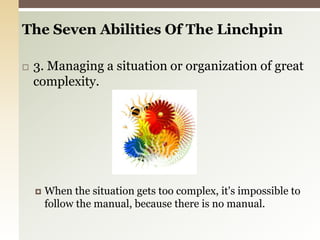
The Seven Abilities Of The Linchpin 3. Managing a situation or organization of great complexity.When the situation gets too complex, it's impossible to follow the manual, because there is no manual.
4. Leading customersThere's no script for leadership. There can't be.The Seven Abilities Of The Linchpin
5. Inspiring staffOrganizations obey Newton's laws. A team at rest tends to stay at rest.The Seven Abilities Of The Linchpin
6. Providing deep domain knowledgeMapmakers often have the confidence to draw maps because they understand their subject so deeply.The Seven Abilities Of The Linchpin
7. Possessing a unique talentThink of stories of super-heroes.If you're not the best in the world at your unique talent, then it's not a unique talent.The Seven Abilities Of The Linchpin
You have only 2 choices1. Develop the other attributes that make you a linchpin.2. Get a lot better at your unique talent.Last Words
Linchpin

Linchpin

  • 1.
  • 4.
    You Are aGeniusA genius looks at something that others are stuck on and gets the world unstuck.
  • 5.
    So the questionisHave you ever done that?Have you ever found a shortcut that others couldn't find?Solved a problem that confounded your family?Seen a way to make something work that wasn't working before?Made a personal connection with someone who was out of reach to everyone else?Even once?
  • 6.
    Where Does AverageCome From? It comes from two places:Brainwashed by school & the system that your job is to do your job and follow instructions.It's not, not anymore.Your lizard brain wants you to be average (and safe).Lizard Brain - Everyone has a little voice inside their head that's angry and afraid.
  • 7.
    The World of Work BureaucratsNote TakersLiteralistsManual ReadersTGIF LaborersMap FollowersFearful Employees.They are in pain.They're overlooked, underpaid, laid off, and stressed out.
  • 8.
    World Has ChangedTherewas a time whenPeople did what they were toldFollowed instructionsFound a jobMade a living& that was that. But nowAnyone who is merely good, merely obedient, and merely reliable is PUNISHED.
  • 9.
    But…..Organizations desire toturn employees into replaceable cogs in a vast machine.The easier people are to replace, the less they need to be paid.Essence of problemWages are stagnantJob security is a fading memoryStress is skyrocketingNowhere to run, and apparently, nowhere to hide.
  • 10.
    Here Comes theOpportunityThe indispensable employeeBrings humanity, connection and art to the organization.Is the key player, the one who's difficult to live withoutThe person you can build something around.
  • 11.
    The PERL(Percentage ofEasily Replaced Laborers) In the factory era, the goal was to have the highest PERL .If you can easily replace most of your workers, you can pay them less.The less you pay them, the more money you make.
  • 12.
    How Companies (Usedto) Make Money The difference between what an employee is paid and how much value she produces leads to profit. If the worker captures all the value in her salary, there's no profit. So, the goal is to hire as many obedient, competent workers, as cheaply as you possibly can.
  • 13.
    How Companies (Usedto) Make Money The problem?Someone else is getting better than you at hiring cheap and competent workers.They can ship the work overseas, or buy more machines, or cut corners faster than you can.Consumers are not loyal to cheap commodities.
  • 14.
    How Companies (Usedto) Make Money Two choicesWin by being more ordinary, more standard, and cheaper.Win by being faster, more remarkable, and more human.
  • 15.
    The Final Straw:TheLaw of the Mechanical TurkAny project, if broken down into sufficiently small, predictable parts, can be accomplished for awfully close to free.Examples
  • 16.
    The Myth ofthe White-Collar Job Most white-collar workers wear white collars, but they're still working in the factory.They push a pencil or process an application or type on a keyboard instead of operating a drill press.It's factory work because it's planned, controlled, and measured.
  • 17.
    The Myth ofthe White-Collar Job Competitive pressures (and greed) have encouraged most organizations to turn their workers into machines.If we can measure it, we can do it faster.If we can put it in a manual, we can outsource it.If we can outsource it, we can get it cheaper.The end resultsLegions of frustrated workers.Wasted geniuses working like automations.
  • 18.
    The Myth ofthe White-Collar Job
  • 19.
    FurtherAverage Is OverOurworld no longer fairly compensates people who are cogs in a giant machineLinchpins are the essential building blocks of tomorrow's high-value organizationsWhen the New System Replaces the OldRevolutions are rare.Electricity – Electrical Outlets - EquipmentsWho Wins?
  • 20.
    The End ofABC and the Search for the Difference Maker ABC - Attendance-Based CompensationOwning the Means of ProductionMediocrity and the Web Mediocrity isn't going to go away.Yesterday's remarkable is today's really good and tomorrow's mediocre. Mediocre is merely a failed attempt to be really good.
  • 21.
  • 22.
    Thinking About YourChoice Can You Become Indispensable? Great teachers are wonderful. They change lives. We need them.The problem is that most schools don't like great teachers.They're organized to stamp them out, bore them, bureaucratize them, and make them average.
  • 23.
    Limited or Unlimited?You can see your marketplace as being limitedA zero-sum game, a place where in order for one person to win, another must lose. Or you can see it as unlimited.A place where talent creates growth and the market increases in size.
  • 24.
    You Can't? Atthe age of four, you were an artist.At seven, you were a poet. By the time you were twelve, if you had a lemonade stand, you were an entrepreneur.If I ask you to do something truly exceptional now….. Answers may beYou don't have what it takes; you're not smart enough or trained enough or gifted enough to pull this off.A simple clarification.You can't--or you don't want to?
  • 25.
    The New AmericanDreamOld dreamKeep your head downFollow instructionsShow up on timeWork hard. . . you will be rewardedNew dreamBe remarkableBe generousCreate artMake judgment callsConnect people and ideas . . . and we have no choice but to reward you
  • 26.
    The 3 DangerousWords“Not My Job”In a factory, doing a job that's not yours is dangerous.Now, if you're a linchpin, doing a job that's not getting done is essential.
  • 27.
    The Boss's Lie"What I want is someone who will do exactly what I tell them to.“"What I want is someone who works cheap.“"What I want is someone who shows up on time and doesn't give me a hard time."
  • 28.
  • 29.
    The Law ofLinchpin Leverage
  • 30.
    Does Every OrganizationNeed Linchpins? Do we want airline pilots and air traffic controllers making up new policies on the fly?
  • 31.
    Does Every OrganizationNeed Linchpins? Do we want the hamburger flippers at McDonald's demanding more pay because their unique talents make them indispensable?
  • 32.
    Organizations that arecentralized, monopolistic, static, safe, cost-sensitive, and far-flung should hire drones, as cheaply as possible.Does Every Organization Need Linchpins?
  • 33.
    Depth of KnowledgeAlone Is Not Enough Depth of knowledge combined with good judgment is worth a lot.
  • 34.
    Depth of KnowledgeAlone Is Not Enough A few years before Detroit's meltdown, Bill Ford knew his company was in jeopardy, so he went outside to hire a new CEO.His biggest concern?"Ford is a place where they wait for the leader to tell them what to do.“Bill Ford hired someone who knew how to train people to live without a map - Alan Mulally from Boeing
  • 35.
    The Problem with(Almost) Perfect
  • 36.
    Saying No Thereare two ways the linchpin can use "no.“The first is to never use it.Always manages to find a way to make things happen, and does it.This person says "no" all the time .Has the strength to disappoint you now in order to delight you later.
  • 37.
    Unsolicited AdviceA –DissatisfiedWon't make eye contact.Takes a lot of breaks.Grumbles a lot. He's not being paid enough to bring his entire self to work, and he's teaching his boss a lesson.B - Engaged, Connected & EnthusiasticDecided that he has a platform & he uses it to make a tiny difference in everyone’s day.
  • 38.
    Unsolicited AdviceThe organizationhas to accept part of the blame for A's situation.They don't do anything at all to reward people who are generous.A is teaching himself that this is the way to do his job.He's fully expecting that his next job will be the time when he'll become the linchpin.
  • 39.
    If he waitsfor a job to be good enough to deserve his best shot, it's unlikely that he'll ever have that job.Unsolicited Advice
  • 40.
  • 41.
    The ResistanceArtists don'tthink outside the box, because outside the box there's a vacuum.Outside of the box there are no rules, there is no reality.You have nothing to interact with, nothing to work against.Artists think along the edges of the box, because that's where things get done.
  • 42.
    The ResistanceThe Resistance:Your Lizard BrainThe lizard brain is hungry, scared, angry, and horny.The lizard brain only wants to eat and be safe.The lizard brain will fight (to the death) if it has to, but would rather run away.The lizard brain is the reason you're afraid & the reason you don't do all the art you can.
  • 43.
    MindDaemonSource of greatideasGround-breaking insightsGenerosityLoveConnectionKindness ResistanceSpends all its time insulating the world from our daemon
  • 44.
    Two MindsSales resistance?Somesalespeople put in years of training, hours of effort, thousands of dollars in travel expenses and then leave without the sale.While others push through to reach the last (profitable) part and walk out with the order.
  • 45.
    Two MindsWeak managers?Manybosses shy away from useful criticism or substantive leadershipWhy is it so easy to hide behind an office door or a title instead of looking people in the eye and making a difference?
  • 46.
    Deadlines?Some people arelate all the time.Some people can't deliver anything of value unless they've stalled so much they've created an urgency, an emergency that requires mind-blowing effort and adrenaline to deliver.Two Minds
  • 47.
    Success & FailureSuccessfulpeople are successful for one simple reason:They think about failure differently. Successful people learn from failure, but the lesson they learn is a different one.They learn that the tactics they used didn't work or that the person they used them on didn't respond.
  • 48.
    SuggestionYou become awinner because you're good at losing.The hard part about losing is thatyou might permit it to give strength to the resistance.you might believe that you don't deserve to win.you might, in some dark corner of your soul, give up.Don't
  • 49.
    Seeking Out DiscomfortGoingout of your way to find uncomfortable situations isn't natural, but it's essential.The resistance seeks comfort. The resistance wants to hide.At work, we spend hours (and millions of dollars) seeking a place we can defend, a market position and sinecure we can feel safe in.Corporations watch their stocks soar when they can describe a comfortable market niche that will generate profits for years to come.
  • 50.
    Seeking Out DiscomfortCollegeprofessors often pick the profession because of the comfort that tenure brings.Salespeople embrace the script because using one is more comfortable than engaging with the prospect.Bosses resist giving direct and useful feedback to employees because it's momentarily uncomfortable.
  • 51.
    Seeking Out DiscomfortTheroad to comfort is crowded and it rarely gets you there.Ironically, it's those who seek out discomfort that are able to make a difference and find their footing.Inevitably, we exaggerate just how uncomfortable we are.
  • 52.
    Seeking Out DiscomfortAnuncomfortable seat on a long airplane flight begins to feel like a open wound.This exaggeration makes it even more likely that embracing the discomfort that others fear is likely to deliver real rewards.Discomfort brings engagement and change.Discomfort means you're doing something that others were unlikely to do, because they're busy hiding out in the comfortable zone .
  • 53.
    Symptoms of theLizard Brain “I don't have any good ideas”“I don't know what to do”“I didn't graduate from ABC premier school”“My boss won't let me”“Well, that's fine for you, but my gender, race, health, religion, nationality, shoe size, handicap, or DNA don't make it easy”
  • 54.
    The Work Yourreal work, then, what you might be paid for, and what is certainly your passion, is simple:The work.Your work is to create art that changes things, to expose your insight and humanity in such a way that you are truly indispensable.Your work is to do the work, not to do your job.Your job is about following instructions; the work is about making a difference.
  • 55.
    Anxiety & FearAnxietyis needless and imaginary.It's fear about fear, fear that means nothing.The difference between fear and anxiety:Anxiety is diffuse and focuses on possibilities in an unknown future, not a real and present threat.Fear is about staying alive, avoiding snakes, feeding your family, and getting the right to play again tomorrow.
  • 56.
    The Grateful Dread:TwoWays to Deal with Anxiety Seek ReassuranceCheck in constantly, measure and repeat. "Is everything okay?”Reward the anxiety with reassurance and positive feedback. Sit with the anxiety, don't run from it.Acknowledge it, explore it, befriend it.
  • 57.
    The Powerful Cultureof GiftsGifts as a Signal of SurplusIt's difficult to be generous when you're hungry.Yet being generous keeps you from going hungry.Hence the conflict.Gifts Make the TribeThree Ways People Think About Gifts1. Give me a gift.2. Here's a gift; now you owe me, big-time.3. Here's a gift, I love you.
  • 58.
    The Quadrants ofDiscernment
  • 59.
    Making a ChoiceYoucan either fit in or stand out. Not both.You are either defending the status quo or challenging it.Playing defense and trying to keep everything "all right," or leading and provoking and striving to make everything better.Either you are embracing the drama of your everyday life or you are seeing the world as it is.
  • 60.
    The Typical Transaction(Andthe Missing Arrow) The typical transaction at work looks like this: The boss gives you an assignment; you do the work.In return, you get salary.
  • 61.
    The Typical Transaction(Andthe Missing Arrow) So, what's missing? The gift.If you give your boss the gift of art, insight, initiative or connection, she's less likely to shop around every day looking to replace the commodity work you do, because the work you do isn't a commodity.
  • 62.
    The Culture ofConnection The Linchpin Can't Succeed in Isolation If you can't sell your ideas, your ideas go nowhere. The new media (Internet) rewards ideas that resonate.It helps them spread.If your work persuades, you prosper.And the new media punishes those who seek to mislead.
  • 63.
    The Five Elementsof PersonalityOpennessConscientiousnessExtra-versionAgreeablenessEmotional Stability.
  • 64.
    Creating a Cultureof ConnectionThink about business-to-business sales.The key point of distinction is rarely price.It's the perceived connection between the prospect and the organization. Consider job satisfaction.The key point of distinction is rarely the work you'll be asking the employee to do.It's the perceived connection between the employee and the people he/she works with.
  • 65.
    Creating a Cultureof ConnectionThus, the individual in the organization who collects, connects, and nurtures relationships is indispensable.
  • 66.
    The Seven AbilitiesOf The Linchpin 1. Providing a unique interface betweenmembers of the organizationIf the link which holds your organization together is just the salary and each person's fear of losing his job, you've already lost. The organization also includes its customers and prospects.
  • 67.
    The Seven AbilitiesOf The Linchpin 2. Delivering unique creativityCreativity is personal, original, unexpected, and useful.Unique creativity requires domain knowledge, a position of trust, and the generosity to actually contribute.Delivering unique creativity is hardest of allNeed to have insightNeed to be passionate enough to risk the rejection that delivering a solution can bring.
  • 68.
    The Seven AbilitiesOf The Linchpin 3. Managing a situation or organization of great complexity.When the situation gets too complex, it's impossible to follow the manual, because there is no manual.
  • 69.
    4. Leading customersThere'sno script for leadership. There can't be.The Seven Abilities Of The Linchpin
  • 70.
    5. Inspiring staffOrganizationsobey Newton's laws. A team at rest tends to stay at rest.The Seven Abilities Of The Linchpin
  • 71.
    6. Providing deepdomain knowledgeMapmakers often have the confidence to draw maps because they understand their subject so deeply.The Seven Abilities Of The Linchpin
  • 72.
    7. Possessing aunique talentThink of stories of super-heroes.If you're not the best in the world at your unique talent, then it's not a unique talent.The Seven Abilities Of The Linchpin
  • 73.
    You have only2 choices1. Develop the other attributes that make you a linchpin.2. Get a lot better at your unique talent.Last Words