B o o k R e v i e w b y
D r. N . A s o k a n
9 4 4 5 1 9 1 3 6 9
n t v a s o k a n @ g m a i l . c o m
Work: Definition
Work is core to the human experience
Any value we create that requires us to spend
our time, focus, energy, and effort – whether
in the context of occupation, relationship or
parenting – is work
Work is a reinforcement of that sense of being-
of our sense of belonging- and a way to
discover ourselves as we interact with the
world around us
Meaningful to individual, Value to others
Your Work:
Not occupation/ Designation
You contribute value to the world
using your available resources
Every task you do and assignment
you engage in
Every instant/effort to grow your
skill/ develop your mind
Every time you go to the extra mile
even though you are exhausted
Your Body of Work
Comprises the sum total of where you choose to
place your limited focus, assets, time, energy,
and effort
Work:
Any instance where you make an effort to create
value where it didn’t previously exists.
You r work is th e most vis ib le ex p res s ion of you r p riorities
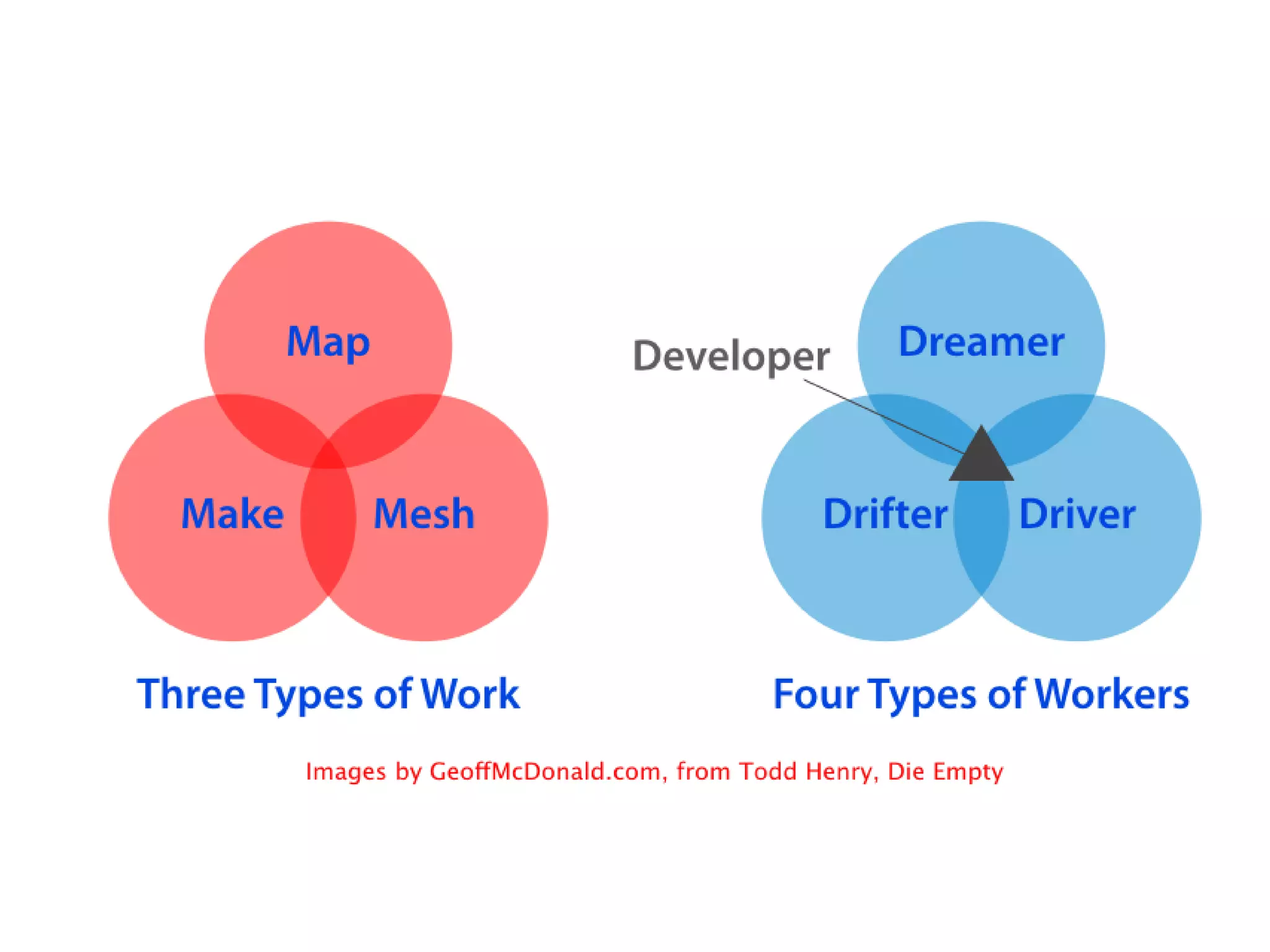
Three Kinds of Work
Work sometimes feels like one massive, melded
blend of tasks, conversations and meetings
To truly unleash your full capacity/potential and
to ultimately find your sewet spot of
contribution, you must engage in all three
kinds of work
M a p p i n g , M a k i n g a n d M e s h i n g
Three Kinds of Work:
1. Mapping
• ‘ Work before the Work” - individually or
with others
• Planning
• Strategy meeting
• Setting priorities
• Less tangible aspects of work, such as values,
sense of why you do what you do
• Fail to account for these, lose your focus and
land in wrong direction
Three Kinds of Work: 2. Making
• Actually doing work……..I did that
• Making is what typically comes to mind when
you think of work
• Executing tasks, Tackling objectives
• Creating value of any kind
• Engaging with reports
• Deliver tangible values
Three Kinds of Work: 2. Making
• Easy to gravitate toward Making at the
expense of other two kinds of work
Most tactical of the three kinds of
work, where it’s easiest to get
distracted
More moving parts,
decisions with
immediate impact,
more opportunities
for things to go awry.
Must have some guiding
principles to stay aligned
and on task.
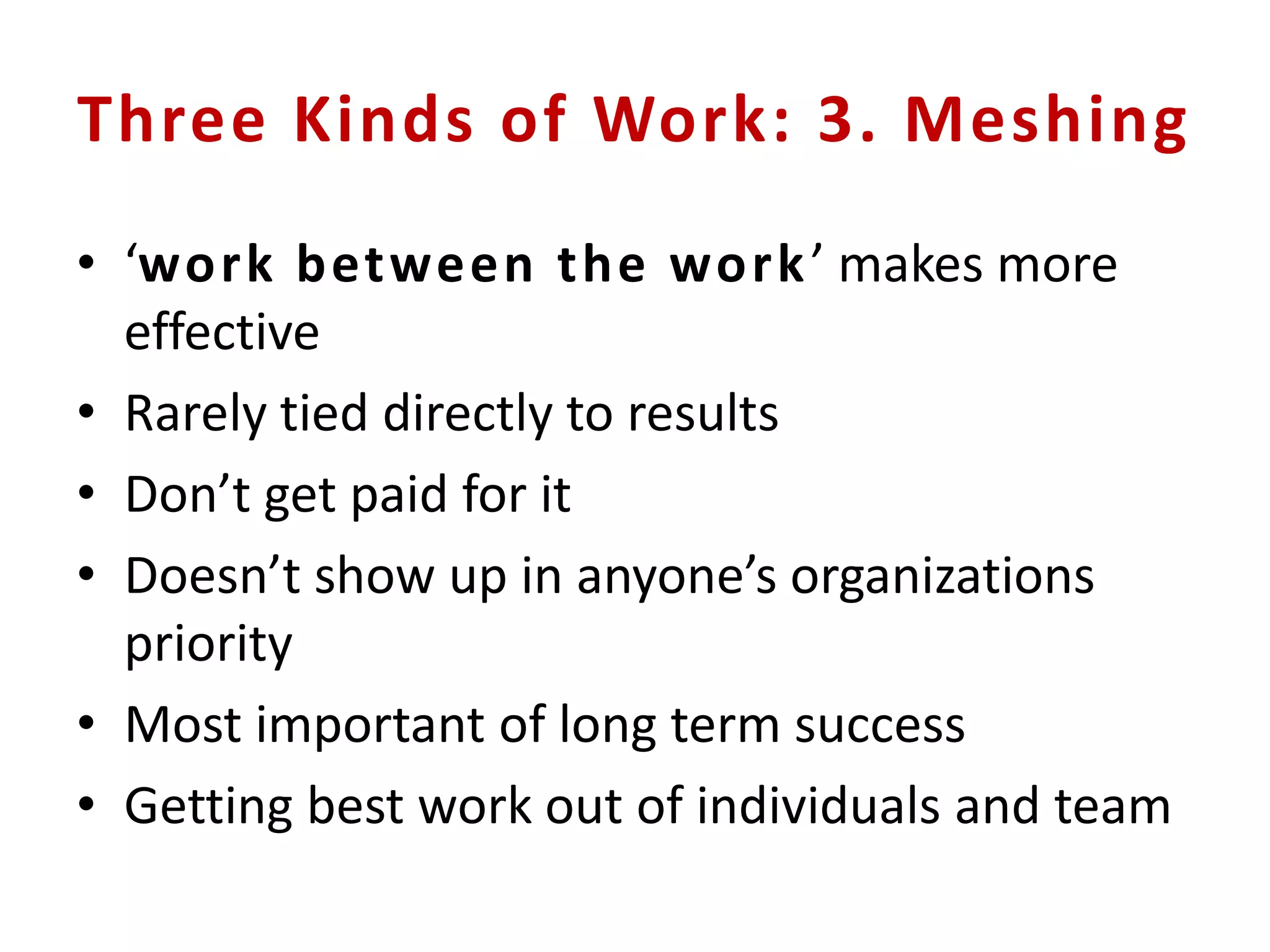
Three Kinds of Work: 3. Meshing
• ‘work between the work’ makes more
effective
• Rarely tied directly to results
• Don’t get paid for it
• Doesn’t show up in anyone’s organizations
priority
• Most important of long term success
• Getting best work out of individuals and team
Three Kinds of Work: 3. Meshing
• Composed of activities that stretch and grow
• Acquiring and developing new skills
• Reinforcing and enhancing knowledge
• Cultivating curiosity
• Generating better understanding of the
context for work
• Paying attention to the adjacent spaces in
industries
All of us have a tendency
to gravitate toward
one of the three kinds of work at
the expense of other two and
while the negative effects of neglect may
not be evident in the short term, they
can be disastrous in the long term
Four Types of Workers
Developer = Mapping + Making + Meshing
Weaving resources and
opportunities to create value
Works with urgency and diligence
Does not work frantically
Making plan and execute them
Learning from his actions and
then redirecting as needed
Recognizes uncertainty is not enemy
Takes advantage from opportunities
Constantly developing skills
to move to next level
F o c u s o n
becoming a
D e v e l o p e r
F o c u s o n
becoming a
D e v e l o p e r
Driver = Mapping + Making - Meshing
• Extremely focus on results
• Spends most of the time in planning and checking the tasks
• Obsessed with today’s results
• Becomes narrowly effective
• Unable to spot opportunities
• Wane in performance over time due to doing the more of
the same
• Neglecting to grow skills and develop the intangibles helps
to tackle new challenges
• Sheer will and determination is only one element of
success
• Fail to unleash full potential
Career Beginners ok
Drifter = Meshing + Making - Mapping
• Enjoys the process of making
• Loves to develop skills and engage curiosity
• Poor Planner, wasted opportunity
• Good work ethic and quite successful in short
bursts
• Frequently bounces from work to work
• Lacks the conviction of long term plan
• Fails to follow through on many ideas
• Have spotty success, never seems to sustain
Dreamer = Meshing + Mapping - Making
Obsessed with ideas, personal
growth, and strategic plan
Lacks conviction, courage or
ethic to put his plan in motion
Talker, rarely accomplish tasks
Effective when they want,
quickly lose interest
Always moving to the next thing
Persistent focus,
willingness to
constantly disrupt
and question not
only what your
doing , but how you
are doing matters
Actively engaging in all
three kinds of work will be
better positioned to Build
a Body of work that you
will be proud at later
Developer
Cultivating
the
Developer
mind-set
takes time
The degree to which your
contribution reflects your
true potential will be largely
determined by how disciplined
you are about improving your
self-awareness and skills
every day
Mediocrity : Definition
Negotiation between
the drive to excel and
the biological urge to
settle for the most
comfortable option
Doesn’t always
mean
underperforming
Sliding scale and a state of mind
Compromise of abilities and potential
Growth cycle is steep and rapid
in career, when we constantly
facing unfamiliar challenges
and in need of developing
new skills to deal with them.
We grow stagnant, relying
on existing skills , earn
respect in the industry, but
deep down NOT doing best
work
Startingofthecareer,everything
new,workwithfullvigour,putour
bestfootforwardtowinrespect,
recognitionandtoprovethen
becomeautopilot
Mediocrity
Doesn’t mean doing poor work
Doesn’t mean failing to achieve success
Appear very successful to others
Outwardly unimpressive to others yet to be
maximizing your abilities
Deep down you are settling
Mediocrity is thoroughly subjective and relative
Satisficing (Satisfy + Sufficing)
• Don’t get the same level of satisfaction once did
• Progress but NOT important progress
• Invisible force holding and feel trapped
• Begin to experience a fear of choosing poorly
• Become paralyzed with inaction
• Exchange aspiration for practical ones
• Fit better with expectations of others
• Settle for the best available option to meet most
of our expectations
Selection options that is sufficient to meet enough of our ongoing expectations
L e a r n i n g C u r v e f o r C o m p l e x A d a p t a t i o n
D i f f i c u l t y o f l e a r n i n g s k i l l
Benefitsofskillacquisition
Followed by a slow levelling off
Rapid growth as the fundamental
mechanics of the skill become
easier to perform
Slow growth at first
People who are successful over the long
arc, and who continue to produce in new
and interesting ways after they are well
established in their career, refuse to allow
circumstances to define their engagement.
They continue to grow, develop new skills,
and seek unanticipated opportunities to
use their skills to create value
Seven Deadly Sins of Mediocrity
1. Aimlessness
2. Boredom
3. Comfort
4. Delusion
5. Ego
6. Fear
7. Guardedness
1. Aimlessness
Aimlessness means a general lack
of cohesiveness within your
day-to-day activities
It is a destructive force because it
removes both the joy of
success and the gratification
that comes from hard, focused
work
Conquering aimlessness is to
define the battles that you
need to fight each day in order
to make meaningful progress,
then focus your efforts on
those above all else.
2. Boredom
• Boredom means mind has grown
weary of the rut you are in and is
ready to jump the tracks and try
something new
• Not necessarily a bad thing
• Rather to use as advantage, often
succumb to it and allow it to zap our
creative firepower
• Cure for boredom is intentional and
applied curiosity
• Maintain a level of disciplined curiosity
• Practice the mechanics of divergent
problem solving
Problem finding is increasingly more critical than problem solving
3. Comfort
• Past innovations inhibit future
innovations
• After success, inevitably leads
to stagnation, out of comfort
or over confidence, stops
focusing on developing their
skills
• Overcome the comfort is a
commitment to continual
growth and skill development
• Identify relevant skills that will
help continue to contribute
• Have frequent check points
Love of comfort is frequently enemy of greatness
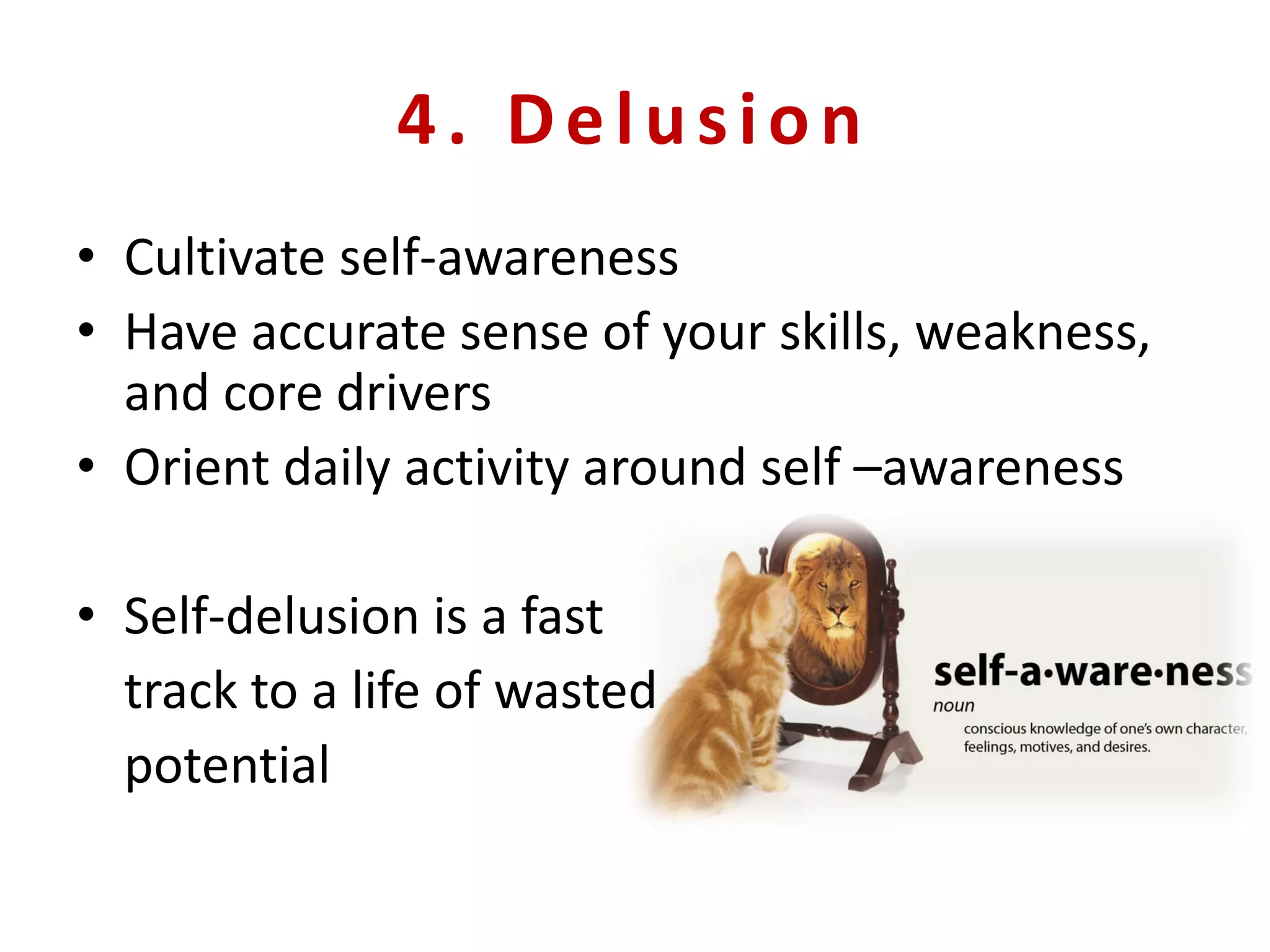
4. Delusion
• Cultivate self-awareness
• Have accurate sense of your skills, weakness,
and core drivers
• Orient daily activity around self –awareness
• Self-delusion is a fast
track to a life of wasted
potential
5.EG0
Rather go down with the
ship than admit that the
ship might be sinking
Overtime, become inflexible
and unwilling to adapt or
learn because of ego
To countermand ego, adopt
a posture of adaptability
Being in a state of continual
learning and openness to
correction
Fa i l u r e s h o u l d b e a l e a r n i n g e x p e r i e n c e N OT a s h a m i n g e x p e r i e n c e
6. Fear Fear thrives on the
unknown
Paralyzing effects often
rooted more in
imagination than
reality
To Countermanding fear
is to instil a practice
of strategic,
intentional and
purposeful risk-taking
in life and work
7. Guardedness
• Great work happens consistently in the
context of community
• In work, always depend on others
• With obligations and pressures, relationship
gets spoiled
• Easy to get into isolation mode, cut 0ff from
opportunities to grow and collaborate
T h e b e s t d e fe n s e i s a l m o s t a l w ay s a n a t - t h e – r e a d y o f fe n s e
Passion: Suffering
• Great work requires
suffering for something
beyond yourself
• It is created when you
bend your life around a
mission and spend
yourself on something
you deem worthy of
your best effort
Wh at work am I willin g to s u ffer for tod ay?
Productive Passion
• The sort of passion that motivates you and is
also beneficial to others
• It is others – focused, NOT self –focused.
• It is what drives you to labor ”on behalf of”
rather than to simply satisfy your own needs,
though it may stoke your own fires as well
Compassionate Anger
• Compassion = suffer with
• Where do you see dynamics in the market
place pr the world at large that cause you to
feel a desire to step in on behalf of those who
are suffering in order to bear part of their
burden or rectify wrong?
• Willingness to address certain problems, even
at great personal cost
Forgotten Battlefronts
• What do you know you should be doing, not nave
been ignoring?
• They are things that have been weighing on your
mind for a while now, and things that you care
deeply about, but you nave been ignoring
because either
• A) you fear that you won’t have time for them OR
• B) you haven’t defined them enough to know
your next steps
Busily Bored
• Highly productive, meeting expectations but
mentally stagnant professionals
• Not stretching minds
• Not acknowledging deeper questions
• Not trying new things
• Living with unchecked, limited assumptions
To avoid busily bored,
stoke the fires of curiosity by addressing
• Specific form (diving deep into topics of
interest)
• Diversive form (exploring possibilities through
purposeful questioning)
Establish Hunting Trails
Keep a list of questions: points of curiosity
Dedicate time to pursue your questions
Prototype Relentlessly
Find your ‘Bliss Station’
Develop Possibility Thinking
Refuse to settle for status-quo ideas
Relentlessly embracing the pursuit of great
ones
Engage with full curiosity
Truly define the parameters of the problem
When you have clear boundaries to work within, you can feel more comfortable asking
extremely divergent questions and exploring initially irrelevant-seeming possibilities.
Structure and freedom are two coins of the same coin.
Structure yields freedom to creatively roam
Entertainment Vs Engagement
The never –
ending
stream of
new stimuli
is
seductive,
and can dip
toe in
anytime
feel slightly
bored
More
opportunity
for
entertainme
nt, but less of
the
breakthrough
synthesis
that often
comes form
deep,
purposeful
engagement
with
experiences
Blessing and the curse of technology
“ i n b e t w e e n ”
Curse of familiarity
• We can become numbed by the constant influx
of new stimulus and our mind may gravitate
intuitively toward whatever is new and shiny
• Because of my awareness of something, I am
often falsely under the impression that I
understand that
• Some people will never learn anything, for this
reason because they understand everything too
soon
If you want something to
happen predictably,
you systematize it
Bliss
Station
• Where is your sacred place?
• It doesn’t have to be a
dedicated, specially equipped
room in your home
• It can be certain chair, coffee
shop, or a bench in the park
• Wherever and whenever it is,
make it your place to Escape,
Think, Pursue your deeper
questions, and stoke the fire
or your curiosity
Structuring your thinking about the work
Four Elements of Redefining Problem
1. Aspirations: taking just a
few minutes to define our
aspirations immediately
sparked new and valuable
insights.
• What does this want to
become?
• What would be the
ultimate end, if we were
to perfectly solve this
problem?
2. Affinities: These are
similarities you notice
between the project you
are working on and other
experiences you ‘ve had.
• Connecting the dots help
to spark new creative
insights or possible path
to pursue in your work
• We learn best within the
context of what we
already know
3. Assumptions: If
assumptions were not
challenged, innovations
would cease
• It is the continual
willingness to press
against assumptions that
eventually opens a crack,
and then a steady flow of
progress
• Spend some time
intentionally challenging
any assumptions you
uncover, and use them as
a basis for generating new
thought and ideas
4. Attributes: These are the characteristics of
the problem you are trying to solve.
• List specific, concrete words that describe the
problem you are really trying to solve- the
specific attributes of the problem- and then
use each of those words as a way to develop
new questions to pursue.
• What does it look, feel, and sound like?
When you are Blocked……….
Conceptual Block
• Solve by asking different
and better questions
Executional Block
• Constraints
• Bottleneck
• Unnecessary complexity
• Relational tension
• Surrender control of project
to someone
• Simple lack of knowledge
The Biology of Comfort
• I ma biologically wired to stay within a
certain zone of comfort and to avoid
the seemingly unnecessary pain that
comes from stretching beyond
• I need regularly challenge that
biological instinct by jumping over
hurdles that force me to grow.
• Growth is about daily, measured, and
disciplined action.
• Growth is about embracing purposeful
skill development and pursuing new
opportunities that stretch you to step
beyond your comfort zone, even when
it means venturing boldly into the
unknown
Thre e Type s of Goals:
Ste p, Sprint, and Stretch
Growth does not happen
by accident.
It’s the result of intentional
effort and consistent
progress.
Step, Sprint and Stretch
nest within one another
Step goal help to
accomplish Sprint, sprint
goal help to accomplish
stretch goal
Step Goals:
What will I do today, no matter what?
• They are small,
measured steps help
you to maintain
forward motion
• Building blocks of
Sprint and Stretch goals
• Help you be strategic
about steeping outside
your comfort zone daily
Make sure to celebrate when you achieve your goals
Very short – arc goal (often daily)
Helps you to maintain even it is small progress
Sprint Goals
• Series of step goals that extend over a
season/period
• Designed to stretch your endurance and
generate momentum on your stretch goal
• Plan your week or two weeks to accomplish
intermediate goal, determine daily task
Make sure to celebrate when you achieve your goals
Medium-arc goal (A week or two weeks)
Causes you to go beyond yourself for a season
in order to increase your capacity
Stretch Goals: What is the change?
• Big and a major
feat
• Challenge you to
grow
• You can control
and measure
• If you can’t control,
you can’t plan for it
Make sure to celebrate when you achieve your goals
Long-arc goal,
forces you to go far beyond our comfort zone
Four Key Areas of Stretch Goals
• Health
• Emotional growth
• Self-awareness
• Personal skill
development
• Cultivating
and growing
relationship
•Developing
Intellectual
capacity
•Ability to process
complex
information
• Skill
Develop
ment
Business/ Work Mental
Personal/spirutualRelational
Be Aware:
the goals many people set are less practical or strategic and more like wishful thinking
You cannot pursue greatness and comfort at the same time
• The singular, oppressive force stands between
where you currently are and the great work you
want to do.
• Actively works against your engagement and
causes to seek any excuse from abdicating fro the
great work
• This leads to distraction, which leads to
procrastination, then eventually to self-loathing,
further feds you cycle until you reach in a
downward spiral of disengagement.
• March confidently into resistance to overcome it
Self-awareness: Belief & Assumptions
• Deeply held beliefs that hold about the work
place, your abilities and the motivations of your
peers can affect your behaviour
• We become coded with assumptions about the
world works, our place in it and what we are and
w are not capable of.
• Over time these beliefs become solidified and we
act reflexively.
• These assumptions can rule our behaviour, career
choices, relationships and capacity for
effectiveness
Self-awareness is a willingness to explore whether your beliefs about wrk
place line up with the reality of your situation
Values and Code of Ethics
• Identifying the things that you hold dear-values
• They are passive, not active imperatives
• Code of ethics is a series of words that concretely
defines how you will engage in work.
• Defines ahead of time how you will make
decisions, interact with others, and make choices
when things get difficult
Willing to take a stand on behalf of the work and what they
believe is right
I can get this right
Acts, observes and redirects
I am valuable
Willing to subvert their own interest for the sake of the work
Potentially compromise when there is a strategic advantage
See past failures as learning
My track record demonstrates competence
I am not explaining it well
Willing to work thro’ communication issues
More concerned with what they will be perceived and how
much credit they will receive
I can do no wrong
Create blind spots that prevents to see the obvious areas of
vulnerability
Do not calculate the risk because they don’t really want to
know the answer
I am invaluable
They believe they add value by their presence
Willing to compromise the overall effectiveness of a project
for the sake of getting the credit
Rationalize past failure or rewrite history in order to protect
their self-worth
My track record demonstrates invulnerability
You don’t get me
Shifts the blame for communication issues to the other party
C o n f i d e n t
Pe r s o n
O v e r i n f l a t e d
E g o
“What can I Offer?” Instead of ‘What can I get?’
Contribute as much as possible, if you want to
successfully navigate the dynamics of politics
Best strategy is to seek ways of making everyone
else’s job easier.
“Others First” mind-set is not for the sake of
others, but that it’s actually in your best
interest- AMAZING THINGS HAPPEN
Waiting for permission mind-set
Critical Business Skill
It does not matter how much
drive or motivation you got,
if you don’t share information
with team members openly,
share credit with colleagues
readily,
put others agendas and
schedules ahead of your own
when necessary and
help your colleagues, then
you are missing a critical business
skills
GIFT (Generosity, Initiative, Forward Momentum, Transparency) to challenge people to seek
ways of adding unexpected value in the work place – Jodi Glickman, career expert
SWOT Analysis
Strength : Activities you are actually good at
What unique value am I able to add consistently?
What have I recently discovered I am good at?
Weakness: Activities you struggle with
What activities am I consistently poor at, despite my best effort?
Is there a way to improve my skills in the more crucial areas where I am
failing?
Opportunities: Areas where you are likely to perform well if given a chance
Where do I have the most potential to add value over the coming weeks or
months? How can I position myself to do so?
Threats: areas where you are vulnerable
Where am I most vulnerable, and where do I have the most likely chance of
failing over the coming term?
How can I mitigate the chance of failure?
• How much time do you spend doing those things – the
true work that really adds value – on a daily basis?
• Because that work – that you alone are capable of – is
your voice
• It is the unique combination of knowledge, skill, talent,
passion and experiences with which you alone are
capable of approaching your work
• Many people ‘close to the middle’ OR ‘simply do what
is expected’ – NOT unleashing their maximum
potential, much of their unique contribution unrealized
Many people present, even successful, but NOT actively engage to do better unique work.
Not engaging in the difficult work necessary to find their voice
Great work results when you stop
doing only what you know you can
do and
instead begin pursuing what you
believe you might be able to do
with a little focussed effort
Stay Connected
We are not wired for isolation
From childhood days, we
grow, learn and understand
our place in the world
through interactions with
others
We need people to help us
stay aligned and to bring
out the best in us
Relationships can be
uncomfortable and
challenging at times
Relationships
• It is easy to slip into
guardedness and close
ourselves off from the world
when dealing with the
messiness involved in
navigating expectations,
misunderstandings, and
collaborative disagreements
• We do not have emotional
bandwidth to deal with the
complexity of relationships
Relationships
“What can I offer?”
Relationships are tricky because they always involve
diverse interest, objectives, and personalities, and
there are no sure fire ways to ensure relational
success
Approach the your relationship with the attitude of
“What can I offer?” instead of
‘What can I receive?’
Probing Conversations
1. The Clarity Conversation:
Be clear and ordered about your Objectives.
It is impossible to accomplish something that you
can’t define.
Many people and teams
waste unnecessary
energy doing work that
was NEVER asked of
them in the first place.
Are you clear about what’s expected of you?
2. Expectation Conversation
• Clarify each person’s expectations to avoid
misunderstanding and misinterpretations
It eliminates the uncertainty and
ambiguity of what’s expected
It creates a culture of
accountability
The goal is to bring expectations into
alignment and ensure that everyone is
focusing their energy in the most
productive place on the work itself
3. Fear Conversation
• Fear can cause self-limitation and unnecessary worry
Discuss the true
consequences of failure
Conversation help you to
redefine reality and assess
what’s TRULY versus what
you perceive to be a risk
W h a t w a s t h e l a s t r i s k y o u t o o k ?
4. Engagement Conversation
• Help you indentify patterns of energy and enthusiasm in others
Explain concepts and
teach others about
what you are seeing
and noticing
Thought and Feelings are often very different
You can change your thinking on a subject,
but it’s impossible to immediately change
your emotions
Don’t sacrifice emotional engagement on the altar of rational engagement
W h a t i s t h e b e s t t h i n g w e a r e d o i n g a n d w hy ?
5. “Final 10 %” Conversation
• Final remnant- a “final 10%” – that is left unsaid turn
into GOSSIP.
Speak difficult truth one
another to create a
culture of transparent trust
Effective tool for Self-awareness
What is something obvious that you
don’t think I am seeing?
Five Step Action Process: EMPTY
E: Focus on your E t h i c s
M: Focus on your M i s s i o n
P: Focus on your P e o p l e
T: Focus on your Ta s k s
Y: Focus on Yo u
Daily Check
Point is to
refocus on your
Effectiveness
rather than
Efficiency
It doesn’t apply directly, it has to be translated to individual situation
Intention and Theory do not Change the
World; Decisive Action Does
Measure you’re your work by daily
progress on what matters to you.
Don’t worry about being Great
in the eyes of others;
Focus on Excelling at your work
Lag :Gap between Cause and Effect
It is the season between a seed and reaping a harvest
When you are in the lag, the only thing that keeps you moving forward are
1. Confidence in your Vision and Ability to bring
it to Fruition
2. Willingness to say NO to other things that
tempt you to divert from your course
3. Daily, Diligent, Urgent Progress
Quitting should be a Strategic Choice, NOT on anything else
Don’t Forget, There is always a DELAY in Planting and Harvesting
Redefining Success and Failure
Definition of failure defines us more than we may realize, because
“fear of failure” is one of the most frequent sources of paralysis.
When we
perceived the
threat of potential
consequences
outweighs the
perceived benefits
of success, we
stop acting
Defin ition of
failu re b ecame
“ NOT T RYI NG”
n ot th e ou tcome
Two Things will paralyze our creativity faster than anything else
1 . We h a v e n ’ t d e f i n e d S u c c e s s
2 . We h a v e n ’ t d e f i n e d Fa i l u re
What did you fail at this week? How did you know?
Stay out of the “Gray Zone”
All great feats, whether building a business or
raising a healthy family, are the result of
alternating cycles of tension and release
Capacity and Character are born and tested in
the fertile fields of tension, where we are
challenged to stretch to our limits, and then
recover through rest and reflection
Today - Tomorrow
• An ounce of preventive discipline today is
worth a pound of corrective action later
• Be mindful of how today’s actions will affect
tomorrow’s outcomes
• The seed of tomorrow’s brilliance are planted
in the soil of today’s activity
Urgent Diligence
• Brilliant work is forged by those who
consistently approach their days with urgency
and diligence
• Urgency means leveraging your finite
resources (focus, assets, time, effort, energy)
in a meaningful and productive way.
• Diligence means sharpening your skills and
conducting your work in a manner that you
won’t regret later.
When you adopt the mind-set of urgent diligence, you bring value to the world around you
Read to know more about
• Purpose Paralysis
• Urgent Diligence
• Pointless Efficiency
• Satisficing (Satisfy + Sufficing)
• Busily Bored
• Curse of familiarity
• Bliss Station
• Commonplace Book
Read to Know more about
• Action defines reality
• Our actions that define us, not our intensions
• Potential is nothing but unproven,
hypothetical value
• The cost of inaction is vast
• Act with urgency and diligence every day
• All lives of contribution are built decision by
decision
You have a finite amount of focus, time,
and energy to offer the world, and it can
never be reclaimed once it’s spent.
Focus on What’s Next.
Your Life will be measured by
What you gave ,
NOT
What you Receive.
Die Empty Book Review

Die Empty Book Review

  • 1.
    B o ok R e v i e w b y D r. N . A s o k a n 9 4 4 5 1 9 1 3 6 9 n t v a s o k a n @ g m a i l . c o m
  • 2.
    Work: Definition Work iscore to the human experience Any value we create that requires us to spend our time, focus, energy, and effort – whether in the context of occupation, relationship or parenting – is work Work is a reinforcement of that sense of being- of our sense of belonging- and a way to discover ourselves as we interact with the world around us Meaningful to individual, Value to others
  • 3.
    Your Work: Not occupation/Designation You contribute value to the world using your available resources Every task you do and assignment you engage in Every instant/effort to grow your skill/ develop your mind Every time you go to the extra mile even though you are exhausted
  • 4.
    Your Body ofWork Comprises the sum total of where you choose to place your limited focus, assets, time, energy, and effort Work: Any instance where you make an effort to create value where it didn’t previously exists. You r work is th e most vis ib le ex p res s ion of you r p riorities
  • 6.
    Three Kinds ofWork Work sometimes feels like one massive, melded blend of tasks, conversations and meetings To truly unleash your full capacity/potential and to ultimately find your sewet spot of contribution, you must engage in all three kinds of work M a p p i n g , M a k i n g a n d M e s h i n g
  • 7.
    Three Kinds ofWork: 1. Mapping • ‘ Work before the Work” - individually or with others • Planning • Strategy meeting • Setting priorities • Less tangible aspects of work, such as values, sense of why you do what you do • Fail to account for these, lose your focus and land in wrong direction
  • 8.
    Three Kinds ofWork: 2. Making • Actually doing work……..I did that • Making is what typically comes to mind when you think of work • Executing tasks, Tackling objectives • Creating value of any kind • Engaging with reports • Deliver tangible values
  • 9.
    Three Kinds ofWork: 2. Making • Easy to gravitate toward Making at the expense of other two kinds of work Most tactical of the three kinds of work, where it’s easiest to get distracted More moving parts, decisions with immediate impact, more opportunities for things to go awry. Must have some guiding principles to stay aligned and on task.
  • 10.
    Three Kinds ofWork: 3. Meshing • ‘work between the work’ makes more effective • Rarely tied directly to results • Don’t get paid for it • Doesn’t show up in anyone’s organizations priority • Most important of long term success • Getting best work out of individuals and team
  • 11.
    Three Kinds ofWork: 3. Meshing • Composed of activities that stretch and grow • Acquiring and developing new skills • Reinforcing and enhancing knowledge • Cultivating curiosity • Generating better understanding of the context for work • Paying attention to the adjacent spaces in industries
  • 12.
    All of ushave a tendency to gravitate toward one of the three kinds of work at the expense of other two and while the negative effects of neglect may not be evident in the short term, they can be disastrous in the long term
  • 13.
  • 14.
    Developer = Mapping+ Making + Meshing Weaving resources and opportunities to create value Works with urgency and diligence Does not work frantically Making plan and execute them Learning from his actions and then redirecting as needed Recognizes uncertainty is not enemy Takes advantage from opportunities Constantly developing skills to move to next level F o c u s o n becoming a D e v e l o p e r F o c u s o n becoming a D e v e l o p e r
  • 15.
    Driver = Mapping+ Making - Meshing • Extremely focus on results • Spends most of the time in planning and checking the tasks • Obsessed with today’s results • Becomes narrowly effective • Unable to spot opportunities • Wane in performance over time due to doing the more of the same • Neglecting to grow skills and develop the intangibles helps to tackle new challenges • Sheer will and determination is only one element of success • Fail to unleash full potential Career Beginners ok
  • 16.
    Drifter = Meshing+ Making - Mapping • Enjoys the process of making • Loves to develop skills and engage curiosity • Poor Planner, wasted opportunity • Good work ethic and quite successful in short bursts • Frequently bounces from work to work • Lacks the conviction of long term plan • Fails to follow through on many ideas • Have spotty success, never seems to sustain
  • 17.
    Dreamer = Meshing+ Mapping - Making Obsessed with ideas, personal growth, and strategic plan Lacks conviction, courage or ethic to put his plan in motion Talker, rarely accomplish tasks Effective when they want, quickly lose interest Always moving to the next thing
  • 18.
    Persistent focus, willingness to constantlydisrupt and question not only what your doing , but how you are doing matters Actively engaging in all three kinds of work will be better positioned to Build a Body of work that you will be proud at later Developer Cultivating the Developer mind-set takes time
  • 19.
    The degree towhich your contribution reflects your true potential will be largely determined by how disciplined you are about improving your self-awareness and skills every day
  • 20.
    Mediocrity : Definition Negotiationbetween the drive to excel and the biological urge to settle for the most comfortable option Doesn’t always mean underperforming Sliding scale and a state of mind Compromise of abilities and potential
  • 21.
    Growth cycle issteep and rapid in career, when we constantly facing unfamiliar challenges and in need of developing new skills to deal with them. We grow stagnant, relying on existing skills , earn respect in the industry, but deep down NOT doing best work Startingofthecareer,everything new,workwithfullvigour,putour bestfootforwardtowinrespect, recognitionandtoprovethen becomeautopilot
  • 22.
    Mediocrity Doesn’t mean doingpoor work Doesn’t mean failing to achieve success Appear very successful to others Outwardly unimpressive to others yet to be maximizing your abilities Deep down you are settling Mediocrity is thoroughly subjective and relative
  • 23.
    Satisficing (Satisfy +Sufficing) • Don’t get the same level of satisfaction once did • Progress but NOT important progress • Invisible force holding and feel trapped • Begin to experience a fear of choosing poorly • Become paralyzed with inaction • Exchange aspiration for practical ones • Fit better with expectations of others • Settle for the best available option to meet most of our expectations Selection options that is sufficient to meet enough of our ongoing expectations
  • 24.
    L e ar n i n g C u r v e f o r C o m p l e x A d a p t a t i o n D i f f i c u l t y o f l e a r n i n g s k i l l Benefitsofskillacquisition Followed by a slow levelling off Rapid growth as the fundamental mechanics of the skill become easier to perform Slow growth at first
  • 25.
    People who aresuccessful over the long arc, and who continue to produce in new and interesting ways after they are well established in their career, refuse to allow circumstances to define their engagement. They continue to grow, develop new skills, and seek unanticipated opportunities to use their skills to create value
  • 26.
    Seven Deadly Sinsof Mediocrity 1. Aimlessness 2. Boredom 3. Comfort 4. Delusion 5. Ego 6. Fear 7. Guardedness
  • 27.
    1. Aimlessness Aimlessness meansa general lack of cohesiveness within your day-to-day activities It is a destructive force because it removes both the joy of success and the gratification that comes from hard, focused work Conquering aimlessness is to define the battles that you need to fight each day in order to make meaningful progress, then focus your efforts on those above all else.
  • 28.
    2. Boredom • Boredommeans mind has grown weary of the rut you are in and is ready to jump the tracks and try something new • Not necessarily a bad thing • Rather to use as advantage, often succumb to it and allow it to zap our creative firepower • Cure for boredom is intentional and applied curiosity • Maintain a level of disciplined curiosity • Practice the mechanics of divergent problem solving Problem finding is increasingly more critical than problem solving
  • 29.
    3. Comfort • Pastinnovations inhibit future innovations • After success, inevitably leads to stagnation, out of comfort or over confidence, stops focusing on developing their skills • Overcome the comfort is a commitment to continual growth and skill development • Identify relevant skills that will help continue to contribute • Have frequent check points Love of comfort is frequently enemy of greatness
  • 30.
    4. Delusion • Cultivateself-awareness • Have accurate sense of your skills, weakness, and core drivers • Orient daily activity around self –awareness • Self-delusion is a fast track to a life of wasted potential
  • 31.
    5.EG0 Rather go downwith the ship than admit that the ship might be sinking Overtime, become inflexible and unwilling to adapt or learn because of ego To countermand ego, adopt a posture of adaptability Being in a state of continual learning and openness to correction Fa i l u r e s h o u l d b e a l e a r n i n g e x p e r i e n c e N OT a s h a m i n g e x p e r i e n c e
  • 32.
    6. Fear Fearthrives on the unknown Paralyzing effects often rooted more in imagination than reality To Countermanding fear is to instil a practice of strategic, intentional and purposeful risk-taking in life and work
  • 33.
    7. Guardedness • Greatwork happens consistently in the context of community • In work, always depend on others • With obligations and pressures, relationship gets spoiled • Easy to get into isolation mode, cut 0ff from opportunities to grow and collaborate T h e b e s t d e fe n s e i s a l m o s t a l w ay s a n a t - t h e – r e a d y o f fe n s e
  • 34.
    Passion: Suffering • Greatwork requires suffering for something beyond yourself • It is created when you bend your life around a mission and spend yourself on something you deem worthy of your best effort Wh at work am I willin g to s u ffer for tod ay?
  • 35.
    Productive Passion • Thesort of passion that motivates you and is also beneficial to others • It is others – focused, NOT self –focused. • It is what drives you to labor ”on behalf of” rather than to simply satisfy your own needs, though it may stoke your own fires as well
  • 36.
    Compassionate Anger • Compassion= suffer with • Where do you see dynamics in the market place pr the world at large that cause you to feel a desire to step in on behalf of those who are suffering in order to bear part of their burden or rectify wrong? • Willingness to address certain problems, even at great personal cost
  • 37.
    Forgotten Battlefronts • Whatdo you know you should be doing, not nave been ignoring? • They are things that have been weighing on your mind for a while now, and things that you care deeply about, but you nave been ignoring because either • A) you fear that you won’t have time for them OR • B) you haven’t defined them enough to know your next steps
  • 38.
    Busily Bored • Highlyproductive, meeting expectations but mentally stagnant professionals • Not stretching minds • Not acknowledging deeper questions • Not trying new things • Living with unchecked, limited assumptions
  • 39.
    To avoid busilybored, stoke the fires of curiosity by addressing • Specific form (diving deep into topics of interest) • Diversive form (exploring possibilities through purposeful questioning) Establish Hunting Trails Keep a list of questions: points of curiosity Dedicate time to pursue your questions Prototype Relentlessly Find your ‘Bliss Station’ Develop Possibility Thinking Refuse to settle for status-quo ideas Relentlessly embracing the pursuit of great ones Engage with full curiosity Truly define the parameters of the problem When you have clear boundaries to work within, you can feel more comfortable asking extremely divergent questions and exploring initially irrelevant-seeming possibilities. Structure and freedom are two coins of the same coin. Structure yields freedom to creatively roam
  • 40.
    Entertainment Vs Engagement Thenever – ending stream of new stimuli is seductive, and can dip toe in anytime feel slightly bored More opportunity for entertainme nt, but less of the breakthrough synthesis that often comes form deep, purposeful engagement with experiences Blessing and the curse of technology “ i n b e t w e e n ”
  • 41.
    Curse of familiarity •We can become numbed by the constant influx of new stimulus and our mind may gravitate intuitively toward whatever is new and shiny • Because of my awareness of something, I am often falsely under the impression that I understand that • Some people will never learn anything, for this reason because they understand everything too soon
  • 42.
    If you wantsomething to happen predictably, you systematize it
  • 43.
    Bliss Station • Where isyour sacred place? • It doesn’t have to be a dedicated, specially equipped room in your home • It can be certain chair, coffee shop, or a bench in the park • Wherever and whenever it is, make it your place to Escape, Think, Pursue your deeper questions, and stoke the fire or your curiosity
  • 44.
    Structuring your thinkingabout the work Four Elements of Redefining Problem 1. Aspirations: taking just a few minutes to define our aspirations immediately sparked new and valuable insights. • What does this want to become? • What would be the ultimate end, if we were to perfectly solve this problem?
  • 45.
    2. Affinities: Theseare similarities you notice between the project you are working on and other experiences you ‘ve had. • Connecting the dots help to spark new creative insights or possible path to pursue in your work • We learn best within the context of what we already know
  • 46.
    3. Assumptions: If assumptionswere not challenged, innovations would cease • It is the continual willingness to press against assumptions that eventually opens a crack, and then a steady flow of progress • Spend some time intentionally challenging any assumptions you uncover, and use them as a basis for generating new thought and ideas
  • 47.
    4. Attributes: Theseare the characteristics of the problem you are trying to solve. • List specific, concrete words that describe the problem you are really trying to solve- the specific attributes of the problem- and then use each of those words as a way to develop new questions to pursue. • What does it look, feel, and sound like?
  • 48.
    When you areBlocked………. Conceptual Block • Solve by asking different and better questions Executional Block • Constraints • Bottleneck • Unnecessary complexity • Relational tension • Surrender control of project to someone • Simple lack of knowledge
  • 49.
    The Biology ofComfort • I ma biologically wired to stay within a certain zone of comfort and to avoid the seemingly unnecessary pain that comes from stretching beyond • I need regularly challenge that biological instinct by jumping over hurdles that force me to grow. • Growth is about daily, measured, and disciplined action. • Growth is about embracing purposeful skill development and pursuing new opportunities that stretch you to step beyond your comfort zone, even when it means venturing boldly into the unknown
  • 50.
    Thre e Types of Goals: Ste p, Sprint, and Stretch Growth does not happen by accident. It’s the result of intentional effort and consistent progress. Step, Sprint and Stretch nest within one another Step goal help to accomplish Sprint, sprint goal help to accomplish stretch goal
  • 51.
    Step Goals: What willI do today, no matter what? • They are small, measured steps help you to maintain forward motion • Building blocks of Sprint and Stretch goals • Help you be strategic about steeping outside your comfort zone daily Make sure to celebrate when you achieve your goals Very short – arc goal (often daily) Helps you to maintain even it is small progress
  • 52.
    Sprint Goals • Seriesof step goals that extend over a season/period • Designed to stretch your endurance and generate momentum on your stretch goal • Plan your week or two weeks to accomplish intermediate goal, determine daily task Make sure to celebrate when you achieve your goals Medium-arc goal (A week or two weeks) Causes you to go beyond yourself for a season in order to increase your capacity
  • 53.
    Stretch Goals: Whatis the change? • Big and a major feat • Challenge you to grow • You can control and measure • If you can’t control, you can’t plan for it Make sure to celebrate when you achieve your goals Long-arc goal, forces you to go far beyond our comfort zone
  • 54.
    Four Key Areasof Stretch Goals • Health • Emotional growth • Self-awareness • Personal skill development • Cultivating and growing relationship •Developing Intellectual capacity •Ability to process complex information • Skill Develop ment Business/ Work Mental Personal/spirutualRelational Be Aware: the goals many people set are less practical or strategic and more like wishful thinking You cannot pursue greatness and comfort at the same time
  • 55.
    • The singular,oppressive force stands between where you currently are and the great work you want to do. • Actively works against your engagement and causes to seek any excuse from abdicating fro the great work • This leads to distraction, which leads to procrastination, then eventually to self-loathing, further feds you cycle until you reach in a downward spiral of disengagement. • March confidently into resistance to overcome it
  • 56.
    Self-awareness: Belief &Assumptions • Deeply held beliefs that hold about the work place, your abilities and the motivations of your peers can affect your behaviour • We become coded with assumptions about the world works, our place in it and what we are and w are not capable of. • Over time these beliefs become solidified and we act reflexively. • These assumptions can rule our behaviour, career choices, relationships and capacity for effectiveness Self-awareness is a willingness to explore whether your beliefs about wrk place line up with the reality of your situation
  • 57.
    Values and Codeof Ethics • Identifying the things that you hold dear-values • They are passive, not active imperatives • Code of ethics is a series of words that concretely defines how you will engage in work. • Defines ahead of time how you will make decisions, interact with others, and make choices when things get difficult
  • 58.
    Willing to takea stand on behalf of the work and what they believe is right I can get this right Acts, observes and redirects I am valuable Willing to subvert their own interest for the sake of the work Potentially compromise when there is a strategic advantage See past failures as learning My track record demonstrates competence I am not explaining it well Willing to work thro’ communication issues More concerned with what they will be perceived and how much credit they will receive I can do no wrong Create blind spots that prevents to see the obvious areas of vulnerability Do not calculate the risk because they don’t really want to know the answer I am invaluable They believe they add value by their presence Willing to compromise the overall effectiveness of a project for the sake of getting the credit Rationalize past failure or rewrite history in order to protect their self-worth My track record demonstrates invulnerability You don’t get me Shifts the blame for communication issues to the other party C o n f i d e n t Pe r s o n O v e r i n f l a t e d E g o
  • 59.
    “What can IOffer?” Instead of ‘What can I get?’ Contribute as much as possible, if you want to successfully navigate the dynamics of politics Best strategy is to seek ways of making everyone else’s job easier. “Others First” mind-set is not for the sake of others, but that it’s actually in your best interest- AMAZING THINGS HAPPEN Waiting for permission mind-set
  • 60.
    Critical Business Skill Itdoes not matter how much drive or motivation you got, if you don’t share information with team members openly, share credit with colleagues readily, put others agendas and schedules ahead of your own when necessary and help your colleagues, then you are missing a critical business skills GIFT (Generosity, Initiative, Forward Momentum, Transparency) to challenge people to seek ways of adding unexpected value in the work place – Jodi Glickman, career expert
  • 61.
    SWOT Analysis Strength :Activities you are actually good at What unique value am I able to add consistently? What have I recently discovered I am good at? Weakness: Activities you struggle with What activities am I consistently poor at, despite my best effort? Is there a way to improve my skills in the more crucial areas where I am failing? Opportunities: Areas where you are likely to perform well if given a chance Where do I have the most potential to add value over the coming weeks or months? How can I position myself to do so? Threats: areas where you are vulnerable Where am I most vulnerable, and where do I have the most likely chance of failing over the coming term? How can I mitigate the chance of failure?
  • 62.
    • How muchtime do you spend doing those things – the true work that really adds value – on a daily basis? • Because that work – that you alone are capable of – is your voice • It is the unique combination of knowledge, skill, talent, passion and experiences with which you alone are capable of approaching your work • Many people ‘close to the middle’ OR ‘simply do what is expected’ – NOT unleashing their maximum potential, much of their unique contribution unrealized Many people present, even successful, but NOT actively engage to do better unique work. Not engaging in the difficult work necessary to find their voice
  • 63.
    Great work resultswhen you stop doing only what you know you can do and instead begin pursuing what you believe you might be able to do with a little focussed effort
  • 64.
    Stay Connected We arenot wired for isolation From childhood days, we grow, learn and understand our place in the world through interactions with others We need people to help us stay aligned and to bring out the best in us Relationships can be uncomfortable and challenging at times
  • 65.
    Relationships • It iseasy to slip into guardedness and close ourselves off from the world when dealing with the messiness involved in navigating expectations, misunderstandings, and collaborative disagreements • We do not have emotional bandwidth to deal with the complexity of relationships
  • 66.
    Relationships “What can Ioffer?” Relationships are tricky because they always involve diverse interest, objectives, and personalities, and there are no sure fire ways to ensure relational success Approach the your relationship with the attitude of “What can I offer?” instead of ‘What can I receive?’
  • 67.
    Probing Conversations 1. TheClarity Conversation: Be clear and ordered about your Objectives. It is impossible to accomplish something that you can’t define. Many people and teams waste unnecessary energy doing work that was NEVER asked of them in the first place. Are you clear about what’s expected of you?
  • 68.
    2. Expectation Conversation •Clarify each person’s expectations to avoid misunderstanding and misinterpretations It eliminates the uncertainty and ambiguity of what’s expected It creates a culture of accountability The goal is to bring expectations into alignment and ensure that everyone is focusing their energy in the most productive place on the work itself
  • 69.
    3. Fear Conversation •Fear can cause self-limitation and unnecessary worry Discuss the true consequences of failure Conversation help you to redefine reality and assess what’s TRULY versus what you perceive to be a risk W h a t w a s t h e l a s t r i s k y o u t o o k ?
  • 70.
    4. Engagement Conversation •Help you indentify patterns of energy and enthusiasm in others Explain concepts and teach others about what you are seeing and noticing Thought and Feelings are often very different You can change your thinking on a subject, but it’s impossible to immediately change your emotions Don’t sacrifice emotional engagement on the altar of rational engagement W h a t i s t h e b e s t t h i n g w e a r e d o i n g a n d w hy ?
  • 71.
    5. “Final 10%” Conversation • Final remnant- a “final 10%” – that is left unsaid turn into GOSSIP. Speak difficult truth one another to create a culture of transparent trust Effective tool for Self-awareness What is something obvious that you don’t think I am seeing?
  • 72.
    Five Step ActionProcess: EMPTY E: Focus on your E t h i c s M: Focus on your M i s s i o n P: Focus on your P e o p l e T: Focus on your Ta s k s Y: Focus on Yo u Daily Check Point is to refocus on your Effectiveness rather than Efficiency It doesn’t apply directly, it has to be translated to individual situation
  • 73.
    Intention and Theorydo not Change the World; Decisive Action Does Measure you’re your work by daily progress on what matters to you. Don’t worry about being Great in the eyes of others; Focus on Excelling at your work
  • 74.
    Lag :Gap betweenCause and Effect It is the season between a seed and reaping a harvest When you are in the lag, the only thing that keeps you moving forward are 1. Confidence in your Vision and Ability to bring it to Fruition 2. Willingness to say NO to other things that tempt you to divert from your course 3. Daily, Diligent, Urgent Progress Quitting should be a Strategic Choice, NOT on anything else Don’t Forget, There is always a DELAY in Planting and Harvesting
  • 75.
    Redefining Success andFailure Definition of failure defines us more than we may realize, because “fear of failure” is one of the most frequent sources of paralysis. When we perceived the threat of potential consequences outweighs the perceived benefits of success, we stop acting Defin ition of failu re b ecame “ NOT T RYI NG” n ot th e ou tcome Two Things will paralyze our creativity faster than anything else 1 . We h a v e n ’ t d e f i n e d S u c c e s s 2 . We h a v e n ’ t d e f i n e d Fa i l u re What did you fail at this week? How did you know?
  • 76.
    Stay out ofthe “Gray Zone” All great feats, whether building a business or raising a healthy family, are the result of alternating cycles of tension and release Capacity and Character are born and tested in the fertile fields of tension, where we are challenged to stretch to our limits, and then recover through rest and reflection
  • 77.
    Today - Tomorrow •An ounce of preventive discipline today is worth a pound of corrective action later • Be mindful of how today’s actions will affect tomorrow’s outcomes • The seed of tomorrow’s brilliance are planted in the soil of today’s activity
  • 78.
    Urgent Diligence • Brilliantwork is forged by those who consistently approach their days with urgency and diligence • Urgency means leveraging your finite resources (focus, assets, time, effort, energy) in a meaningful and productive way. • Diligence means sharpening your skills and conducting your work in a manner that you won’t regret later. When you adopt the mind-set of urgent diligence, you bring value to the world around you
  • 79.
    Read to knowmore about • Purpose Paralysis • Urgent Diligence • Pointless Efficiency • Satisficing (Satisfy + Sufficing) • Busily Bored • Curse of familiarity • Bliss Station • Commonplace Book
  • 80.
    Read to Knowmore about • Action defines reality • Our actions that define us, not our intensions • Potential is nothing but unproven, hypothetical value • The cost of inaction is vast • Act with urgency and diligence every day • All lives of contribution are built decision by decision
  • 81.
    You have afinite amount of focus, time, and energy to offer the world, and it can never be reclaimed once it’s spent. Focus on What’s Next. Your Life will be measured by What you gave , NOT What you Receive.