The Golden Circle
The Golden Circle
The Golden Circle
• There are a few leaders who
choose to inspire rather than
manipulate in order to motivate
people.
• Great leaders follow a naturally
occurring pattern that Simon
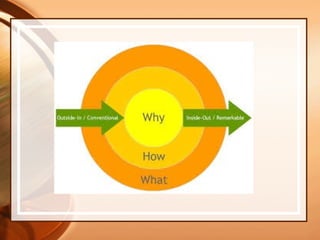
Sinek calls The Golden Circle
• The concept of the Golden Circle
was inspired by the golden ratio.
From the Egyptians to Pythagoras
to Leonardo da Vinci , many have
looked to the golden ratio to
provide a mathematical formula for
proportion and even beauty. It also
supports the notion that there is
more order in nature than we
think, as in symmetry of leaves
and the geometric perfection of
snowflakes.
• The Golden Circle also finds
order and predictability in
human behavior. Put simply, it
helps us understand why we
do what we do. The Golden
Circle provides compelling
evidence of how much more
we can achieve if we remind
ourselves to start everything
we do by first asking WHY.
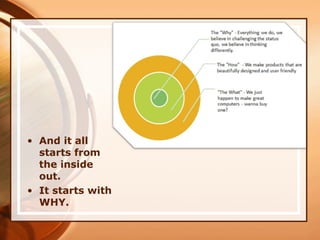
• And it all
starts from
the inside
out.
• It starts with
WHY.
• Every single company or
organization on the planet
knows WHAT they do. This is
true no matter how big or
small, no matter what industry.
Everyone is easily able to
describe the products or
services a company sells or the
job function they have within
that system.
• WHATs are easy to identify.
• Some companies know HOW
they do WHAT they do.
• HOWs are often given to
explain how something is
different or better.
• It would be false to assume
that’s all that is required .
There is one missing detail:
WHY?
• Very few people or companies
can clearly articulate WHY they
do WHAT they do. By WHY it is
meant your purpose, cause or
belief. WHY does your
company/ organization exist?
WHY do you get out of bed
every morning? And WHY
should anyone care?
• The principle of the
Golden circle will be
demonstrated with a
simple example.
• If Apple were like most
other companies, a
marketing message from
them would move from
outside in of The Golden
Circle.
08/25/13
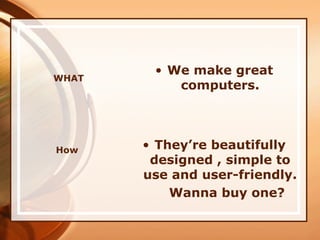
WHAT
• We make great
computers.
• They’re beautifully
designed , simple to
use and user-friendly.
Wanna buy one?
How
• Now let’s rewrite the
example in order
Apple actually
communicates.
08/25/13
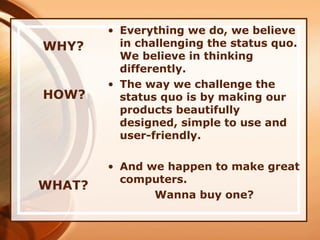
WHY?
• Everything we do, we believe
in challenging the status quo.
We believe in thinking
differently.
• The way we challenge the
status quo is by making our
products beautifully
designed, simple to use and
user-friendly.
• And we happen to make great
computers.
Wanna buy one?
WHAT?
HOW?
DEAR TEACHERS,
• Now that you know
the principle of the
Golden Circle, it is up
to you whether to use
it in your work or not.
• Everybody makes their
own choice.
Don’t forget!
• Poor leaders want
others to follow them.
• Great leaders are
committed to
following a cause or
idea greater than
themselves.
• The materials for this
presentation are from Simon
Sinek’s book
START WITH WHY
THANK YOU!
08/25/13

The golden circle

  • 1.
    The Golden Circle TheGolden Circle The Golden Circle
  • 2.
    • There area few leaders who choose to inspire rather than manipulate in order to motivate people. • Great leaders follow a naturally occurring pattern that Simon Sinek calls The Golden Circle
  • 4.
    • The conceptof the Golden Circle was inspired by the golden ratio. From the Egyptians to Pythagoras to Leonardo da Vinci , many have looked to the golden ratio to provide a mathematical formula for proportion and even beauty. It also supports the notion that there is more order in nature than we think, as in symmetry of leaves and the geometric perfection of snowflakes.
  • 5.
    • The GoldenCircle also finds order and predictability in human behavior. Put simply, it helps us understand why we do what we do. The Golden Circle provides compelling evidence of how much more we can achieve if we remind ourselves to start everything we do by first asking WHY.
  • 6.
    • And itall starts from the inside out. • It starts with WHY.
  • 7.
    • Every singlecompany or organization on the planet knows WHAT they do. This is true no matter how big or small, no matter what industry. Everyone is easily able to describe the products or services a company sells or the job function they have within that system. • WHATs are easy to identify.
  • 8.
    • Some companiesknow HOW they do WHAT they do. • HOWs are often given to explain how something is different or better. • It would be false to assume that’s all that is required . There is one missing detail:
  • 9.
  • 10.
    • Very fewpeople or companies can clearly articulate WHY they do WHAT they do. By WHY it is meant your purpose, cause or belief. WHY does your company/ organization exist? WHY do you get out of bed every morning? And WHY should anyone care?
  • 11.
    • The principleof the Golden circle will be demonstrated with a simple example. • If Apple were like most other companies, a marketing message from them would move from outside in of The Golden Circle. 08/25/13
  • 12.
    WHAT • We makegreat computers. • They’re beautifully designed , simple to use and user-friendly. Wanna buy one? How
  • 13.
    • Now let’srewrite the example in order Apple actually communicates. 08/25/13
  • 14.
    WHY? • Everything wedo, we believe in challenging the status quo. We believe in thinking differently. • The way we challenge the status quo is by making our products beautifully designed, simple to use and user-friendly. • And we happen to make great computers. Wanna buy one? WHAT? HOW?
  • 15.
    DEAR TEACHERS, • Nowthat you know the principle of the Golden Circle, it is up to you whether to use it in your work or not. • Everybody makes their own choice.
  • 16.
    Don’t forget! • Poorleaders want others to follow them. • Great leaders are committed to following a cause or idea greater than themselves.
  • 17.
    • The materialsfor this presentation are from Simon Sinek’s book START WITH WHY THANK YOU! 08/25/13