Mithilesh Mandal
114ar00006
Department of Planning and Architecture
National Institute of Technology Rourkela
Introduction
 In 2001 the idea of transparent concrete was put
forward by Hungarian architect Aron Losonzi.
Successfully produced the first transparent concrete
block in 2003,named LiTraCon.
 Light transmitting concrete (LiTraCon) also known as
translucent concrete, is a concrete based building
material having light transmitting property.
 Light transmitting property is mainly due to uniform
distribution of optical fibres throughout its body. It is
also known to be transparent concrete.
 It is available as prefabricated building blocks and
panels.
Principle
 Translucent concrete works based on “Nano-Optics”.
 These fibres pass as much light when tiny slits are placed directly on top of
each other. Hence optical fibres in the concrete act like the slits and carry
the light across throughout the concrete.
Optical Fibre
 Flexible, transparent fibre made up of glass or plastic (as thin as a human hair).
 It transmits light between two ends of the fibre by process of total internal reflection.
 Optical fibre transmits light so effectively that there is almost no loss of light conducted
through the fibres.
Working Principle
 Total Internal Reflection
 When a ray of light travels from a denser to a rarer medium such that the
angle of incidence is greater than the critical angle, the ray reflects back into
the same medium this phenomena is called total internal reflection.
 In the optical fibre the rays undergo repeated total number of reflections
until it emerges out of the other end of the fibre, even if the fibre is bent.
Materials Required
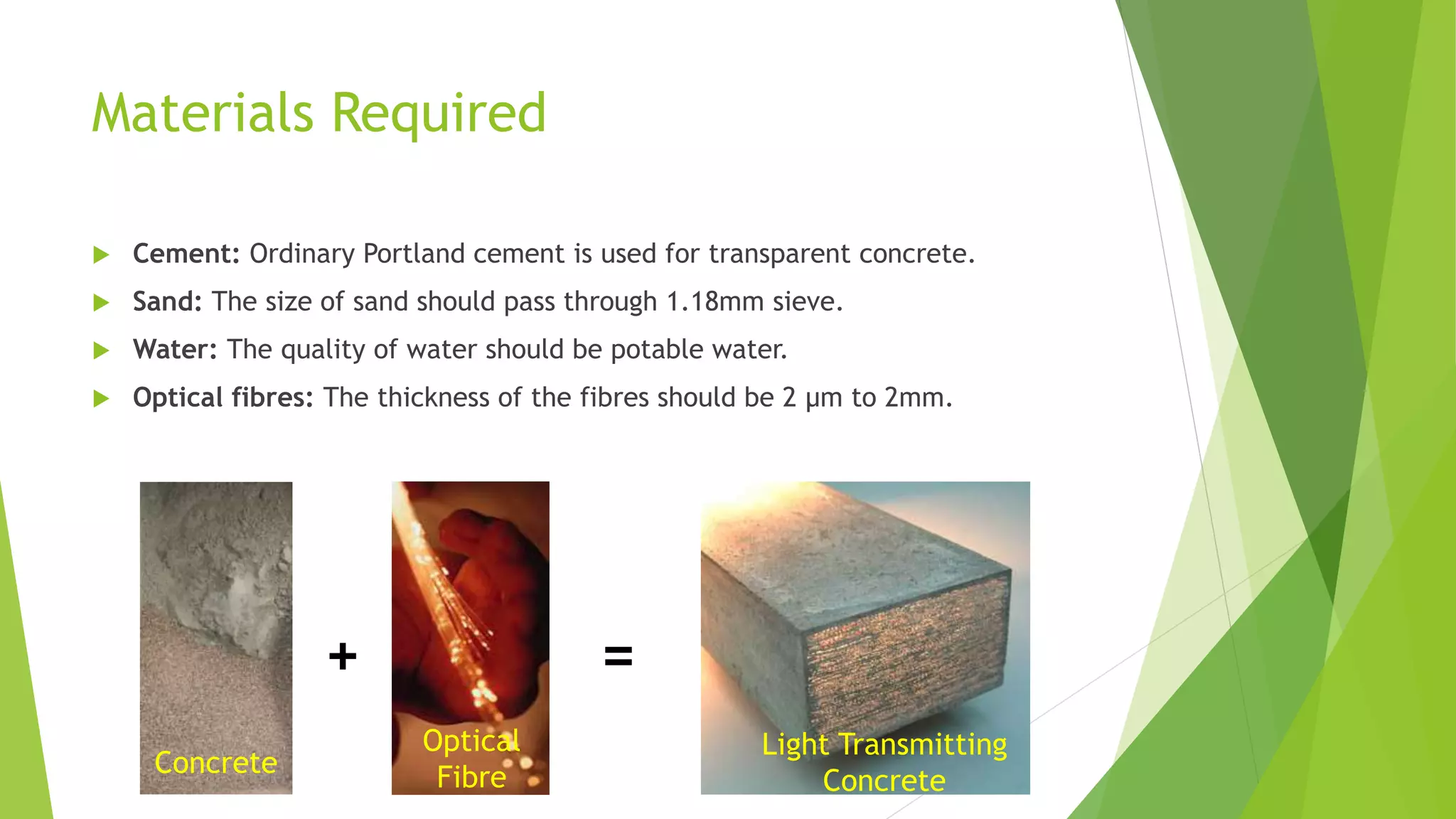
 Cement: Ordinary Portland cement is used for transparent concrete.
 Sand: The size of sand should pass through 1.18mm sieve.
 Water: The quality of water should be potable water.
 Optical fibres: The thickness of the fibres should be 2 μm to 2mm.
+ =
Concrete
Optical
Fibre
Light Transmitting
Concrete
Manufacturing Process
 Concrete mixture is made up of fine materials only, it contains no coarse
aggregate.
 Strands of optical fibres are cast by thousands into concrete.
 Light-transmitting concrete is produced by adding optical fibres into the
concrete mixture.
 The fibres run parallel to each other.
 Thickness of the optical fibres can be varied between 2 μm and 2 mm
according to the requirements.
Manufacturing Process (contd.)
 The most important requirement for the success of the product is assurance
the fibre optic strands make contact with both surfaces; otherwise it looses
the ability to transmit.
 An uninterrupted passage through the concrete is achieved by using long
moulds, which are filled with a thin layer of concrete, before layers of fibre
optic strands and more concrete are added until the mould is full.
 From the long moulds, the product can be removed, and then cut to length
accordingly.
Mixing of concrete
 COMPONENTS OF CONCRETE
1) Epoxy matrix from 0% to 90%
2) Polycarbonate matrix from 0% to 60%
3) Fiberglass from 0% to 10%
4) Colloidal silica sol from 0.5% to 5%
5) Silica from 0.5% to 10%
6) Diethylenetriamine (DETA) from 10% to 50%
7) Optical fibres from 0% to 3%
8) Portland cement from 0% to 15%
Manufacturing of translucent concrete
a)Mixing the cement with water according to specific proportions.
b)Mixing the polymer matrices with the respective catalyst or hardener, and
c)Mixing the previous two mixtures with the other components in the specific
proportions.
Properties
 a) Technical specifications
• Form: prefabricated blocks / panels
• Components: Concrete, Optical
fibre
• Cast Material: Fibre Ratio: 1:15 to
1:8
• Density: 2100 – 2400 kg/m3
• Compressive strength varying
• Bending Strength: 7.7 N/mm2
 b) Material performance
• Concrete retains its strength
• High density top layer concrete
• Infused with optical fibres
• Frost and de-icing salt
resistant.
• Fire protection.
• Highest UV resistance.
 c) Environment Impact
• When a solid wall has the
ability to transmit light, it means
that one can use fewer lights
during daylight hours.
Advantages and Disadvantages
 Advantages
1) Less energy consumption.
2) Illuminated Pavements.
3) Homogeneous in structure.
4) Finishing Surface.
5) Routine maintenance not
required.
6) Saves electricity by emitting
light during day
7) . Translucent concrete can
enhance security in places where
people and their actions can be
seen, but not their entire image.
 Disadvantages
 1)Very high cost about USD
1000/sq.m of 25mm thickness.
 2) Labours with technical skills are
needed to use it.
 3) It’s a factory product.
Applications
 1. Translucent concrete
inserts on front doors of
homes, allowing the resident
to see when there is a person
standing outside.
 2. Translucent concrete walls
on restaurants, clubs, and
other establishments to reveal
how many patrons are inside.
 3. Ceilings of any large office
building or commercial
structure incorporating
translucent concrete would
reduce lighting costs during
daylight hours.
 4. Sidewalks poured with
translucent concrete could be
made with lighting
underneath, creating lit
walkways which would
enhance safety, and also
encourage foot travel where
previously avoided at night.
 5. The use of translucent
concrete in an outer wall of
an indoor stairwell would
provide illumination in a
power outage, resulting in
enhanced safety.
 6. Subways using this material
could be illuminated with
daylight.
Examples
 CELLA SEPTICHORA /
PECS,HUNGARY
Cella Septichora Visitors Centre in
Pécs, Hungary, which has a door made
of Litracon Panels set in a steel frame.
Examples
 MONTBLANC, TOKYO
The illuminated interior wall of the
new boutique of Montblanc in Tokyo is
considered to be the most prestigious
project of Litracon up-to-date.
Litracon blocks were used as
illuminated wall in the new flagship
boutique of famous producer of
handwriting instruments and
jewellery, Montblanc.
THANK YOU

Light Transmitting concrete

  • 1.
    Mithilesh Mandal 114ar00006 Department ofPlanning and Architecture National Institute of Technology Rourkela
  • 2.
    Introduction  In 2001the idea of transparent concrete was put forward by Hungarian architect Aron Losonzi. Successfully produced the first transparent concrete block in 2003,named LiTraCon.  Light transmitting concrete (LiTraCon) also known as translucent concrete, is a concrete based building material having light transmitting property.  Light transmitting property is mainly due to uniform distribution of optical fibres throughout its body. It is also known to be transparent concrete.  It is available as prefabricated building blocks and panels.
  • 3.
    Principle  Translucent concreteworks based on “Nano-Optics”.  These fibres pass as much light when tiny slits are placed directly on top of each other. Hence optical fibres in the concrete act like the slits and carry the light across throughout the concrete.
  • 4.
    Optical Fibre  Flexible,transparent fibre made up of glass or plastic (as thin as a human hair).  It transmits light between two ends of the fibre by process of total internal reflection.  Optical fibre transmits light so effectively that there is almost no loss of light conducted through the fibres.
  • 5.
    Working Principle  TotalInternal Reflection  When a ray of light travels from a denser to a rarer medium such that the angle of incidence is greater than the critical angle, the ray reflects back into the same medium this phenomena is called total internal reflection.  In the optical fibre the rays undergo repeated total number of reflections until it emerges out of the other end of the fibre, even if the fibre is bent.
  • 6.
    Materials Required  Cement:Ordinary Portland cement is used for transparent concrete.  Sand: The size of sand should pass through 1.18mm sieve.  Water: The quality of water should be potable water.  Optical fibres: The thickness of the fibres should be 2 μm to 2mm. + = Concrete Optical Fibre Light Transmitting Concrete
  • 7.
    Manufacturing Process  Concretemixture is made up of fine materials only, it contains no coarse aggregate.  Strands of optical fibres are cast by thousands into concrete.  Light-transmitting concrete is produced by adding optical fibres into the concrete mixture.  The fibres run parallel to each other.  Thickness of the optical fibres can be varied between 2 μm and 2 mm according to the requirements.
  • 8.
    Manufacturing Process (contd.) The most important requirement for the success of the product is assurance the fibre optic strands make contact with both surfaces; otherwise it looses the ability to transmit.  An uninterrupted passage through the concrete is achieved by using long moulds, which are filled with a thin layer of concrete, before layers of fibre optic strands and more concrete are added until the mould is full.  From the long moulds, the product can be removed, and then cut to length accordingly.
  • 9.
    Mixing of concrete COMPONENTS OF CONCRETE 1) Epoxy matrix from 0% to 90% 2) Polycarbonate matrix from 0% to 60% 3) Fiberglass from 0% to 10% 4) Colloidal silica sol from 0.5% to 5% 5) Silica from 0.5% to 10% 6) Diethylenetriamine (DETA) from 10% to 50% 7) Optical fibres from 0% to 3% 8) Portland cement from 0% to 15%
  • 10.
    Manufacturing of translucentconcrete a)Mixing the cement with water according to specific proportions. b)Mixing the polymer matrices with the respective catalyst or hardener, and c)Mixing the previous two mixtures with the other components in the specific proportions.
  • 11.
    Properties  a) Technicalspecifications • Form: prefabricated blocks / panels • Components: Concrete, Optical fibre • Cast Material: Fibre Ratio: 1:15 to 1:8 • Density: 2100 – 2400 kg/m3 • Compressive strength varying • Bending Strength: 7.7 N/mm2  b) Material performance • Concrete retains its strength • High density top layer concrete • Infused with optical fibres • Frost and de-icing salt resistant. • Fire protection. • Highest UV resistance.  c) Environment Impact • When a solid wall has the ability to transmit light, it means that one can use fewer lights during daylight hours.
  • 12.
    Advantages and Disadvantages Advantages 1) Less energy consumption. 2) Illuminated Pavements. 3) Homogeneous in structure. 4) Finishing Surface. 5) Routine maintenance not required. 6) Saves electricity by emitting light during day 7) . Translucent concrete can enhance security in places where people and their actions can be seen, but not their entire image.  Disadvantages  1)Very high cost about USD 1000/sq.m of 25mm thickness.  2) Labours with technical skills are needed to use it.  3) It’s a factory product.
  • 13.
    Applications  1. Translucentconcrete inserts on front doors of homes, allowing the resident to see when there is a person standing outside.  2. Translucent concrete walls on restaurants, clubs, and other establishments to reveal how many patrons are inside.  3. Ceilings of any large office building or commercial structure incorporating translucent concrete would reduce lighting costs during daylight hours.  4. Sidewalks poured with translucent concrete could be made with lighting underneath, creating lit walkways which would enhance safety, and also encourage foot travel where previously avoided at night.  5. The use of translucent concrete in an outer wall of an indoor stairwell would provide illumination in a power outage, resulting in enhanced safety.  6. Subways using this material could be illuminated with daylight.
  • 14.
    Examples  CELLA SEPTICHORA/ PECS,HUNGARY Cella Septichora Visitors Centre in Pécs, Hungary, which has a door made of Litracon Panels set in a steel frame.
  • 15.
    Examples  MONTBLANC, TOKYO Theilluminated interior wall of the new boutique of Montblanc in Tokyo is considered to be the most prestigious project of Litracon up-to-date. Litracon blocks were used as illuminated wall in the new flagship boutique of famous producer of handwriting instruments and jewellery, Montblanc.
  • 16.

Editor's Notes

  • #2 NOTE: To change the image on this slide, select the picture and delete it. Then click the Pictures icon in the placeholder to insert your own image.