SEMINAR
ON
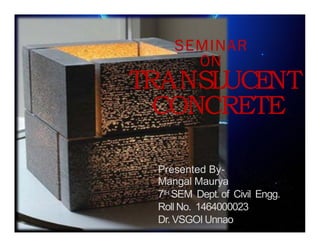
TRANSLUCENT
CONCRETE
Presented By-
Mangal Maurya
7TH SEM Dept. of Civil Engg.
Roll No. 1464000023
Dr. VSGOI Unnao
CONTENTS








INTRODUCTION
MATERIAL USED FOR TRANSLUCENT
CONCRETE
PRINCIPLE
MANUFACTURING PROCESS
APPLICATIONS
ADVANTAGES AND DISADVANTAGES
CONCLUSION
REFERENCES
INTRODUCTION



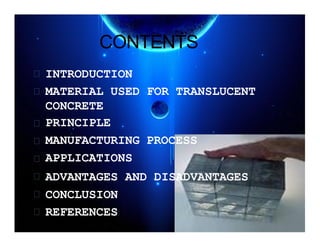
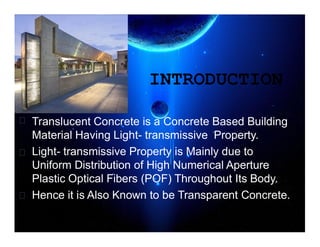
Translucent Concrete is a Concrete Based Building
Material Having Light- transmissive Property.
Light- transmissive Property is Mainly due to
Uniform Distribution of High Numerical Aperture
Plastic Optical Fibers (POF) Throughout Its Body.
Hence it is Also Known to be Transparent Concrete.
MANUFACTURING PROCESS



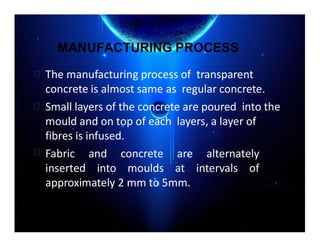
The manufacturing process of transparent
concrete is almost same as regular concrete.
Small layers of the concrete are poured into the
mould and on top of each layers, a layer of
fibres is infused.
Fabric and concrete are alternately
inserted into moulds at intervals of
approximately 2 mm to 5mm.
MATERIAL USED FOR TRANSLUCENT
CONCRETE

 Fine concrete
 Optical fibres
 Fine concrete: Consists of cement and
fine aggregate such as sand.
 Optical fibres: There are 3 kinds
I. Multimode graded-index fiber
II. Multimode step-index fibre
III. Single-mode step-index fibres.
PRINCIPLE


Translucent concrete works Based on
“Nano-Optics”.
These fibres passes as much light when tiny
slits are placed directly on top of each other.
Hence optical fibers in the concrete act like
the slits and carry the light across throughout
the concrete.
MANUFACTURING PROCESS




Light-transmitting concrete is produced by adding
4% to 5% optical fibres by volume into the concrete
mixture.
The concrete mixture is made from fine materials
and does not contain coarse aggregate.
Thousands of strands of optical fibres are cast into
concrete to transmit light.
Smaller or thinner layers allow an increased amount
of light to pass through the concrete.
MANUFACTURING PROCESS
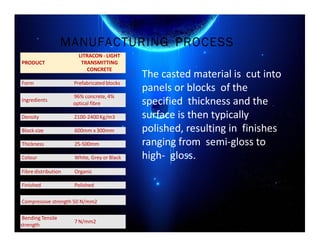
 The casted material is cut into
panels or blocks of the
specified thickness and the
surface is then typically
polished, resulting in finishes
ranging from semi-gloss to
high- gloss.
PRODUCT
LITRACON - LIGHT
TRANSMITTING
CONCRETE
Form Prefabricated blocks
Ingredients
96% concrete, 4%
optical fibre
Density 2100-2400 Kg/m3
Block size 600mm x 300mm
Thickness 25-500mm
Colour White, Grey or Black
Fibre distribution Organic
Finished Polished
Compressive strength 50 N/mm2
Bending Tensile
strength
7 N/mm2
APPLICATIONS



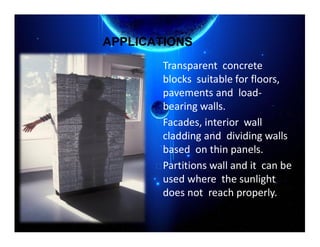
Transparent concrete
blocks suitable for floors,
pavements and load-
bearing walls.
Facades, interior wall
cladding and dividing walls
based on thin panels.
Partitions wall and it can be
used where the sunlight
does not reach properly.
APPLICATIONS





In furniture for the decorative and
aesthetic purpose.
Light sidewalks at night.
Increasing visibility in dark subway
stations.
Lighting indoor fire escapes, in the
event of a power failure.
Illuminating speed bumps on
roadways at night.
ADVANTAGES


Energy saving can be done by utilization
of transparent concrete in building.
It has very good architectural properties
for giving good aesthetical view to the
building.
DISADVANTAGES


The concrete is very costly because of
the optical fibres.
Casting of transparent concrete block is
difficult for the labour so special skilled
person is required.
CONCLUSION




Transparent concrete can be developed by adding
optical fibre or large diameter glass fibre in the
concrete mixture.
It has good light guiding property and the ratio of
optical fibre volume to concrete is proportionate to
transmission of light.
It doesn’t loose the strength parameter when
compared to regular concrete and also it has very
vital property from the aesthetic point of view.
This new kind of building material can integrate the
concept of green energy saving
REFERENCES





Victoria Bailey, “Translucent Concrete”,
MEEN
en.wikipedia.org/wiki/Translucent_concr
ete
wikipedia.org/wiki/Optical_fiber
byen.wikipedia.org/wiki/LiTraCon
www.litracon.hu/
Translucent concret

Translucent concret

  • 1.
    SEMINAR ON TRANSLUCENT CONCRETE Presented By- Mangal Maurya 7THSEM Dept. of Civil Engg. Roll No. 1464000023 Dr. VSGOI Unnao
  • 2.
    CONTENTS         INTRODUCTION MATERIAL USED FORTRANSLUCENT CONCRETE PRINCIPLE MANUFACTURING PROCESS APPLICATIONS ADVANTAGES AND DISADVANTAGES CONCLUSION REFERENCES
  • 3.
    INTRODUCTION    Translucent Concrete isa Concrete Based Building Material Having Light- transmissive Property. Light- transmissive Property is Mainly due to Uniform Distribution of High Numerical Aperture Plastic Optical Fibers (POF) Throughout Its Body. Hence it is Also Known to be Transparent Concrete.
  • 4.
    MANUFACTURING PROCESS    The manufacturingprocess of transparent concrete is almost same as regular concrete. Small layers of the concrete are poured into the mould and on top of each layers, a layer of fibres is infused. Fabric and concrete are alternately inserted into moulds at intervals of approximately 2 mm to 5mm.
  • 5.
    MATERIAL USED FORTRANSLUCENT CONCRETE   Fine concrete  Optical fibres  Fine concrete: Consists of cement and fine aggregate such as sand.  Optical fibres: There are 3 kinds I. Multimode graded-index fiber II. Multimode step-index fibre III. Single-mode step-index fibres.
  • 6.
    PRINCIPLE   Translucent concrete worksBased on “Nano-Optics”. These fibres passes as much light when tiny slits are placed directly on top of each other. Hence optical fibers in the concrete act like the slits and carry the light across throughout the concrete.
  • 7.
    MANUFACTURING PROCESS     Light-transmitting concreteis produced by adding 4% to 5% optical fibres by volume into the concrete mixture. The concrete mixture is made from fine materials and does not contain coarse aggregate. Thousands of strands of optical fibres are cast into concrete to transmit light. Smaller or thinner layers allow an increased amount of light to pass through the concrete.
  • 8.
    MANUFACTURING PROCESS  Thecasted material is cut into panels or blocks of the specified thickness and the surface is then typically polished, resulting in finishes ranging from semi-gloss to high- gloss. PRODUCT LITRACON - LIGHT TRANSMITTING CONCRETE Form Prefabricated blocks Ingredients 96% concrete, 4% optical fibre Density 2100-2400 Kg/m3 Block size 600mm x 300mm Thickness 25-500mm Colour White, Grey or Black Fibre distribution Organic Finished Polished Compressive strength 50 N/mm2 Bending Tensile strength 7 N/mm2
  • 9.
    APPLICATIONS    Transparent concrete blocks suitablefor floors, pavements and load- bearing walls. Facades, interior wall cladding and dividing walls based on thin panels. Partitions wall and it can be used where the sunlight does not reach properly.
  • 10.
    APPLICATIONS      In furniture forthe decorative and aesthetic purpose. Light sidewalks at night. Increasing visibility in dark subway stations. Lighting indoor fire escapes, in the event of a power failure. Illuminating speed bumps on roadways at night.
  • 11.
    ADVANTAGES   Energy saving canbe done by utilization of transparent concrete in building. It has very good architectural properties for giving good aesthetical view to the building.
  • 12.
    DISADVANTAGES   The concrete isvery costly because of the optical fibres. Casting of transparent concrete block is difficult for the labour so special skilled person is required.
  • 13.
    CONCLUSION     Transparent concrete canbe developed by adding optical fibre or large diameter glass fibre in the concrete mixture. It has good light guiding property and the ratio of optical fibre volume to concrete is proportionate to transmission of light. It doesn’t loose the strength parameter when compared to regular concrete and also it has very vital property from the aesthetic point of view. This new kind of building material can integrate the concept of green energy saving
  • 14.
    REFERENCES      Victoria Bailey, “TranslucentConcrete”, MEEN en.wikipedia.org/wiki/Translucent_concr ete wikipedia.org/wiki/Optical_fiber byen.wikipedia.org/wiki/LiTraCon www.litracon.hu/