STUDY OF TRANSPARENT
CONCRETE
Civil Engineering
Ayush Kumar Singh
Madan Mohan Malviya University of Technology
Gorakhpur (UP State Govt. University)
Email: 2019011051@mmmut.ac.in
CONTENT
• INTRODUCTION
• MATERIALS USED
• TYPES OF OPTICAL FIBRE
• CONSTRUCTION OF BLOCKS USING POF.
• COMPARISON WITH CONVENTIONAL CONCRETE.
• APPLICATIONS OF LITRACON
• ADVANTAGES AND DISADVANTAGES
• CONCLUSION.
• REFERENCES
INTRODUCTION
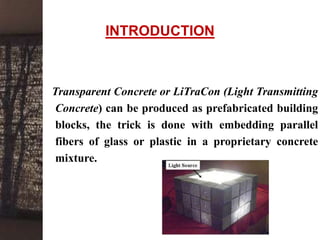
Transparent Concrete or LiTraCon (Light Transmitting
Concrete) can be produced as prefabricated building
blocks, the trick is done with embedding parallel
fibers of glass or plastic in a proprietary concrete
mixture.
MATERIAL USED
• There are two basic materials used for making
transparent concrete, one is from construction
field and another from sensing field.
• Concrete
• Optical fibres
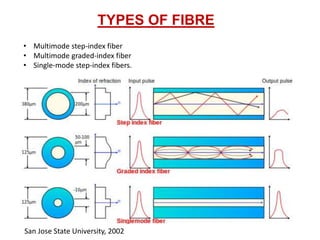
TYPES OF FIBRE
San Jose State University, 2002
• Multimode step-index fiber
• Multimode graded-index fiber
• Single-mode step-index fibers.
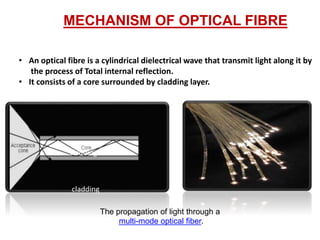
MECHANISM OF OPTICAL FIBRE
The propagation of light through a
multi-mode optical fiber.
cladding
• An optical fibre is a cylindrical dielectrical wave that transmit light along it by
the process of Total internal reflection.
• It consists of a core surrounded by cladding layer.
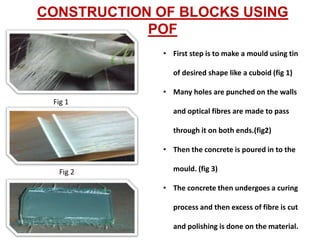
CONSTRUCTION OF BLOCKS USING
POF
• First step is to make a mould using tin
of desired shape like a cuboid (fig 1)
• Many holes are punched on the walls
and optical fibres are made to pass
through it on both ends.(fig2)
• Then the concrete is poured in to the
mould. (fig 3)
• The concrete then undergoes a curing
process and then excess of fibre is cut
and polishing is done on the material.
Fig 1
Fig 2
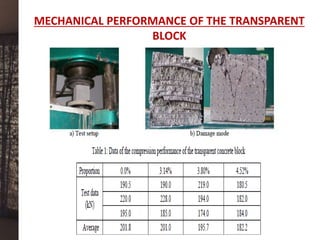
MECHANICAL PERFORMANCE OF THE TRANSPARENT
BLOCK
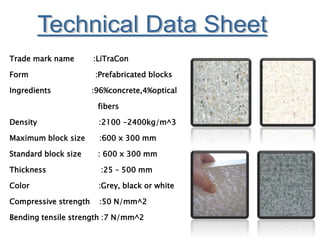
Trade mark name :LiTraCon
Form :Prefabricated blocks
Ingredients :96%concrete,4%optical
fibers
Density :2100 -2400kg/m^3
Maximum block size :600 x 300 mm
Standard block size : 600 x 300 mm
Thickness :25 – 500 mm
Color :Grey, black or white
Compressive strength :50 N/mm^2
Bending tensile strength :7 N/mm^2
 Quantity of optical fiber is the rate influencing parameter.
 Life of LiTraCon depends on the bending radius of
the optical fibers.
 Aesthetic appearance is comparably high.
 The parameters like bending strength, compressive strength,
density is similar to conventional concrete.
 They provide same structural performance
as conventional concrete.
COMPARISON WITH CONVENTIONAL
CONCRETE
ADVANTAGES
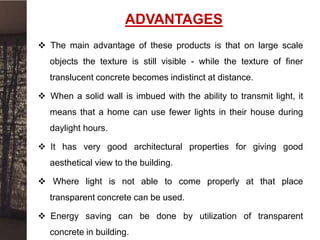
 The main advantage of these products is that on large scale
objects the texture is still visible - while the texture of finer
translucent concrete becomes indistinct at distance.
 When a solid wall is imbued with the ability to transmit light, it
means that a home can use fewer lights in their house during
daylight hours.
 It has very good architectural properties for giving good
aesthetical view to the building.
 Where light is not able to come properly at that place
transparent concrete can be used.
 Energy saving can be done by utilization of transparent
concrete in building.
DISADVANTAGES
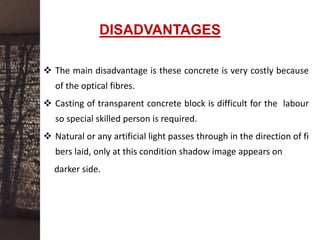
 The main disadvantage is these concrete is very costly because
of the optical fibres.
 Casting of transparent concrete block is difficult for the labour
so special skilled person is required.
 Natural or any artificial light passes through in the direction of fi
bers laid, only at this condition shadow image appears on
darker side.
APPLICATIONS
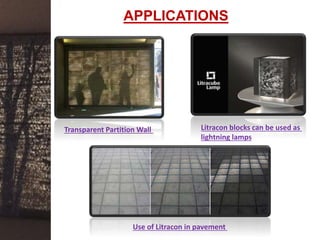
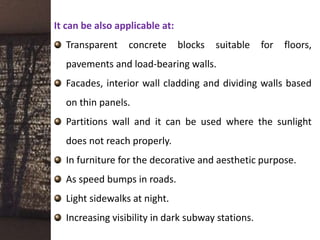
Transparent Partition Wall Litracon blocks can be used as
lightning lamps
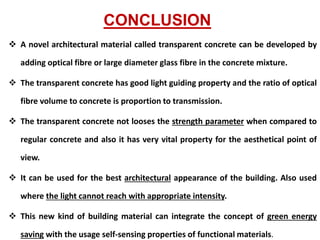
Use of Litracon in pavement
It can be also applicable at:
Transparent concrete blocks suitable for floors,
pavements and load-bearing walls.
Facades, interior wall cladding and dividing walls based
on thin panels.
Partitions wall and it can be used where the sunlight
does not reach properly.
In furniture for the decorative and aesthetic purpose.
As speed bumps in roads.
Light sidewalks at night.
Increasing visibility in dark subway stations.
CONCLUSION
 A novel architectural material called transparent concrete can be developed by
adding optical fibre or large diameter glass fibre in the concrete mixture.
 The transparent concrete has good light guiding property and the ratio of optical
fibre volume to concrete is proportion to transmission.
 The transparent concrete not looses the strength parameter when compared to
regular concrete and also it has very vital property for the aesthetical point of
view.
 It can be used for the best architectural appearance of the building. Also used
where the light cannot reach with appropriate intensity.
 This new kind of building material can integrate the concept of green energy
saving with the usage self-sensing properties of functional materials.
REFERENCES
• http://www.litracon.hu
• https://en.wikipedia.org/wiki/Optical_fiber
• https://en.wikipedia.org/wiki/Translucent_concrete
• www.archicentral.com/litracon-transparent-concrete
• http://www.materialproject.org/wiki/Translucent_concrete
PPT on transparent concrete.pptx

PPT on transparent concrete.pptx

  • 1.
    STUDY OF TRANSPARENT CONCRETE CivilEngineering Ayush Kumar Singh Madan Mohan Malviya University of Technology Gorakhpur (UP State Govt. University) Email: 2019011051@mmmut.ac.in
  • 2.
    CONTENT • INTRODUCTION • MATERIALSUSED • TYPES OF OPTICAL FIBRE • CONSTRUCTION OF BLOCKS USING POF. • COMPARISON WITH CONVENTIONAL CONCRETE. • APPLICATIONS OF LITRACON • ADVANTAGES AND DISADVANTAGES • CONCLUSION. • REFERENCES
  • 3.
    INTRODUCTION Transparent Concrete orLiTraCon (Light Transmitting Concrete) can be produced as prefabricated building blocks, the trick is done with embedding parallel fibers of glass or plastic in a proprietary concrete mixture.
  • 4.
    MATERIAL USED • Thereare two basic materials used for making transparent concrete, one is from construction field and another from sensing field. • Concrete • Optical fibres
  • 5.
    TYPES OF FIBRE SanJose State University, 2002 • Multimode step-index fiber • Multimode graded-index fiber • Single-mode step-index fibers.
  • 6.
    MECHANISM OF OPTICALFIBRE The propagation of light through a multi-mode optical fiber. cladding • An optical fibre is a cylindrical dielectrical wave that transmit light along it by the process of Total internal reflection. • It consists of a core surrounded by cladding layer.
  • 7.
    CONSTRUCTION OF BLOCKSUSING POF • First step is to make a mould using tin of desired shape like a cuboid (fig 1) • Many holes are punched on the walls and optical fibres are made to pass through it on both ends.(fig2) • Then the concrete is poured in to the mould. (fig 3) • The concrete then undergoes a curing process and then excess of fibre is cut and polishing is done on the material. Fig 1 Fig 2
  • 8.
    MECHANICAL PERFORMANCE OFTHE TRANSPARENT BLOCK
  • 9.
    Trade mark name:LiTraCon Form :Prefabricated blocks Ingredients :96%concrete,4%optical fibers Density :2100 -2400kg/m^3 Maximum block size :600 x 300 mm Standard block size : 600 x 300 mm Thickness :25 – 500 mm Color :Grey, black or white Compressive strength :50 N/mm^2 Bending tensile strength :7 N/mm^2
  • 10.
     Quantity ofoptical fiber is the rate influencing parameter.  Life of LiTraCon depends on the bending radius of the optical fibers.  Aesthetic appearance is comparably high.  The parameters like bending strength, compressive strength, density is similar to conventional concrete.  They provide same structural performance as conventional concrete. COMPARISON WITH CONVENTIONAL CONCRETE
  • 11.
    ADVANTAGES  The mainadvantage of these products is that on large scale objects the texture is still visible - while the texture of finer translucent concrete becomes indistinct at distance.  When a solid wall is imbued with the ability to transmit light, it means that a home can use fewer lights in their house during daylight hours.  It has very good architectural properties for giving good aesthetical view to the building.  Where light is not able to come properly at that place transparent concrete can be used.  Energy saving can be done by utilization of transparent concrete in building.
  • 12.
    DISADVANTAGES  The maindisadvantage is these concrete is very costly because of the optical fibres.  Casting of transparent concrete block is difficult for the labour so special skilled person is required.  Natural or any artificial light passes through in the direction of fi bers laid, only at this condition shadow image appears on darker side.
  • 13.
    APPLICATIONS Transparent Partition WallLitracon blocks can be used as lightning lamps Use of Litracon in pavement
  • 14.
    It can bealso applicable at: Transparent concrete blocks suitable for floors, pavements and load-bearing walls. Facades, interior wall cladding and dividing walls based on thin panels. Partitions wall and it can be used where the sunlight does not reach properly. In furniture for the decorative and aesthetic purpose. As speed bumps in roads. Light sidewalks at night. Increasing visibility in dark subway stations.
  • 15.
    CONCLUSION  A novelarchitectural material called transparent concrete can be developed by adding optical fibre or large diameter glass fibre in the concrete mixture.  The transparent concrete has good light guiding property and the ratio of optical fibre volume to concrete is proportion to transmission.  The transparent concrete not looses the strength parameter when compared to regular concrete and also it has very vital property for the aesthetical point of view.  It can be used for the best architectural appearance of the building. Also used where the light cannot reach with appropriate intensity.  This new kind of building material can integrate the concept of green energy saving with the usage self-sensing properties of functional materials.
  • 16.
    REFERENCES • http://www.litracon.hu • https://en.wikipedia.org/wiki/Optical_fiber •https://en.wikipedia.org/wiki/Translucent_concrete • www.archicentral.com/litracon-transparent-concrete • http://www.materialproject.org/wiki/Translucent_concrete