How do you LIGHT Up
   your world ?
Welcome to a power point
         presentation on LIGHT.


• We will investigate the following:
• 1. What is light?
• 2.What are some sources of light around us?
• 3. What are opaque, transparent, and translucent
    objects?
• 4. What is a light wave?
Light
• Our primary source of light is the sun.
• Light travels in straight lines at a speed of
  186,000miles per second.
• *Light waves travel faster than sound waves!
• Light energy from the sun travels through space,
  reaches earth, and some of it turns to heat energy
  and warms the earth’s air.
• Light from the sun also travels to the cells of green
  plants (producers) and is stored as energy.
• When light reaches an object, it is absorbed,
  reflected, or passes through it.
Sensing Light
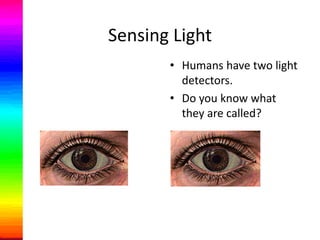
       • Humans have two light
         detectors.
       • Do you know what
         they are called?
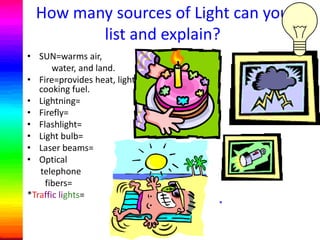
How many sources of Light can you
         list and explain?
• SUN=warms air,
       water, and land.
• Fire=provides heat, light, and
   cooking fuel.
• Lightning=
• Firefly=
• Flashlight=
• Light bulb=
• Laser beams=
• Optical
   telephone
    fibers=
*Traffic lights=
                                   *
Can you answer these 6th grade
                questions?
• 1. A person will see a flash of lightning before they
  hear the thunder that goes with it because?

• 2.Can you draw a long wavelength and a short
  wavelength next to it?

• 3. Can you contrast objects that are transparent,
  translucent, and opaque?
“Just Passing Through:”
What happens when light strikes glass? Or
       waxed paper? Or a book?

                     • If light travels through an
                       object it is =transparent
                     • If light is blocked by an
                       object and a dark shadow
                       is cast it is= opaque.
                     • If some light passes
                       through but not all and a
                       light shadow is present it
                       is=translucent.
What happens when light
  hits these objects?
       •   Glass of water
       •   School bus window
       •   Notebook paper
       •   Waxed paper
       •   Plastic wrap
       •   Tissue paper
       •   Cardboard
       •   Textbook
       •   Hand lens…
Transparent objects:

           •   The windows on a school bus,
           •   A clear empty glass,
           •   A clear window pane,
           •   The lenses of some eyeglasses,
           •   Clear plastic wrap,
           •   The glass on a clock,
           •   A hand lens,
           •   Colored glass…
           •   ALL of these are transparent. Yes,
               we can see through them because
               light passes through each of them.
Translucent objects
•   Thin tissue paper,
•   Waxed paper,
•   Tinted car windows,
•   Frosted glass,
•   Clouds,
•   All of these materials
    are translucent and
    allow some light to
    pass but the light
    cannot be clearly seen
    through.
Opaque objects:
           • Heavy weight paper,
           • Cardboard
           • Aluminum foil,
           • Mirror, bricks, buildings,
           • Your eyelids and hands,
           • Solid wood door,
           • All of these objects are
             opaque because light cannot
             pass through them at all.
           • They cast a dark shadow.
Let’s find out how light travels?

• Simple Activity: 1 working flashlight
• 1. Shine a flashlight on a wall.
• 2. Does light from the flashlight reach the
  wall? How do you know?
• 3. What evidence do you have showing light
  travels in a straight line?
• 4.Move closer with the flashlight. Any
  changes?
What is light really?
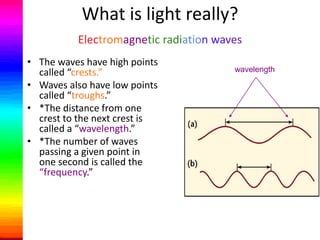
          Electromagnetic radiation waves
• The waves have high points
  called “crests.”                     wavelength

• Waves also have low points
  called “troughs.”
• *The distance from one
  crest to the next crest is
  called a “wavelength.”
• *The number of waves
  passing a given point in
  one second is called the
  “frequency.”

Light

  • 1.
    How do youLIGHT Up your world ?
  • 2.
    Welcome to apower point presentation on LIGHT. • We will investigate the following: • 1. What is light? • 2.What are some sources of light around us? • 3. What are opaque, transparent, and translucent objects? • 4. What is a light wave?
  • 3.
    Light • Our primarysource of light is the sun. • Light travels in straight lines at a speed of 186,000miles per second. • *Light waves travel faster than sound waves! • Light energy from the sun travels through space, reaches earth, and some of it turns to heat energy and warms the earth’s air. • Light from the sun also travels to the cells of green plants (producers) and is stored as energy. • When light reaches an object, it is absorbed, reflected, or passes through it.
  • 4.
    Sensing Light • Humans have two light detectors. • Do you know what they are called?
  • 5.
    How many sourcesof Light can you list and explain? • SUN=warms air, water, and land. • Fire=provides heat, light, and cooking fuel. • Lightning= • Firefly= • Flashlight= • Light bulb= • Laser beams= • Optical telephone fibers= *Traffic lights= *
  • 6.
    Can you answerthese 6th grade questions? • 1. A person will see a flash of lightning before they hear the thunder that goes with it because? • 2.Can you draw a long wavelength and a short wavelength next to it? • 3. Can you contrast objects that are transparent, translucent, and opaque?
  • 7.
    “Just Passing Through:” Whathappens when light strikes glass? Or waxed paper? Or a book? • If light travels through an object it is =transparent • If light is blocked by an object and a dark shadow is cast it is= opaque. • If some light passes through but not all and a light shadow is present it is=translucent.
  • 8.
    What happens whenlight hits these objects? • Glass of water • School bus window • Notebook paper • Waxed paper • Plastic wrap • Tissue paper • Cardboard • Textbook • Hand lens…
  • 9.
    Transparent objects: • The windows on a school bus, • A clear empty glass, • A clear window pane, • The lenses of some eyeglasses, • Clear plastic wrap, • The glass on a clock, • A hand lens, • Colored glass… • ALL of these are transparent. Yes, we can see through them because light passes through each of them.
  • 10.
    Translucent objects • Thin tissue paper, • Waxed paper, • Tinted car windows, • Frosted glass, • Clouds, • All of these materials are translucent and allow some light to pass but the light cannot be clearly seen through.
  • 11.
    Opaque objects: • Heavy weight paper, • Cardboard • Aluminum foil, • Mirror, bricks, buildings, • Your eyelids and hands, • Solid wood door, • All of these objects are opaque because light cannot pass through them at all. • They cast a dark shadow.
  • 12.
    Let’s find outhow light travels? • Simple Activity: 1 working flashlight • 1. Shine a flashlight on a wall. • 2. Does light from the flashlight reach the wall? How do you know? • 3. What evidence do you have showing light travels in a straight line? • 4.Move closer with the flashlight. Any changes?
  • 13.
    What is lightreally? Electromagnetic radiation waves • The waves have high points called “crests.” wavelength • Waves also have low points called “troughs.” • *The distance from one crest to the next crest is called a “wavelength.” • *The number of waves passing a given point in one second is called the “frequency.”