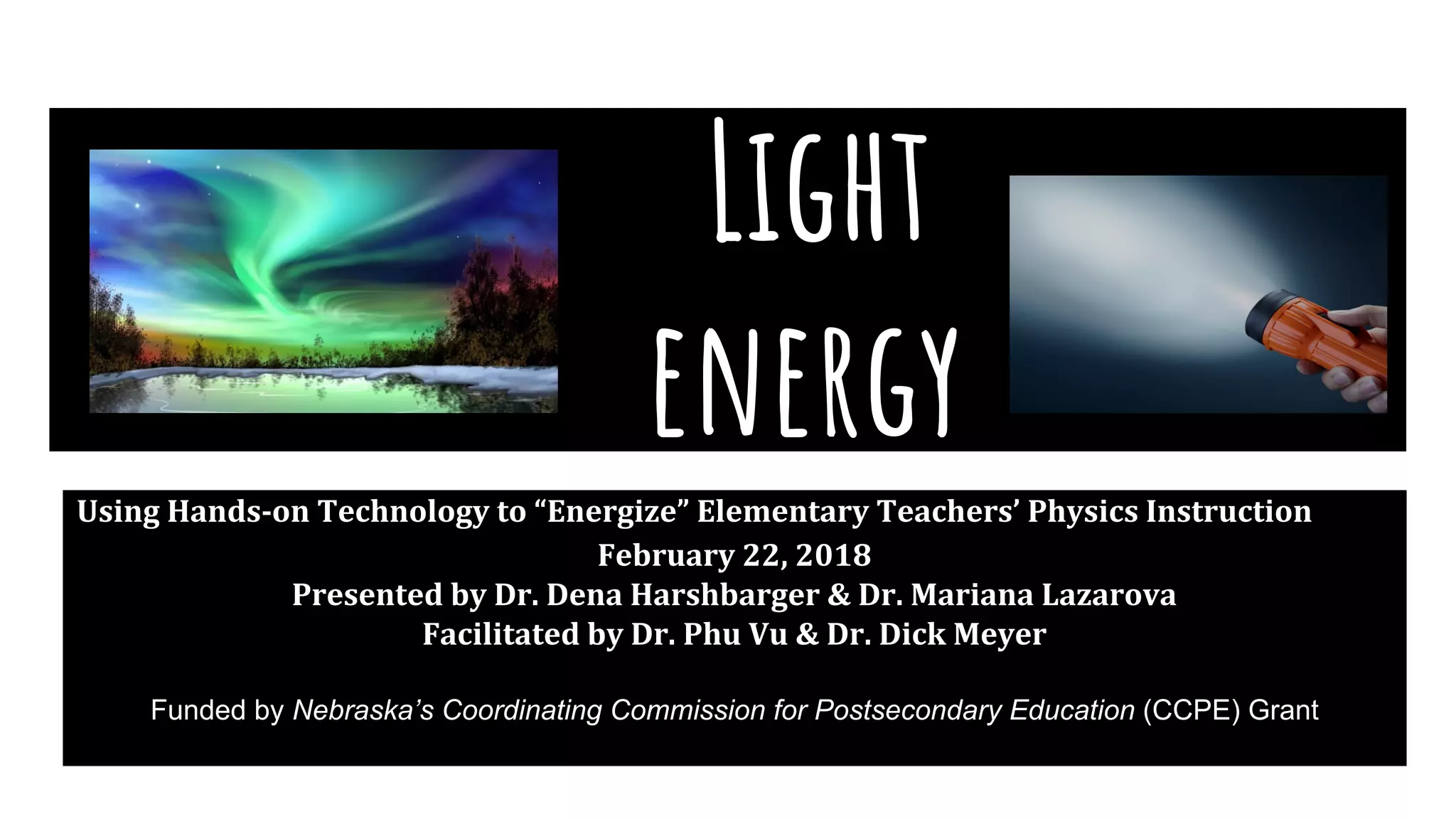
Light
energy
Using Hands-on Technology to “Energize” Elementary Teachers’ Physics Instruction
February 22, 2018
Presented by Dr. Dena Harshbarger & Dr. Mariana Lazarova
Facilitated by Dr. Phu Vu & Dr. Dick Meyer
Funded by Nebraska’s Coordinating Commission for Postsecondary Education (CCPE) Grant
Numbered heads together
What ideas did you try from Workshop #2
★ How did it go?
★ How did students respond?
★ Did you note any impact on learning? Explain.
Two stay, two stray...
What ideas did you try from Workshop #2
★ How did it go?
★ How did students respond?
★ Did you note any impact on learning? Explain.
Never stop growing and learning!
We are so glad you are here!
Most importantly...
Enjoy the Learning Experience
● Take comfort breaks as needed
● Ask questions
● Share ideas
● Share answers. Don’t be afraid of
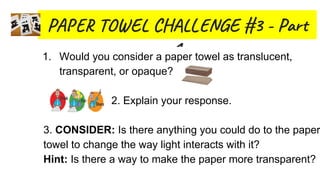
being “wrong”.
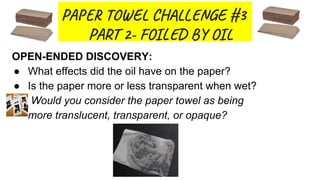
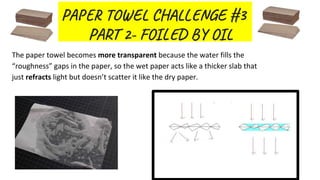
Do y pi l ac L h er ?
Yes NoSome
Connection to NEbraska Science standards NE
Science Standards
● SC5.1.1 Students will combine scientific processes and knowledge with scientific
reasoning and critical thinking to ask questions about phenomenon and propose
explanations based on gathered evidence.
● SC5.2.2 Students will identify the influence of forces on motion.
❖ SC5.2.2a Describe motion by tracing and measuring an object’s position over a
period of time (speed).
❖ SC5.2.2b Describe changes in motion due to outside forces (push, pull, gravity)
❖ MA 5.4.2 Analysis & Applications: Students will analyze data to address the situation.
➢ MA 5.4.2.a Use observations and experiments to collect, represent, and interpret the data using tables and bar
graphs.
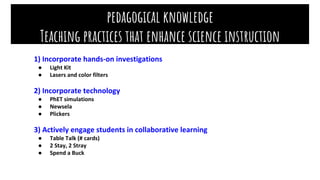
pedagogical knowledge
Teaching practices that enhance science instruction
●
●
●
●
●
●
●
●
Reminder: Science logs/journals
● Develop learners’ scientific process skills (i.e., predicting,
inferring, observing, recording and analyzing data/results,
and communicating)
● Helps students process & recall information
● Serves as study guides and/or student resources
● Can be used to assess students’ understanding
● Interactive notebooks are more engaging!
***Please use your science log throughout the day and
consider how you can use journals with your students.
Background knowledge
LIGHT...
11
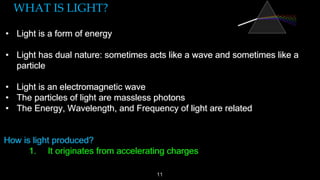
WHAT IS LIGHT?
• Light is a form of energy
• Light has dual nature: sometimes acts like a wave and sometimes like a
particle
• Light is an electromagnetic wave
• The particles of light are massless photons
• The Energy, Wavelength, and Frequency of light are related
How is light produced?
1. It originates from accelerating charges
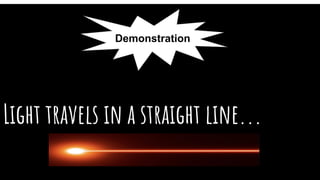
Light travels in a straight line...
Demonstration
Let’s explore how light
interacts with matter...
So, now…
Safety precautions:
● Avoid placing materials near your
mouth or eyes.
● Be aware of and handle sharp objects
with care (corner of mirrors, prisms).
● Use materials appropriately.
● Do not look directly into sunlight or
laser beams.
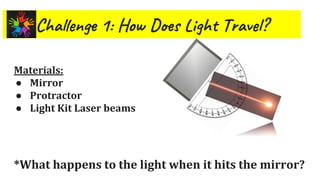
Cha n 1: How i h T av ?
Materials:
● Mirror
● Protractor
● Light Kit Laser beams
*What happens to the light when it hits the mirror?
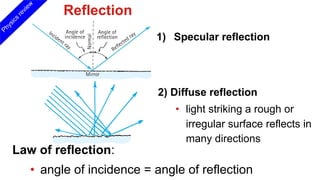
Reflection
Law of reflection:
• angle of incidence = angle of reflection
Physics
review
2) Diffuse reflection
• light striking a rough or
irregular surface reflects in
many directions
1) Specular reflection
Cha n 2: Wha p s en
Lig s ik f e n je s?
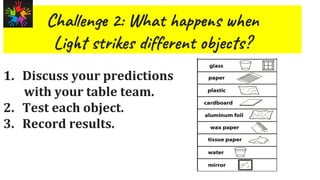
1. Discuss your predictions
with your table team.
2. Test each object.
3. Record results.
Discussion:
Find SOMEONE WHO SITS AT A DIFFERENT TABLE
1. Which objects block some light? How do those objects
compare to the ones that allow all light to pass through?
2. Which objects block all light? Is this what you predicted?
Why or why not?
3. What evidence is there that no light passes through some
objects?
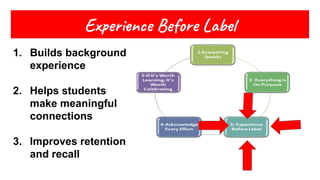
Ex e n e B re L
1. Builds background
experience
2. Helps students
make meaningful
connections
3. Improves retention
and recall
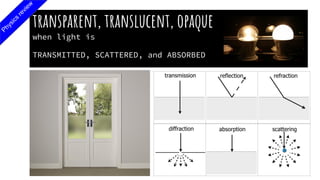
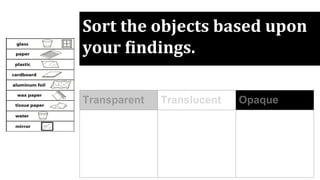
transparent, translucent, opaque
when light is
TRANSMITTED, SCATTERED, and ABSORBED
Physics
review
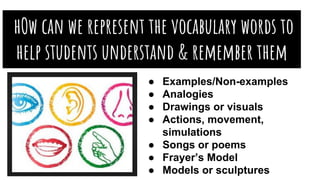
hOw can we represent the vocabulary words to
help students understand & remember them
better?● Examples/Non-examples
● Analogies
● Drawings or visuals
● Actions, movement,
simulations
● Songs or poems
● Frayer’s Model
● Models or sculptures
Sort the objects based upon
your findings.
Transparent Translucent Opaque
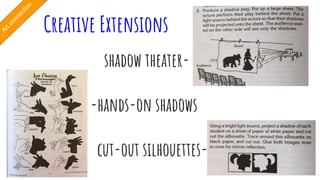
shadow theater-
-hands-on shadows
cut-out silhouettes-
Art connection
Creative Extensions
Ada d m: Jus s Th o h
(p. 109-111)
PA T E C L E #3 - Par
11. Would you consider a paper towel as translucent,
transparent, or opaque?
2. Explain your response.
3. CONSIDER: Is there anything you could do to the paper
towel to change the way light interacts with it?
Hint: Is there a way to make the paper more transparent?
PA T E C L E #3
PA 2- FO B O
OPEN-ENDED DISCOVERY:
● What effects did the oil have on the paper?
● Is the paper more or less transparent when wet?
● Would you consider the paper towel as being
more translucent, transparent, or opaque?
PA T E C L E #3
PA 2- FO B O
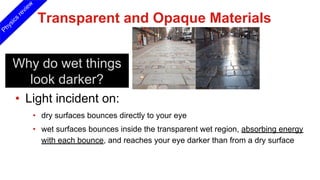
Transparent and Opaque Materials
• Light incident on:
• dry surfaces bounces directly to your eye
• wet surfaces bounces inside the transparent wet region, absorbing energy
with each bounce, and reaches your eye darker than from a dry surface
Why do wet things
look darker?
Physics
review
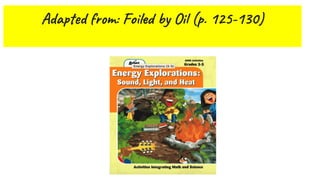
Ada d m: Fo l y Oi (p. 125-130)
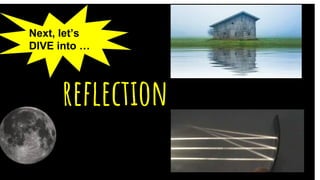
reflection
Next, let’s
DIVE into …
EX R O Y L GE 5:
Par 1: Pap
1. What happens when white light reflects off of white paper?
2. What happens when white light reflects off of black paper?
3. What happens when white light reflects off of red paper?
4. What happens when white light reflects off of blue paper?
5. Which color of paper had the brightest reflection? Why?
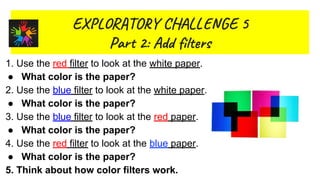
EX R O Y L GE 5
Par 2: Ad il s
1.
2. What kinds of objects reflect light?
3.
Whgat
1. Use the red filter to look at the white paper.
● What color is the paper?
2. Use the blue filter to look at the white paper.
● What color is the paper?
3. Use the blue filter to look at the red paper.
● What color is the paper?
4. Use the red filter to look at the blue paper.
● What color is the paper?
5. Think about how color filters work.
EX R O Y L GE 5
Par 3: Pen t ug l s
1.
2. What kinds of objects reflect light?
3.
Whgat
1. Draw a circle on a white paper with the pink highlighter.
● Look at the circle through the red/blue filter. What do you see?
2. Draw a circle on a white paper with the blue highlighter.
● Look at the circle through the red/blue filter. What do you see?
3. Use the color filters to look at multi-colored images in the room.
4. Now, think about how color filters work.
PA C LE 5
OPEN-ENDED DISCOVERY:
1. Is a red sheet always red?
2. What can you conclude about how colors add and
subtract?
Color
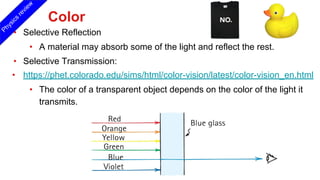
• Selective Reflection
• A material may absorb some of the light and reflect the rest.
• Selective Transmission:
• https://phet.colorado.edu/sims/html/color-vision/latest/color-vision_en.html
• The color of a transparent object depends on the color of the light it
transmits.
© 2017 Pearson Education, Inc.
Physics
review
Color
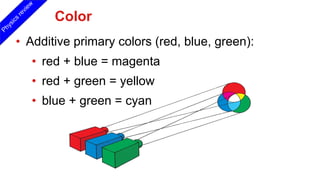
• Additive primary colors (red, blue, green):
• red + blue = magenta
• red + green = yellow
• blue + green = cyan
Physics
review
How does light interact with matter?
https://phet.colorado.edu/sims/html/color-vision/latest/color-vision_en.html
Physics
review
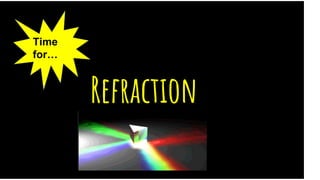
Refraction
Time
for…
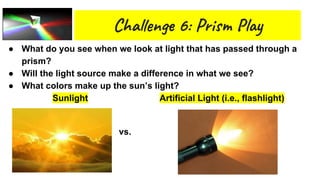
Cha n 6: Pri l
● What do you see when we look at light that has passed through a
prism?
● Will the light source make a difference in what we see?
● What colors make up the sun’s light?
Sunlight Artificial Light (i.e., flashlight)
Vs. vs.
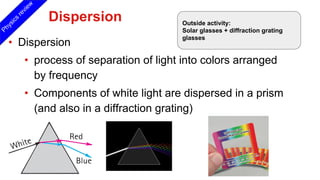
Dispersion
• Dispersion
• process of separation of light into colors arranged
by frequency
• Components of white light are dispersed in a prism
(and also in a diffraction grating)
Physics
review
Outside activity:
Solar glasses + diffraction grating
glasses
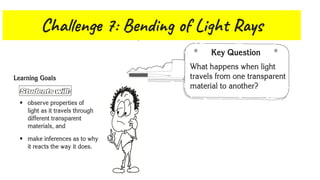
Cha n 7: Ben g Li h s
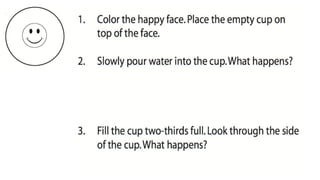
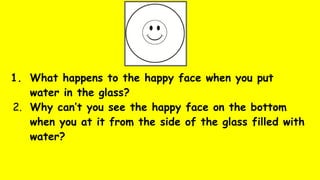
1. What happens to the happy face when you put
water in the glass?
2. Why can’t you see the happy face on the bottom
when you at it from the side of the glass filled with
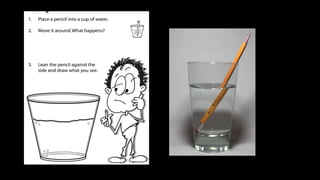
water?
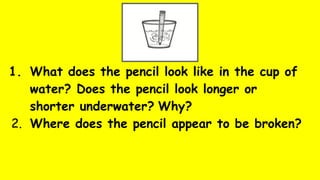
1. What does the pencil look like in the cup of
water? Does the pencil look longer or
shorter underwater? Why?
2. Where does the pencil appear to be broken?
Ada d m: Lig y w Do
(p. 153-158)
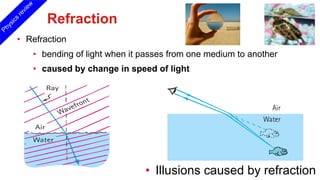
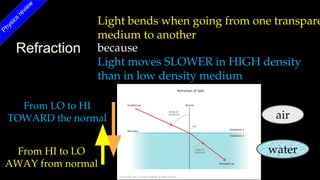
Refraction
• Refraction
• bending of light when it passes from one medium to another
• caused by change in speed of light
• Illusions caused by refraction
Physics
review
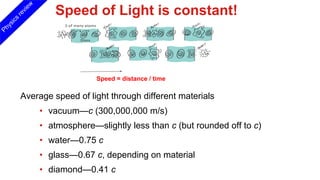
Speed of Light is constant!
Average speed of light through different materials
• vacuum—c (300,000,000 m/s)
• atmosphere—slightly less than c (but rounded off to c)
• water—0.75 c
• glass—0.67 c, depending on material
• diamond—0.41 c
Physics
review
Speed = distance / time
Refraction
Light bends when going from one transpare
medium to another
because
Light moves SLOWER in HIGH density
than in low density medium
From HI to LO
AWAY from normal
air
water
From LO to HI
TOWARD the normal
Physics
review
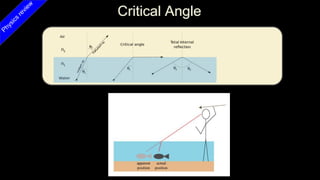
Critical Angle
Physics
review
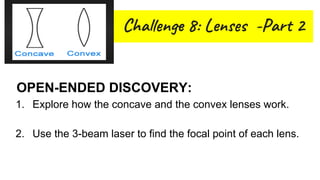
Cha n 8: Len -Par 2
OPEN-ENDED DISCOVERY:
1. Explore how the concave and the convex lenses work.
2. Use the 3-beam laser to find the focal point of each lens.
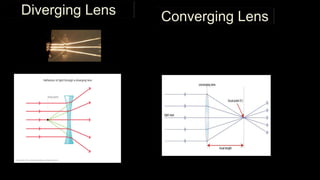
Diverging Lens Converging Lens
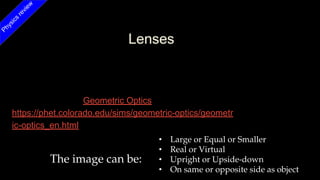
Lenses
The image can be:
• Large or Equal or Smaller
• Real or Virtual
• Upright or Upside-down
• On same or opposite side as object
Physics
review
PHET simulation: Geometric Optics:
https://phet.colorado.edu/sims/geometric-optics/geometr
ic-optics_en.html
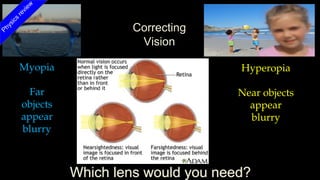
Myopia
Far
objects
appear
blurry
Hyperopia
Near objects
appear
blurry
Which lens would you need?
Correcting
Vision
Physics
review
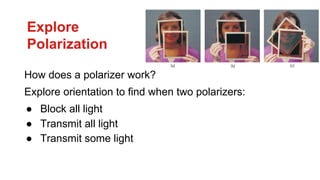
Explore
Polarization
How does a polarizer work?
Explore orientation to find when two polarizers:
● Block all light
● Transmit all light
● Transmit some light
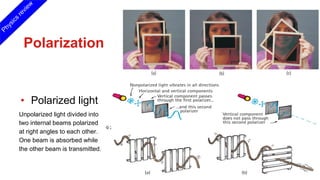
Polarization
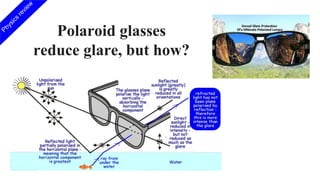
• Polarized light
Unpolarized light divided into
two internal beams polarized
at right angles to each other.
One beam is absorbed while
the other beam is transmitted.
© 2017 Pearson Education, Inc.
Physics
review
Polaroid glasses
reduce glare, but how?
Physics
review
• What is something new you’ve learned
today?
• What is an idea you’d like to try in your
classroom?
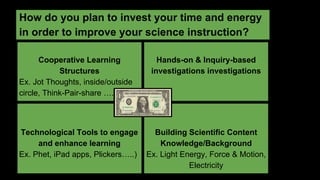
How do you plan to invest your time and energy
in order to improve your science instruction?
Cooperative Learning
Structures
Ex. Jot Thoughts, inside/outside
circle, Think-Pair-share ….
Hands-on & Inquiry-based
investigations investigations
Technological Tools to engage
and enhance learning
Ex. Phet, iPad apps, Plickers…..)
Building Scientific Content
Knowledge/Background
Ex. Light Energy, Force & Motion,
Electricity
Tha y o p ci n i r C S im v s i c G a t
We p ci o r ic o t en uc o !
Have a great rest of
the school year!
Best Wishes!
Evaluations & Paperwork
References and Resources
Energy Explorations: Sound, Light, and Heat (2010). AIMS Education Foundation.
Fresno, CA.
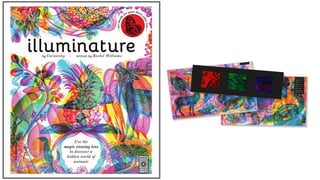
Williams, R. (2016). Illuminature. Wide-Eyed Edition.

Abbreviated ccps light energy workshop #3

  • 1.
    Light energy Using Hands-on Technologyto “Energize” Elementary Teachers’ Physics Instruction February 22, 2018 Presented by Dr. Dena Harshbarger & Dr. Mariana Lazarova Facilitated by Dr. Phu Vu & Dr. Dick Meyer Funded by Nebraska’s Coordinating Commission for Postsecondary Education (CCPE) Grant
  • 2.
    Numbered heads together Whatideas did you try from Workshop #2 ★ How did it go? ★ How did students respond? ★ Did you note any impact on learning? Explain.
  • 3.
    Two stay, twostray... What ideas did you try from Workshop #2 ★ How did it go? ★ How did students respond? ★ Did you note any impact on learning? Explain.
  • 4.
    Never stop growingand learning! We are so glad you are here!
  • 5.
    Most importantly... Enjoy theLearning Experience ● Take comfort breaks as needed ● Ask questions ● Share ideas ● Share answers. Don’t be afraid of being “wrong”.
  • 6.
    Do y pil ac L h er ? Yes NoSome
  • 7.
    Connection to NEbraskaScience standards NE Science Standards ● SC5.1.1 Students will combine scientific processes and knowledge with scientific reasoning and critical thinking to ask questions about phenomenon and propose explanations based on gathered evidence. ● SC5.2.2 Students will identify the influence of forces on motion. ❖ SC5.2.2a Describe motion by tracing and measuring an object’s position over a period of time (speed). ❖ SC5.2.2b Describe changes in motion due to outside forces (push, pull, gravity) ❖ MA 5.4.2 Analysis & Applications: Students will analyze data to address the situation. ➢ MA 5.4.2.a Use observations and experiments to collect, represent, and interpret the data using tables and bar graphs.
  • 8.
    pedagogical knowledge Teaching practicesthat enhance science instruction ● ● ● ● ● ● ● ●
  • 9.
    Reminder: Science logs/journals ●Develop learners’ scientific process skills (i.e., predicting, inferring, observing, recording and analyzing data/results, and communicating) ● Helps students process & recall information ● Serves as study guides and/or student resources ● Can be used to assess students’ understanding ● Interactive notebooks are more engaging! ***Please use your science log throughout the day and consider how you can use journals with your students.
  • 10.
  • 11.
    11 WHAT IS LIGHT? •Light is a form of energy • Light has dual nature: sometimes acts like a wave and sometimes like a particle • Light is an electromagnetic wave • The particles of light are massless photons • The Energy, Wavelength, and Frequency of light are related How is light produced? 1. It originates from accelerating charges
  • 12.
    Light travels ina straight line... Demonstration
  • 13.
    Let’s explore howlight interacts with matter... So, now…
  • 14.
    Safety precautions: ● Avoidplacing materials near your mouth or eyes. ● Be aware of and handle sharp objects with care (corner of mirrors, prisms). ● Use materials appropriately. ● Do not look directly into sunlight or laser beams.
  • 15.
    Cha n 1:How i h T av ? Materials: ● Mirror ● Protractor ● Light Kit Laser beams *What happens to the light when it hits the mirror?
  • 16.
    Reflection Law of reflection: •angle of incidence = angle of reflection Physics review 2) Diffuse reflection • light striking a rough or irregular surface reflects in many directions 1) Specular reflection
  • 17.
    Cha n 2:Wha p s en Lig s ik f e n je s? 1. Discuss your predictions with your table team. 2. Test each object. 3. Record results.
  • 18.
    Discussion: Find SOMEONE WHOSITS AT A DIFFERENT TABLE 1. Which objects block some light? How do those objects compare to the ones that allow all light to pass through? 2. Which objects block all light? Is this what you predicted? Why or why not? 3. What evidence is there that no light passes through some objects?
  • 19.
    Ex e ne B re L 1. Builds background experience 2. Helps students make meaningful connections 3. Improves retention and recall
  • 20.
    transparent, translucent, opaque whenlight is TRANSMITTED, SCATTERED, and ABSORBED Physics review
  • 21.
    hOw can werepresent the vocabulary words to help students understand & remember them better?● Examples/Non-examples ● Analogies ● Drawings or visuals ● Actions, movement, simulations ● Songs or poems ● Frayer’s Model ● Models or sculptures
  • 22.
    Sort the objectsbased upon your findings. Transparent Translucent Opaque
  • 23.
    shadow theater- -hands-on shadows cut-outsilhouettes- Art connection Creative Extensions
  • 24.
    Ada d m:Jus s Th o h (p. 109-111)
  • 25.
    PA T EC L E #3 - Par 11. Would you consider a paper towel as translucent, transparent, or opaque? 2. Explain your response. 3. CONSIDER: Is there anything you could do to the paper towel to change the way light interacts with it? Hint: Is there a way to make the paper more transparent?
  • 26.
    PA T EC L E #3 PA 2- FO B O OPEN-ENDED DISCOVERY: ● What effects did the oil have on the paper? ● Is the paper more or less transparent when wet? ● Would you consider the paper towel as being more translucent, transparent, or opaque?
  • 27.
    PA T EC L E #3 PA 2- FO B O
  • 28.
    Transparent and OpaqueMaterials • Light incident on: • dry surfaces bounces directly to your eye • wet surfaces bounces inside the transparent wet region, absorbing energy with each bounce, and reaches your eye darker than from a dry surface Why do wet things look darker? Physics review
  • 29.
    Ada d m:Fo l y Oi (p. 125-130)
  • 30.
  • 31.
    EX R OY L GE 5: Par 1: Pap 1. What happens when white light reflects off of white paper? 2. What happens when white light reflects off of black paper? 3. What happens when white light reflects off of red paper? 4. What happens when white light reflects off of blue paper? 5. Which color of paper had the brightest reflection? Why?
  • 32.
    EX R OY L GE 5 Par 2: Ad il s 1. 2. What kinds of objects reflect light? 3. Whgat 1. Use the red filter to look at the white paper. ● What color is the paper? 2. Use the blue filter to look at the white paper. ● What color is the paper? 3. Use the blue filter to look at the red paper. ● What color is the paper? 4. Use the red filter to look at the blue paper. ● What color is the paper? 5. Think about how color filters work.
  • 33.
    EX R OY L GE 5 Par 3: Pen t ug l s 1. 2. What kinds of objects reflect light? 3. Whgat 1. Draw a circle on a white paper with the pink highlighter. ● Look at the circle through the red/blue filter. What do you see? 2. Draw a circle on a white paper with the blue highlighter. ● Look at the circle through the red/blue filter. What do you see? 3. Use the color filters to look at multi-colored images in the room. 4. Now, think about how color filters work.
  • 34.
    PA C LE5 OPEN-ENDED DISCOVERY: 1. Is a red sheet always red? 2. What can you conclude about how colors add and subtract?
  • 35.
    Color • Selective Reflection •A material may absorb some of the light and reflect the rest. • Selective Transmission: • https://phet.colorado.edu/sims/html/color-vision/latest/color-vision_en.html • The color of a transparent object depends on the color of the light it transmits. © 2017 Pearson Education, Inc. Physics review
  • 36.
    Color • Additive primarycolors (red, blue, green): • red + blue = magenta • red + green = yellow • blue + green = cyan Physics review
  • 37.
    How does lightinteract with matter? https://phet.colorado.edu/sims/html/color-vision/latest/color-vision_en.html Physics review
  • 39.
  • 40.
    Cha n 6:Pri l ● What do you see when we look at light that has passed through a prism? ● Will the light source make a difference in what we see? ● What colors make up the sun’s light? Sunlight Artificial Light (i.e., flashlight) Vs. vs.
  • 41.
    Dispersion • Dispersion • processof separation of light into colors arranged by frequency • Components of white light are dispersed in a prism (and also in a diffraction grating) Physics review Outside activity: Solar glasses + diffraction grating glasses
  • 42.
    Cha n 7:Ben g Li h s
  • 44.
    1. What happensto the happy face when you put water in the glass? 2. Why can’t you see the happy face on the bottom when you at it from the side of the glass filled with water?
  • 46.
    1. What doesthe pencil look like in the cup of water? Does the pencil look longer or shorter underwater? Why? 2. Where does the pencil appear to be broken?
  • 47.
    Ada d m:Lig y w Do (p. 153-158)
  • 48.
    Refraction • Refraction • bendingof light when it passes from one medium to another • caused by change in speed of light • Illusions caused by refraction Physics review
  • 49.
    Speed of Lightis constant! Average speed of light through different materials • vacuum—c (300,000,000 m/s) • atmosphere—slightly less than c (but rounded off to c) • water—0.75 c • glass—0.67 c, depending on material • diamond—0.41 c Physics review Speed = distance / time
  • 50.
    Refraction Light bends whengoing from one transpare medium to another because Light moves SLOWER in HIGH density than in low density medium From HI to LO AWAY from normal air water From LO to HI TOWARD the normal Physics review
  • 51.
  • 52.
    Cha n 8:Len -Par 2 OPEN-ENDED DISCOVERY: 1. Explore how the concave and the convex lenses work. 2. Use the 3-beam laser to find the focal point of each lens.
  • 53.
  • 54.
    Lenses The image canbe: • Large or Equal or Smaller • Real or Virtual • Upright or Upside-down • On same or opposite side as object Physics review PHET simulation: Geometric Optics: https://phet.colorado.edu/sims/geometric-optics/geometr ic-optics_en.html
  • 55.
  • 56.
    Explore Polarization How does apolarizer work? Explore orientation to find when two polarizers: ● Block all light ● Transmit all light ● Transmit some light
  • 57.
    Polarization • Polarized light Unpolarizedlight divided into two internal beams polarized at right angles to each other. One beam is absorbed while the other beam is transmitted. © 2017 Pearson Education, Inc. Physics review
  • 58.
    Polaroid glasses reduce glare,but how? Physics review
  • 59.
    • What issomething new you’ve learned today? • What is an idea you’d like to try in your classroom?
  • 63.
    How do youplan to invest your time and energy in order to improve your science instruction? Cooperative Learning Structures Ex. Jot Thoughts, inside/outside circle, Think-Pair-share …. Hands-on & Inquiry-based investigations investigations Technological Tools to engage and enhance learning Ex. Phet, iPad apps, Plickers…..) Building Scientific Content Knowledge/Background Ex. Light Energy, Force & Motion, Electricity
  • 64.
    Tha y op ci n i r C S im v s i c G a t We p ci o r ic o t en uc o ! Have a great rest of the school year! Best Wishes!
  • 65.
  • 67.
    References and Resources EnergyExplorations: Sound, Light, and Heat (2010). AIMS Education Foundation. Fresno, CA. Williams, R. (2016). Illuminature. Wide-Eyed Edition.