LIFESTY
LE
PE 10 UNIT 1: ACTIVE RECREATION
(Lesson 1)
LIFESTYLE
Do Activity 2: WHAT IS IT
FOR YOU? This activity will
assess the prior knowledge
of students about lifestyle
and weight management.
(Page 5)
LIFESTYLE
The way in which an
individual lives.
Includes the typical
patterns of an
individual’s behavior like
everyday routine at
home, in school, or at
LIFESTYLE
Examples are your
ways of eating,
sleeping, and exercise
habits.
is related to elevated
and reduced health
ASPECTS OF LIFESTYLE:
Food choice
Physical
activity
Eating habits
RISK FACTORS
These are
variables in your
lifestyle that may
lead to certain
diseases.
RISK FACTORS THAT
CANNOT BE CHANGED:
Genetics
Heredity
Age
Physical Make-up
RISK FACTORS THAT
CAN BE CHANGED:
Nutrition
Body weight
Physical activity
Health habits
UNHEALTHY LIFESTYLE
brings:
NON-
COMMUNICABLE
DISEASES (NCDs) or
chronic diseases.
NON-COMMUNICABLE
DISEASES (NCDs)
Diseases that are
not transmitted
from one person to
another person.
4 Main Types of NCDs:
Cardiovascular
dieseases (e.g.
Hypertension)
Cancer
Chronic Respiratory
Diseases (e.g. COPD)
WEIGHT &
MANAGING
IT
PE 10 UNIT 1: ACTIVE RECREATION
(Lesson 1)
WEIGHT
A result of metabolic
responses of your
body to your food
intake, energy
expenditure, and
physiologic
UNDERSTANDING HOW
YOUR BODY WORKS
is the vital key as well
as a combination of
healthy food practices
and a more active
ENERGY
CONSUMPTION
The amount
of energy you
take in
through food.
ENERGY EXPENDITURE
The amount of
energy you
spend through
physical activity.
WEIGHT GAIN
Energy consumed is
greater than energy
expended. (High BMI)
More food intake but
less physical exertion.
WEIGHT LOSS
Energy consumed is
less than energy
expended. (Low BMI)
More physical exertion
but less food intake.
WEIGHT
MAINTENANCE
Energy consumed
equals energy
expended. (Normal
BMI)
Physical exertion is the
ACTIVE
RECREATIONAL
ACTIVITIES
PE 10 UNIT 1: ACTIVE RECREATION
(Lesson 1)
ACTIVE RECREATIONAL
ACTIVITIES
Are those activities held
during one’s leisure time.
Their purpose is to
refresh oneself by ding
activities that are
considered by an
These are the activities
that require large body
movements such as
running, throwing, or
jumping, or small
movements.
EATING HABITS
These are the patterns of
behavior with regards to
eating like choosing
available food, preparing
it, deciding where to eat,
which rules to follow,
and who to dine with.
PHYSICAL
ACTIVITY &
PHYSICAL
FITNESS
PE 10 UNIT 1: ACTIVE RECREATION
(Lesson 1)
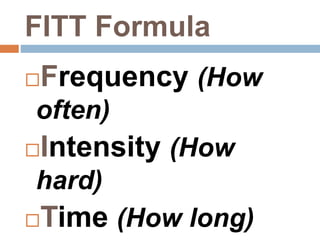
FITT Formula
Frequency (How
often)
Intensity (How
hard)
Time (How long)
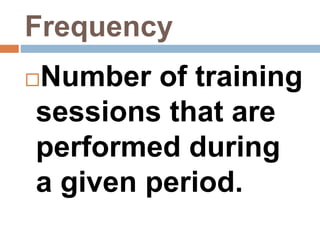
Frequency
Number of training
sessions that are
performed during
a given period.
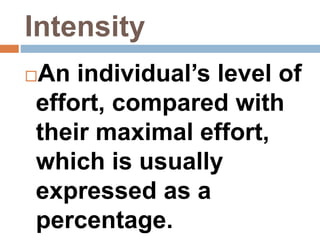
Intensity
An individual’s level of
effort, compared with
their maximal effort,
which is usually
expressed as a
percentage.
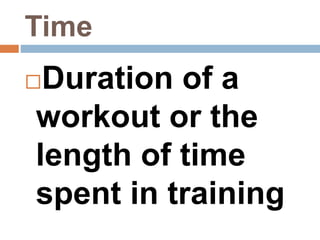
Time
Duration of a
workout or the
length of time
spent in training
Type
Mode of
physical
activity

Lifestyle