IMPRESSION
1872- mid 1800s
Emerged in the second half of 19th
century among Paris-based artists
Had a tremendous impact and influence
on the painting styles that followed, such
as neo-impressionism, post-
impressionism, fauvism, and cubism—and
even the artistic styles and movements of
today
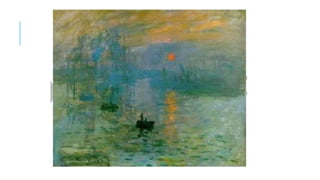
Coined from the Claude Monet’s
Impression, soleil levant
The term precisely
captured what this group of
artists sought to represent
in their works: the viewer’s
momentary “impression” of
an image.
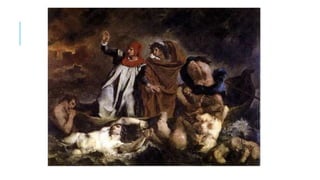
EUGÈNE DELACROIX
French painter
 was greatly admired and emulated by
the early impressionists—specifically for
his use of expressive brushstrokes, his
emphasis on movement rather than on
clarity of form, and most of all his study of
the optical effects of color.
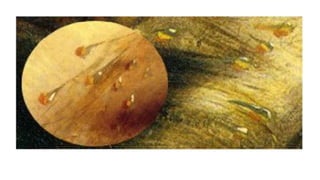
 The Barque of Dante, contained a then
revolutionary technique that would
profoundly influence the coming
IMPRESSIONISM: A
BREAK FROM PAST
COLOR AND LIGHT
 the impressionists painted with
freely brushed colors that conveyed
more of a visual effect than a detailed
rendering of the subject.
They used short “broken” strokes
that were intentionally made visible to
the viewer.
They also often placed pure
“EVERYDAY” SUBJECTS
Ventured into capturing scenes of
life around them, household objects,
landscape, seascape, houses, café,
and buildings
They presented ordinary people
seemingly caught off-guard, doing
everyday task, or at leisure or doing
nothing at all
PAINTING OUTDOORS
 the impressionists found that
they could best capture the ever-
changing effects of light on color
by painting outdoors in natural
light
 gave their works a freshness and
immediacy
OPEN COMPOSITION
experimented with unusual
visual angles, sizes of objects
that appeared out of
proportion, off-center
placement, and empty spaces
on the canvas.
THE INFLUENCE OF
PHOTOGRAPHYPhotography was in its early stages at this time
as well. As it gained popularity, photography
inspired impressionists to capture fleeting
moments of action, whether in landscapes or in
the day-to-day lives of people. But whereas
camera snapshots provided objective, true-to-
life images, the artists were able to offer a
subjective view of their subjects, expressing
their personal perceptions rather than creating
exact representations. They also had the
advantage of manipulating color, which
WHAT TO KNOW
1. How did the term impressionism originate? What did it mean?
2. In what country did this art movement begin, and in what period of
history?
3. What was the significance of the painting technique used by
Delacroix in the development of the impressionist style?
4. What characteristics distinguished impressionism from the art
movements of the earlier centuries?
5. how was the impressionst style influenced by the early stages of
photography?

Mapeh art 10

  • 1.
  • 3.
    1872- mid 1800s Emergedin the second half of 19th century among Paris-based artists Had a tremendous impact and influence on the painting styles that followed, such as neo-impressionism, post- impressionism, fauvism, and cubism—and even the artistic styles and movements of today Coined from the Claude Monet’s Impression, soleil levant
  • 4.
    The term precisely capturedwhat this group of artists sought to represent in their works: the viewer’s momentary “impression” of an image.
  • 5.
    EUGÈNE DELACROIX French painter was greatly admired and emulated by the early impressionists—specifically for his use of expressive brushstrokes, his emphasis on movement rather than on clarity of form, and most of all his study of the optical effects of color.  The Barque of Dante, contained a then revolutionary technique that would profoundly influence the coming
  • 8.
  • 9.
    COLOR AND LIGHT the impressionists painted with freely brushed colors that conveyed more of a visual effect than a detailed rendering of the subject. They used short “broken” strokes that were intentionally made visible to the viewer. They also often placed pure
  • 10.
    “EVERYDAY” SUBJECTS Ventured intocapturing scenes of life around them, household objects, landscape, seascape, houses, café, and buildings They presented ordinary people seemingly caught off-guard, doing everyday task, or at leisure or doing nothing at all
  • 11.
    PAINTING OUTDOORS  theimpressionists found that they could best capture the ever- changing effects of light on color by painting outdoors in natural light  gave their works a freshness and immediacy
  • 12.
    OPEN COMPOSITION experimented withunusual visual angles, sizes of objects that appeared out of proportion, off-center placement, and empty spaces on the canvas.
  • 13.
    THE INFLUENCE OF PHOTOGRAPHYPhotographywas in its early stages at this time as well. As it gained popularity, photography inspired impressionists to capture fleeting moments of action, whether in landscapes or in the day-to-day lives of people. But whereas camera snapshots provided objective, true-to- life images, the artists were able to offer a subjective view of their subjects, expressing their personal perceptions rather than creating exact representations. They also had the advantage of manipulating color, which
  • 14.
    WHAT TO KNOW 1.How did the term impressionism originate? What did it mean? 2. In what country did this art movement begin, and in what period of history? 3. What was the significance of the painting technique used by Delacroix in the development of the impressionist style? 4. What characteristics distinguished impressionism from the art movements of the earlier centuries? 5. how was the impressionst style influenced by the early stages of photography?