support@indiegogolife.com
@IndiegogoLife
© Copyright Indiegogo. All rights reserved. Confidential & proprietary.
Today’s Agenda
● Welcome
● Indiegogo and Indiegogo Life
● Why fundraise for a personal cause
● Best practices
● Bay Area Heroes
● Q and A
● Create a Fundraiser
Bay Area Heroes
Honor a local hero by running a fundraiser for him
or her in March for the chance to receive funds and
recognition for your hero
Stay tuned for more information!
Your ideas??
People want to give to successful projects.
Higher Goal
More Money
What will your goal be?
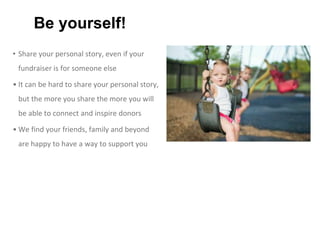
• Share your personal story, even if your
fundraiser is for someone else
• It can be hard to share your personal story,
but the more you share the more you will
be able to connect and inspire donors
• We find your friends, family and beyond
are happy to have a way to support you
Be yourself!
What makes a good story?
• Email brings in 20% more
funding than any other source
• Clear call to action
• Put up a vacation responder
• Add your campaign to
your signature
Send direct
emails
• 22% of a campaign’s funds raised
comes from social media
• If you don’t have a community
on social media, don’t promote
through social media.
• Email drives ⅓ of all online giving
(change.org)
• Fundraisers that have shared on
Facebook raise 200% more than
those that have not
• Online donations increased by 8.9%
in 2014 (change.org)
Share via social
media
• Are you part of university alumni,
geographic, religious, sports,
interest area, volunteer or other
groups?
• Members will take interest in
your fundraiser due to their
affiliation with it
• Find and post your link on these
Facebook, Twitter and LinkedIn
community groups
• Contact the organizers of them to
think through deeper ways they
could help to share your
message.
Share with your
groups
• Campaigns with updates raise 286% on average more than campaigns with no
updates
• Include fundraiser milestones such as percent raised and number of donors
• Share information on the purpose of your fundraiser and the impact of funds raised
20
Use the update
feature
20
Engage the media
• Do your research
• Create your pitch
– What is your fundraiser about?
Does it relate to recent articles
or news trends?
– Why should other people in
your community care and
contribute to your fundraiser?
– Why is it important? Why does
the fundraiser matter now?
• Reach out
20
Share your
fundraiser offline
• Send hand-written letters and thank
you notes
• Announce at community group
meetings
• Host an event, such as a bake sale or
happy hour, and use your fundraiser
as a way for people to donate in
person
• Create and hand out flyers at local
meetings, businesses or community
boards
How will you spread the word?
Thank you!
● Let us know if you want us to host a learning session with
your community
● Resources: https://learn.life.indiegogo.com/fundraising-best-
practices/
○ Personal Fundraising Handbook
○ Social Media Tips
○ PR Toolkit
● Keep in touch
○ @IndiegogoLife
○ Bre@Indiegogo.com

Life Webinar

  • 1.
  • 2.
    © Copyright Indiegogo.All rights reserved. Confidential & proprietary. Today’s Agenda ● Welcome ● Indiegogo and Indiegogo Life ● Why fundraise for a personal cause ● Best practices ● Bay Area Heroes ● Q and A ● Create a Fundraiser
  • 8.
    Bay Area Heroes Honora local hero by running a fundraiser for him or her in March for the chance to receive funds and recognition for your hero Stay tuned for more information!
  • 9.
  • 10.
    People want togive to successful projects.
  • 11.
  • 12.
  • 13.
    • Share yourpersonal story, even if your fundraiser is for someone else • It can be hard to share your personal story, but the more you share the more you will be able to connect and inspire donors • We find your friends, family and beyond are happy to have a way to support you Be yourself!
  • 14.
    What makes agood story?
  • 15.
    • Email bringsin 20% more funding than any other source • Clear call to action • Put up a vacation responder • Add your campaign to your signature Send direct emails
  • 16.
    • 22% ofa campaign’s funds raised comes from social media • If you don’t have a community on social media, don’t promote through social media. • Email drives ⅓ of all online giving (change.org) • Fundraisers that have shared on Facebook raise 200% more than those that have not • Online donations increased by 8.9% in 2014 (change.org) Share via social media
  • 17.
    • Are youpart of university alumni, geographic, religious, sports, interest area, volunteer or other groups? • Members will take interest in your fundraiser due to their affiliation with it • Find and post your link on these Facebook, Twitter and LinkedIn community groups • Contact the organizers of them to think through deeper ways they could help to share your message. Share with your groups
  • 18.
    • Campaigns withupdates raise 286% on average more than campaigns with no updates • Include fundraiser milestones such as percent raised and number of donors • Share information on the purpose of your fundraiser and the impact of funds raised 20 Use the update feature
  • 19.
    20 Engage the media •Do your research • Create your pitch – What is your fundraiser about? Does it relate to recent articles or news trends? – Why should other people in your community care and contribute to your fundraiser? – Why is it important? Why does the fundraiser matter now? • Reach out
  • 20.
    20 Share your fundraiser offline •Send hand-written letters and thank you notes • Announce at community group meetings • Host an event, such as a bake sale or happy hour, and use your fundraiser as a way for people to donate in person • Create and hand out flyers at local meetings, businesses or community boards
  • 21.
    How will youspread the word?
  • 22.
    Thank you! ● Letus know if you want us to host a learning session with your community ● Resources: https://learn.life.indiegogo.com/fundraising-best- practices/ ○ Personal Fundraising Handbook ○ Social Media Tips ○ PR Toolkit ● Keep in touch ○ @IndiegogoLife ○ Bre@Indiegogo.com