Life Detection System Using
Microwave L- band
ABSTRACT
“An earthquake causes loss of many human lives every year as
humans are trapped under collapsed debris or earthquake
rubble”
• existing methods for detecting such victims are the utilization of
dogs or some optical devices, acoustic life detector & the
rescue robot.
• These existing devices are ineffective in recovering human victims
lying much below a few feet, especially for the cases where
the victims are completely trapped below or very weak to
respond to the signals sent by the recues. The above problem
have been efficiently solved by using life detection system
INTRODUCTION
• A new revolutionary microwave life detection system, which is
used to locate human beings buried under earthquake rubble, has been
designed. This system operating at certain frequency can remotely
detect the breathing and heartbeat signals of human beings buried
under earthquake rubble.
• By proper processing of these signals, the status of the person
under trap can be easily judged. The entire process takes place within
a few seconds as the system is controlled by a microprocessor (8085)
or microcontroller unit.
By advent of this system the world death rate may decrease to
greater extent as large percentage of death occur due to
earthquake.
PRINCIPLE OF OPERATION
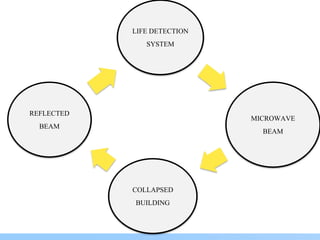
• The basic principle is that when a microwave beam of certain
frequency [L (or) S band (or) UHF band] is aimed at a portion
of rubble (or) collapsed building under which a person has been
trapped, the microwave beam can penetrate through the rubble to
reach the person.
• When the microwave beam focuses the person, the reflected
wave from the person’s body will be modulated (or) changed by
his/her movements, which include breathing and heartbeat.
Simultaneously, reflected waves are also received from the
collapsed structures.
COLLAPSED
BUILDING
REFLECTED
BEAM
LIFE DETECTION
SYSTEM
MICROWAVE
BEAM
• So, if the reflected waves from the immovable debris are cancelled
and the reflected wave from the person’s body is properly
distinguished, the breathing and heartbeat signals can be detected.
• By proper processing of these signals, the status of the person under
trap can be easily judged. Thus a person under debris can be
identified.
• The microwave life detection system can work on different range of
frequencies from L-band (2GHz) to X- band (10GHz). But X- band
microwave is unable to penetrate deep into the rubble. It can penetrate
rubble up to 1.5 ft in the thickness (5 layers of bricks) while L- band
can penetrate the rubble of about 3 ft in thickness (10 layers of
bricks). For this reason, the a microwave life detection system
operates on the L-band frequency.
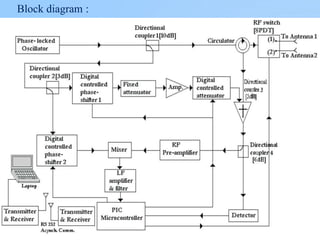
Block diagram :
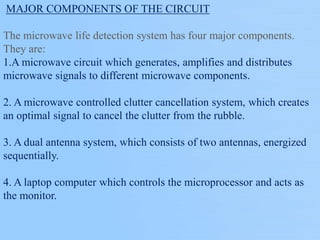
MAJOR COMPONENTS OF THE CIRCUIT
The microwave life detection system has four major components.
They are:
1.A microwave circuit which generates, amplifies and distributes
microwave signals to different microwave components.
2. A microwave controlled clutter cancellation system, which creates
an optimal signal to cancel the clutter from the rubble.
3. A dual antenna system, which consists of two antennas, energized
sequentially.
4. A laptop computer which controls the microprocessor and acts as
the monitor.
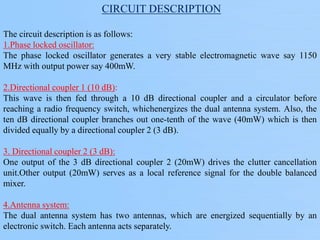
CIRCUIT DESCRIPTION
The circuit description is as follows:
1.Phase locked oscillator:
The phase locked oscillator generates a very stable electromagnetic wave say 1150
MHz with output power say 400mW.
2.Directional coupler 1 (10 dB):
This wave is then fed through a 10 dB directional coupler and a circulator before
reaching a radio frequency switch, whichenergizes the dual antenna system. Also, the
ten dB directional coupler branches out one-tenth of the wave (40mW) which is then
divided equally by a directional coupler 2 (3 dB).
3. Directional coupler 2 (3 dB):
One output of the 3 dB directional coupler 2 (20mW) drives the clutter cancellation
unit.Other output (20mW) serves as a local reference signal for the double balanced
mixer.
4.Antenna system:
The dual antenna system has two antennas, which are energized sequentially by an
electronic switch. Each antenna acts separately.
5)A Clutter Cancellation Circuit:
In any remote sensing instrument the clutter caused by
undesirable objects surrounding the detectable subject must be
cancel to the optimum level. The clutter canceller forms the heart
of life detection system. It consists of Programmable Phase Shifters,
Programmable Attenuator, a RF Amplifier and a Microprocessor
based control unit.
Clutter cancellation unit:
1.A digital controlled phase shifter 1
2.A fixed attenuator
3.A RF amplifier
4.A digitally controlled attenuator.
.
WORKING
1) The wave radiated by the antenna 1 penetrates the earthquake
rubble to reach the buried person.
2) The reflected wave received by the antenna 2 consists of a large
reflected wave from the rubble and a small-reflected wave from the
person’s body.
3 ) The large clutter from the rubble can be cancelled by a clutter-
cancelling signal.
4 ) The small reflected wave from the person’s body couldn’t be
cancelled by a pure sinusoidal cancelling because his/her movements
modulate it.
5 ) The output of the clutter cancellation circuit is automatically
adjusted to be of equal amplitude and opposite phase as that of the
clutter from the rubble.
6 ) Thus, when the output of the clutter cancellation circuit is
combined with the directional coupler 3 (3 dB), the large clutter from
the rubble is completely cancelled. 7 ) Now, the output of the
directional coupler 3 (3 dB) is passed through a directional coupler 4
(6 dB).
8 ) One-fourth of the output directed is amplified by a RF pre-
amplifier and then mixed with a local reference signal in a double
balanced mixer.
9 ) Three-fourth of the output is directed by a microwave detector to
provide dc output, which serves as the indicator for the degree of the
clutter cancellation.
10 ) When the settings of the digitally controlled phase shifter and the
attenuator are swept the microprocessor control system, the output of
the microwave detector varies accordingly.
Opeartion of the clutter cancelled signal:
1.At the double balanced mixer, the amplified signal of the reflected wave
from the person’s body is mixed with the local reference signal.
2.The phase of the local reference signal is controlled by another digitally
controlled phase shifter 2 for an optimal output from the mixer.
3.The output of the mixer consists of the breathing and heartbeat signals of
the human plus some avoidable noise. 4.This output is fed through a low
frequency amplifier and a band pass filter (0.4 Hz) before displayed on the
monitor.
5.The function of the digitally controlled phase shifter 2 is to control the
phase of the local reference signal for the purpose of increasing the system
sensitivity.
6.The reflected signal from the person’s body after amplification by the
pre-amplifier is mixed with the local reference signal in a double balanced
mixer.
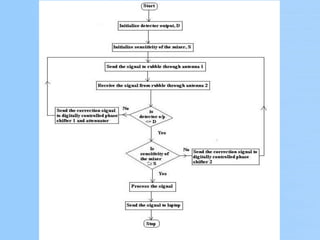
Clutter cancellation system:
1. Send the signal to the rubble through antenna 1.
2. Receive the signal from the rubble through antenna 2.
3. Check the detector output. If it is within the predetermined limits
go to step 5.
4. Otherwise send the correction signal to the digitally controlled
phase shifter 1 and attenuator and go to step 1.
5. Check the sensitivity of the mixer. If the optimum go to step 7.
6. Otherwise send the correction signal to the digitally controlled
phase shifter 2 to change the phase and go to step 1.
7. Process the signal and send it to the laptop.
ADVANTAGES:
• Remote life sensing could be a powerful tool in applications where it is not
desirable to disturb a subject’s physiological and/or emotional state during
detection or in other situations where access to the subject is limited.
• The frequency 2.45 GHz i.e. L-band frequency and this is free for use by
commercial applications, so we expect a minimum interference with other
devices during our tests.
• No need to use heart beat and the breathing sensor. Our interest in just
to observe the minute movement of the victim.
DIS-ADVANTAGES:
• Project is expensive but once it Iimplemented the expenses can be
reduce lower extend.
• The L- band frequency is unable to penetrate more metal like structure but
it can penetrate over 10 layers of bricks
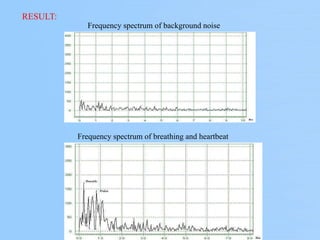
Frequency spectrum of background noise
Frequency spectrum of breathing and heartbeat
RESULT:
CONCLUSION:
Thus a new sensitive life detection system using microwave
radiation for locating human beings buried under earthquake rubble
(or) hidden behind various barriers has been designed. This system
operating either at L (or) S band, UHF band can detect the breathing
and heartbeat signals of human beings buried under earthquake
rubble. By the advent of this system the world death rate as a cause
of natural disaster may decrease to a great extent.
Thank you

Life detection using microwave L band

  • 1.
    Life Detection SystemUsing Microwave L- band
  • 2.
    ABSTRACT “An earthquake causesloss of many human lives every year as humans are trapped under collapsed debris or earthquake rubble” • existing methods for detecting such victims are the utilization of dogs or some optical devices, acoustic life detector & the rescue robot. • These existing devices are ineffective in recovering human victims lying much below a few feet, especially for the cases where the victims are completely trapped below or very weak to respond to the signals sent by the recues. The above problem have been efficiently solved by using life detection system
  • 3.
    INTRODUCTION • A newrevolutionary microwave life detection system, which is used to locate human beings buried under earthquake rubble, has been designed. This system operating at certain frequency can remotely detect the breathing and heartbeat signals of human beings buried under earthquake rubble. • By proper processing of these signals, the status of the person under trap can be easily judged. The entire process takes place within a few seconds as the system is controlled by a microprocessor (8085) or microcontroller unit. By advent of this system the world death rate may decrease to greater extent as large percentage of death occur due to earthquake.
  • 4.
    PRINCIPLE OF OPERATION •The basic principle is that when a microwave beam of certain frequency [L (or) S band (or) UHF band] is aimed at a portion of rubble (or) collapsed building under which a person has been trapped, the microwave beam can penetrate through the rubble to reach the person. • When the microwave beam focuses the person, the reflected wave from the person’s body will be modulated (or) changed by his/her movements, which include breathing and heartbeat. Simultaneously, reflected waves are also received from the collapsed structures.
  • 5.
  • 6.
    • So, ifthe reflected waves from the immovable debris are cancelled and the reflected wave from the person’s body is properly distinguished, the breathing and heartbeat signals can be detected. • By proper processing of these signals, the status of the person under trap can be easily judged. Thus a person under debris can be identified. • The microwave life detection system can work on different range of frequencies from L-band (2GHz) to X- band (10GHz). But X- band microwave is unable to penetrate deep into the rubble. It can penetrate rubble up to 1.5 ft in the thickness (5 layers of bricks) while L- band can penetrate the rubble of about 3 ft in thickness (10 layers of bricks). For this reason, the a microwave life detection system operates on the L-band frequency.
  • 7.
  • 8.
    MAJOR COMPONENTS OFTHE CIRCUIT The microwave life detection system has four major components. They are: 1.A microwave circuit which generates, amplifies and distributes microwave signals to different microwave components. 2. A microwave controlled clutter cancellation system, which creates an optimal signal to cancel the clutter from the rubble. 3. A dual antenna system, which consists of two antennas, energized sequentially. 4. A laptop computer which controls the microprocessor and acts as the monitor.
  • 9.
    CIRCUIT DESCRIPTION The circuitdescription is as follows: 1.Phase locked oscillator: The phase locked oscillator generates a very stable electromagnetic wave say 1150 MHz with output power say 400mW. 2.Directional coupler 1 (10 dB): This wave is then fed through a 10 dB directional coupler and a circulator before reaching a radio frequency switch, whichenergizes the dual antenna system. Also, the ten dB directional coupler branches out one-tenth of the wave (40mW) which is then divided equally by a directional coupler 2 (3 dB). 3. Directional coupler 2 (3 dB): One output of the 3 dB directional coupler 2 (20mW) drives the clutter cancellation unit.Other output (20mW) serves as a local reference signal for the double balanced mixer. 4.Antenna system: The dual antenna system has two antennas, which are energized sequentially by an electronic switch. Each antenna acts separately.
  • 10.
    5)A Clutter CancellationCircuit: In any remote sensing instrument the clutter caused by undesirable objects surrounding the detectable subject must be cancel to the optimum level. The clutter canceller forms the heart of life detection system. It consists of Programmable Phase Shifters, Programmable Attenuator, a RF Amplifier and a Microprocessor based control unit. Clutter cancellation unit: 1.A digital controlled phase shifter 1 2.A fixed attenuator 3.A RF amplifier 4.A digitally controlled attenuator. .
  • 11.
    WORKING 1) The waveradiated by the antenna 1 penetrates the earthquake rubble to reach the buried person. 2) The reflected wave received by the antenna 2 consists of a large reflected wave from the rubble and a small-reflected wave from the person’s body. 3 ) The large clutter from the rubble can be cancelled by a clutter- cancelling signal. 4 ) The small reflected wave from the person’s body couldn’t be cancelled by a pure sinusoidal cancelling because his/her movements modulate it. 5 ) The output of the clutter cancellation circuit is automatically adjusted to be of equal amplitude and opposite phase as that of the clutter from the rubble.
  • 12.
    6 ) Thus,when the output of the clutter cancellation circuit is combined with the directional coupler 3 (3 dB), the large clutter from the rubble is completely cancelled. 7 ) Now, the output of the directional coupler 3 (3 dB) is passed through a directional coupler 4 (6 dB). 8 ) One-fourth of the output directed is amplified by a RF pre- amplifier and then mixed with a local reference signal in a double balanced mixer. 9 ) Three-fourth of the output is directed by a microwave detector to provide dc output, which serves as the indicator for the degree of the clutter cancellation. 10 ) When the settings of the digitally controlled phase shifter and the attenuator are swept the microprocessor control system, the output of the microwave detector varies accordingly.
  • 13.
    Opeartion of theclutter cancelled signal: 1.At the double balanced mixer, the amplified signal of the reflected wave from the person’s body is mixed with the local reference signal. 2.The phase of the local reference signal is controlled by another digitally controlled phase shifter 2 for an optimal output from the mixer. 3.The output of the mixer consists of the breathing and heartbeat signals of the human plus some avoidable noise. 4.This output is fed through a low frequency amplifier and a band pass filter (0.4 Hz) before displayed on the monitor. 5.The function of the digitally controlled phase shifter 2 is to control the phase of the local reference signal for the purpose of increasing the system sensitivity. 6.The reflected signal from the person’s body after amplification by the pre-amplifier is mixed with the local reference signal in a double balanced mixer.
  • 15.
    Clutter cancellation system: 1.Send the signal to the rubble through antenna 1. 2. Receive the signal from the rubble through antenna 2. 3. Check the detector output. If it is within the predetermined limits go to step 5. 4. Otherwise send the correction signal to the digitally controlled phase shifter 1 and attenuator and go to step 1. 5. Check the sensitivity of the mixer. If the optimum go to step 7. 6. Otherwise send the correction signal to the digitally controlled phase shifter 2 to change the phase and go to step 1. 7. Process the signal and send it to the laptop.
  • 16.
    ADVANTAGES: • Remote lifesensing could be a powerful tool in applications where it is not desirable to disturb a subject’s physiological and/or emotional state during detection or in other situations where access to the subject is limited. • The frequency 2.45 GHz i.e. L-band frequency and this is free for use by commercial applications, so we expect a minimum interference with other devices during our tests. • No need to use heart beat and the breathing sensor. Our interest in just to observe the minute movement of the victim. DIS-ADVANTAGES: • Project is expensive but once it Iimplemented the expenses can be reduce lower extend. • The L- band frequency is unable to penetrate more metal like structure but it can penetrate over 10 layers of bricks
  • 17.
    Frequency spectrum ofbackground noise Frequency spectrum of breathing and heartbeat RESULT:
  • 18.
    CONCLUSION: Thus a newsensitive life detection system using microwave radiation for locating human beings buried under earthquake rubble (or) hidden behind various barriers has been designed. This system operating either at L (or) S band, UHF band can detect the breathing and heartbeat signals of human beings buried under earthquake rubble. By the advent of this system the world death rate as a cause of natural disaster may decrease to a great extent.
  • 19.